Early Warning Signals of Customer Payment Default in B2B
Early warning signs in payment patterns reveal trouble weeks before default becomes inevitable.
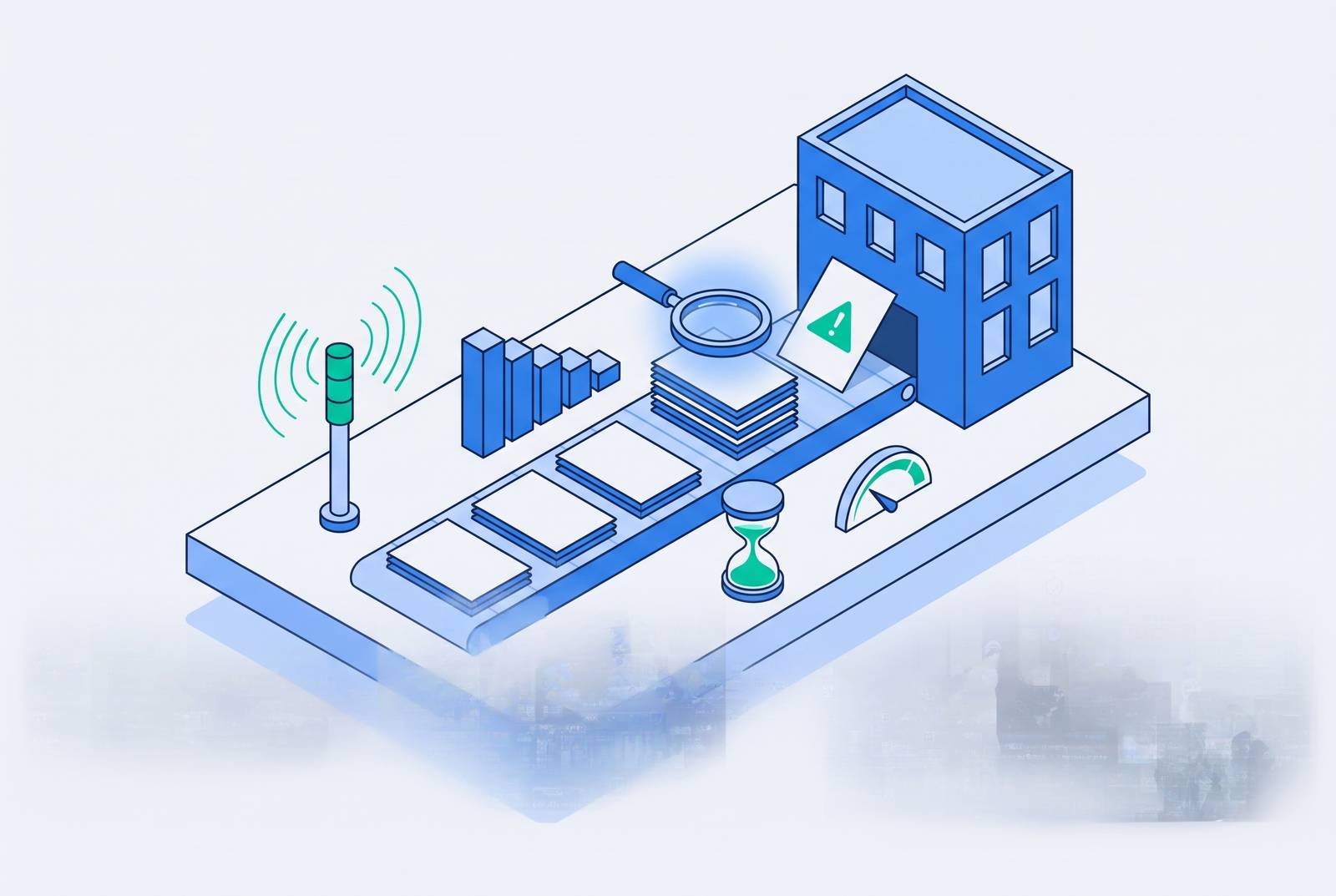
B2B payment default is often visible weeks or months before a write-off. The warning signs are in when customers pay, what they dispute, which promises they break and how much less they say. Finance teams that read those changes continuously can act while customers still have options, rather than waiting for an aging report to deliver the financial equivalent of a smoke alarm after the fire.
Why B2B payment defaults are predictable, not sudden
Defaults usually develop in sequence. Payment timeliness declines, Days Beyond Terms rises, disputes increase, partial payments begin, and eventually payment stops. By those later stages, recovery leverage has already eroded. The apparent surprise often comes from reviewing the account too infrequently to see the steps between healthy and distressed.
A customer may look healthy on paper while delaying suppliers, conserving cash and choosing which creditors get paid. Internal AR data captures those choices as behavior, rather than waiting for them to appear in a financial snapshot. That makes default detection less a test of luck than a test of how closely a team reads changes already underway.
How static credit monitoring misses the deterioration that matters most
Traditional credit reviews answer a dated question. Historical statements, bureau reports, static credit scores and annual reviews show risk as it was at one point, but a customer’s circumstances can change within months. Economic slowdowns, supply chain pressure and internal operational problems do not wait for the next review. By the time a formal credit rating changes, payment problems may already be affecting receivables.
The gap is what happens between snapshots, which requires evidence from the ongoing payment relationship. A good payment history provides background for assessing the next invoice. Teams that treat delinquency as a single event respond only after a deadline passes, while teams that track deterioration can see trouble forming before that event. More effort at the annual review cannot fix a monitoring interval that is too long.
The earliest signal: gradual drift in payment timing
Gradually increasing days-to-pay is the earliest and most reliable signal to watch in internal AR data. Direction tells more than the absolute number. A customer who has always paid late is less alarming than one whose previously dependable payment timing is slipping with each cycle. A static aging balance can show lateness without showing that a relationship has changed.
Tracking Days Beyond Terms over time reveals whether lateness is stable or worsening, while periodic reviews can lose the subtle movement between review dates. A single extension may be ordinary, but repeated requests point to cash pressure the customer is quietly managing.
Unchecked lateness can also reshape the relationship itself. Once a customer pays late and nothing happens, the agreed date starts to look optional, and later talks start from the schedule the customer has changed. The due date has become a suggestion with stationery. For finance teams, the useful signal is therefore both the drift in actual payment timing and the growing expectation that terms can keep moving.
Cash conservation tactics disguised as billing disputes
Rising disputes and chargebacks can be cash conservation dressed as administration. When billing practices have not changed but objections multiply, the customer may be buying time. Pricing objections, documentation claims and approval delays can all pause payment without an outright refusal. The invoice remains unpaid, but now it has a more respectable excuse.
Vague disputes call for a closer look because they give the team no clear problem to fix. An objection with no detail can remain open indefinitely, which may be its purpose. The practical response is to request the dispute in writing with supporting documentation. That gives a genuine billing problem something concrete to fix and forces a vague objection into a form that can be assessed.
Even so, one dispute does not establish distress. Businesses often blame their own late outgoing payments on errors in paperwork, technical issues or disputes, discounting a shortage of cash as the cause. Because of that attribution bias, the customer’s explanation says little about its financial health, though some objections may be honest. The stronger evidence is an increase in dispute frequency over time, especially when billing practices offer no corresponding explanation.
Broken payment commitments and selective remittance as liquidity signals
A missed promise-to-pay reveals more than ordinary lateness. The customer has named a date and then failed to meet it, exposing a gap between stated intent and ability to pay. Repeatedly missed or rescheduled commitments make that gap a pattern. Silence after the missed date adds another warning because the customer has let both the payment and the explanation lapse.
Smaller remittances, payment of smaller invoices while larger balances age, and selective payment of strategic vendors reveal cash prioritization. Broken commitments show that the promised cash did not arrive, while selective remittance shows where available cash is going. Neither pattern is reassuring simply because some money still comes through.
For AR teams, a broken commitment should change the next arrangement. Future payment promises should require written confirmation, with less flexibility after a missed date. Otherwise, giving the customer more time teaches it that nothing happens when it breaks a promise. A promise-to-pay should not function as an endlessly renewable subscription to more time.
Communication withdrawal as a pre-default behavior pattern
Changes in communication can precede visible changes in payment behavior. Slower replies without a credible explanation, increasingly vague answers and avoidance of collections discussions widen the warning beyond the ledger. A sudden change in who talks about payment is also a sign to watch. The relationship may be deteriorating before the aging report catches up.
Specificity separates an actionable explanation from an evasion. A customer who says "we're waiting on a funding cycle, it usually lands by the 15th" offers a reason and a timeline. Repeating "we're working on it" without either gives the team nothing to assess. A customer who acknowledges the balance and then stops taking calls presents a particularly serious pattern because the discussion has moved from resolving an objection to avoiding payment altogether.
Financial failures can contradict reassuring conversation too. One check returned for insufficient funds might be an error, but a second suggests the customer has less cash than it admits. Declined card payments should be part of that check as well. For portfolio teams, withdrawal mid-collection cycle warrants faster escalation than late payment from a customer who remains engaged, because engagement preserves room to negotiate.
External signals that reach you before your own aging report does
Other suppliers may detect pressure before your account shows it. Several credit-reference requests about the same customer within a month can indicate that existing credit lines are exhausted. Complaints from other vendors may show that a delay that looks like a one-off is part of a wider pattern.
Public records and reviews extend that view. Key management departures, unexpected ownership changes, legal claims and court filings can precede payment problems, while recurring reviews about billing disputes, staff turnover or operational chaos offer another window into business health. Repeated complaints that no one can reach anyone should be weighed alongside the financial data. One unhappy review is not a credit assessment.
For customers with publicly traded bonds, a downgrade below investment grade can make borrowing cost more and leave less cash to pay suppliers within months. Management language about "managing cash flow" is another prompt to examine whether Days Payable Outstanding is rising. Teams should also check downstream exposure when a customer wins a much larger contract than usual with a buyer it does not know. If that buyer fails to pay, the pressure can flow through the customer to its suppliers.
Concentration risk: why the same signal carries different weight for different accounts
The same warning can demand very different urgency. A default from a small occasional buyer may be a nuisance, while one from a customer representing a large share of receivables can threaten solvency. Signal intensity alone cannot set the response. The account’s share of the portfolio changes what delay could cost.
For AR teams, outreach priorities should combine deterioration with concentration, rather than following only the oldest invoice or the largest absolute balance. A subtle early warning on a highly concentrated account can justify stronger action than a later warning on a small account. Recovery leverage also declines as deterioration advances, so waiting for the largest exposure to become unmistakably distressed gives away useful time. This is the bridge from spotting risk to deciding which conversation cannot wait.
From signal to intervention: what early detection actually makes possible
Proactive outreach, flexible payment arrangements, term adjustments and documented commitments remain possible before communication collapses. Late-stage recovery is more expensive and less effective. Once an account goes silent, the team has fewer ways to reach a workable agreement.
The practical response is consistent, professional follow-up through email, phone and written notice on a regular schedule. A customer managing several creditors is more likely to prioritize a supplier who stays attentive than one who waits quietly. That persistence need not become confrontation, especially when early first-party contact gives the customer room to explain and respond. Human judgment is essential to making the contact useful.
Every call, email and commitment made or missed should be documented. Those records give the team something to draw on in the next conversation and evidence to use if it needs to escalate or take legal action. At the same time, teams should clear genuine operational blockers, including missing W-9s, portal friction on Coupa and Ariba, and unanswered document requests. Removing those obstacles resolves legitimate delays and strips away administrative cover for cash conservation. A missing form should not give an unpaid balance a permit to live there forever.
Building a continuous monitoring practice from your existing AR data
To keep watch on accounts, a team needs data inputs, a scoring model, alert thresholds, a watchlist and clear steps to take. Each component can start with existing AR records. The central change is to read those records as a history of behavior. Days Beyond Terms should be tracked as a trend, with rising accounts flagged separately from stable ones, and dispute frequency reviewed month-over-month.
For teams without predictive tools, a watchlist is a practical starting point. Accounts showing two or more warning signals should move from monthly to weekly review. Any broken promise-to-pay or rise in dispute frequency should trigger an immediate escalation review. Portfolio weight should inform that review so that a queue of noisy small accounts does not hide a quieter, larger exposure.
A more developed practice can score customers before extending credit, monitor continuously, set dynamic limits and trigger early intervention. Risk tiers and scoring integrated with the ERP system can connect detection to routine decisions, whether or not AI tools are involved. Advanced analytics can identify risk faster than a human team, but judgment still determines how to reach the customer effectively.
Success means shortening the gap between deterioration and action, since even one month can change the available interventions. A finance team can begin next week by building the watchlist and applying those review triggers. The starting constraint is not missing data, but the habit of reading what is already there continuously.