Self-Serve AR Automation Platforms Built for Finance Teams With No IT Department
Lean finance teams can now automate AR without IT support or complex implementation.
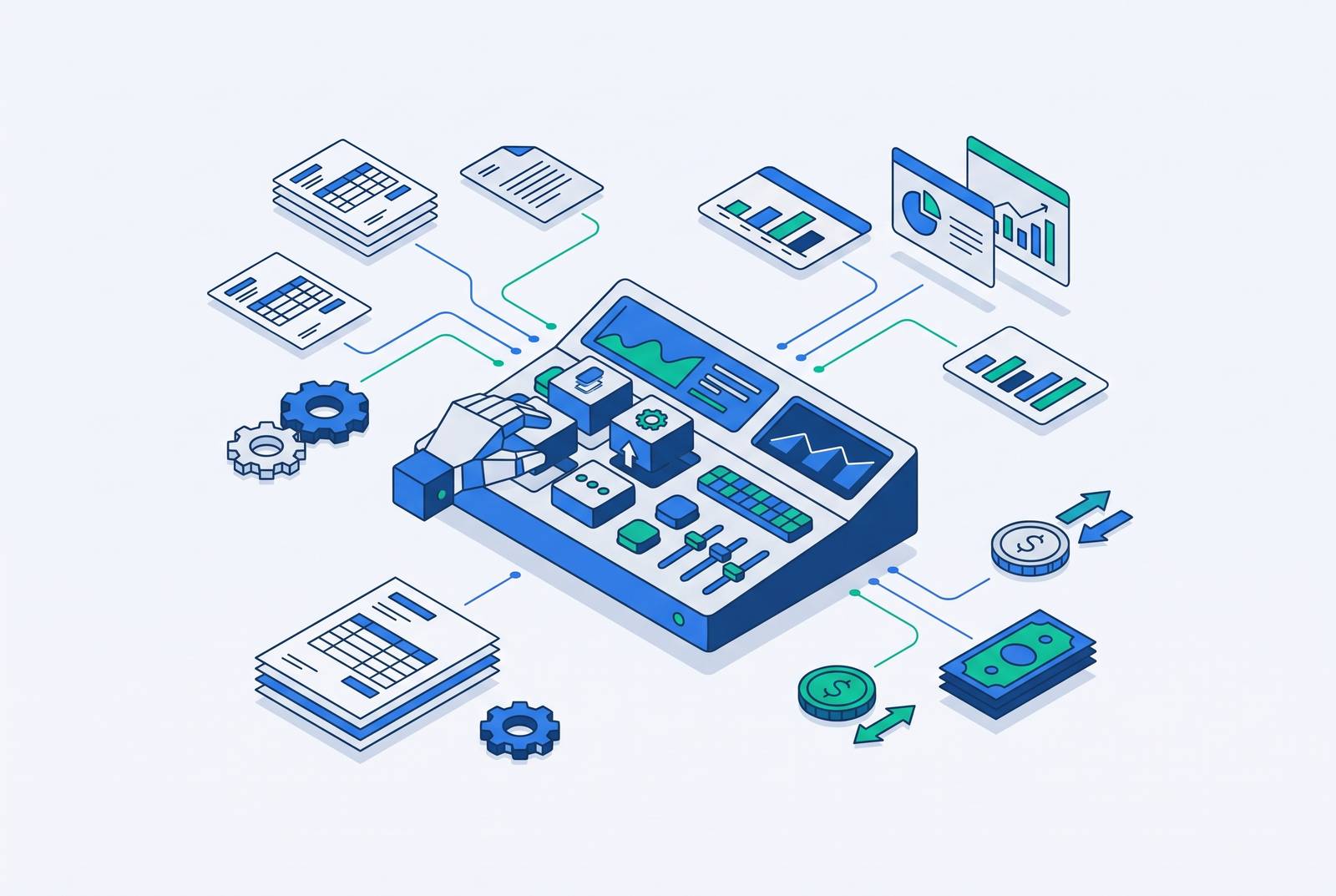
For small finance teams, fast-setup AR automation without IT involvement needs to do more than send easy invoice reminders. It needs code-free configuration, native accounting connections, guided onboarding, and pricing the team can judge without a sales call. This guide explains how the options differ and why genuinely self-serve software must let finance configure, connect, and operate it without inheriting an IT job.
Why finance teams without IT departments are stuck with AR processes that were never designed for them
The person who sends invoices also takes care of payroll, reporting, and vendor calls. Collections follow-up has to fit between those jobs, while cash application and disputes wait their turn. There is no dedicated IT department standing by to connect another system or maintain its workflows. For these teams, software setup competes with the work the software is supposed to remove.
Traditional AR automation assumes a different workplace. Enterprise deployments draw on ERP specialists, integration teams, and IT project managers to configure systems and keep them connected. Those are invisible prerequisites for a lean finance team. A platform may offer every needed capability yet still be impractical because nobody has time, or the technical skills, to make those capabilities work together.
Consequently, tools go unevaluated or go live incompletely, and manual AR survives. That is not a vote of confidence in spreadsheets. Nor is the central bottleneck simply cost or awareness, since knowing a product exists does little to resolve its implementation demands. Self-serve AR is a distinct need because it changes who can put the software to work.
What “self-serve” actually requires a platform to do — and where the term gets misused
A finance user needs visual workflow builders or plain-English rule definitions. If advanced customization requires Deluge scripting, the technical prerequisite has returned. The same test applies after launch, because a workflow the team cannot change itself is only temporarily self-serve.
The team must be able to use the connections without a separate integration project. Native, pre-built connectors to accounting systems such as QuickBooks, Xero, and NetSuite need to sync bidirectionally without middleware. An API provides a way to build a connection, while leaving the building to someone else. For a team without IT, that distinction separates a working link from an assignment.
CSV imports, migration wizards, and templated workflows should guide users who have no implementation experience, rather than assume they know which dependencies to configure first. Published pricing lets a finance leader see if the team can afford the software without a sales call. Even with a simple screen, buying and deploying the software can still call for the support staff an enterprise has.
Agentic AI adds a further requirement to this standard. By inferring behavior from transaction history, it reduces the rules a team must define before automation becomes useful. That targets the configuration burden directly, rather than merely speeding up a task after someone has programmed every step. These criteria work together, and a platform that fails one should not receive an unqualified self-serve label.
How agentic AI and consumption pricing changed what a lean team can realistically deploy in 2025–2026
The shift in 2025–2026 concerns both setup effort and buying scope. Agentic AI lowers the amount of behavior that must be specified in advance, while natural-language-as-code makes workflow instructions accessible without scripting. Consumption pricing helps teams avoid having to commit to enterprise scope before they have the volume to need it. With either mechanism alone, the team still has implementation work to do.
BILL shows how agents are taking on tasks for the 1–499 employee SMB segment, as AI handles more routine workflows while people still have a key role in approving and overseeing the work. BILL’s October 2026 press release says its AI hub lets finance teams “monitor the actions BILL AI has taken for them, switch AI tools on or off, and control how much AI does for them”. That is delegation with a control panel. Its CPO described moving money agentically as “chapter two, chapter three”, distinguishing the direction of travel from fully autonomous money movement. For buyers, the useful change is reduced setup and operating effort.
How the leading self-serve platforms differ in practice — what each one actually does and where it stops
The strongest shortlist depends on the job, because these products are not interchangeable versions of one AR application. Some combine AP and AR, some specialize in subscriptions, and another automates workflows around an existing ERP. Architecture determines what the team must already have. Their features establish possible fit, but do not by themselves prove that each product meets every self-serve criterion, including onboarding independence and published pricing.
BILL is the first option to consider for a small business seeking accessible AP and AR automation without a dedicated finance operations function. Its AR tools cover invoice tracking, ACH and card payments, and automated reminders, with native integrations for QuickBooks, Xero, Oracle NetSuite, Sage Intacct, and Microsoft Dynamics. AI agents handle invoice routing and overdue follow-up as the platform takes on more tasks within policy guardrails. Its fit has clear boundaries, however. It is not suited to multi-entity structures, global payment complexity, or high invoice volume, while its full suite may exceed an AR-only team’s needs or fall short for a team beyond basic reminders.
Esker fits teams that need AP-and-AR in one system and have more to handle than reminders alone. Its document process automation covers invoice delivery, cash application, collections management, customer self-service portals, and dispute handling. That breadth suits mid-to-large enterprises or teams seeking a single vendor with proven ERP integration. A lean team still needs to establish whether it can configure and maintain the relevant workflows without the implementation resources that this wider scope might assume.
Quadient AR, powered by YayPay, addresses collections with AI-driven automation, predictive cash flow analytics, and customizable workflows. It also supports multiple currencies and entities, giving it a different fit from a basic SMB reminder tool. The constraint is its configuration depth. Compared with enterprise platforms, that depth is more limited, and complex exception workflows require workarounds. The evaluation therefore turns on whether the team’s actual exceptions fit the product, rather than whether its standard collections sequence looks good in a demo.
Kognitos takes a different route by automating around an existing major ERP. When an anomaly occurs, it pauses and asks a plain-English clarifying question through Slack, Teams, or email. It then generates a permanent runbook from the resolution, reducing repeated manual intervention. Kognitos positions this approach as removing the IT bottleneck for AP, AR, and close automation, making it relevant to complex, exception-heavy work, but teams without an ERP environment need additional infrastructure.
Younium is the specialist choice for B2B SaaS and subscription businesses with contract-based pricing and revenue recognition requirements under ASC 606 or IFRS 15. It pairs subscription management with automated dunning, a self-service payment portal, real-time aging and metrics reporting, and ERP sync to NetSuite, QuickBooks, and Xero. Its two reminder logics use days since the invoice due date or days since the last reminder. The specialization is the point. It is less useful for project-based, one-off, or highly variable invoice structures, where tools built for subscriptions do not match the billing work.
There is also an option outside the platform shortlist. A managed AR service keeps reaching out to deal with problems such as missing W-9s, trouble with buyer portals, and gaps in communication, so finance does not have to do all the follow-through. That distinction is especially relevant to fast-growing companies whose teams cannot both operate the tooling and perform collections work. These companies then want to pay for results, including collected invoices and landed cash. Software capability alone cannot settle that choice, because the limiting resource is the person available to act.
The failure modes that turn self-serve into a new kind of manual work
A faster setup can also bring problems with the data to light faster. Stale customer records, inconsistent payment terms, and inaccurate open invoices give automation the wrong instructions before anyone builds a workflow. The system then propagates those errors across the invoices it touches. Self-serve reduces implementation friction, but it does not remove the need to audit the data that drives collection activity.
Adaptive AI makes that dependency especially important. It needs clean, integrated ERP and CRM data from which to infer useful behavior. Where that foundation is missing, rule-based automation outperforms AI until the data is fixed. The more ambitious tool is not automatically the better starting point for the information a team currently has.
Invoice capture may be automated while people in some departments still approve invoices by hand, or AR may move into a platform while AP stays on spreadsheets. The bottleneck then appears across more parts of the process. Stopping at partial configuration is a common failure point because going live quickly makes it easy to miss what remains unconfigured. Audit the data and map the full workflow before evaluating platforms.
How to run an evaluation that matches how a lean finance team actually works
Start with the primary pain point. What a team needs to tackle late payments and make collections more efficient differs from what it needs for accurate cash application, customer self-service, or credit risk management. Portal friction with large buyers is not the same problem as high invoice volume with inconsistent remittance data. Give the evaluation an explicit target. Otherwise, a vendor can demonstrate an excellent answer to a question the team never needed to ask.
Before booking demos, audit customer master records, payment terms, and open invoice accuracy, then map the full workflow. Use that map to make handoffs and unconfigured steps visible. A platform that surfaces data gaps during onboarding is more trustworthy than one that promises to work around them. Keep the buying questions plain. Can the team configure it without code or a support ticket, connect it without a custom project, and start at its current volume without committing to enterprise scope.
During the demo, ask to configure a live workflow. Put the configuration layer in front of the non-technical person expected to use it. A rehearsed demo is not a driving test. The gap between what a product can do and what that person can set up in an afternoon is where lean-team implementations often stall. This test should expose whether plain-English instructions or visual controls remain usable beyond the simplest path.
Next, check what the connectors can do. A native, bidirectional connection to QuickBooks or NetSuite is not equivalent to a nightly CSV export. Ask how payments reconcile to the general ledger and whether maintaining that connection requires IT. Then assess published tiers and entry-level scope. Transparent pricing that permits a small start signals a better fit, while quote-only pricing often reflects a sales and deployment model built around IT-supported implementation.
Finally, decide whether the team needs software or more people to do the work. If it can run collections but has no tools it can use, a self-serve platform may let it get past the setup hurdle. If follow-up, portals, and correspondence about exceptions already take more time than it has, moving those jobs to a new interface still leaves the team short of staff. That is a genuine fork in the road. A platform gives finance something it can operate, while a managed service removes work it has no capacity to operate itself.