Escalation Triggers That Move Silent B2B Buyers From AI Outreach to Live Collector Intervention
When buyers go silent, broken promises and distress signals matter more than invoice age.
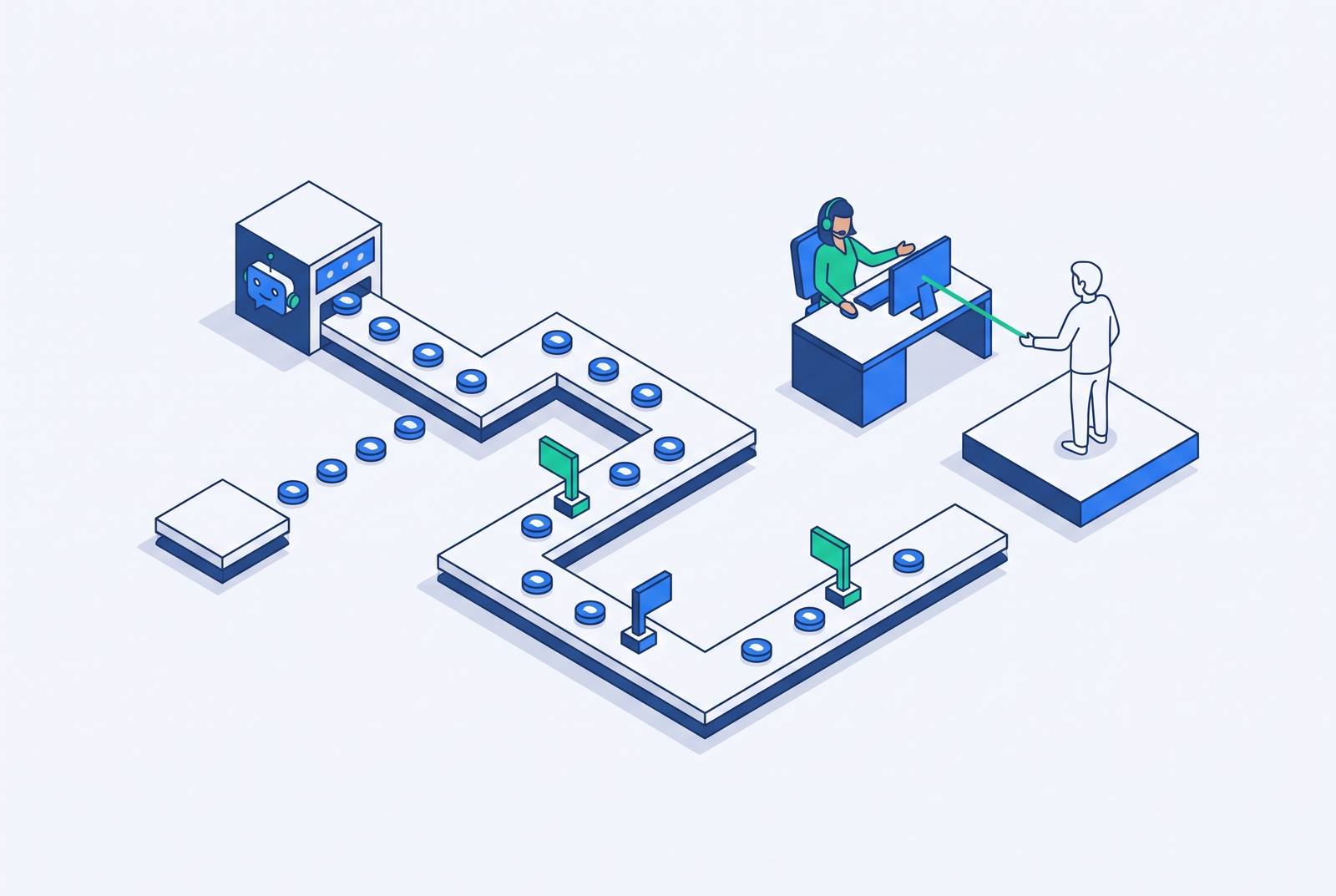
AI plus human collections follow-up for B2B accounts receivable works best when automation handles routine outreach and people take over when defined risk signals appear, with aging milestones as only part of the guide. Broken payment promises, sudden silence, changing disputes, financial distress, and legal exposure are reasons to hand off an account. The goal is to automate the reminder without automating the judgment that determines what happens next.
Why the AI-to-human handoff in B2B collections is a behavioral problem, not a calendar problem
The aging-bucket assumption is simple enough to fit on a spreadsheet. As an invoice gets older, the team pushes harder to collect until a live collector takes over. That gives finance teams a consistent schedule, but it treats silence as though it has only one meaning. A buyer who goes quiet on day 31 can enter the same bucket as one who remains in steady dialogue. The dates match, but the situations do not.
Payment history makes that mismatch even clearer. A monthly customer who has cleared every invoice for months but leaves one item well past due presents a different problem from a new account that is only weeks overdue and has never communicated. An aging rule sends both buyers down the same path but does not explain why either one acts as they do. By contrast, broken commitments, sudden disengagement, and changing objections reveal something about intent and capacity.
The aging report remains a record of how long money has been outstanding. The problem starts when that record becomes the sole authority on whether another reminder will help. A calendar can schedule a conversation, but it cannot read the room.
How do you automate B2B collections outreach without losing the human touch?
AI covers the volume layer of collections, including scoring, personalized outreach, cadence adjustment, dispute routing, and portal submissions. It can keep routine follow-up moving across accounts without requiring a collector to write each message. Resolve Pay’s agentic collections platform illustrates that scope. Its system escalates automatically from email to SMS to AI voice calls, but pauses the entire sequence when it receives a payment or dispute. The schedule controls outreach, while the response interrupts it.
A dispute may need documentation. But a customer expressing financial hardship, requesting terms outside predefined parameters, or showing signs of legal involvement needs a human. So does an account whose deals are worth more than standard collection economics allow for. Those situations require decisions about what the seller can accept.
Human collectors have availability limits and can make uneven decisions, while automated outreach avoids those constraints. Once a buyer needs an exception or raises a legal issue, another scheduled message cannot make the judgment the case needs. It can instead damage the relationship or create liability. A very reliable metronome still cannot negotiate payment terms.
Silence patterns that signal an account needs a human, not another automated touch
A buyer who never answered and a buyer who stopped answering should not be treated as equivalent. The first offers no established engagement pattern to compare against. The second does, and the break in that pattern is useful information. Waiting for the invoice to enter another aging bucket discards that signal.
A broken promise-to-pay is more specific still. The buyer has committed to a payment date, so the seller has more than an unanswered email to work with. When a buyer repeatedly names dates and misses them, another automated request for payment leaves the central problem untouched. The commitments themselves are no longer dependable. The live collector needs to deal with that pattern rather than treat each missed date as a new slip in the paperwork.
In practice, the handoff begins with detection. The system records the broken promise or identifies that a contact has stopped responding after a defined number of touches, then routes the account with its conversation context. That context lets the collector pick up where the conversation stopped without asking the buyer to go over it again. The trigger is the missed commitment or change in engagement. A touch count can help define the condition, but it does not explain the silence on its own.
External distress signals that change the collections calculus before aging catches up
Silence comes from inside the buyer relationship, but evidence of distress can arrive from outside it. New liens, judgments, or UCC filings against a buyer, other creditors publicly seeking payment, and requests for longer terms without corresponding revenue growth warrant immediate human escalation. These signs can be visible outside the buyer relationship before an invoice reaches the later aging buckets. Waiting for the report to catch up can narrow the recovery window. The invoice’s age does not set the buyer’s financial timetable.
Layoffs, closed locations, and leadership departures can point to deteriorating payment capacity. A significant fall in an external credit score or bureau rating also changes the risk assessment. So do late payments on several invoices, including those owed to sellers other than this one. These are reasons to reassess the account.
Timing becomes especially consequential when other creditors are involved. The priority of claims in insolvency proceedings means that securing a payment arrangement before a buyer grants security to another creditor can put the collector in a fundamentally different position from escalating two weeks later. A human must decide whether to accelerate all open invoices, apply a credit hold, involve sales, or refer the account to legal.
Dispute signals that distinguish a legitimate billing question from a delay tactic
A wrong PO number and a newly invented objection both delay payment, but they call for different responses. Genuine billing questions, missing documents, and delivery discrepancies are operational blockers. AI can retrieve documentation, answer factual questions, and route the issue to the right team. Prompt attention can resolve many of these issues without negotiation. A missing document is not a test of character.
A buyer who previously accepted an invoice without question and then raises new objections has changed the basis of the conversation. An objection appearing only after follow-up begins may also signal an attempt to manage cash flow at the seller’s expense. That pattern warrants human scrutiny to distinguish a real issue raised late from an objection designed to buy time.
The routing rule can be concrete even when the judgment cannot. A dispute that follows prior acceptance, involves contract interpretation, or comes with a request for a significant accommodation should go immediately to a live collector. Extended terms and partial credits require a decision about what to concede, while product-quality and delivery disputes may require negotiation. For strategic accounts, that decision also includes how hard to push and whether sales should join the discussion. Relationship value changes the stakes, but it does not make the dispute disappear.
Dollar thresholds and account designation as hard-rule escalation triggers
Behavioral escalation does not mean every handoff needs an interpretation of buyer intent. Dollar size can justify automatic human involvement because the cost of a mistaken response grows with the amount at risk. A large, unanswered invoice after an extended period warrants faster intervention than a small invoice backed by a credible promise to pay. Policy sets the point at which a human must look at the account. Behavioral evidence can bring the handoff forward, but it should not cancel that requirement.
Strategic account designation is separate from the size of the invoice. A buyer may have long-term relationship value or complex contractual terms that make routine collection treatment unsuitable even when the current balance is modest. Written criteria give those accounts an earlier route to a collector. This keeps the decision from depending on who happens to recognize the customer’s name.
When credit policy documents automatic hold triggers, the collector applies the hold when the threshold is reached. The resulting conversation is concrete for the buyer’s controller, CFO, or purchasing team. The next order has to wait until the past-due balance is settled. That connects the overdue invoice to the buyer’s purchasing needs more directly than another dunning email can.
Compliance exposure as an escalation trigger in its own right
A collections sequence can require a handoff because of how it communicates, even before the buyer’s payment behavior changes. If the system cannot produce a full audit trail of the decision behind a particular contact, continuing automatically creates avoidable exposure. The practical handoff criterion is whether that decision can be reconstructed and documented. An unexplained touch is not just a reporting gap. It limits the team’s ability to defend why the communication occurred.
California’s SB 1286 makes the commercial-collections concern concrete. Effective July 1, 2025, it extended the Rosenthal Fair Debt Collection Practices Act to qualifying commercial debts below a specified threshold, with protections for natural-person guarantors. Mayer Brown’s analysis explains that the protections apply to individual guarantors rather than businesses as such, and that the threshold aggregates transactions between the same parties. The protections are similar to, but not identical to, those afforded individual consumers. Willful and knowing violations can bring a statutory penalty plus attorney’s fees.
B2B teams need to account for collection protections beyond consumer receivables and for differences in how the law treats commercial accounts. Signs of legal involvement, a formal complaint, or a buyer invoking rights explicitly or implicitly require immediate human escalation. A collector can then make the communication documented, appropriate, and defensible. When the system cannot explain its own contact decision, routing to a human is the lower-risk choice.
How well-designed escalation logic is built into the workflow rather than left to collector judgment
To put these distinctions into practice, teams should define escalation conditions in the collections workflow. Broken promises, sudden silence, distress signals, and changes in dispute patterns become rules that send an account straight to a person. Dollar thresholds and strategic designations supply additional routing rules. Compliance concerns are a separate reason to stop automated contact. The handoff should not depend on who is on duty.
Scheduled outreach still has a place within that design. Resolve Pay uses configurable day thresholds to move from email to SMS to AI voice calls, with payment or dispute receipt interrupting the sequence. A pause, however, is not the same as resolution. The workflow needs a human gate for escalation and disputed situations.
The collector also needs enough context to act. Invoice history, payment history, the conversation log, and the specific escalation trigger should travel with the account so the next exchange can begin mid-conversation. Written credit policy should set the rules for automatic credit holds, thresholds, and account designation so people can focus on the decisions that need their judgment. Automate the reminder, never the ultimatum.