Why Finance Teams Need AI That Can Explain Its Own Decisions
Finance leaders reject AI tools that can't show their work, no matter how accurate.

AI use in finance rose sharply from 2023 to 2024, then basically flatlined. The 2025 number came in at 59%, a rounding error's worth of movement. Something hit a wall, and that wall has a name: explainability. Without it, AI in finance is just a guess wearing a suit, and finance people have never trusted a guess, no matter how nice the suit.
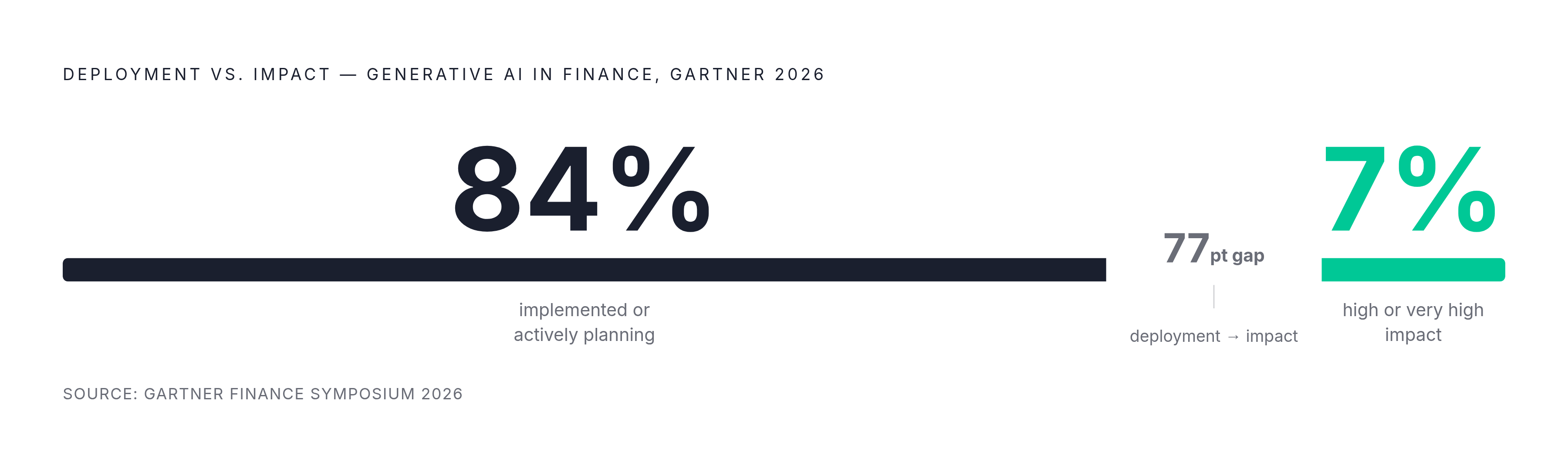
Gartner's 2026 Finance Symposium data shows the shape of that wall clearly. 84% of finance organizations have implemented or are actively planning generative AI. Only 7% report high or very high impact from it. Placed side by side, those two numbers show the plateau is not a fluke. It looks like a pattern: teams buy the tools, deploy the tools, and then quietly refuse to let the tools do anything that actually matters.
This isn't a technology problem. Models keep improving, and the math hasn't gotten worse at forecasting or pattern-matching. The stall happens between "the AI works" and "someone signs off on what the AI said." That gap, specifically, is where explainability lives, and most teams are trying to close it with more dashboards when what they need is a model that can answer a direct question.
What "black box" AI means in a finance context
A black box model hands you an answer with no receipts. It flags an invoice, ranks a customer as high-risk, predicts a cash shortfall, and offers nothing about how it got there. When asked to defend the answer, it just repeats the answer, louder, like a toddler insisting the dog ate the homework it never had.
Older finance software never had this problem, because a person wrote the rules: if balance drops below X, flag it. You can read the logic because a human typed the logic. Machine learning models don't work that way. They learn patterns from data and store those patterns in ways that resist plain inspection, even by the people who built them.
Research published on this topic puts it precisely: AI systems process large, complex inputs and produce results through mechanisms whose internal decision logic isn't directly inspectable. That opacity makes it hard for professionals and oversight bodies to challenge algorithmic outcomes, and it risks something worse than distrust: misplaced trust in an answer that happens to be wrong.
That opacity looks like this on an actual finance desk. A cash flow model flags a liquidity shortfall next quarter, and nobody can say which receivables drove that number or how confident the model actually is. A collections tool ranks accounts by payment risk, and nobody knows what signals fed that ranking, or one of them may be quietly acting as a proxy for something you'd rather not be sorting customers by. A reconciliation system posts a journal entry on its own, based on logic nobody can name, and whoever's name goes on the filing is now vouching for math they can't explain. An AR system escalates an invoice today instead of next week, and good luck explaining that call to the customer who got the email, let alone the auditor who asks about it eight months later.
Every one of those is a live decision with money and reputation attached. None of them tolerate a shrug for an answer.
Explainability as the factor that determines whether finance teams keep using an AI tool
Sage found that 71% of finance leaders would reject an AI tool that's 99% accurate if it can't explain its answers. Read that twice. Finance leaders, a group not exactly famous for leaving accuracy on the table, are saying they'd take a less accurate tool over an unexplainable one, and they're right to.
A wrong answer you can trace is a Tuesday. A wrong answer you can't trace is a liability with no paper trail, and finance people have spent entire careers building paper trails for exactly this reason. That instinct isn't paranoia, it's the job.
insightsoftware's survey found that 75% of respondents say explainable AI would raise their confidence in a tool, ranking it among the most impactful governance measures tested. Explainability alone moved the needle furthest, which should settle an argument some vendors are still having with themselves about whether transparency is a "nice to have."
A study out of Springer Nature adds the behavioral mechanism behind that number. Explanation quality, the type of advisor giving the recommendation, and how risky the decision is all interact to shape whether someone actually acts on an AI's suggestion. High-explainability AI produces different trust and adoption outcomes than low-explainability AI, even when the underlying recommendation is word-for-word identical. Same answer, different coat of paint, completely different reception. Trust comes down to showing your work, the way a tenth-grade math teacher always insisted, and it turns out she had a point.
The regulatory and audit pressure that has turned explainability into a compliance requirement
Regulators got here first, and they got loud about it. Research on AI and machine learning in financial services has consistently found that the black-box nature of algorithms is the issue regulators cite most often as a barrier to compliance. Not data quality. Not model drift. The black box itself.
The EU AI Act put teeth behind that concern. It's the first binding AI law anywhere in the world, and it applies risk-based rules to AI used in credit scoring, insurance underwriting, and anti-money-laundering tools across every EU member state (standalone fraud detection gets a specific carve-out under Annex III point 5(b), so it skips the high-risk bucket). The original compliance deadline of August 2, 2026 got pushed to December 2, 2027 by the EU Digital Omnibus on AI, but that extension is only breathing room. Banks and insurers running credit scoring, AML, or underwriting AI still have to clear the bar eventually. The fines aren't symbolic either: up to €35 million or 7% of global annual turnover for prohibited practices, up to €15 million or 3% for high-risk non-compliance, whichever number stings more.
One national regulatory approach is less centralized but no gentler. SR 11-7, from the Federal Reserve and OCC, already required banks to explain model outputs in documentation an informed reviewer, someone who didn't build the model, could actually follow. On April 17, 2026, banking regulators issued revised guidance that sharpened that into a risk-based standard scaled to an institution's size and complexity. Meanwhile, the Treasury's FS AI RMF adapts the NIST AI Risk Management Framework specifically for financial institutions, with 230 control objectives mapped across the AI lifecycle. It's voluntary for now, but it was built with input from more than 100 financial institutions, and voluntary frameworks with that much buy-in tend to become expected ones fast.
Consumer protection closes the loop. CFPB Circular 2023-03, reinforced in January 2025 Supervisory Highlights, makes clear that ECOA adverse action notice requirements apply fully to credit decisions made by automated models. The regulator's own language leaves no room for a technical excuse: "a creditor cannot justify noncompliance based on the mere fact that the technology it employs is too complicated or opaque to understand." Translation: "the algorithm did it" has never been a legal defense, and nothing about 2027 is going to change that.
State law is stacking on top. Colorado's original AI law, SB 24-205, got repealed and replaced by SB 26-189, extending state-level AI oversight requirements to high-risk applications. It adds one more jurisdiction where opacity in AI decision-making carries real compliance consequences. California's AI Transparency Act (SB 942), effective August 2, 2026, requires disclosure whenever a customer is interacting with AI, backed by penalties up to $5,000. Smaller dollar figures than the EU, sure, but still one more jurisdiction where "opaque" has become a compliance defect rather than a UX complaint.
How explainability works: the techniques finance teams should understand
The CFA Institute's report, "Explainable AI in Finance: Addressing the Needs of Diverse Stakeholders," frames explainable AI (XAI) as a cognitive bridge between human judgment and machine output, turning black-box systems into something transparent, auditable, and legally defensible. That bridge is built out of a handful of concrete parts, not a vague promise of "transparency."
Start with the distinction that clears up most of the confusion in this space: global versus local explainability. Global explainability describes how a model behaves overall, and a model-validation team or governance committee needs it to judge whether the model is conceptually sound and quietly creating systemic risk. Local explainability zooms into one decision: why did the model flag this account, this invoice, this journal entry? That's the question a loan officer or a collector has to answer when a customer or an auditor asks "why," and no amount of global model documentation helps them in that moment.
A handful of techniques do the actual work. SHAP (SHapley Additive Explanations) breaks down which input features drove a specific result and by how much. Peer-reviewed AML research shows SHAP naming the specific drivers behind individual alert decisions instead of leaving analysts to guess. LIME approximates a complex model's behavior locally, showing what pushed one particular prediction in one particular direction, and it's useful precisely because the person reading the explanation usually isn't a data scientist. Counterfactual explanations answer the more human version of the question: what would have had to change for the outcome to flip? That framing matters most when a decision goes against someone, since it turns a rejection into a roadmap instead of a dead end. Interpretable models, decision trees and rule-based systems, are transparent from day one and need no extra explanation layer, though that clarity sometimes costs some predictive sharpness. Post-hoc methods bolt explanation onto a model after the fact, translating whatever the model did into something a human can actually read.
None of this comes free. Research in this area has found that finance practitioners still lean toward traditional machine learning methods over more complex models, specifically because the traditional ones are easier to explain, even when that means giving up some predictive performance. That's the trade finance teams are already making, quietly, every time they pick the boring model over the fancy one. It's the right trade, and any vendor selling pure accuracy without an explanation layer is selling half a product.
Explainability in finance workflows: collections, reconciliation, and cash positioning
The CFA Institute's report ranges across multiple finance domains where AI explainability intersects with stakeholder accountability. The office of the CFO has its own version of the problem, and The distinction worth drawing here is that the audience is not a regulator weighing fairness. It is an external auditor or audit committee weighing professional judgment. Different question, same demand for a paper trail.
Collections and AR carry the most immediate exposure. An AI deciding which invoices to chase, when to escalate, and how to phrase the ask needs to be auditable because customers push back, loudly and by email, often cc'ing someone's boss. When a system navigates a supplier portal, answers a customer question, or flags a payment as at risk, the reasoning behind that move shapes the customer relationship and days sales outstanding at the same time. An unexplained, wrong escalation can undo a relationship that took years to build over one bad automated nudge. The persistent, human-sounding follow-up work, chasing missing documents, working around portal friction, closing communication gaps, only holds up if the humans who own that relationship can see why the AI did what it did.
Reconciliation and journal entries raise the stakes further. When a platform calculates a lease liability or flags a journal entry, "the platform calculated it" doesn't survive a PBC list request or a management representation letter. Someone still has to trace the number back to its source document, by hand if necessary. Three things matter here, and they don't substitute for each other: transparency (what data did the model actually use?), interpretability (why did it land on this number?), and traceability (can the path from input to output be reconstructed well enough to support workpaper documentation?). Missing any one of the three leaves the audit trail with a hole in it, full stop.
Cash flow forecasting and positioning sit under the same microscope. The PCAOB's stance is blunt: "the platform calculated it" is not an acceptable answer to a question about a cash positioning decision. As AI systems take on more of this work, they need to validate themselves continuously against policy, regulatory limits, and risk thresholds, not once at deployment and then never again. That means enforcing least-privilege access for AI agents, keeping reasoning separate from execution, classifying actions by how much risk they carry, and keeping a human in the loop wherever the stakes run highest. None of that is optional bureaucracy tacked on to slow things down. Finance teams keep using a tool that gives a straight answer, and they quietly uninstall one that shrugs when asked a simple question.
Sources
- The Role of Explainability In AI-Driven Financial Decision Making | Information Systems Frontiers | Springer Nature Link
- Explainable AI in Finance: Addressing the Needs of Diverse Stakeholders
- Trade-offs in Financial AI: Explainability in a Trilemma with Accuracy and Compliance
- sage.com
- Why Finance Teams Don't Trust AI, And It Isn't About the AI Itself