GL Auto-Posting Systems That Cut Month-End Close Time
Finance teams can shave days off month-end close by automating GL posting in the right order.
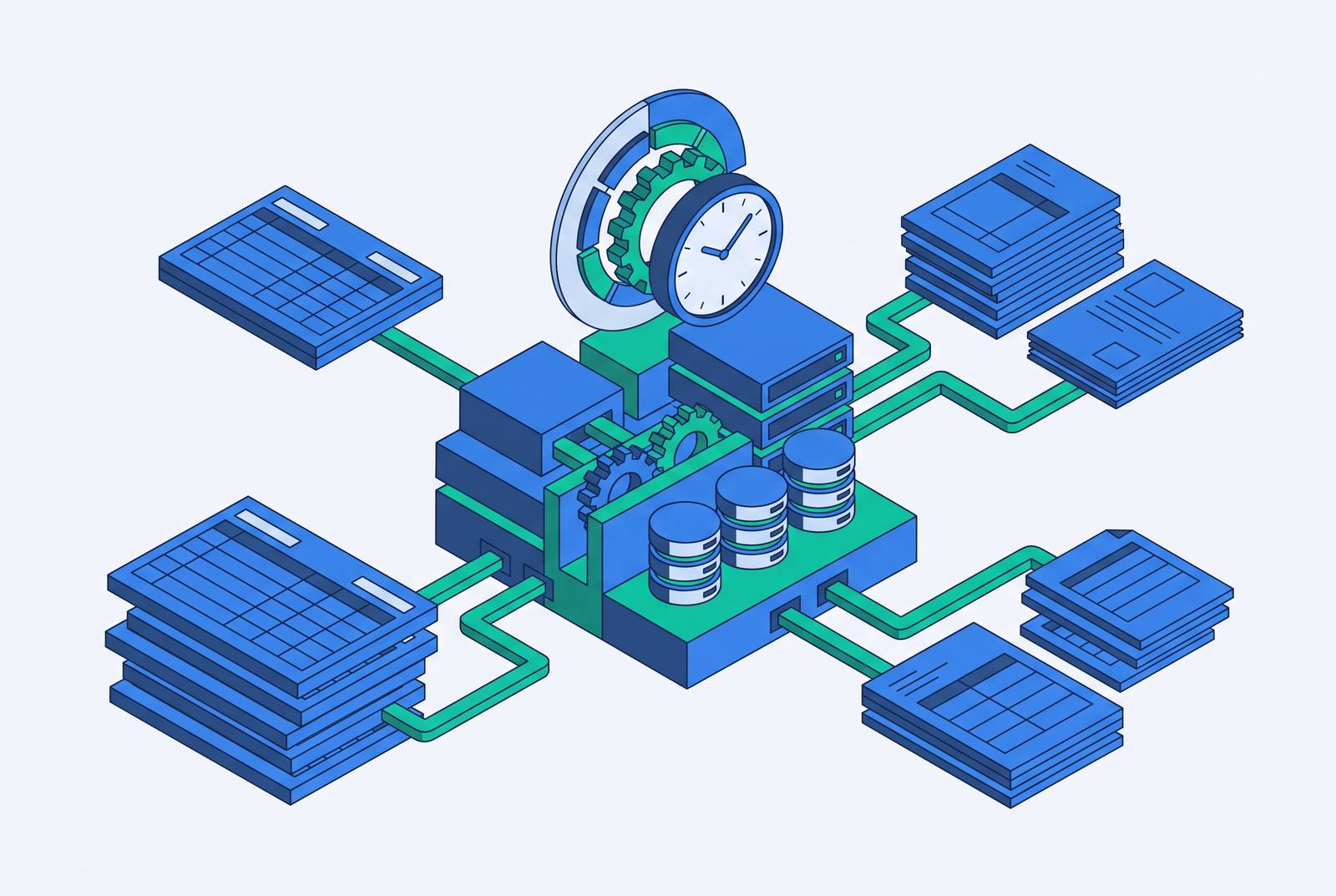
Month-end close eats up 6 days for the average finance team, and half need six or more business days to finish, according to Ledge's 2025 benchmarking study. Only 18% hit a three-day close. This piece walks through where GL auto-posting actually cuts that time, bottleneck by bottleneck, so finance leaders know what to fix first.
APQC's cross-industry survey of 2,300 organizations puts the average at 6.4 days, with the bottom quarter needing 10 or more calendar days and the top quarter wrapping in 4.8 days or less. A $10M month-end AR balance delayed 10 extra days ties up roughly $2.7 million in working capital that could be doing something else. The CFO can't make a real call on that cash until day 10 or 12 of the month, by which point the decision window has mostly closed.
These numbers haven't moved in years. Not because the problem is unsolvable, but because the workflow underneath them hasn't changed.
The manual habits that stack delay into the close cycle
Start with the obvious offender. 94% of finance teams still run close activities through Excel, and half say Excel is a direct reason the close runs slow, according to Ledge's 2025 data. A traditional manual setup burns 120 to 150 hours across the finance team every cycle, on top of whatever gets lost waiting on other departments to respond.
Five tasks eat most of that time, and none of them share a fix:
- Recurring journal entries. Accruals, prepayments, depreciation, all built by hand, every period, even though the logic barely changes.
- Bank and payment reconciliation. Cash reconciliation alone can run 20 to 50 hours a month, per Ledge 2025.
- Subledger-to-GL matching. Done line by line in spreadsheets, which is exactly as tedious as it sounds.
- Intercompany eliminations. Gets worse fast in any multi-entity or multi-location setup.
- Variance investigation. Last on the list, and it can't start until everything above it is done.
Industry data puts a number on what manual handling costs at the transaction level: manual GL coding runs about $9.40 per invoice, while best-in-class AP teams using automation have brought that down to $2.78. That gap is the whole argument, in miniature.
Most teams mistakenly expect these bottlenecks to solve each other. A tool that automates journal entries but leaves reconciliation manual still leaves the close slow. Most finance leaders buy the flashiest automation for whatever looks worst on a dashboard, when the real fix is sequencing every layer so none of them sits there waiting on a human. Fixing one layer without touching the others is like rotating one tire and wondering why the car still pulls left.
How GL auto-posting works: from source transaction to posted entry
Two kinds of posting exist, and it helps to keep them straight. Manual posting is when a preparer submits an entry through the ERP's journal entry module, still the standard path for most month-end accruals and one-off adjustments. It's human-initiated, carries more risk, and needs proper segregation of duties before it goes anywhere. Automated posting works differently: subledgers and connected systems push transactions straight to the GL with no human in the loop. AP invoices, payroll runs, revenue recognition schedules, bank feeds, all posting themselves.
The workflow runs through five stages: data import, logic application, validation, approval, then the ERP posting itself. Nothing exotic about the stages on their own, but the architecture behind them has changed. Real-time posting is the shift that's actually mattered over the past decade. Modern ERPs sync subledger transactions the moment they happen, instead of batching everything up and dumping it in at period-end like a backlog finally hitting the inbox.
Direct API connections make that possible, and the connections themselves are specific and well-documented. SAP S/4HANA uses API_JOURNALENTRY_SRV. Oracle Fusion Cloud runs through fscmRestApi. NetSuite posts via SuiteTalk REST, a POST to /services/rest/record/v1/journalentry. Acumatica connects through its own REST API. A transaction gets recorded the instant it clears, which gives finance an always-on view of cash and liabilities instead of a snapshot stitched together after the fact.
What that buys, practically, is early warning. Anomalies show up mid-month instead of the last week of the cycle. The close stops being a discovery exercise and turns into a confirmation of what's already been watched.
What AI adds that rule-based automation cannot handle on its own
Rules get you partway there, and partway is the problem. Traditional rule-based matching hits a 60% to 70% auto-match rate, leaving a real chunk of transactions stuck in an exception queue for someone to review by hand. AI-driven matching pushes that to 85% to 95%. That 20-some point gap, where the exception queue stops piling up, is the difference most vendors won't say out loud when they pitch "automation" that's really just rules with a nicer interface.
Audit coverage tells a similar story. A traditional audit samples 5% to 10% of journal entries and hopes the sample holds up. AI-powered testing reviews all of them, every entry, every cycle, instead of hoping the 10% you checked was the 10% that mattered.
What AI does that a rule set can't: it flags anomalous GL transactions in real time against historical patterns, catching a misclassified department, a mismatched vendor, or a missed accrual reversal before it turns into a line item nobody can explain. It recommends a fix and creates the remediation task on its own, instead of just flagging something and waiting for a human to notice. It learns from prior-period patterns and adjusts the workflow itself, rather than needing someone to update the rule set by hand every time the business changes. And it handles task creation, scheduling, approvals, dependencies, and recurring close activities through reusable templates.
The time savings show up in specific tasks. Bank reconciliation drops from 4 hours to 45 minutes. Audit prep documentation goes from 2 days to half a day. A 2025 MIT/Stanford study found finance teams using generative AI cut an average of 7.5 days off their monthly close, against an industry median close of around 6 days. Run that math and the right AI tooling doesn't just speed teams up, it puts them ahead of the calendar entirely.
Adoption is still uneven, and the gap is the story. APQC found 31% of organizations actively use AI in record-to-report, with another 39% in early stages. The early movers are pulling away from everyone else, and that distance only grows from here.
The right sequence for layering automation into an existing close process
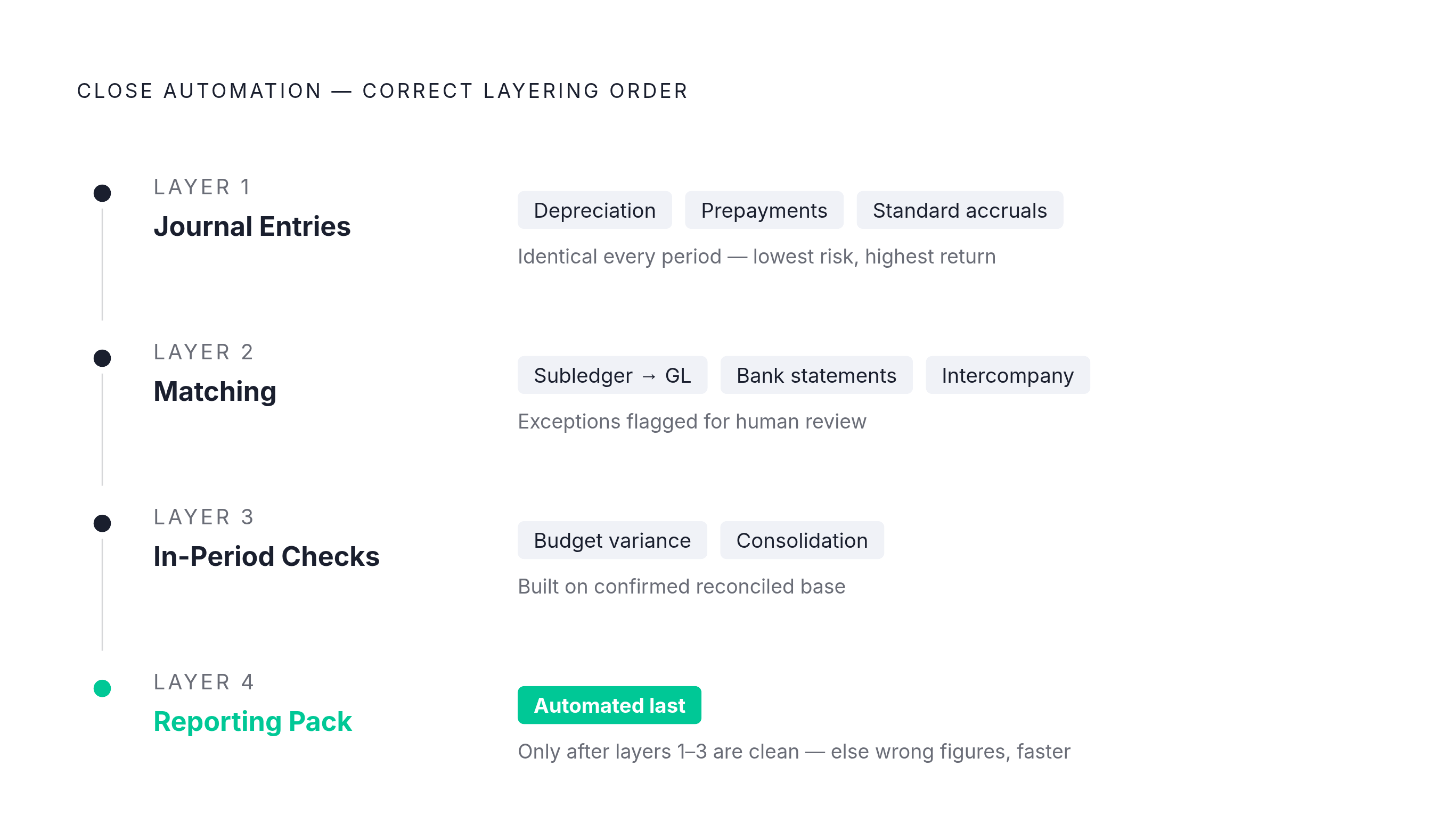
Order matters more than most finance teams assume, and getting it wrong is the single most common mistake in these rollouts. Layer one is recurring, rule-based journal entries: depreciation, prepayments, standard accruals. These are the lowest-risk entries to automate and the highest-return, since the entry is basically identical every period anyway. Template-driven automation removes the manual prep step entirely, no judgment calls required.
Layer two is matching: subledger-to-GL, bank statements, intercompany balances. Exceptions get flagged for a human to look at, instead of someone comparing every line by hand.
Layer three covers the checks that don't need final numbers before the period closes. Reconcile in the first two days, then automate budget variance analysis and consolidation on top of that clean base.
Layer four, and only layer four, is the reporting pack. Automate that last, not a moment sooner. A generated report built on numbers that haven't been reconciled yet just publishes the wrong figures faster than a human would have. Speed isn't the goal if the number underneath it is wrong.
The whole category is heading toward what's called a continuous close. Transaction monitoring runs all month instead of turning into a month-end sprint, reconciliations stay always-on instead of batched, and AI drafts variance explanations as changes happen rather than after the period's already shut.
One piece doesn't live inside the GL at all: accounts receivable. Open receivables and unresolved invoice exceptions are a close bottleneck that GL automation, on its own, can't touch. The subledger only reconciles cleanly if the AR sitting underneath it is clean, which means chasing aging invoices, handling portal submissions, and collecting missing documents like W-9s and PO numbers before the close starts, not during it.
What finance teams actually achieve after implementation
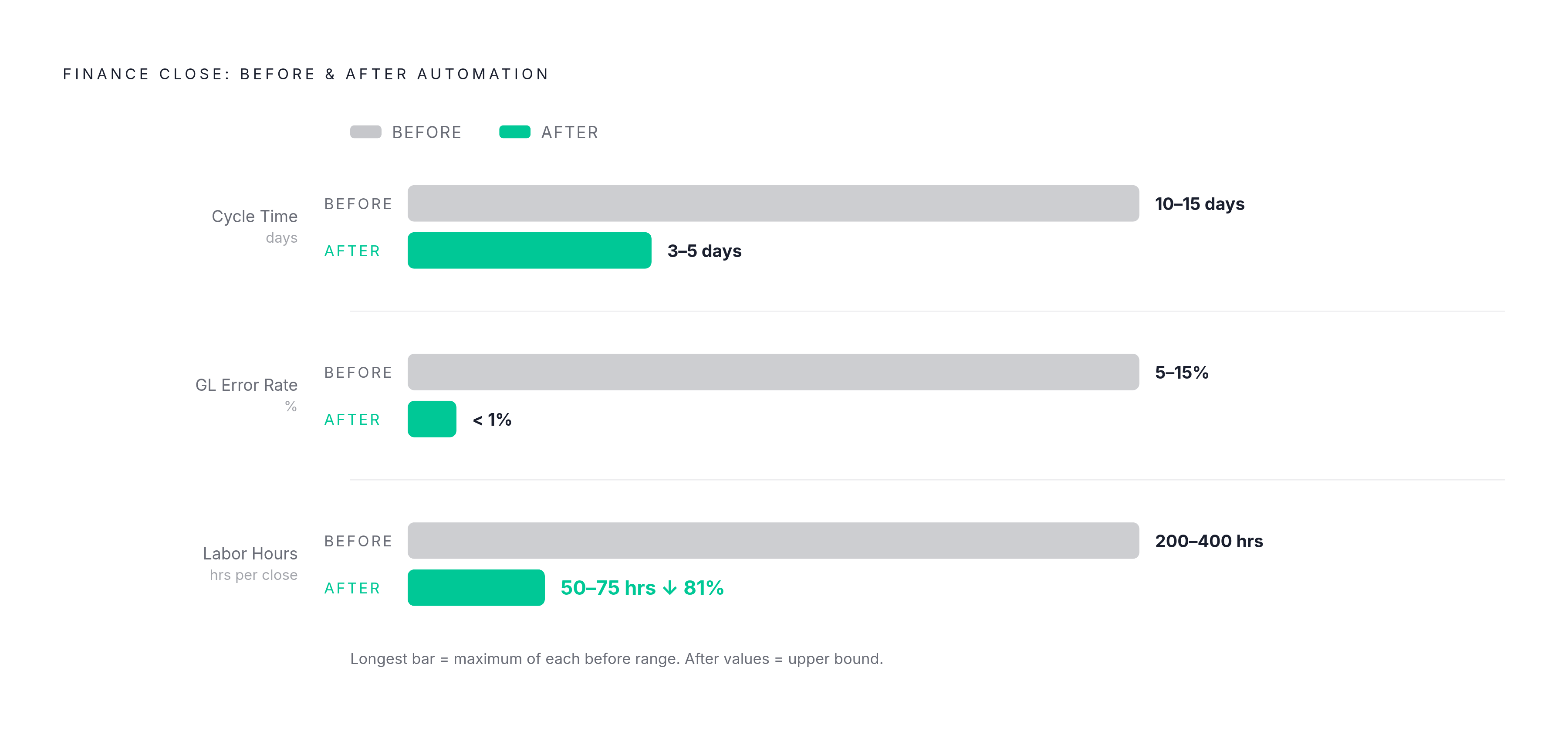
Companies report cutting close time from 7 days down to 2 or 3 days after putting month-end close automation in place. That's the gap between having the books closed before the second week of the month even starts, and closing them after it's already over.
The target metrics line up consistently across implementations. Close cycle time drops to 3 to 5 days, against a 10 to 15 day baseline. GL posting errors fall below 1%, compared to 5% to 15% under manual processes. Labor hours on the close land around 50 to 75 hours a month, down from a 200 to 400 hour baseline.
Transaction volume capacity changes too. With manual close work reduced, teams are better positioned to absorb growing transaction volume without a proportional increase in headcount. Audit quality moves in the same direction as speed, not against it: AI-powered journal entry testing covers every entry rather than a sample, which means errors surface before they compound.
What this means for the CFO is plain. Reliable numbers by day 2 or 3 of the month instead of day 10 or 12, so decisions about cash, hiring, and capital allocation get made while they still matter, not after the window's shut.
Vendor benchmarks reflect best-case rollouts, and results depend on data quality, how deep the ERP integration actually goes, and whether operational blockers, like unresolved AR or missing documents, get cleared before automation gets layered on top. Automation doesn't fix a messy foundation. It just runs the mess faster, and a faster mess is still a mess.
How the leading GL auto-posting platforms compare on the bottlenecks that matter
Judge these platforms on the same six things every time: recurring journal automation, subledger matching, approval routing, exception flagging, how wide the ERP integration goes, and whether the platform actually automates the accounting work or just organizes the close around a task list. That last question is where most buyers get fooled, because a slick task list feels like progress even when the work behind it is still manual.
HighRadius was named a Challenger in the 2025 Gartner Magic Quadrant for Financial Close and Consolidation Solutions. It targets 95% journal entry automation using AI agents, and claims up to an 80% reduction in manual journal entry effort along with a 30% cut in close time through systematic journal entry review. Its LiveCube tool is a no-code, Excel-like interface for building journal templates without pulling IT into the project. The workflow pulls data via API from ERPs, banks, and SFTP systems, applies ML-based mapping from GL to P&L accounts, flags anomalies using historical pattern detection, and routes approvals through multi-level, smart task assignment. It fits enterprise organizations managing high-volume, complex journal entry workflows where exception handling and audit trail governance carry real weight.
BlackLine stays focused on the internal close: reconciliations, journal entries, close task management, controls. It targets large organizations digitizing financial close management, pulling ERP data into a structured reconciliation workflow. It's built for companies where compliance, controls, and audit readiness sit alongside speed as primary drivers, not as an afterthought.
FloQast connects to NetSuite, Sage Intacct, QuickBooks Online, Microsoft Dynamics, SAP, Workday, Infor, and others to pull trial balance data for reconciliation matching, flagging variances between the GL balance and the supporting documentation behind it. Worth being blunt about one distinction here: FloQast organizes the close, it doesn't automate the accounting work inside it. Preparers and reviewers still do the actual work, the platform tracks and coordinates it. In September 2025, FloQast added a Report Builder with a pivot-style interface for audit-ready reports and drill-through access to source transactions. Pricing is positioned for mid-market budgets. It fits mid-market teams that want close orchestration and visibility without taking on a full enterprise automation build.
Platforms built for external reporting, SEC filings, ESG disclosures, and board materials solve a different problem than platforms built around the internal close itself. Know which one you're buying before you sign the contract.
Whichever platform gets evaluated, the same four questions apply. How deep does the ERP API integration actually go? Is the matching engine rule-based or AI-driven? How are exceptions routed and resolved? And are the vendor's outcome claims tied to the specific bottlenecks your team deals with, or just to bottlenecks in general?
AR belongs in this conversation even though it's not, technically, a GL tool. GL auto-posting resolves the subledger-to-GL reconciliation step, but only if the AR subledger feeding it is already clean. Unresolved invoices, failed portal submissions, and missing customer documents like W-9s and PO references are exactly what generates the exceptions that reconciliation then has to chase down by hand. AR automation that handles the follow-up, the portal navigation, and the document collection upstream is what keeps that subledger accurate in the first place, so the GL auto-posting layer gets a clean close instead of a queue of exceptions to sort through.