Working Capital Optimization Through Faster Collections
Collecting invoices 18 days faster than your median peer frees $223 billion in trapped cash.

$223 billion. That's the cash sitting in receivables that companies could free up just by getting their collections closer to top-quartile speed, according to J.P. Morgan's 2024 Working Capital Index. Collections is also the one working capital lever a finance leader can pull without renegotiating a single supplier contract or ripping apart an inventory model. This piece walks through why that number is real, where it hides, and what actually closes the gap.
J.P. Morgan's research found that if companies improved by just one quartile across DSO, DPO, and DIO, roughly $707 billion in working capital could turn into free cash flow. Inventory (DIO) is the biggest chunk at $353 billion, payables (DPO) adds $130 billion, and collections (DSO) accounts for the remaining $223 billion. PwC's global study of more than 19,000 listed companies puts the systemic number even higher: €1.56 trillion in excess working capital worldwide. So the $223 billion isn't the whole problem. It's one slice of it, and it happens to be the slice finance can act on directly, this quarter, without a single vendor call.
And to be clear about what "one quartile of improvement" means: it's not a finance transformation project. It's not a new ERP. It's the difference between a company that follows up on invoice day 31 and one that waits until day 61. Small, boring, achievable.
What DSO actually measures and why the gap between top and median performers is so large
DSO is the average number of days between sending an invoice and actually getting paid. Think of it as the pulse of your receivables. If it's slow, your cash is stuck somewhere between "we did the work" and "we got paid for the work," and that gap is where working capital goes to die.
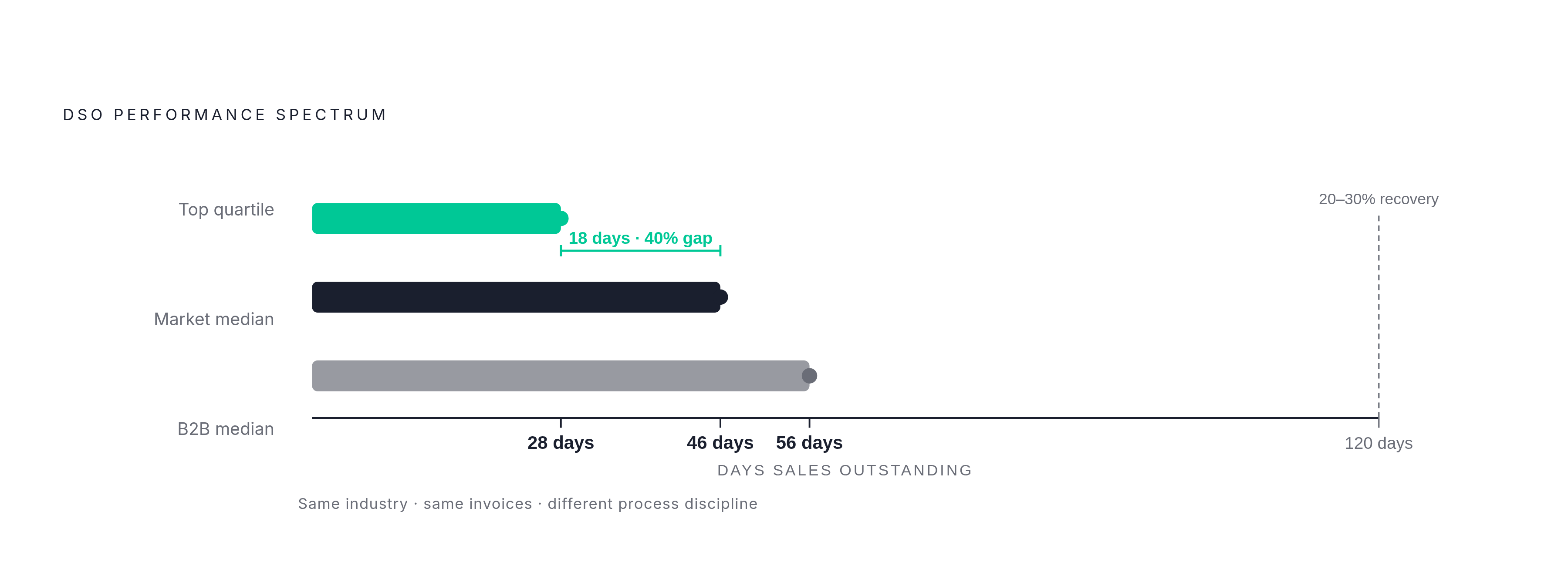
The Hackett Group's 2025 U.S. Working Capital Survey found top performers collecting in an average of 28 days, while the market median sits at 46 days. That's a 40% gap between companies doing the exact same thing: sending invoices and asking to be paid. A separate 2024 industry report on B2B payments put the overall median DSO across industries at 56 days, which suggests the 46-day median might actually be generous for a lot of companies. J.P. Morgan's index adds another gut punch: more than 70% of companies report DSO above 46 days, and 63% said their DSO is actively getting worse, not better.
So why the spread? It's tempting to blame industry mix, some sectors just take longer to get paid, and that's true to a point. But companies in the same sector show wildly different DSO numbers, which means industry alone doesn't explain it. What explains it is process discipline: how fast you follow up, how consistently you escalate, how much friction you've removed from the path between "invoice sent" and "cash received." That's not a customer problem. That's a you problem, and it's fixable.
Deloitte's 2025 roundup of 2024 data found the cash conversion cycle shortened by about 0.9 days year-over-year. Good news, right? Not really. DSO actually rose during that period. The gains came entirely from squeezing inventory and stretching payables further, not from collecting faster. Companies are finding working capital relief everywhere except the one place with $223 billion sitting in it. That's like finding spare change in every couch cushion except the one with the actual wallet in it.
How one DSO day translates into cash — and what the math looks like at different company sizes
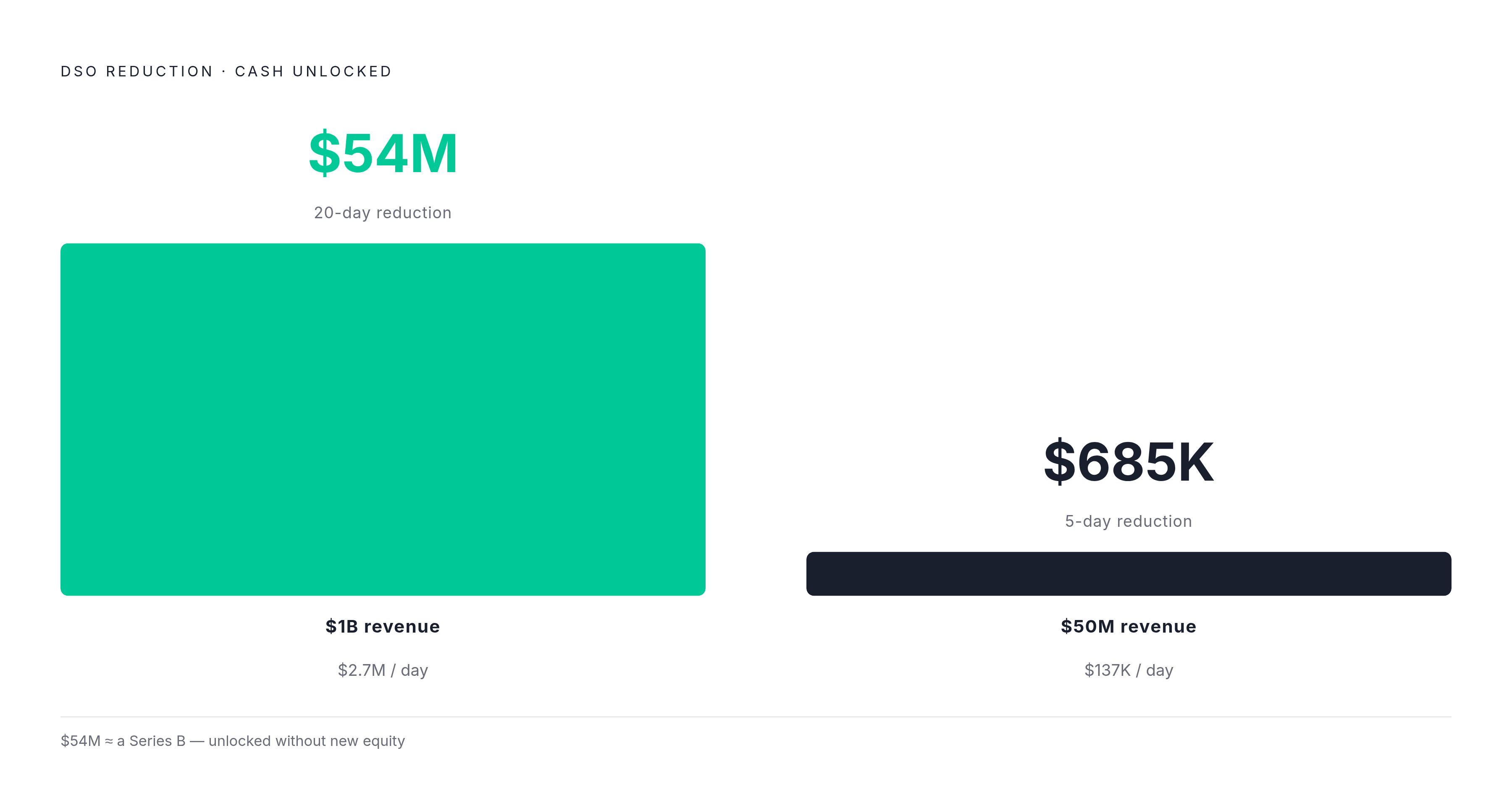
Here's where the abstract becomes concrete. For a company doing $1 billion in revenue, each single day shaved off DSO frees up roughly $2.7 million in working capital. Knock 20 days off, and you've unlocked $54 million. That's not a rounding error; that's a funding round you didn't have to raise.
Scale it down. A $50 million revenue company that trims five days off DSO frees up around $685,000. That's real money: enough to hire two or three people, restock inventory, or fund a product launch, all without touching a credit line or calling a bank.
The part that gets missed: this cash isn't new revenue. It's already earned. It's sitting in invoices that customers already agreed to pay. DSO reduction isn't about selling more, it's about timing, plain and simple.
Compare that to the other levers on the table. Stretching payables further can strain supplier relationships, and a lot of companies are already leaning on suppliers about as hard as they can without damaging the relationship. Cutting inventory means restructuring your supply chain and accepting more service risk, no small thing if a stockout costs you a customer. Collections, on the other hand, just needs better process and more consistent follow-up. No external negotiation. No one else's terms to argue over. It's the lever entirely inside your own building.
And what does that freed-up cash actually fund? Growth you don't have to borrow for. A stronger negotiating position with your own suppliers. Less dependence on revolving credit lines that carry interest and covenants. Working capital, done right, isn't a safety net. It's a funding source.
Industry baselines that explain why some companies carry structurally high DSO
Some industries are just built slower. Engineering and Construction averages 100 days DSO. Energy Services and Equipment sits around 82. On the other end, Food and Staples Retail runs at 11 days, and Homebuilding at a lean 6.
Construction is the poster child for structural complexity, and it's worth understanding why. Payments get tied to project milestones through progress billing, so you don't get paid until a phase is done. Retainage holds back 5 to 10% of the invoice until the whole project wraps. And approval chains run through multiple layers of sign-off, often pushing final payment out to 90 or even 120 days. None of that is sloppy. It's just how the industry works.
Net 30 terms are still the default across B2B, used by roughly 60% of companies. But enterprise contracts frequently push that to Net 45 or Net 60, tacking on another 15 to 25 days at the contract level before collections even starts the clock.
Here's the catch, though: structural factors set a floor, they don't explain the 40% gap between top and median performers within the same industry. Two construction companies with the same retainage terms and the same milestone structure can still land 20 days apart on DSO. That gap is operational, not structural. So the real move for finance leaders isn't benchmarking against some global median that doesn't apply to you. Benchmark against your industry peers, then ask the harder question: what's the top performer in my sector doing differently?
The late-payment crisis that sits underneath the DSO numbers
Now for the number that should make every CFO sit up straight: according to the Atradius 2025 Payment Practices Barometer, 55% of all B2B invoiced sales in the United States are currently overdue. More than half. Of credit-based B2B sales specifically, only 52% got paid on time, and 5% were written off entirely as bad debt.
The average annual cost of late payments per company comes in at $39,406, and for a notable share of businesses, that cost climbs past six figures a year. That's not a rounding error on the income statement; that's a line item with teeth.
Here's the part that turns this from an annoyance into a genuine crisis: a large share of US companies say late payments from their own customers cause them to struggle meeting their own financial obligations. So what do they do? They delay paying their own suppliers. The problem doesn't stay contained, it spreads down the chain like a very slow, very expensive game of telephone.
Small businesses feel this hardest. A 2025 Intuit QuickBooks report surveying more than 2,000 small businesses found those with overdue invoices are owed more than $17,000 each on average, and they're far more likely to report cash flow problems, credit card dependence, and trouble hiring.
And the clock matters more than people think. Once an invoice crosses 120 days past due, the odds of ever collecting it drop to just 20 to 30%. Late payment isn't a scheduling hiccup. It's the first mile on the road to a write-off. In Europe, roughly a quarter of all bankruptcies trace back to late payments from customers. DSO isn't a vanity metric for the finance team's slide deck. It's a survival variable.
Why invoices go unpaid: the operational root causes finance teams underestimate
Here's the twist most finance teams miss: customers aren't usually refusing to pay. They're stuck. Globally, the majority of late payments trace back to administrative errors, wrong pricing, a bad purchase order reference, a missing tax code, an invoice sent to someone who left the company two years ago. Every one of those disputes resets the payment clock back to zero.
Manual processes make it worse. Manual collections work typically tacks on 15 to 30 extra days to DSO. Finance teams report spending up to 20 hours a week just processing invoices by hand, and the average invoice takes about two weeks to process manually. Suppliers can wait that long just for their invoice to land on the right desk.
Then there's the portal problem. Procurement platforms like Coupa and Ariba add approval layers, demand specific document formatting, and throw exceptions that quietly stall payment. This is where invoices go to disappear. Not lost, exactly, just stuck in a queue nobody's watching.
And without a real follow-up cadence, invoices just age in silence. No one flags the due date. No one escalates at day 45. Nobody notices until the invoice is 60 or 90 days old and suddenly it's a "collections problem" instead of a five-minute email that should've gone out weeks earlier.
Most growing companies respond to this by adding AR headcount as invoice volume grows. Sounds reasonable. It doesn't work, though, because the backlog grows faster than any hiring plan can keep up with. The upshot: most of that DSO overhang isn't customers refusing to pay. It's friction, typos, and silence, three things that are entirely within a company's power to remove.
What automation and AI-assisted collections actually change about the DSO equation
AI adoption in finance functions rose sharply in 2024, up significantly from the year before, according to Gartner. CFOs are pointing most of that investment straight at AR and AP.
The results back it up. A 2025 study by Billtrust and Wakefield Research, surveying 500 finance decision-makers at companies with $250 million or more in revenue, found nearly all companies using AI in AR reported reduced DSO. Ninety-nine percent. That's about as close to unanimous as you get in any business survey. The Hackett Group's research adds more texture: organizations using AI in AR saw a dramatic reduction in process costs per collection contact and a 43% improvement in cash flow predictability.
What's actually happening under the hood? AI-powered cash application matches incoming payments to open invoices at high accuracy, cutting out the manual reconciliation that used to eat hours. Collections prioritization algorithms figure out which overdue accounts to chase first, replacing the old method of "whoever's loudest gets called." And centralizing documentation and communication drives real reductions in billing disputes, plus faster resolution on the disputes that do happen.
Here's the thing worth remembering, though: most firms haven't fully automated AR yet. There's a lot of runway left here, this isn't a saturated market where all the easy wins are gone.
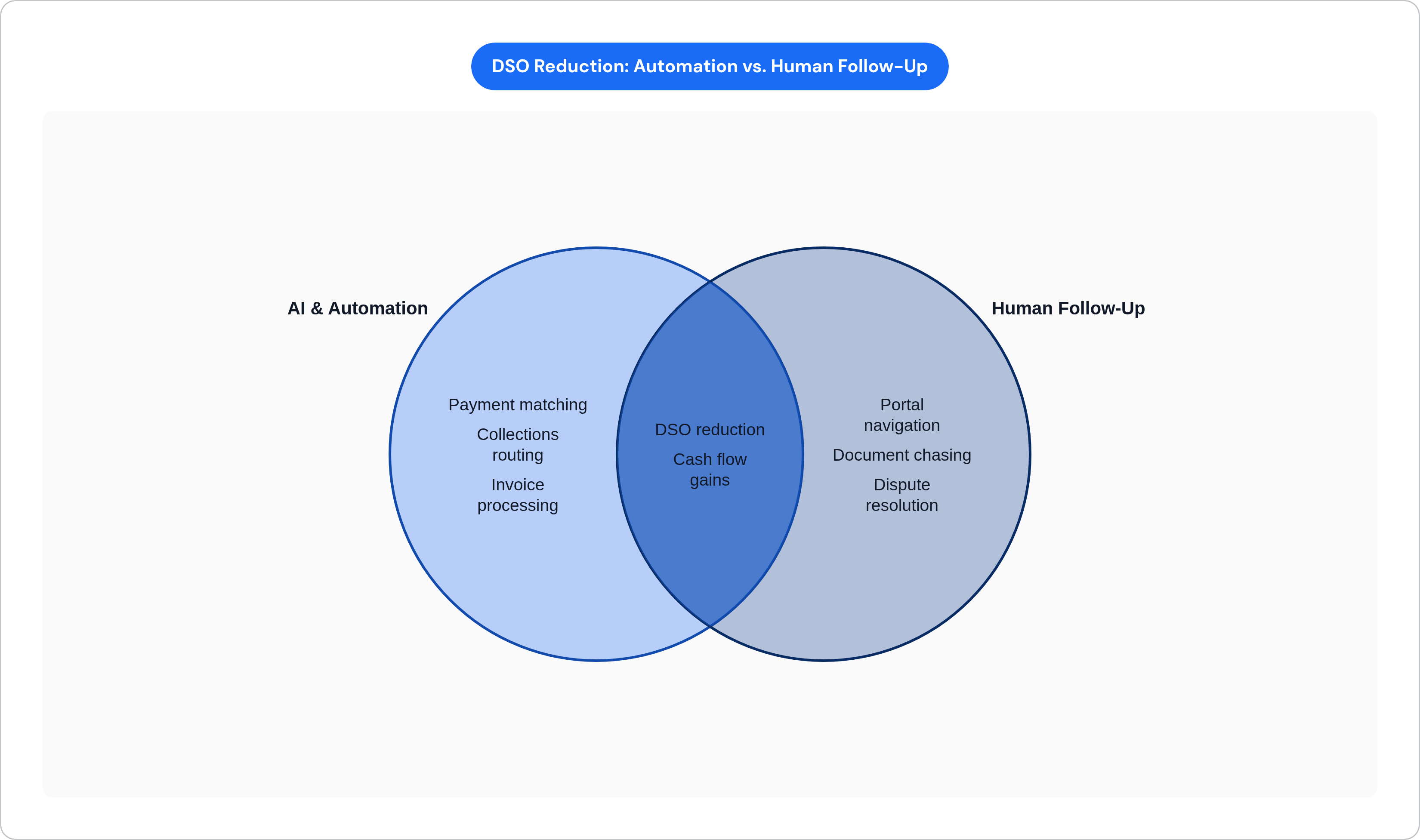
But automation has a ceiling, and it's important to name it honestly. Software is great at routing and matching. It does not replace the persistent, human-feeling follow-up that actually gets a stuck invoice moving through a supplier portal, or gets someone to finally submit that W-9 that's been sitting in their inbox for three weeks. That last stretch needs something automation alone doesn't do well.
Why the last mile of collections — portal navigation, document chasing, escalation — resists pure automation
Every AR process has an exception pile. Wrong contact. Missing PO number. A portal rejection nobody explained. An outstanding compliance document that's been "getting to it" for a month. These aren't edge cases you can automate away with a workflow rule; they need someone to actually go look and fix it.
Supplier portals like Coupa and Ariba don't just sit there waiting for a file upload. They demand active navigation: the right invoice format, ongoing status checks, resubmission after a rejection, escalation when an approval stalls for no visible reason. Treat a portal like a mailbox and your invoice will sit there for a month.
The missing document trap deserves its own callout. A single missing W-9 or certificate of insurance can hold an invoice in limbo indefinitely. No software resolves that on its own; someone has to request it, chase it, and confirm it landed.
And customers respond to follow-up that actually sounds human. A templated email blast gets ignored, or worse, marked as spam. A reply that says "hey, I see the hold-up is the PO mismatch on line 3, here's the corrected version" gets action, because it shows someone's actually paying attention.
This is exactly the layer an always-on AR team fills: following up persistently, replying to customer questions, navigating the portal maze, escalating stalled approvals, and pushing every invoice until the cash actually lands. Invoice Butler operates in this space, and it's managing billions in receivables, real evidence that this model holds up at scale, especially for fast-growing companies where the sheer volume of exceptions outpaces what any internal team can chase down alone.
The broader lesson holds regardless of which tool a company picks: teams that try to automate the last mile without persistent, human-like follow-up hit a wall. The DSO gains show up fast, then plateau right where the hardest, messiest cases live.
The working capital that faster collections funds — and why it matters more than a lower credit line
Let's bring the math back one more time, because it deserves repeating in plain terms. A 20-day DSO reduction at a $1 billion company unlocks $54 million. That's not a tidier balance sheet. That's a funding source showing up without a single investor meeting or bank negotiation.
What does that money actually do? It funds organic growth without touching a revolving credit line. It strengthens your own position on payables, because when cash is sitting in the bank instead of stuck in a customer's AP queue, you can actually pay your own suppliers early and negotiate better terms in return. And it lowers your overall cost of capital, because lenders and investors both price predictability. A company with a steady, tight cash conversion cycle looks like a safer bet than one that's white-knuckling it every quarter.
The Hackett Group's 2025 European survey found something worth sitting with: cash conversion cycle efficiency worsened by 3% across the largest European companies in 2024, driven mainly by rising DSO. That's the cost of deprioritizing collections while chasing gains everywhere else. The working capital position erodes quietly, even while every other lever looks like it's being optimized.
So here's the reframe worth carrying into the next budget meeting: DSO management isn't a task you hand off to the collections team and forget about. It's a CFO-level decision about where your cash comes from and when it shows up. Companies willing to close even a fraction of the gap between their current DSO and top-quartile performance will find the cash was already there the whole time, earned, owed, and sitting in a stack of invoices waiting for someone to go get it.