W-9 and Compliance Document Collection in AR
Higher thresholds for 1099 reporting still require W-9 collection and backup withholding compliance.
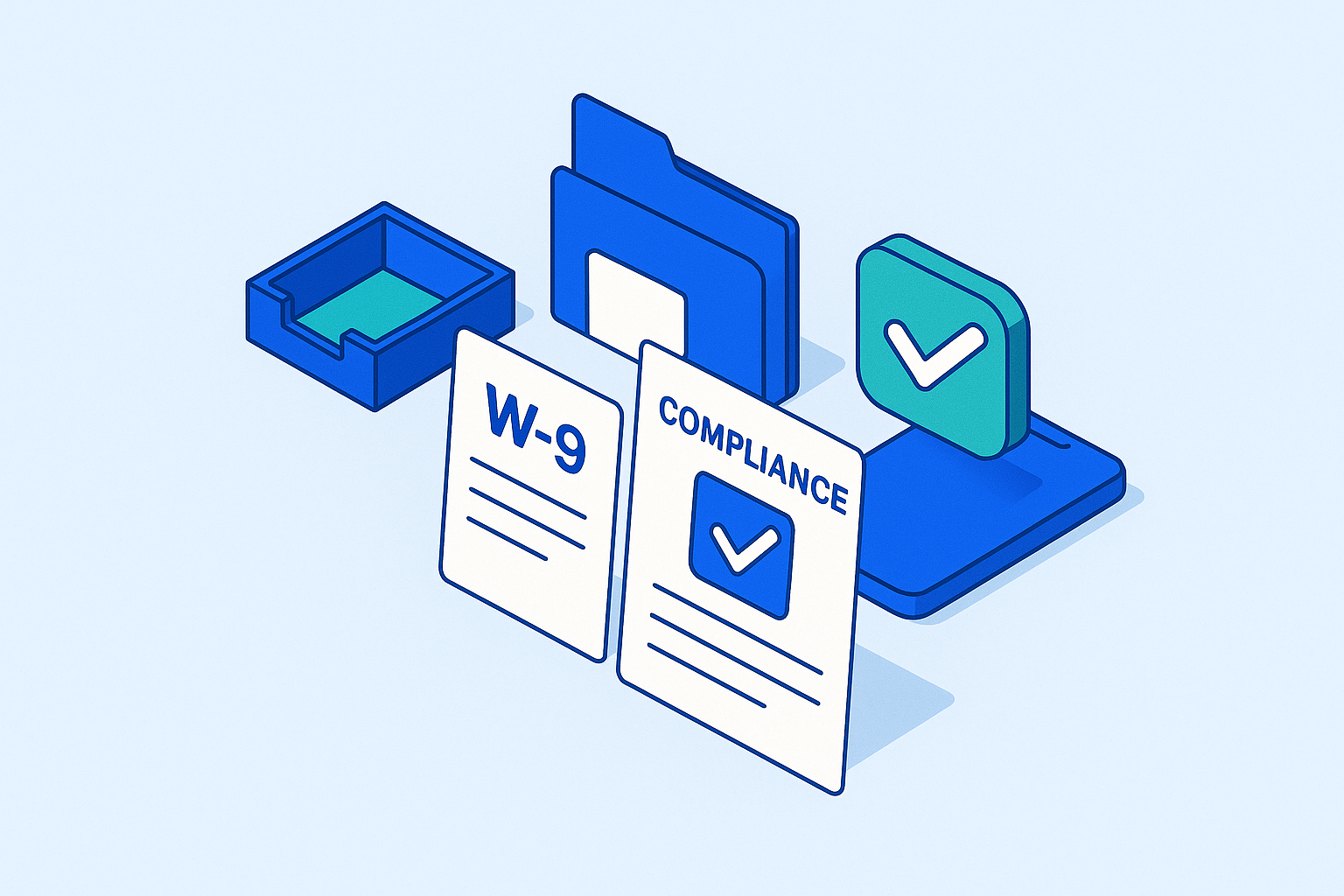
Start with the basics. A W-9 collects three things: legal name, taxpayer identification number (TIN), and tax classification. The paying company uses that information to file 1099s with the IRS at year-end. The vendor doesn't file the W-9 anywhere. They hand it to the company paying them, and that's it.
Who needs to provide one? U.S.-based individuals, sole proprietors, partnerships, LLCs, and unincorporated businesses getting paid for services. Graphic designers, consultants, attorneys, IT contractors, accountants. If you're billing a business for your time or your firm's services, they will ask for a W-9.
Payments to corporations are generally exempt from 1099 reporting. That means the company paying you often doesn't need a W-9 if you're a corporation. But "often" isn't "always." Attorneys are the most notable exception. Gross proceeds paid to attorneys require reporting regardless of entity type, so even a corporate law firm should expect the request.
Foreign vendors are a completely separate track. They complete a W-8BEN or W-8BEN-E instead. Those forms expire every three years, which becomes a real problem if you're trying to keep a vendor file current and actively failing to track it.
From an AR perspective, whether your company needs to supply a W-9 depends partly on how you're classified. A sole proprietor billing a business client will almost certainly be asked. A corporation billing another corporation, less often but not never. The smart move is to anticipate this request before it surfaces mid-payment cycle rather than scramble for it when an invoice is already sitting in a hold queue. You already know the ask is coming. Get the form ready before anyone has to ask.
How the March 2024 Form Revision and the Forthcoming 2026 Draft Change What a Valid W-9 Looks Like
There's a current version and a coming version, and both matter.
The current W-9 carries a March 2024 revision date. It added Line 3b, which flags partnerships, LLCs classified as partnerships, trusts, and estates that have foreign partners, owners, or beneficiaries. This catches a lot of people off guard, particularly flow-through entities that didn't realize it applied to them.
The draft January 2026 revision has been published but isn't final yet. The biggest change for most people: sole proprietors must list their individual legal name on Line 1 and their Social Security number on Line 5. Not a business name. An EIN won't cut it. Their personal legal name and SSN are what the IRS wants.
This is a problem because many sole proprietors have historically submitted W-9s the other way. Business name, EIN. It felt cleaner, more professional even. The IRS is now making clear that for sole proprietors, the TIN has to match the individual, not the business.
The 2026 draft also adds a new checkbox on Line 3a for digital asset brokers, relevant for 1099-DA reporting. If you're not a digital asset broker, you can genuinely ignore that one.
The practical implication for AR and AP teams: if you're holding a W-9 from a sole proprietor that was submitted under a business name and EIN, that form will need to be resubmitted once the 2026 revision is finalized. The IRS technically puts the burden on the vendor to resubmit when their information changes. In reality, the AP or AR team is the one hunting them down when January arrives and the deadline is three weeks out.
Flag those accounts now. Seriously, this one cannot wait.
What the 2025 Threshold Increase Actually Changes and What It Doesn't
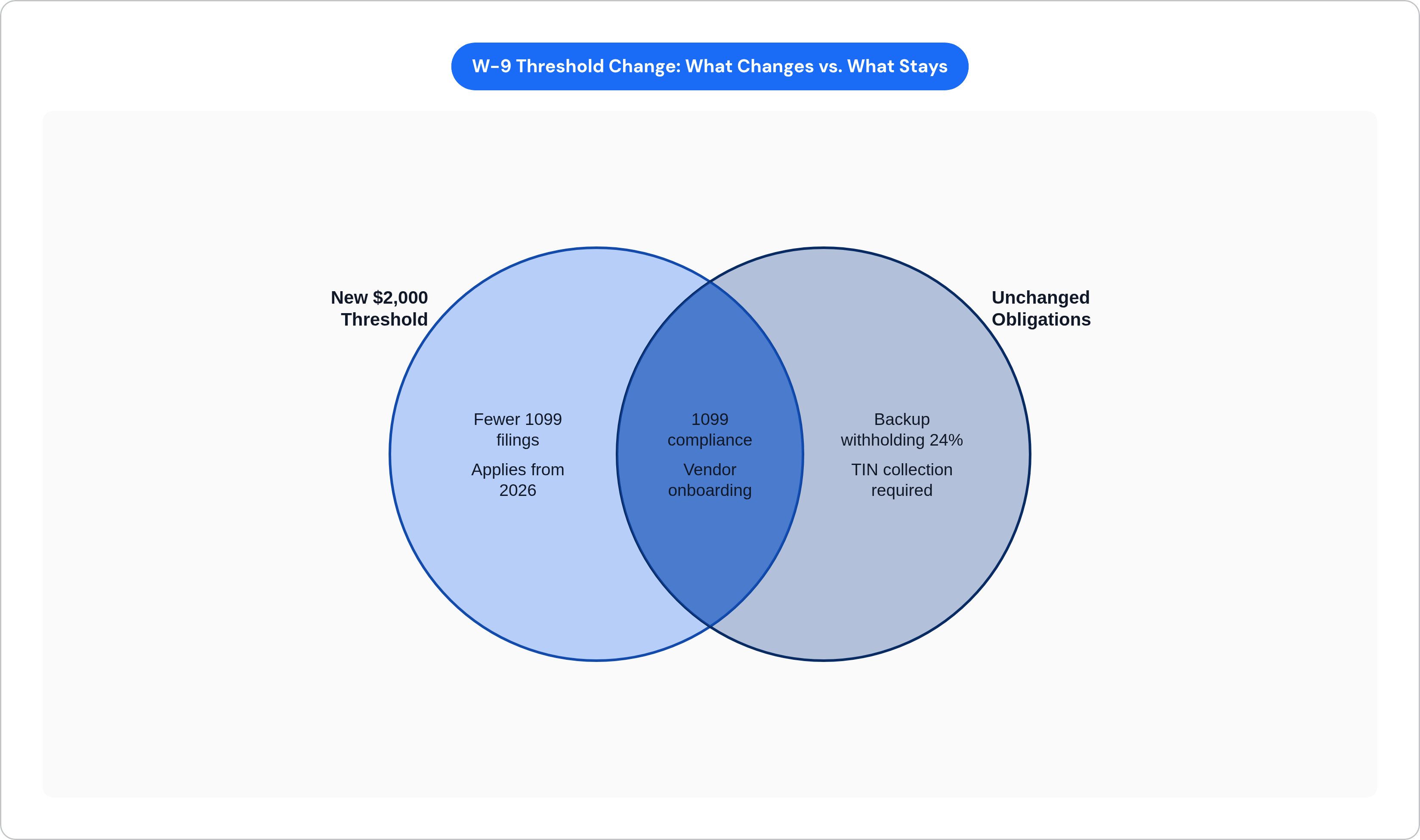
The One Big Beautiful Bill Act, signed July 4, 2025, raises the 1099-NEC and 1099-MISC filing threshold from $600 to $2,000 for payments made in 2026 and beyond. Starting in 2027, that threshold adjusts for inflation in $100 increments. For 1099-K, the threshold reverts to $20,000 and 200 transactions starting in 2026.
Forms 1099-INT, 1099-DIV, 1099-R, and 1099-S are unaffected.
What the threshold change actually does: it reduces how many information returns you have to file at year-end. Fewer vendors under $2,000 means fewer 1099s, which is genuinely less work for some relationships.
What it does not do: change anything about backup withholding.
If a vendor never provided a valid TIN, backup withholding applies to every payment regardless of dollar amount. The $2,000 line is completely irrelevant to that obligation. You still need the W-9. You still need the TIN. The threshold only governs when you must file the information return, not whether you're exposed to withholding risk. Think of the threshold as the finish line of a race — it tells you when the race ends, but it has nothing to say about whether you laced your shoes up correctly at the start.
Worth flagging separately: state-level thresholds don't conform to the federal increase in every state. If you operate across multiple states, verify state requirements before scaling back 1099 filings below $2,000. Some states will still want the form, and finding that out in February is worse than knowing it in October.
The practical read is simple. The threshold change reduces paperwork. It does not reduce the need for a W-9 collection policy. Don't let the headline number convince you the underlying compliance obligation got smaller.
What Backup Withholding Costs and When It Gets Triggered
The backup withholding rate is 24%. It's been there since 2018. It applies to the full payment amount. Not a portion. All of it.
Four things trigger it:
- Missing TIN
- Incorrect TIN (flagged via an IRS CP2100 or CP2100A notice)
- Underreporting of interest or dividends
- Failure to certify on the W-9 itself
The CP2100 B-Notice process has a real timeline. Once you receive a notice, you have 15 business days to send a notice to the affected payee requesting a corrected W-9. If they don't respond, withholding must begin within 30 business days. There's no flexibility built into that window.
If the payer fails to withhold when required, the payer becomes liable for the 24%. Plus penalties. Plus interest. The remittance goes through Form 945 via EFTPS. This is not a situation you want to back into accidentally because someone forgot to chase a form.
One that trips people up consistently: a W-9 returned without a signature is treated the same as no W-9 at all. Payments made against an unsigned form still carry withholding exposure. An unsigned form is a liability waiting to mature, not a placeholder.
The AR flip side is worth sitting with. If your company fails to supply a valid W-9 to a customer and they apply backup withholding, you're receiving 24 cents less on every dollar. Across a long vendor relationship, that's not a rounding error. It's a cash flow hit that comes directly from a document gap, and it's entirely preventable.
The Penalty Structure for Late or Incorrect 1099 Filings That a Missing W-9 Eventually Causes
A missing W-9 doesn't just stall a payment. It plants a problem that shows up again in January, usually at the worst possible time.
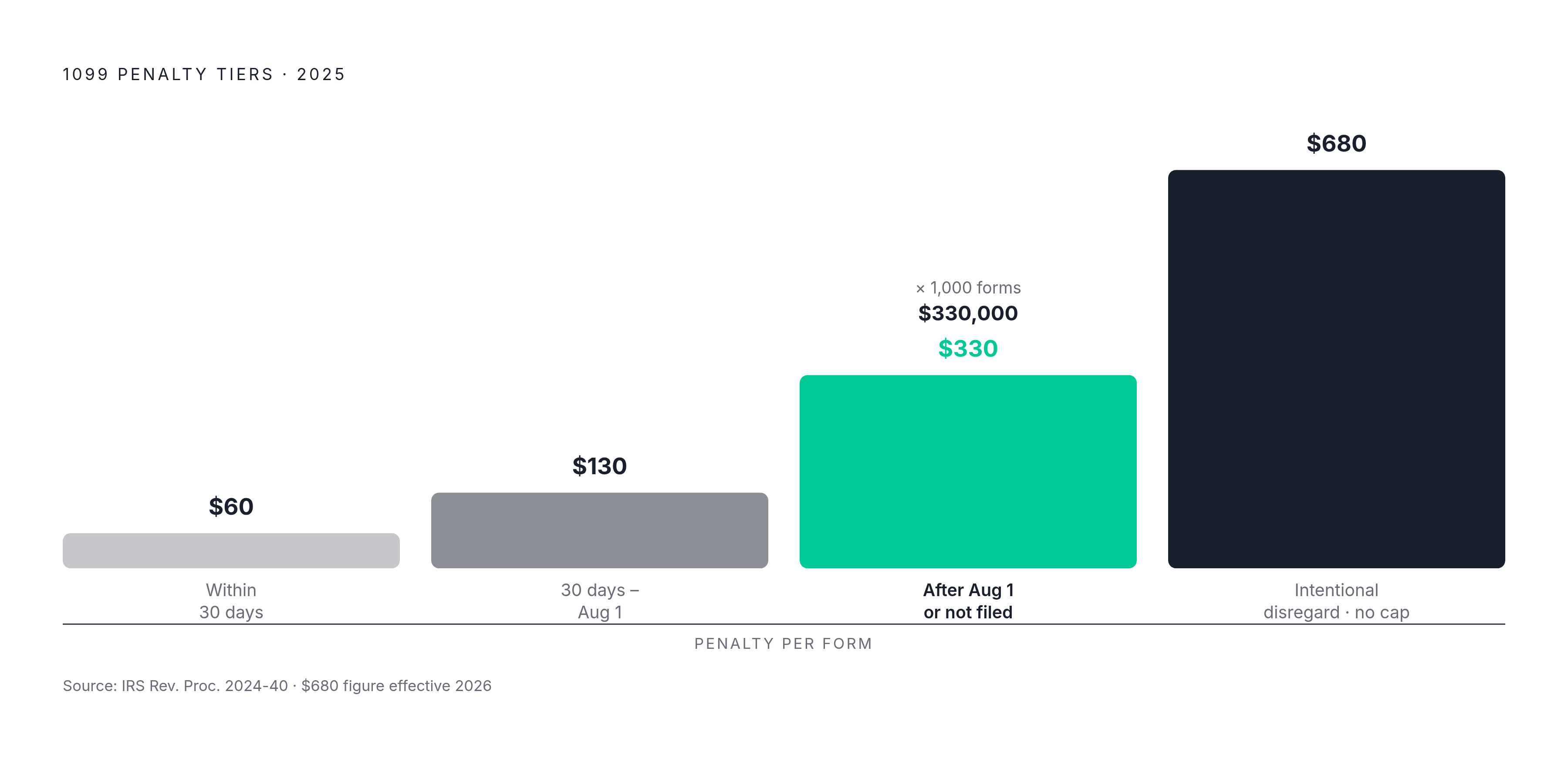
The 2025 penalty tiers per information return:
- $60 if filed correctly within 30 days of the deadline
- $130 if filed correctly after 30 days but by August 1
- $330 if filed after August 1 or not filed at all
- $680 per form for intentional disregard, with no annual cap (2026 figure)
Scale the $330 tier across a company with 1,000 contractor relationships that missed the August 1 cutoff. Federal exposure alone reaches $330,000. That's a real number, and it traces directly back to document collection gaps from earlier in the year. Not a data breach. Not a system failure. A missing form.
As of the 2024 filing season, any filer submitting 10 or more information returns of any type must file electronically. The old 250-form threshold is gone. If you're filing 10 or more returns total across any combination of 1099 types, you're filing electronically whether you planned for it or not.
Once the IRS issues a Notice 972CG proposing penalties, you have 45 days to respond or contest. After that, penalties are assessed and collection follows.
The chain is direct. Invoice goes out without a W-9. Payment stalls. Year-end comes. You're scrambling to file a 1099 with incomplete or unverified TIN information. You miss the deadline or file with a bad TIN. Penalties land. All of it traces to a missing form that should have been collected at onboarding months earlier.
When to Collect the W-9 and What to Check When It Comes Back
The single most common and costly mistake is waiting until January to collect W-9s. Every year, AP and AR teams spend weeks chasing contractors who have moved, changed their business structure, or simply stopped responding. The information is stale, the deadline is close, and the scramble is completely avoidable.
The correct timing is before any payment is made. Pair the W-9 request with the vendor agreement or purchase order. Make it part of onboarding. A 10 to 14 business day return window gives vendors enough time without letting the request drift indefinitely.
A "no W-9, no payment" policy enforced at onboarding eliminates the mid-cycle chase entirely. It's not punitive. It's just clear, and vendors generally respect clarity more than they respect ambiguity.
When the form comes back, check four things:
- Legal name is present on Line 1
- Tax classification is selected on Line 3
- TIN is filled in
- Certification is signed and dated
A form missing any of these is invalid. Send it back immediately with specific notes on what's missing. An incomplete form sitting in a file as though it's good is where liability quietly accumulates.
Use the IRS TIN Matching Program to confirm name and TIN combinations before filing. You can check up to 25 combinations online instantly, and bulk uploads handle larger vendor lists. A validated match through TIN Matching qualifies as reasonable cause under IRC Section 6724(a) if a mismatch surfaces later. This step takes minutes and creates a documented defense. There's no good reason to skip it.
Request an updated W-9 when a vendor changes their legal name, business structure, address, or TIN. Trigger it on the change itself, not on a fixed annual cycle. Retain completed forms for at least four years.
How W-9 and Compliance Document Gaps Show Up as Payment Delays in AR Workflows
Here's what this actually looks like from the AR side.
You send an invoice. The customer's AP team puts it on hold pending a valid W-9, a certificate of insurance, or a completed supplier portal profile. You don't know any of this is outstanding. No one calls. No notification comes through. The invoice just sits there, aging, while your DSO climbs for reasons that have nothing to do with the work you did.
Supplier portals like Coupa and Ariba frequently require compliance documents to be uploaded and approved before an invoice can advance to payment status. The invoice shows as "submitted." It is effectively frozen. And the part that makes this operationally maddening: these holds rarely generate a proactive notification back to the vendor. You find out only when someone calls or logs in to check status, usually after the invoice is already significantly past due.
No dispute. No cash shortage. No disagreement on terms. Just an administrative gap sitting quietly in someone else's AP queue.
A systematic AR process needs a compliance document checklist at customer onboarding. W-9 on file. Insurance certificates current. Supplier portal registration complete. The goal is to make sure the invoice goes out clean rather than stalling at the customer's AP gate after you've already done the work and moved on.
Building a Repeatable System for W-9 and Compliance Document Collection That Doesn't Depend on Manual Follow-Up
Manual follow-up is expensive and unreliable. It depends on someone remembering to chase a form while also managing everything else in their queue. The process should do the chasing, not the person.
The core components of a functional system:
- A document checklist tied to customer onboarding. W-9, insurance certificates, portal registration. These boxes get checked before the first invoice goes out, not after.
- A triggered request workflow at the point of the first invoice or vendor agreement. The request goes out automatically. It doesn't depend on someone's memory or a sticky note on a monitor.
- A defined follow-up cadence with a hard deadline before payment release. If the document isn't back by day 14, the workflow escalates. Payment doesn't release until it does.
Track document status at the account level, not the invoice level. A W-9 collected once covers future invoices. A certificate of insurance has an expiration date that needs active monitoring. Those are two different tracking problems, and conflating them is exactly how things fall through the cracks in ways no one notices until an invoice is already aging.
For W-8 forms from foreign vendors, build expiration tracking into the system from the moment of collection. These forms lapse every three years. An expired form reactivates withholding risk the same way a missing form does. Set the calendar alert at collection, not when the form is already past its date.
The goal is zero compliance surprises, not zero compliance issues. Vendors change their information and forget to tell you. Forms get submitted with errors. That's going to happen. The goal is that those gaps surface and get resolved before an invoice goes out, not after it's already sitting in a customer's AP queue aging toward 60 days.
Finance teams that treat W-9 and compliance document collection as a front-of-cycle discipline consistently remove one of the most common and least visible reasons invoices don't convert to cash on time. It's not glamorous work. But neither is explaining to leadership why DSO is climbing on invoices that were never in dispute to begin with.