Full Cycle Accounts Receivable in B2B Services
Services companies carry longer payment delays than SaaS due to structural complexity, not neglect.
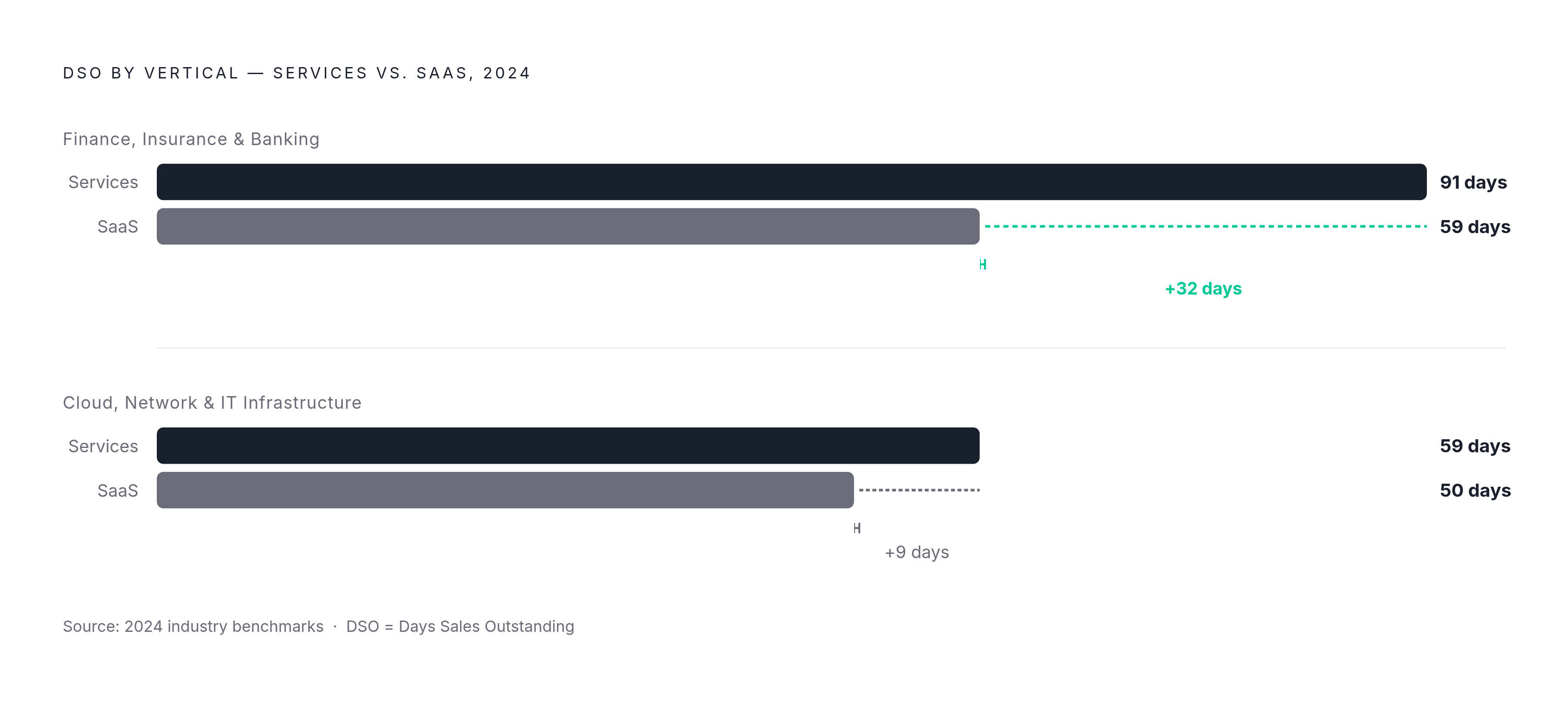
According to 2024 industry data, the median Days Sales Outstanding for services companies in Finance, Insurance, and Banking is 91 days. SaaS companies in the same vertical? 59 days. In Cloud, Network, and IT Infrastructure, services companies sit at 59 days while SaaS is closer to 50.
That's not a small gap. That's an entire month of revenue floating somewhere between "done" and "deposited," and the delay is rarely because services teams are less diligent.
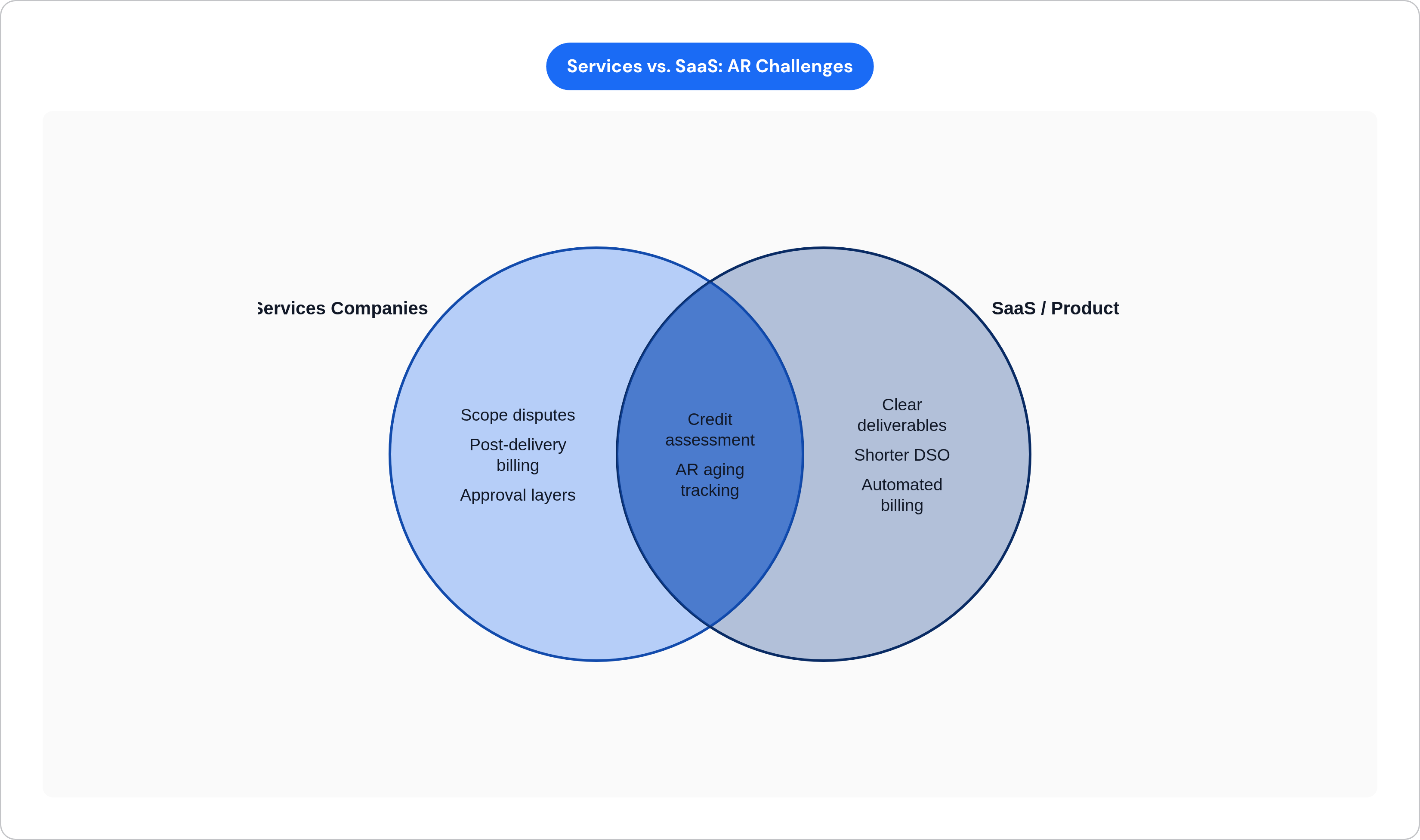
The gap is structural. When you sell a product, either it showed up or it didn't. Services are messier. "Was that actually in scope?" is a completely legitimate question, and it can hold up payment for weeks. Billing usually happens after the work. Sometimes well after. Every day between delivery and invoice is a day you've already added to your DSO before the clock officially starts. Enterprise clients have layers of approvers. A services engagement needs sign-off from the project manager, procurement, finance, and legal before AP even opens the invoice.
And retainer invoices? They feel routine. Which makes them easy to deprioritize. There's no urgency attached to something that shows up every month like the electric bill.
The broader context makes this harder to wave off. According to available B2B payment data, 55% of all B2B invoiced sales in the U.S. are past due. The average business waits 43 days for payment. Late payments cost the average company over $39,000 a year, and roughly 10% of companies absorb more than $100,000 in related expenses annually.
For a company doing $50 million in revenue, shaving five days off DSO frees up nearly $700,000 in working capital. That's not an abstract improvement on a dashboard. That's cash you can actually deploy. In services, DSO is almost always longer than it needs to be, and the reasons are almost never random.
How credit assessment at the front end shapes every collection outcome downstream
Most services companies treat the credit decision like a formality. Sales closes the deal, finance finds out what terms were promised, and AR inherits whatever situation that created. That's backwards, and it's a surprisingly expensive habit.
Credit assessment is the first AR decision you make. Who you extend credit to, and on what terms, sets the risk profile for everything downstream. A weak credit call doesn't just affect one invoice. It shapes the entire payment history of that relationship.
A real credit process does a few specific things. It checks financial history through specialized credit reporting agencies, ideally before work starts rather than two months in when you're already wondering why nothing has come in. It matches terms to actual risk instead of rubber-stamping whatever the client's procurement team requested. Net 60 is a request, not an entitlement. And it gets everything documented before work begins, because "we discussed net 30 on the call" is not an argument that holds up when an invoice is 75 days overdue.
The tradeoff is real. Longer terms help close deals. Shorter terms protect liquidity. There's no universal right answer here. But there is a consistently wrong approach: letting sales set terms without AR's input, nothing in writing, no logic attached.
The piece that gets skipped most reliably is ongoing monitoring. A client who paid on time for two years can change. They rarely announce it in advance. Credit assessment isn't an onboarding checkbox you complete and file away. It's a continuous practice. The teams that treat it like a one-time task are the same teams that express genuine surprise when a long-standing client suddenly goes quiet.
Getting the invoice right before it goes out
A significant share of late B2B payments trace back to incorrect invoices or disputed charges. Not the client's cash flow situation. Macroeconomic headwinds are rarely the culprit either. Invoices that were wrong when they left your office are. In services, that number is frequently cited around 53%.
"Incorrect" in a services context rarely means a typo. It means the invoice is missing the PO number the client's AP team needs to route it internally. The billing period description is vague enough that the project manager can't confirm the work without digging through a month of emails. You billed the parent company when the contract is with a subsidiary. There's a missing W-9 sitting in someone's queue and the invoice is on hold until someone thinks to ask for it. The hours or rate don't match what the client's internal system shows, and now you're in a reconciliation conversation you didn't see coming.
Manual invoicing compounds all of this, and slow follow-up on those invoices makes the problem worse. Only 6% of manually processed invoices are paid within a month. One in sixteen. That's not a collection problem. That's an origination problem.
Timing is its own form of accuracy. Invoice the moment a milestone is met or a billing period closes. Every day between delivery and invoice is a day you've already lost on DSO, and nobody on your team knows it yet because the invoice hasn't appeared on the aging report.
A clean services invoice covers the basics and then some: a clear description of what was delivered, the period it covers, the relevant milestone. It spells out payment terms including the actual due date, not just "net 30." It has correct remittance instructions, the preferred payment method, and the PO or contract reference the client needs for their own AP process.
Worth flagging separately: large enterprise clients increasingly require invoices submitted through procurement portals like Coupa or Ariba. A formatting error triggers an automatic rejection. The correction cycle can add weeks to your payment timeline, and it resets from day one. No rejection notice gets sent to you. The invoice just disappears into a queue somewhere, and you find out weeks later when you're wondering why you haven't heard anything.
Tracking what's been sent and catching slippage before it becomes a collection problem
Knowing which invoices are open, which are aging, and which have gone quiet is the basic job. It sounds obvious. Most companies don't actually do it well.
The aging report is the foundation. Current, 1 to 30 days past due, 31 to 60, 61 to 90, and 90 and beyond. That last bucket is where real damage accumulates. In Q1 2025, 17 of 209 U.S. industry segments had at least 10% of their receivables sitting at 91 or more days past due. Invoices caught at 15 days cost meaningfully less to collect than invoices that have aged past 90. The math on early intervention isn't subtle.
Good tracking catches things before they compound. A few specific patterns worth watching:
- Invoices delivered but never acknowledged. Especially common with portal submissions, where a formatting error can silently reject the invoice and nobody tells you.
- Partial payments without explanation. These are almost never good news. They signal either a dispute or deprioritization, and you want to know which one you're dealing with.
- Clients who consistently pay on day 45 of a net-30 term. That's a pattern, not an anomaly. It should change how you manage the relationship going forward.
Average Days Delinquent (ADD) is worth adding to the dashboard alongside DSO. It hit an average of six days in 2025, up one day year-over-year. The reason CFOs pay attention to it is that it signals worsening trends before those trends show up in DSO. DSO tells you what happened. ADD points toward where things are heading.
Without structured tracking, teams find out about problems when those problems are already old. Collections gets harder, more expensive, and honestly, more awkward for everyone involved.
How collections should actually work — and where most teams fall short
Not every overdue account deserves the same response. That's the starting point, and it's where a lot of teams go wrong immediately.
If your process treats a first-time client who's five days late the same as someone sitting at 75 days with a history of slow payments, you're either damaging good relationships or under-reacting to bad ones. In practice, usually both, on some kind of rotation.
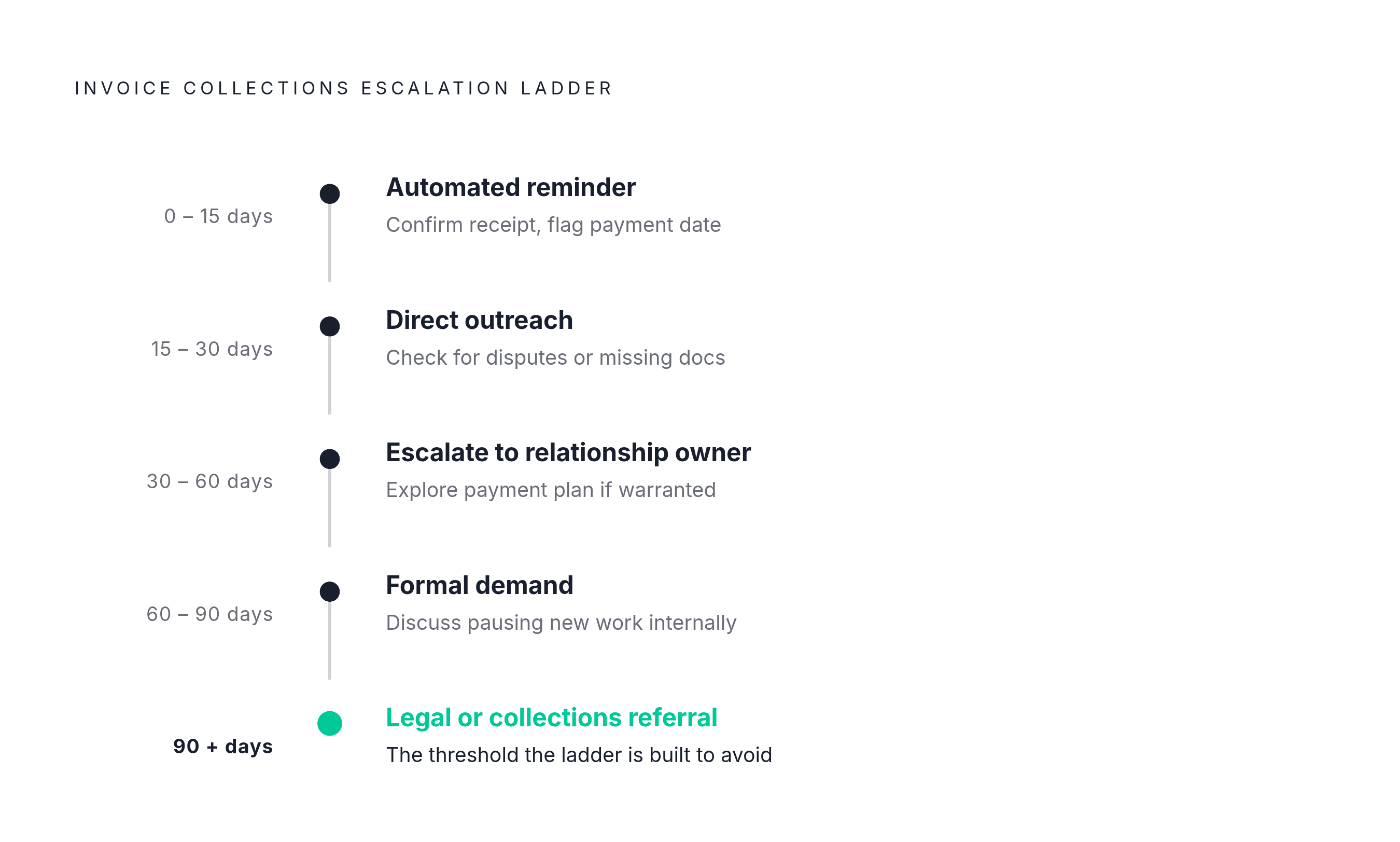
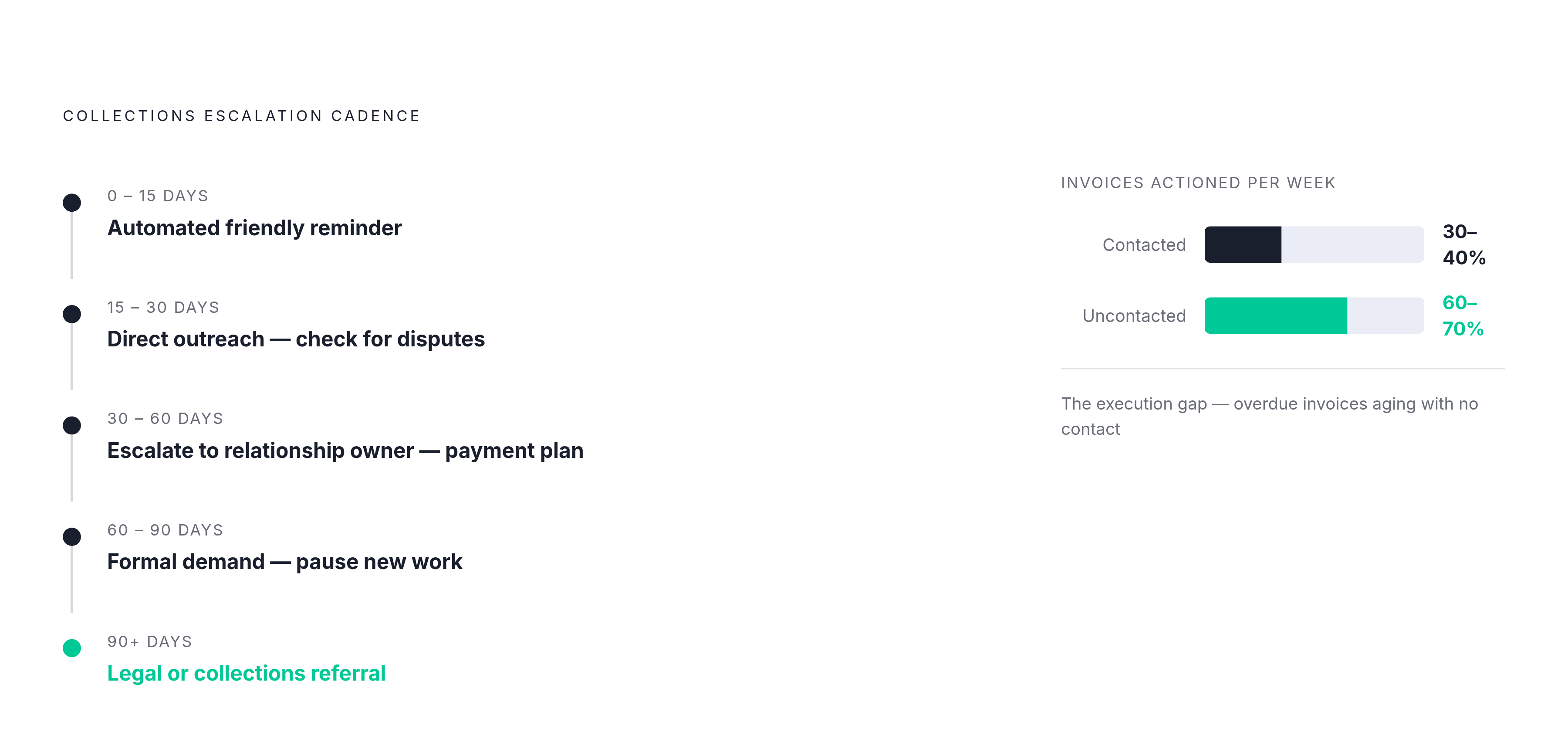
Segmentation should account for how many days overdue the invoice is, the balance size relative to total AR, the client's payment history, whether a dispute is open or suspected, and the risk profile from the original credit stage. In rough terms, that looks like:
- 0 to 15 days past due. Automated friendly reminder. Confirm they received it.
- 15 to 30 days past due. Direct outreach. Check for disputes or missing documentation.
- 30 to 60 days past due. Escalate to the relationship owner. Have a payment plan conversation if it looks warranted.
- 60 to 90 days past due. Formal demand. Start having the conversation internally about pausing new work.
- 90 days and beyond. Legal or collections referral is now a real option on the table.
The execution gap is where things actually fall apart. Per IOFM's 2025 AR Benchmarking Report, manual collections teams action only 30 to 40% of overdue invoices in any given week. The remaining 60 to 70% age without any contact. Teams gravitate toward the biggest balances and the loudest complaints, and mid-tier invoices quietly compound into bigger problems.
Persistence is the underrated variable. Most payments don't happen because of one perfectly timed call. They happen because of consistent, professional follow-through that makes it easier for the client to just pay than to keep putting it off. An AR team without a structured follow-up cadence isn't really running collections. It's hoping.
In B2B services specifically, this is always a customer relationship conversation at the same time. Tone matters. Timing matters. The goal isn't to make someone feel bad about being late. The goal is to make paying the path of least resistance.
Dispute management as a distinct workflow, not a collections sidebar
55% of AR professionals say dispute management is their most difficult task. 31% of businesses attribute late supplier payments directly to disputes. One unresolved dispute doesn't just delay a single invoice. It can stall an entire relationship's payment flow while everyone waits for someone to figure out who's responsible for resolving what.
In services, disputes take pretty predictable forms. Scope disagreements are the most common: the client says the work wasn't authorized or wasn't completed to spec. Rate discrepancies happen when your invoice reflects one number and the client's procurement system has a different one on file, and both sides are technically reading their own paperwork correctly. Documentation gaps occur when AP needs a signed delivery confirmation or approved timesheet that nobody attached to the invoice. Tax and compliance issues, missing certificates, wrong entity structures. These things shouldn't take long to fix, but they have a reliable way of lingering.
The problem usually isn't that the dispute is hard to resolve. It's how it gets handled. When disputes live inside general email threads, a few things happen with near certainty: there's no audit trail, the dispute gets lost or reassigned when someone goes on vacation, collections follow-ups keep going out while the dispute is still open (which damages the relationship), and weeks pass with no resolution while the invoice quietly ages toward bad debt territory.
A real dispute process looks different. The dispute gets logged. The invoice gets flagged. Dunning pauses. It routes to the person who can actually resolve it, which is usually the service delivery lead and not an AR analyst who has no context for what happened on the engagement. There's a target resolution window, not "we'll circle back." And when the dispute closes, re-invoicing or a corrected payment request goes out immediately, with the right documentation attached this time.
A 2025 SSON report found that centralized AR processes improved dispute resolution by 59% and cut aged debt by 75%. The structural fix matters more than the individual effort. How you process disputes is a bigger variable than how talented your AR team is.
Cash application and reconciliation — where collections work becomes closed revenue
Cash application is where a payment that landed in your bank account gets matched to the correct invoice in your system and recorded accurately. Sounds like the finish line. In services, it's often its own obstacle course.
Clients pay multiple invoices in a single remittance with minimal reference information. You received $47,000. Which invoices does that cover? Sometimes nobody specified. Partial payments on disputed invoices require judgment calls: close the invoice, leave it open, apply to the oldest balance? The wrong call creates reconciliation problems that surface later, usually at the worst possible moment. ACH payments often arrive without remittance detail. The money shows up. The context doesn't. Retainer structures create credits that need to be offset against new invoices, and when managed loosely, those credits float around the system and confuse everyone who looks at the ledger.
Unapplied cash is a real problem that gets treated like a minor inconvenience. Payments sitting unmatched make AR reports inaccurate. Teams end up chasing invoices that have technically already been paid. DSO gets inflated because the system still shows those invoices as open. You're measuring the wrong thing and acting on bad information.
Match rate is worth tracking. It's the percentage of payments applied automatically without manual intervention. A low match rate points to either payment data quality problems or process gaps upstream, and either way, knowing which one it is matters.
Reconciliation closes the loop: comparing the AR ledger to actual bank receipts, confirming no invoices are still showing open after payment, making sure the books reflect the real cash position. When this step works cleanly, finance has an accurate picture of what's actually been collected versus what's genuinely outstanding. That accuracy is the foundation everything else rests on. Without it, you're managing AR with a blurry lens, and the decisions that follow are only as good as the data underneath them.
What AR reporting should actually tell you — and what most teams measure instead
DSO is the most-watched AR metric, and it matters. Global DSO was running roughly 50 to 54 days in 2025 according to Allianz Research, with 44% of companies sitting above 60 days. But the benchmark that actually means something is your peer set. A services company comparing its DSO to a product distributor is comparing apples to a filing cabinet.
The metrics worth tracking in a services-specific context:
- DSO. Total AR divided by average daily revenue. The trend over time matters as much as the absolute number.
- Collection Efficiency Index (CEI). How much of the AR that was collectible in a given period did you actually collect? A healthy target is 80 to 90% and above.
- AR aging distribution. What percentage of your AR sits in the 90-plus-day bucket? Keeping that below 15 to 20% is the target for a well-run operation.
- Bad debt ratio. Write-offs as a percentage of revenue. Under 1 to 2% is the benchmark.
- Average Days Delinquent (ADD). The average delay beyond due date across open invoices. Predictive of worsening trends before they show up in DSO.
Here's where most reporting misses the point. These metrics describe what happened. Useful AR reporting tells you where to act next.
That means seeing which clients are trending toward delinquency based on shifts in their payment behavior, not just who already is delinquent. It means identifying which invoice cohorts have the highest dispute rates, which usually points back upstream to a billing problem or a delivery communication gap. It means cash flow forecasting: expected inflows by week, based on open AR aging and historical payment patterns, so finance knows with reasonable confidence what's actually coming in and when.
Middle-market companies lose an average of 3.1% of revenue to payment collection issues, which works out to roughly $14 million for a company of that size, according to a 2025 PYMNTS report. Reporting that surfaces the pattern early turns that from an accepted cost of doing business into a solvable operational problem, which is the gap Invoice Butler, an AI-powered accounts receivable tool that automates invoice follow-ups across email, phone, and SMS with human collections experts behind it, is built to close.
AR reporting isn't a historical document. It's a decision-making tool. If it's only telling you what happened last month, it's doing about half its job. And the half it's skipping is the part that actually changes outcomes.