Order-to-Cash Process Steps and Bottlenecks
Identify the four bottlenecks that extend your collection timeline.
The order-to-cash process has one job: turn a confirmed order into collected, reconciled cash. Not shipped goods. Not a sent invoice. Cash, sitting in your account, matched to the right record. Everything in between is just the path to get there. And that path has more places to go wrong than most finance teams realize until they're already losing days, dollars, and patience trying to figure out why their DSO looks the way it does.
The order-to-cash cycle runs through eight sequential steps: order management, credit management, order fulfillment, shipping and delivery, invoicing, collections and AR management, dispute resolution, and cash application and reporting. Bottlenecks that hurt DSO concentrate at four points in particular: invoicing errors (nearly 39% of invoices contain at least one error, adding 5 to 20-plus days per dispute and restarting the payment clock from zero), collections follow-up failures (manual teams action only 30 to 40% of overdue invoices weekly, and waiting 14 days to make first contact drops collection success from 65% to 15%), supplier portal rejections that go undetected because AR systems lack live portal connectivity, and cash application lag that leaves paying customers flagged as delinquent while collections wastes time chasing them. These bottlenecks compound each other, an invoice error generates a dispute, the dispute suspends collections, and by resolution the invoice is 30 or more days older than necessary, which is why fixing any single step in isolation rarely closes the DSO gap.
O2C cuts across more of the business than people expect. It isn't just a finance problem. It touches supply chain, inventory, logistics, and AR in sequence, and a delay in any one stage creates downstream pressure on things that appear totally unrelated: payroll timing, acquisition capacity, liquidity planning. That's what makes it worth understanding at the process level, not just at the invoice level.
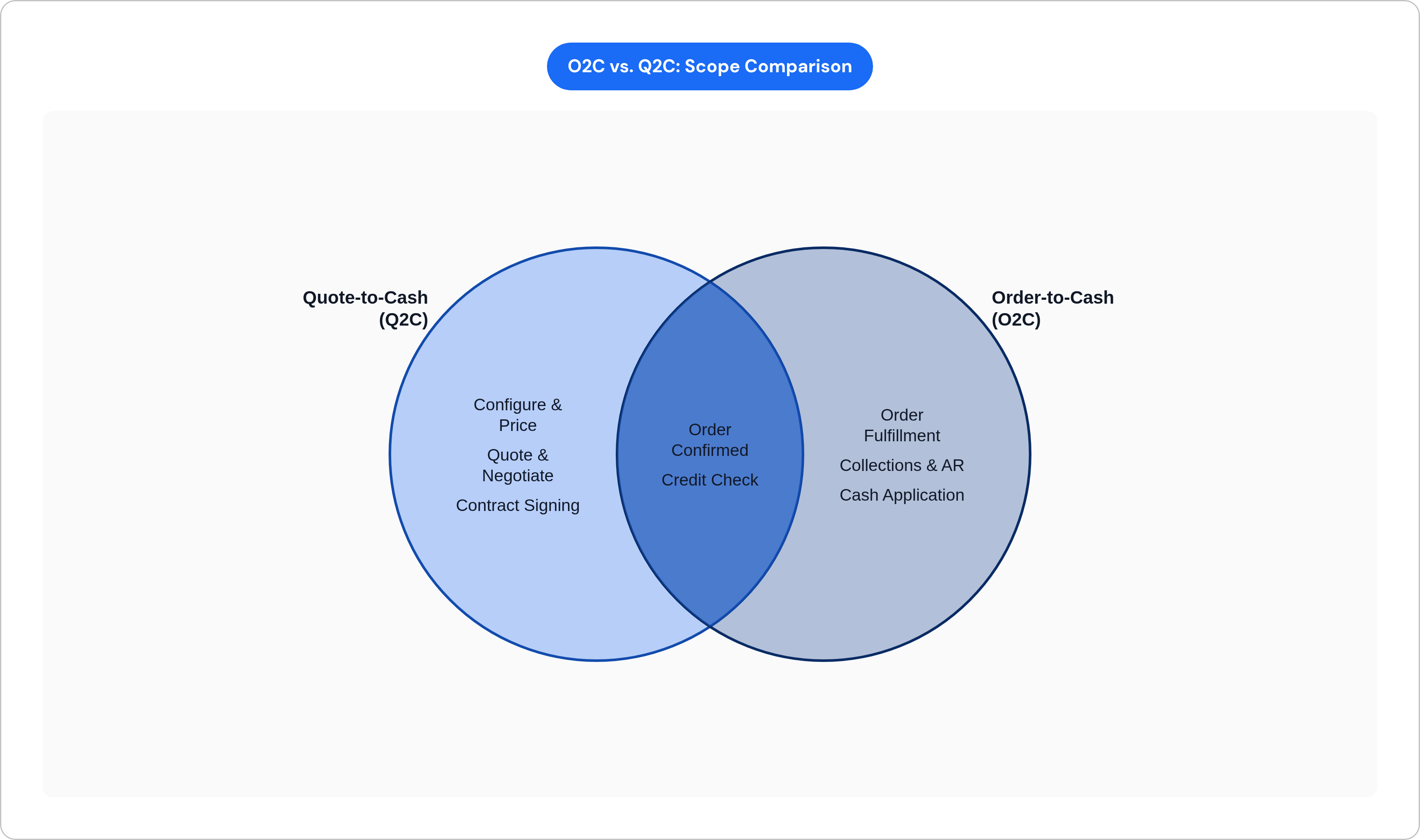
One quick distinction worth making before diving in. O2C is often confused with Quote-to-Cash (Q2C). Q2C adds upstream steps: configure, price, quote, negotiate, get the signature. Once the deal is done and the order is confirmed, you're in O2C territory. Companies frequently conflate the two when mapping their own processes, and it leads to misdiagnosed bottlenecks. If you're fixing the wrong cycle, you won't fix the problem.
The cycle's output is cash inflow. Not revenue recognition. Not a shipped pallet. That distinction matters because it's what connects process efficiency directly to working capital health.
What Are the Steps of the O2C Cycle, in Sequence?
Think of O2C as a handoff chain — each step receives something from the one before it and passes something forward, like runners in a relay race. If a baton gets dropped, every runner after that point is starting from behind.
Step 1: Order Management
The cycle starts the moment an order is confirmed, regardless of how it came in. E-commerce checkout, email, a sales rep's CRM entry. Doesn't matter. From that moment, automated notifications should fire to downstream departments: fulfillment, credit, logistics. The teams that need to act need to know immediately. Companies with best-in-class O2C practices are significantly more effective at order management than their peers. The gap isn't minor.
Step 2: Credit Management
New customer? Credit check and terms approval before anything ships. Existing customer with a clean record? The order routes straight to fulfillment. This step gets underestimated constantly. Bad credit decisions made here don't show up as a problem until Step 6 or Step 7, when a customer with inappropriate terms is suddenly disputing an invoice or ignoring a payment reminder. The upstream error has downstream consequences, and by then it costs far more to fix.
Step 3: Order Fulfillment
Picking, packing, assembling. Sounds mechanical, but this is where inventory gaps cause shipment delays, which push back delivery confirmation, which pushes back invoicing. Good inventory software surfaces those gaps before they become delays. Without it, the team finds out when the order can't ship.
Step 4: Shipping and Delivery
Whether you run your own logistics or use a third-party provider, delivery confirmation is what matters most here. In many B2B agreements, that confirmation is the contractual trigger for invoicing. No confirmation, no clock. That's why auditing delivery consistency isn't just an operations priority. It's a cash flow priority.
Step 5: Invoicing
This is the pivot. You've moved from fulfilling the order to collecting for it. The invoice has to be accurate: right items, right amounts, right shipping costs, right taxes, right payment terms, right customer, right portal. Any of those wrong, and you're restarting the clock. Sending within 24 hours of delivery confirmation can reduce DSO by 5 to 8 days on its own. That's not a system upgrade. That's just timing discipline.
Step 6: Collections and AR Management
Collections begins at invoice issuance, not when a payment is overdue. Overdue accounts should be flagged automatically. Automated holds on new orders for delinquent customers create leverage before the conversation gets awkward. Structured, persistent follow-up is the mechanism. A single reminder email is not a collections process — it's just hoping with a timestamp.
Step 7: Dispute Resolution
Short-pays and deductions are common in B2B. Damaged goods, missed discounts, shipping delays. Every open dispute suspends the payment clock. Speed of investigation determines how many days you lose. Valid claims get approved quickly. Invalid deductions get recovered before they age into write-offs. The longer a dispute sits, the worse both outcomes get.
Step 8: Cash Application and Reporting
Matching incoming payments to open invoices clears AR and makes forecasting accurate. When this lags, you get ghost balances: customers flagged as unpaid when the money has already arrived. Collections teams then chase customers who have paid, which is both embarrassing and corrosive to relationships. Reporting closes the loop. DSO, Collection Effectiveness Index, AR aging. These metrics tell you where the cycle broke, so you can fix it rather than just watch it repeat.
How to Read O2C Performance Before Diagnosing Problems
Before you can fix anything, you need to know your score and understand what it's actually measuring.
Days Sales Outstanding (DSO) is the primary diagnostic. It's the average number of days from invoice to cash received. Simple concept, expensive when the number is high.
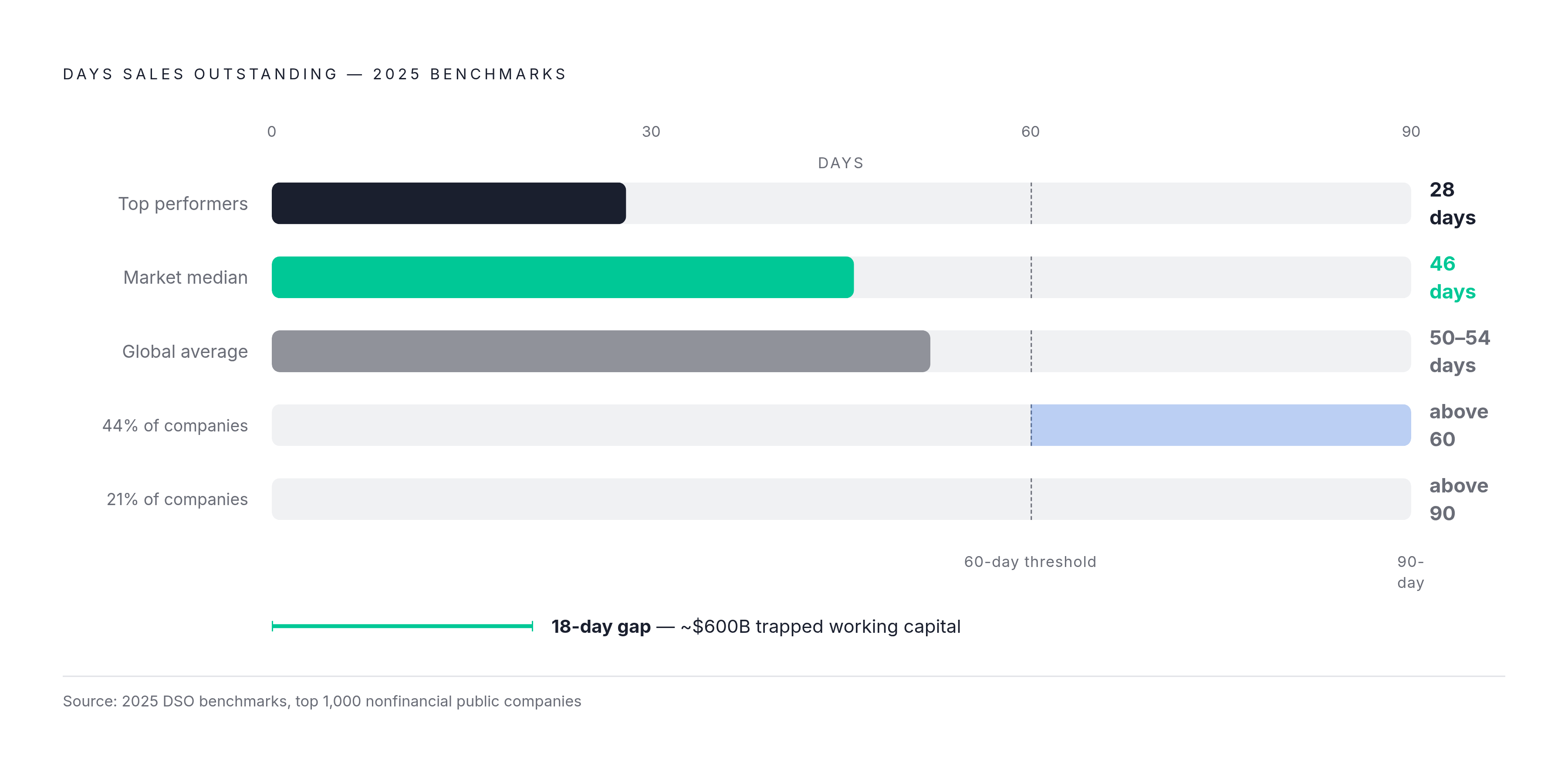
Here's what the benchmarks look like right now. Per The Hackett Group's 2025 U.S. Working Capital Survey, top performers are collecting within 28 days. The median is 46 days. That 18-day gap across the top 1,000 nonfinancial public companies translates to roughly $600 billion in trapped working capital. Allianz Research data from 2025 puts global DSO at approximately 50 to 54 days, with 44% of companies reporting DSO above 60 days and 21% above 90 days. Industry medians vary a lot. Retail B2B can run around 15 days. Heavy construction can run 90. Benchmarking matters, but it needs to be within your sector.
The cost of a high DSO isn't abstract. At an 8% cost of capital on a €100M revenue base, each additional day of DSO costs approximately €22,000. Every. Day.
DSO alone doesn't tell the whole story, though. Here are the secondary metrics that surface what DSO obscures:
- Collection Effectiveness Index (CEI): Measures whether the team is collecting what it theoretically could, not just how fast.
- AR aging: Shows where invoices are stacking up. The 30, 60, and 90-plus-day buckets tell you which bottleneck is active right now.
- Invoice accuracy rate: The canary in the coal mine. When this starts rising, DSO deterioration follows a few weeks later.
- Cash application efficiency: The lag between payment receipt and ledger clearance. Longer than it should be means your AR picture is a lie.
Companies relying on manual AR processes see DSO stretch an average of 30% longer than automated ones. That gap is measurable and consistent.
Metrics tell you the score. The next sections explain why it's that score.
Where the Cycle Breaks: Invoicing Errors and the Disputes They Generate
Here's a number that should bother every AR leader: nearly 39% of all invoices contain at least one error. The industry threshold considered acceptable is 5%. You can do that math yourself.
What does error rate actually mean for payment timelines? A 0 to 2% error rate causes minimal delay. A 3 to 5% rate adds 5 to 10 days per disputed invoice. Above 10% and you're adding 20 or more days per dispute. And every dispute restarts the payment clock from zero. Not from where it was. From zero.
The errors that cause the most damage aren't exotic:
- Wrong amounts or incorrect PO references
- Missing tax IDs or mismatched payment terms
- Invoice sent to the wrong contact, wrong inbox, or wrong portal entirely
- Missing supporting documents (proof of delivery, certifications, tax forms)
Each of those mistakes triggers a correction and resubmission cycle. Customer has to act. Your team has to revise. Someone has to resubmit. Days are lost at every exchange, often multiple rounds of them.
Manual invoice processing costs between $12.88 and $19.83 per invoice, according to Ardent Partners data from 2024 and 2025. That's the baseline cost before you factor in any delay. It's not just slow. It's expensive to run even when it works.
The fix is upstream. Quality control at the invoicing stage — format checks, PO matching, portal compliance validation — prevents disputes from happening. Managing them after the fact, once they've aged into the 60-day bucket, costs more in time, labor, and customer relationship than catching them at issuance.
The errors that don't get caught here flow directly into collections and dispute resolution, where they're harder to resolve and take longer to close.
Why Collections Follow-Up Fails at Scale and What It Costs
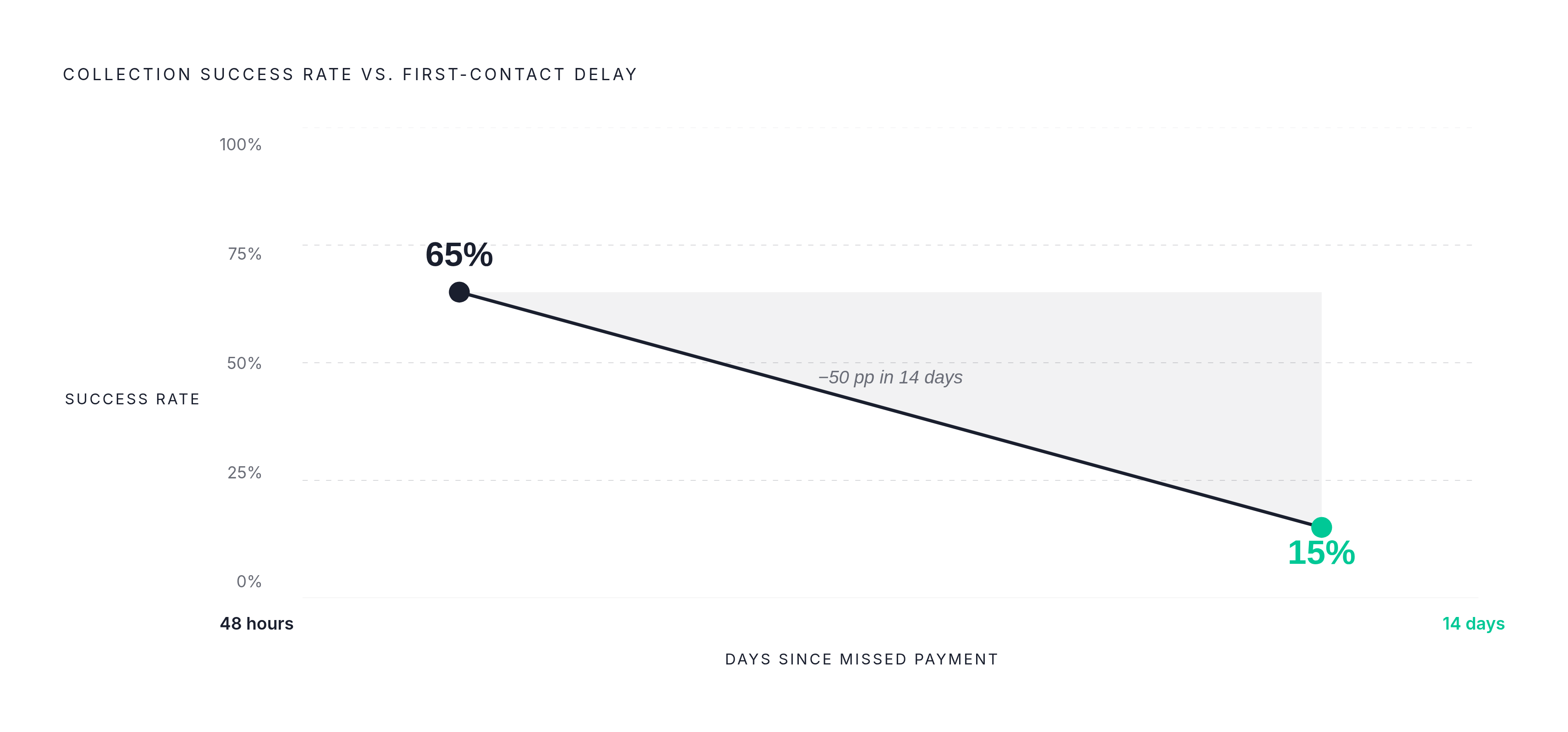
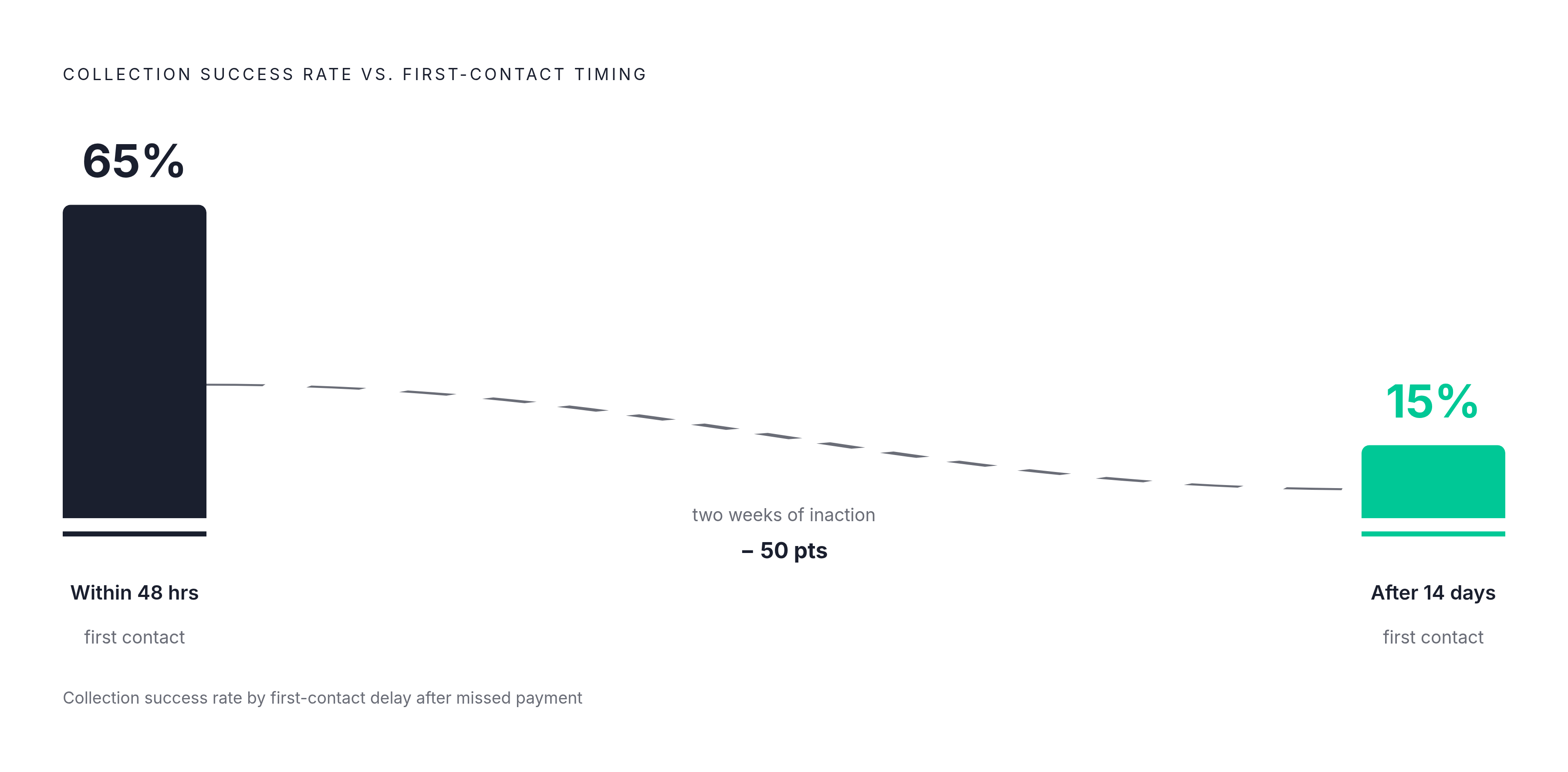
Manual collections teams action only 30 to 40% of overdue invoices in any given week. That's from IOFM's 2025 AR Benchmarking Report. It means 60 to 70% of overdue invoices are aging without any contact at all.
The timing cost here is steep and specific. First contact within 48 hours of a missed payment produces a 65% collection success rate. Wait 14 days and that drops to 15%. That isn't a marginal difference. That's the difference between a collections function that works and one that's mostly reactive.
Why do teams fall behind?
- Invoice volumes outpace headcount. Prioritization defaults to largest balances, and mid-tier invoices age silently without anyone touching them.
- No structured cadence exists. One reminder email goes out, and then the team waits. That's not follow-up. That's hoping.
- Automated reminder cadences outperform manual follow-up by 12 to 18 days on average. Consistently.
Late payment is not a niche problem. Atradius's 2025 Payment Practices Barometer reports that 47% of B2B invoices in North America were overdue. Only 36% of U.S. invoices are paid on time. If you're feeling like collections is unusually hard right now, it's because it is.
The write-off risk at the tail end is real. Atradius data from Western Europe in 2025 shows approximately 6% of B2B receivables were written off as uncollectable in the prior 12 months, rising year over year since 2021. A business with €100M in revenue and 3% leakage surrenders €3M annually. For many mid-market companies, that's the entire net profit for the year.
Most collections teams aren't under-motivated. They're under-resourced, working without a system that tells them who to contact, when, and how. The problem is structural, not personal.
Supplier Portal Friction as an Invisible but Systematic Delay Source
This one flies under the radar until it doesn't. Large enterprise buyers increasingly require suppliers to submit invoices through procurement portals: Coupa, Ariba, Taulia, and others. These platforms exist for legitimate reasons. They create standardization and audit trails for buyers. For suppliers, they add an entirely separate category of failure modes.
Common rejection triggers:
- Invoice submitted to the wrong portal, or the wrong inbox within the right one
- Missing or mismatched PO number causes automatic rejection
- Required supporting documents aren't attached
- Format requirements differ by portal, so an invoice that passes validation for one buyer fails at another
Each rejection triggers a correction and resubmission cycle that can add a week or more to the payment timeline. And the rejection notice often goes unread or arrives in a low-priority inbox. Nobody knows it failed until someone notices the invoice hasn't been paid.
Zone's 2024 survey found that 92% of businesses reported partial or no connectivity across their O2C processes and data. That means portal status updates often don't surface in the AR team's own systems. The team thinks the invoice is in queue. It was rejected three days ago.
Collections follow-up inside portals is qualitatively different from sending an email. It requires logging in, navigating the buyer's specific workflow, understanding why a hold or dispute was placed, and responding in the format the portal requires. That's manual work. It doesn't scale.
This is also where traditional automation hits its ceiling. Rule-based tools can generate a reminder email. They can't log into a portal, interpret a hold reason, or attach a missing document to the right field in the right format. Portal compliance is a hands-on problem that most AR automation wasn't built to handle.
How Disconnected Systems and Cash Application Lag Extend the Cycle's Tail
When your CRM doesn't talk to your ERP, and your ERP doesn't talk to your billing system, and none of them have a live connection to where payments land, a single transaction gets manually transferred across multiple platforms. Each transfer is a point of error. Each transfer is a delay.
The 92% fragmentation figure from Zone's 2024 survey isn't a warning about what will happen. It's describing the current state for most businesses. The modal state of O2C operations is fragmentation, not integration.
Cash application lag is one of the most damaging and most invisible consequences. Payment arrives. Nobody matches it to the invoice yet. The customer shows as unpaid in the AR ledger. Collections chases them. The customer is annoyed because they paid. The relationship frays. Meanwhile, finance teams often spend five or more days manually matching transactions across systems, delaying both cash application and month-end close.
The reporting gap makes it worse. Without real-time visibility, teams analyze O2C performance after the fact. They see the DSO number after the delay has already happened and been baked in. Nearly 58% of financial teams have to reopen their books at least once a year to address errors, and 35% do so more frequently. Without current AR aging data, collections prioritization is essentially guesswork.
By the time a bottleneck shows up in the reporting layer, it's already cost the business days or weeks of float. You're not diagnosing in real time. You're doing a post-mortem.
How Bottlenecks Interact and Why Fixing One Step in Isolation Rarely Holds
Here's the thing about O2C bottlenecks: they don't stay in their lane. Each one creates conditions that make the next one worse — like dominoes that don't just fall but knock over the entire table on their way down.
Walk through the chain. An invoice error generates a dispute. The dispute suspends the payment clock. Collections can't meaningfully follow up on an actively disputed invoice. By the time the dispute resolves, the invoice is 30 or more days older than it needed to be, and the team is already behind on the next wave of overdue accounts.
Or: a portal rejection goes undetected because AR systems aren't connected to portal status. Collections assumes the invoice is in queue. It isn't. Two weeks pass. When someone finally logs in to check, the invoice is rejected and now needs to be corrected, resubmitted, and re-entered into the approval workflow. The payment clock restarts.
Or: a cash application backlog means paying customers show as delinquent. Collections contacts them. The customer responds with proof of payment. Someone has to manually reconcile, update the record, and close the dispute. Time and relationship capital, both spent on a problem that didn't need to exist.
This interaction effect is why fixing one step in isolation rarely holds. You tighten up invoicing, but collections is still under-resourced and missing its contact windows. You automate reminders, but portal submissions are still getting rejected. You speed up cash application, but the AR aging report is still two weeks stale. Invoice Butler, an accounts receivable automation tool that combines AI agents with human collections experts to chase overdue invoices across email, phone, SMS, and supplier portals, is one option built to address several of these links at once.
O2C is a chain. When you improve one link and ignore the others, the weak links just become more visible. Sustainable improvement means addressing the bottlenecks in context of each other. Understanding how they interact is the prerequisite for fixing any of them effectively.