Accounts Receivable Automation Explained
Most B2B companies leave $1.7 trillion in working capital stuck chasing late payments manually.
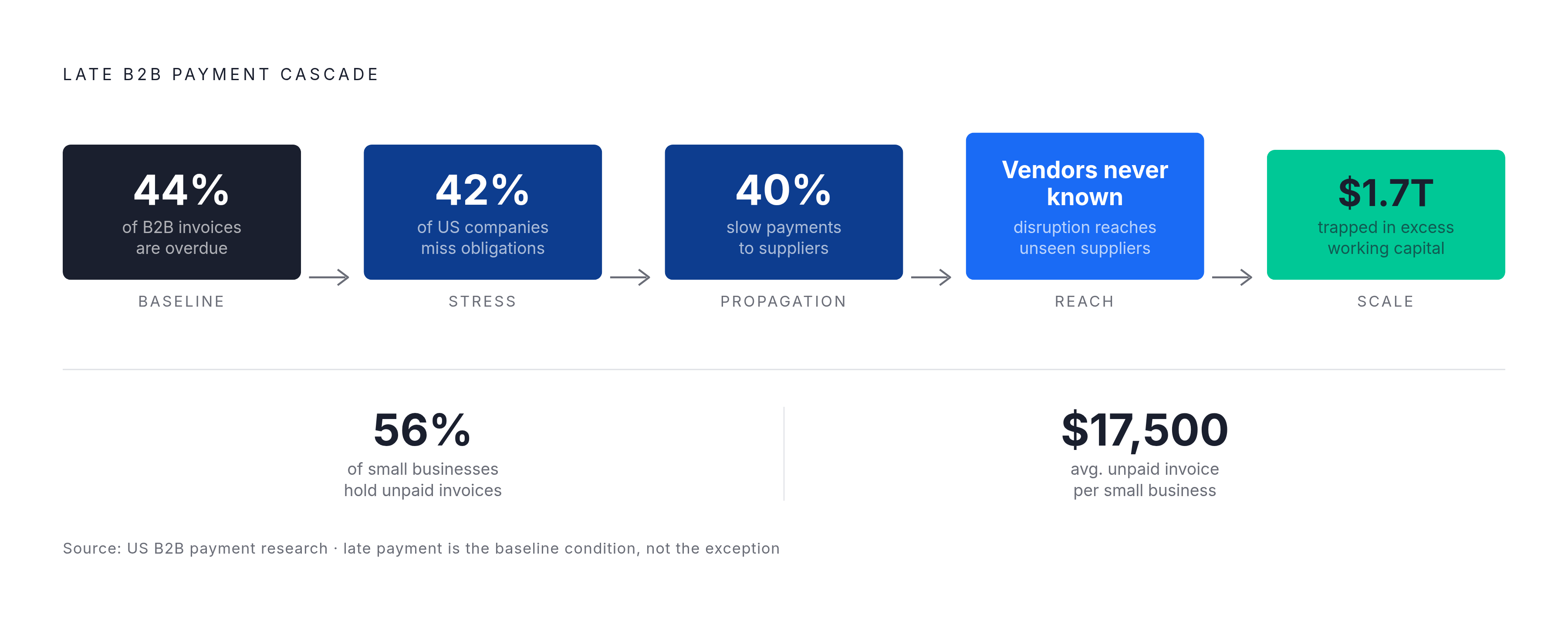
Late payments aren't a fluke. They're the default setting of B2B commerce right now. According to Quadient's 2025 data, 44% of B2B invoices in the US are currently overdue. Nearly half. At any given moment, almost half of what your business is owed hasn't arrived yet. And 3% of invoices just get written off entirely. Gone.
That's not a tail risk. That's Tuesday.
The cascade effect is what makes it genuinely ugly. When customers pay late, 42% of US companies struggle to meet their own obligations. 40% respond by slowing payments to their own suppliers. So one slow payer creates another slow payer downstream, and so on, until the disruption reaches vendors the original payer never even knew existed. For small businesses specifically, Quadient's data shows 56% are currently owed money on unpaid invoices, with an average outstanding balance around $17,500 per business — like a stone dropped in a pond, the ripples keep spreading long after the initial splash. Half of those dealing with frequent late payments report cash flow problems. Only 34% of businesses with fewer late payments say the same.
Zoom out and it gets even wilder. US companies are collectively sitting on $1.7 trillion in excess working capital. Global working capital days hit their highest point since 2008 in early 2025, at 78 days. That's cash stuck in receivables that isn't available for operations, hiring, investment, or anything else useful.
What often gets overlooked is that the process for chasing late payments is itself broken. Finance teams are manually re-keying data, reformatting the same invoice four different ways for four different customer portals, and managing a separate login for each procurement system. The operational friction isn't just annoying. It compounds the payment problem.
AR automation exists to close the gap between invoice sent and cash in the bank, and tools like Invoice Butler, an AI-powered accounts receivable software that automates invoice follow-ups across email, phone, and SMS while pairing AI agents with human collections experts, are built specifically around that gap. That's a liquidity problem. A working capital problem. A forecasting problem. Efficiency is the side effect. It was never really the point.
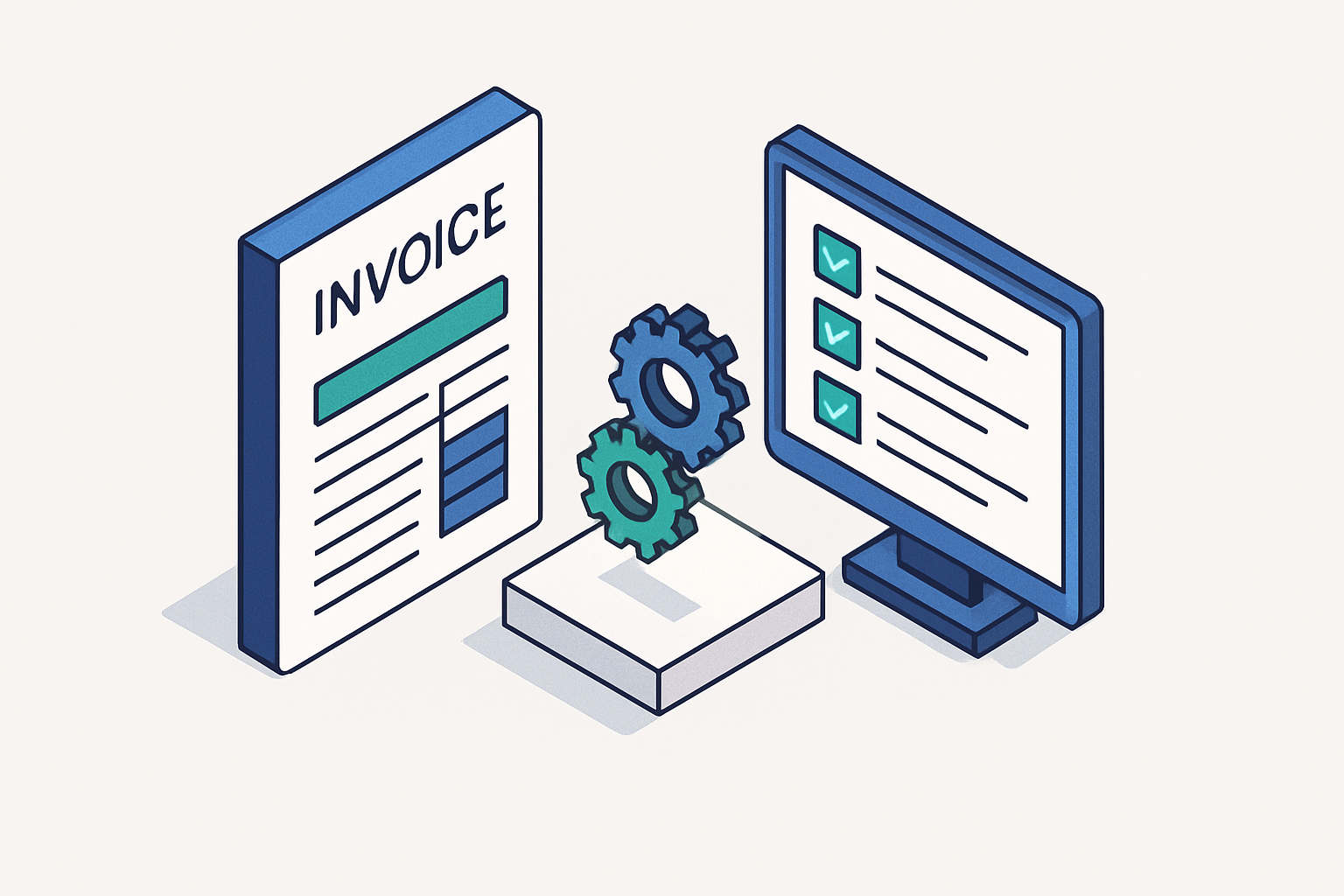
How the End-to-End AR Cycle Actually Runs When It's Automated
AR automation is a chain. Every link connects. When it's working, here's what that looks like.
A sale closes in the CRM. The automation creates an invoice directly from the contract terms. No one re-keys data. No one builds it in a spreadsheet and pastes it somewhere else. The invoice goes out through whatever channel the customer actually accepts. Email with an embedded payment link for some. Direct submission to Coupa, Ariba, or SAP Business Network for others. The format matches what the customer's system expects.
From there, the system tracks the due date and sends reminders on a schedule you've set. No response? It escalates. When money arrives, it matches the payment to the open invoice, including partial payments, bulk payments covering five invoices at once, and remittance data that's incomplete or formatted strangely. Matched payments post to the general ledger automatically. Anything the system can't confidently resolve gets flagged for a human.
Each step depends on the one before it. If delivery fails because the invoice landed in the wrong portal or the wrong format, the follow-up never triggers. The payment never comes. The aging report goes stale. One broken link and you're back to chasing manually.
A few blockers that real automation has to handle, beyond just the reminders:
- Missing W-9s or compliance documents that put invoices on hold before the customer even sees them
- Portal rejections because a field was formatted wrong or a vendor ID was missing
- Customer-side approval workflows that require follow-up beyond just the invoice itself
Automation that only covers some of these isn't end-to-end. It's partial coverage with manual gaps hiding in the middle. Which, honestly, describes most of what gets sold as "end-to-end."
Where AI Fits In — and Where Rule-Based Automation Still Does the Work
People use AI and automation interchangeably. They're not the same thing and they don't do the same jobs.
Rule-based automation (RPA, robotic process automation) handles structured, predictable tasks. Send a reminder when an invoice hits 30 days overdue. Match a payment using the reference number. Format an invoice for a specific portal's field requirements. These are if-then rules. Fast, reliable, no judgment required.
AI handles the messy stuff where rules alone break down:
- Payment prediction. Machine learning models rank invoices by likelihood of late payment and forecast expected payment dates. Collectors can focus on the accounts that actually need attention instead of working through everything alphabetically.
- Cash application. AI reads remittance advice in any format — scanned PDF, email body, partial reference numbers — and figures out what matches what.
- Early warning. Flags accounts showing behavioral signals of payment delay before the due date even passes.
- Communication personalization. Adjusts tone and timing of follow-up based on how a specific customer has actually paid historically.
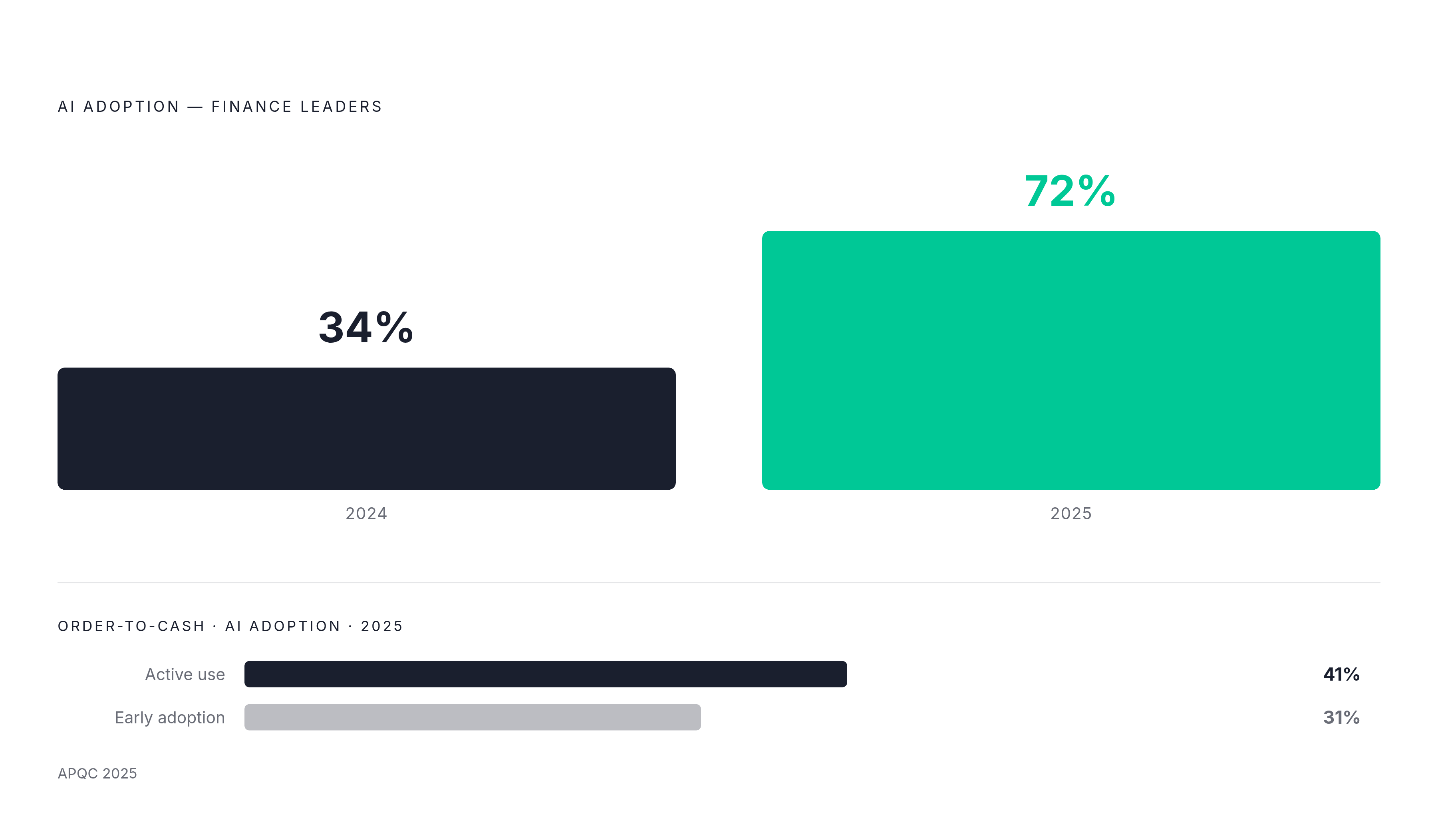
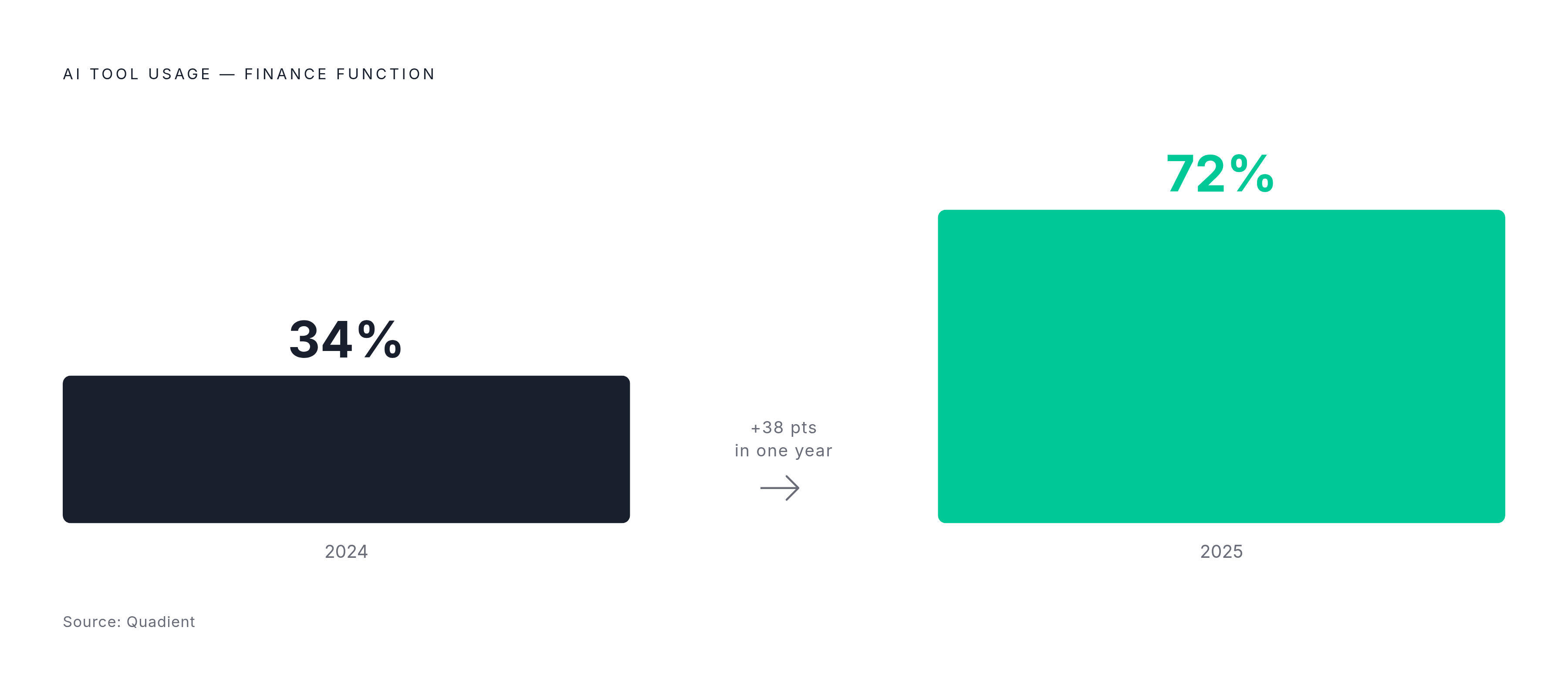
The adoption shift here is significant. Quadient's 2025 data shows 72% of finance leaders report using AI tools in their function. The year before, that number was 34%. That's not gradual. In Order-to-Cash specifically, APQC's 2025 data shows 41% of organizations actively using AI, with another 31% in early adoption stages.
What AI doesn't replace: human judgment for sensitive escalations, relationship-critical conversations, and disputes that need actual negotiation. AI is a decision-support layer. It still needs a human at the end of certain threads, and anyone telling you otherwise is selling something.
Invoice Delivery and Portal Navigation — the Layer Most Automation Skips
This is where most AR automation quietly fails. Quietly being the operative word.
Your customers don't all accept invoices the same way. Some want email. Some require portal submission. Many mandate specific formats: EDI, XML, PDF with structured fields in specific columns. A single customer is likely to require a format that none of your others use. And the big procurement portals (Coupa, Ariba, SAP Business Network) each have their own login requirements, field structures, and approval routing logic. What works in one portal breaks in another.
Portal rejection is the silent killer. An invoice gets submitted. The portal kicks it back because the PO number format is wrong, or a tax field is incomplete, or a vendor ID is missing. The invoice sits in rejected status. Nobody tells you. The clock on your days sales outstanding keeps running. You're waiting on payment for an invoice the customer's system never actually processed. It's like mailing a letter with the wrong zip code and wondering why no one wrote back.
Montopay's data suggests proper AR automation can deliver a 95%+ reduction in portal rejection rates. Think about what that implies about how high those rejection rates are before this layer gets handled correctly.
What fixing this actually requires isn't just automated submission. It's monitoring for rejection notices. Correcting the errors. Resubmitting. Persistent follow-through, not send-and-forget.
Missing documents add another layer of fun. W-9s. Certificates of insurance. Vendor onboarding forms. When these are absent, procurement portals hold invoices regardless of how perfectly formatted the invoice itself is. The system has to track these requirements and chase them proactively, or the whole thing stalls at a compliance checkpoint the automation never even reaches.
Most AR platforms build decent invoice generation. Fewer build good delivery. Even fewer handle what happens when delivery goes wrong. That gap is where days pile up on your aging report.
Cash Application — Why Matching Payments to Invoices Is Harder Than It Sounds
You'd think this would be straightforward. Money comes in. Match it to the invoice. Done.
It's not.
Customers pay late, so the remittance data doesn't always line up neatly with what's open on your ledger. They pay partial amounts. They bundle five invoices into one wire transfer and send a remittance file that is or isn't accurate or complete. Sometimes the remittance advice is a structured EDI file. Sometimes it's a paragraph in an email. Sometimes it's a scanned PDF that looks like it was faxed first.
Traditional cash application is a manual lookup. Someone pulls the payment, finds the matching open invoice, does the journal entry, posts it. Slow. At any real volume, error-prone.
Automated cash application works differently. It pulls transaction data directly from bank feeds, reads remittance advice in whatever format it arrives in, matches payments to open invoices including partial or bundled payments, and posts matched items to the general ledger automatically.
High-performing AR teams, per APQC data cited by Auxis, receive 94% of payments automatically matched. That's the benchmark for mature cash application. 94 out of every 100 payments handled without a human touching them. The other 6% don't get ignored. They get flagged, the system surfaces its best-match suggestion, and a human confirms or corrects. Edge cases stay in the loop without slowing down the 94% that are clean.
The downstream benefit is real-time aging. Because posting happens as payments are matched, the AR aging report reflects actual current exposure. Not a batch update from last night. Not a snapshot someone ran on Friday. Now. That sounds like a minor detail until you're trying to forecast cash for the week.
What AR Automation Measurably Changes About Collections Performance
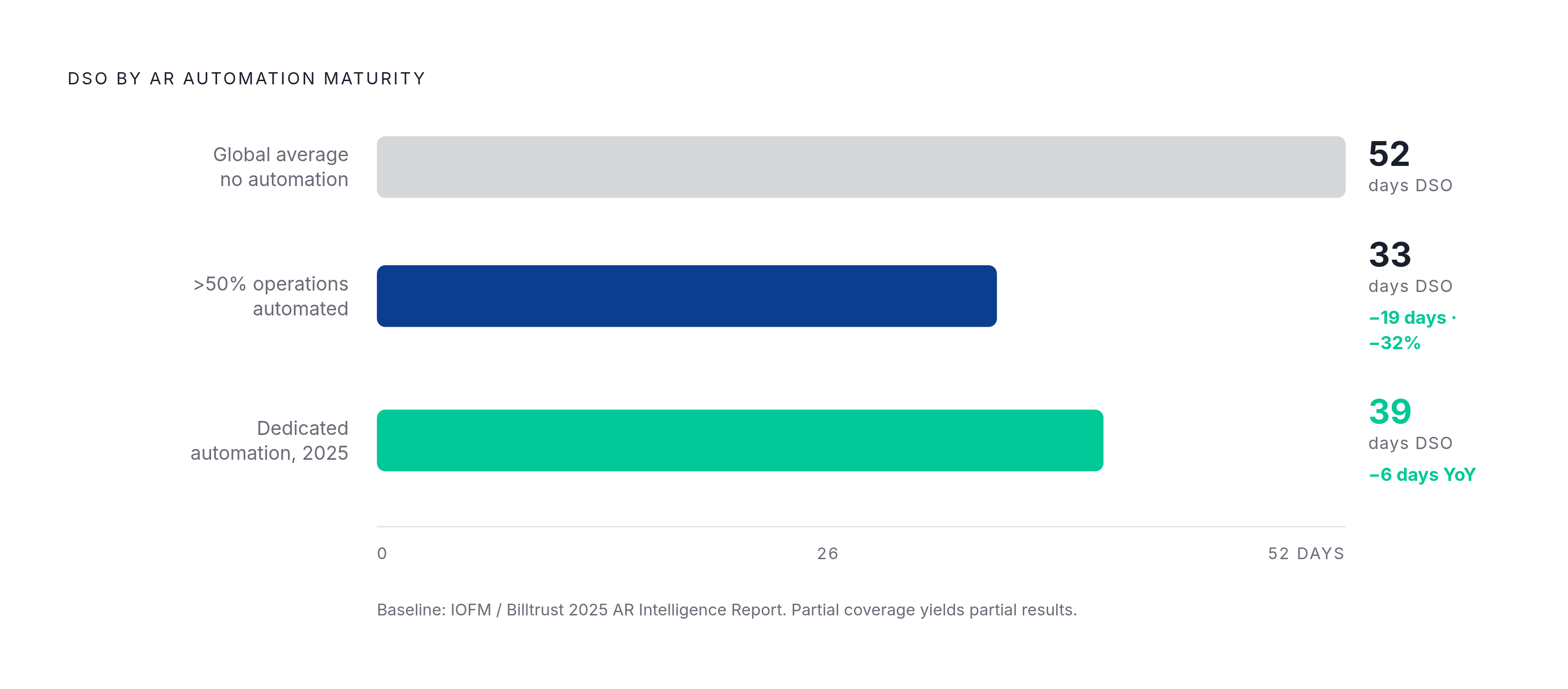
The numbers are genuinely good. Billtrust's 2025 Benchmark Report shows their clients averaged 39 days DSO in 2025, six days better year-over-year and meaningfully below the global average of roughly 50 to 54 days. Organizations with dedicated AR automation covering more than 50% of their operations saw a 32% DSO reduction, equivalent to 19 fewer days outstanding, according to PYMNTS data cited by Invensis. Firms using AI-driven AR specifically report an additional 3 to 5 day DSO reduction on top of whatever baseline automation was already delivering.
Across the industry, common efficiency metrics include:
- 15 to 30% DSO reduction as a typical range
- 75% decrease in manual AR work
- 6 minutes saved per invoice through invoicing automation (Billtrust, 2025). Small per unit. Enormous at volume.
- 52% more transactions handled per AR team member, from an IDC study commissioned by Billtrust in 2025
The Hackett Group's 2024 Customer-to-Cash Receivables Software report found that automating AR processes can deliver up to $7 million in benefits for mid-sized firms. McKinsey's 2025 analysis found that mapping and standardizing AR processes can improve receivables-related working capital by up to 30% within weeks. Weeks, not quarters.
Billtrust's ROI study, which surveyed 500 finance professionals, found 93% confirmed AR automation delivered expected ROI, and those who fully embraced automation reported a 40%+ reduction in days to pay. That's vendor-commissioned data, so the specific figures deserve some healthy skepticism. The directional signal, though, shows up consistently enough across independent sources that the overall picture holds.
Where Most AR Automation Implementations Fall Short
Nearly 90% of businesses say 30% of their invoices are paid late, even as automation adoption has grown significantly. The late payment rate hasn't collapsed. That gap between rising automation investment and persistent late payments is telling you something real: it matters how deeply you implement, not just whether you implemented at all.
Quadient's 2025 data shows 34% of US businesses say the average time to get paid has actually increased over the past year. Despite more automation spending. That's worth sitting with for a second.
The common failure modes aren't surprising once you've seen them a few times:
Automating generation but not delivery. The invoice leaves the system but lands in the wrong portal or the wrong format. No one notices until the payment doesn't show up.
Sending reminders but not handling replies. A customer responds with a question, a dispute, or a document request. The automation ignores it. The invoice sits.
Treating every account the same. Identical reminders go to everyone regardless of payment history or risk profile. You're burning urgency on low-risk payers who were going to pay anyway, while accounts that actually need attention get the same canned message.
Skipping the document and compliance layer. W-9s, vendor forms, onboarding requirements. These block payment regardless of how well the invoice was built. If the system doesn't track and chase these, invoices stall at a checkpoint the automation never reaches.
Most organizations see positive ROI within 90 to 120 days. But the full gains — that 40%+ reduction in days to pay — come from organizations that implemented broadly across the whole cycle. Partial implementation yields partial results. Which is precisely how you end up with a company that technically "uses AR automation" and still has 30% of invoices overdue.
What fills the gap is persistent, responsive follow-through. Not just reminders. Handling replies. Navigating portals. Escalating when needed. Tracking every blocker to resolution. That's the operational layer that pure workflow automation frequently skips, and it's where the real money lives.
How to Think About Building or Buying an AR Automation Stack
Start with the workflow audit, not the software demo. Before you look at a single vendor, map where your invoices actually stall. Delivery? Follow-up? Disputes? Cash application? Portal navigation? The answer determines what you need most. Every platform looks impressive in a demo. Your bottleneck is specific.
A solid capability checklist covers:
- Invoice generation connected directly to your CRM or order management system, no re-keying
- Multi-channel delivery including the major procurement portals your customers actually use
- Configurable collections workflows with escalation logic, not just a reminder schedule
- Automated cash application with exception handling for the edge cases
- AI-driven payment prediction and account prioritization so your collectors work the right queue
- Real-time reporting on DSO, aging, and collector activity
Integration is the thing most people underweight during evaluation. AR automation only performs as well as its connections to your ERP, CRM, banking feeds, and portal APIs. A platform with beautiful features that can't actually talk to your ERP is decorative software. Evaluate integration depth, not just feature lists. This is the part of the conversation most sales reps want to skip.
On the build vs. buy vs. managed service question: a software platform puts your finance team in the driver's seat, which works when your team has the capacity to configure workflows, monitor for exceptions, and handle edge cases. A managed AR service brings in an external team to operate the function end-to-end, which is relevant when the bottleneck is less about software and more about people power. Portal navigation, dispute handling, document chasing — these are operational problems as much as they are technology problems, and software alone doesn't solve them.
The market is moving down-market. Mordor Intelligence data shows large enterprises held 58.71% of AR automation spending in 2025, but SMEs are the fastest-growing segment, projected at a 12.07% CAGR through 2031. The tools and the economics are increasingly accessible below enterprise scale. Cloud-based AR automation captured 79.21% of the market in 2025. The on-premise vs. cloud question is mostly already answered.
Use the ROI timeline as a decision input, not just a selling point. Typical payback within 90 to 120 days is a reasonable expectation if you implement broadly. Use that window to scope your pilot, set internal expectations, and define what "working" looks like before you go live. The companies that get the most out of AR automation aren't the ones that bought the most features. They're the ones that implemented with enough depth to actually close the gap between invoice sent and cash received.