Outsourced AR versus In-House Collections Teams
Outsourcing AR means trading control for cost—and the tradeoff isn't always equal.

What "Outsourced AR" and "In-House Collections" Actually Mean in Practice Today
These terms get thrown around like everyone's working from the same definition. They're not, and that's where a lot of bad decisions start.
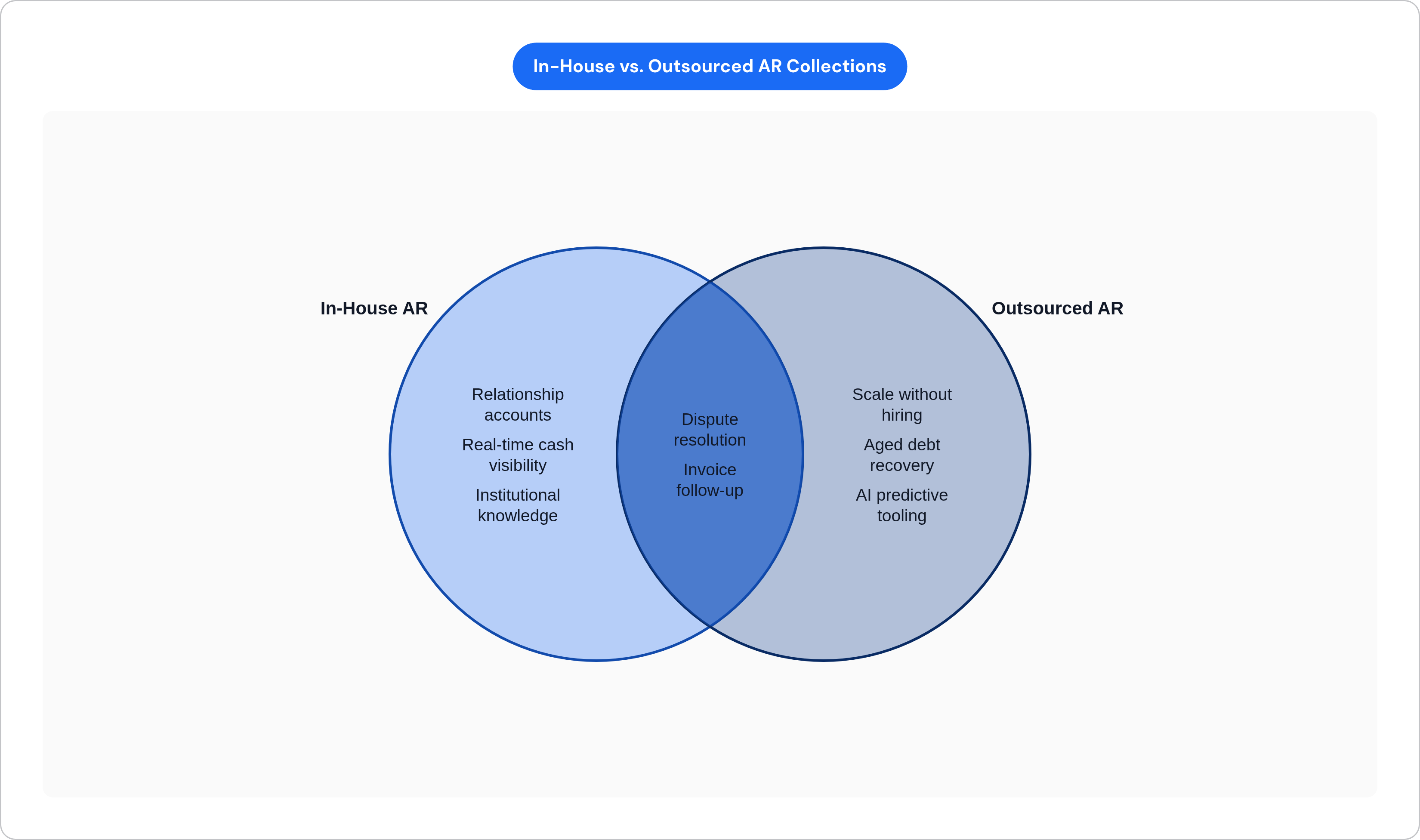
In-house AR means a dedicated internal team handling the full cycle: invoicing, follow-up calls and emails, dispute resolution, cash application, and credit decisions. The team lives inside your systems, knows your customers, and reports up through your finance org.
Outsourced AR is not one thing. It includes:
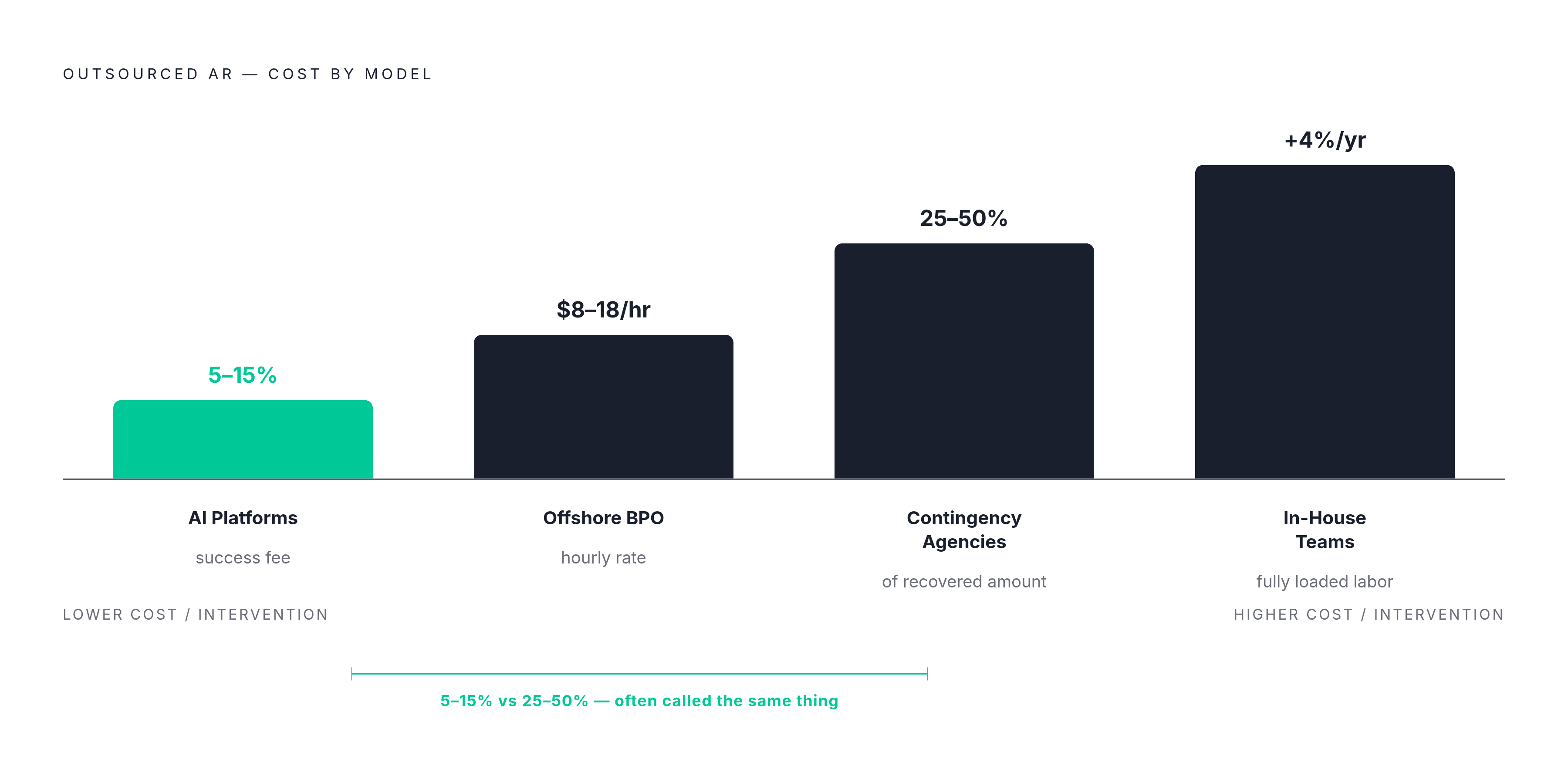
- Offshore BPO teams handling invoice processing and follow-up at lower hourly rates
- Contingency collection agencies that charge a percentage of whatever they recover (typically 25–50%) on aged or delinquent accounts
- AI-powered AR platforms that operate on a lower success fee (in the 5–15% range) and automate large portions of the follow-up and escalation process
The pricing model matters as much as the model type. A contingency structure aligns vendor incentives very differently than a flat monthly fee. A BPO handling invoice processing is a completely different engagement than an agency chasing accounts 90 days past due. Conflating these two things leads to bad decisions. Expensive ones.
One more thing worth getting out of the way early: most companies doing this well aren't running a pure model. A common setup is in-house for current accounts, an external partner for aged or at-risk ones. The hybrid is the norm, not the exception.
The Real Pressures Pushing Companies Toward Outsourcing Right Now
The pressure toward outsourcing isn't coming from one direction. Several things are hitting at once.
The talent situation is rough and getting rougher. Between 2019 and 2024, more than 340,000 accountants left the U.S. profession. CPA candidate pipelines are shrinking. Finding capable AR staff is harder than it was five years ago. Bureau of Labor Statistics data shows labor costs rising more than 4% year over year. The fully loaded cost of an in-house AR team goes up every cycle, regardless of whether AR performance improves alongside it.
The technology gap is also widening in ways that are hard to close organically. Specialized AR vendors run predictive analytics and AI tooling at a scale most mid-market companies can't justify building internally. A 2024 Deloitte study found that 75% of businesses had either outsourced or were planning to outsource AR functions to providers leveraging AI and automation. That's not a fringe trend.
Post-pandemic finance teams are stretched thin on top of all this. Distributed teams, managed service models, and a general push toward doing more with leaner headcount accelerated the move. Nearly half of businesses signaled intentions to increase AR outsourcing in the years following the pandemic. Some of that is opportunism. A lot of it is necessity.
None of this makes outsourcing the automatic right answer. But the in-house default deserves more scrutiny than it used to get.
Where In-House Collections Genuinely Outperforms
There are situations where keeping it internal is simply the better call.
Relationship-sensitive accounts are the clearest example. When a customer represents a meaningful chunk of your revenue and you've spent years building that relationship, the risk of an outside agency making one tone-deaf call is real. An internal team knows the account history, the personalities involved, when to push and when to let something sit for a week. A vendor doesn't have that on day one. Institutional knowledge is like a language. It takes years to learn, and an outside partner will always be working from a rough translation.
There's also the context that never makes it into a CRM note. Internal teams know why invoices stall on specific accounts. They know which customers always pay late but always pay. They know which disputes are legitimate and which are stall tactics. That context takes real time to transfer to an outside partner, and some of it never transfers at all.
In-house AR also feeds directly into credit decisions, cash flow forecasting, and the CFO's real-time view of the business. No translation layer. No reporting lag. No "we'll have the weekly update to you by Friday" when Friday is too late.
The in-house case is strongest when invoice volume is manageable, customer relationships are concentrated, and DSO is already healthy relative to the industry. But there's a condition that matters more than people admit: the team has to actually have capacity. An in-house team that's overwhelmed and under-resourced doesn't outperform anyone. It just costs more while underperforming more quietly.
Where Outsourcing Delivers Results In-House Teams Structurally Can't Match
Some outcomes are structurally hard for in-house teams to replicate. Not because the people aren't capable. Because the model doesn't allow it.
Scale without hiring is the obvious one. When a company is adding customers faster than it can add finance headcount, outsourcing absorbs the volume. No hiring cycle, no onboarding lag, no capacity ceiling that materializes six months into a growth push.
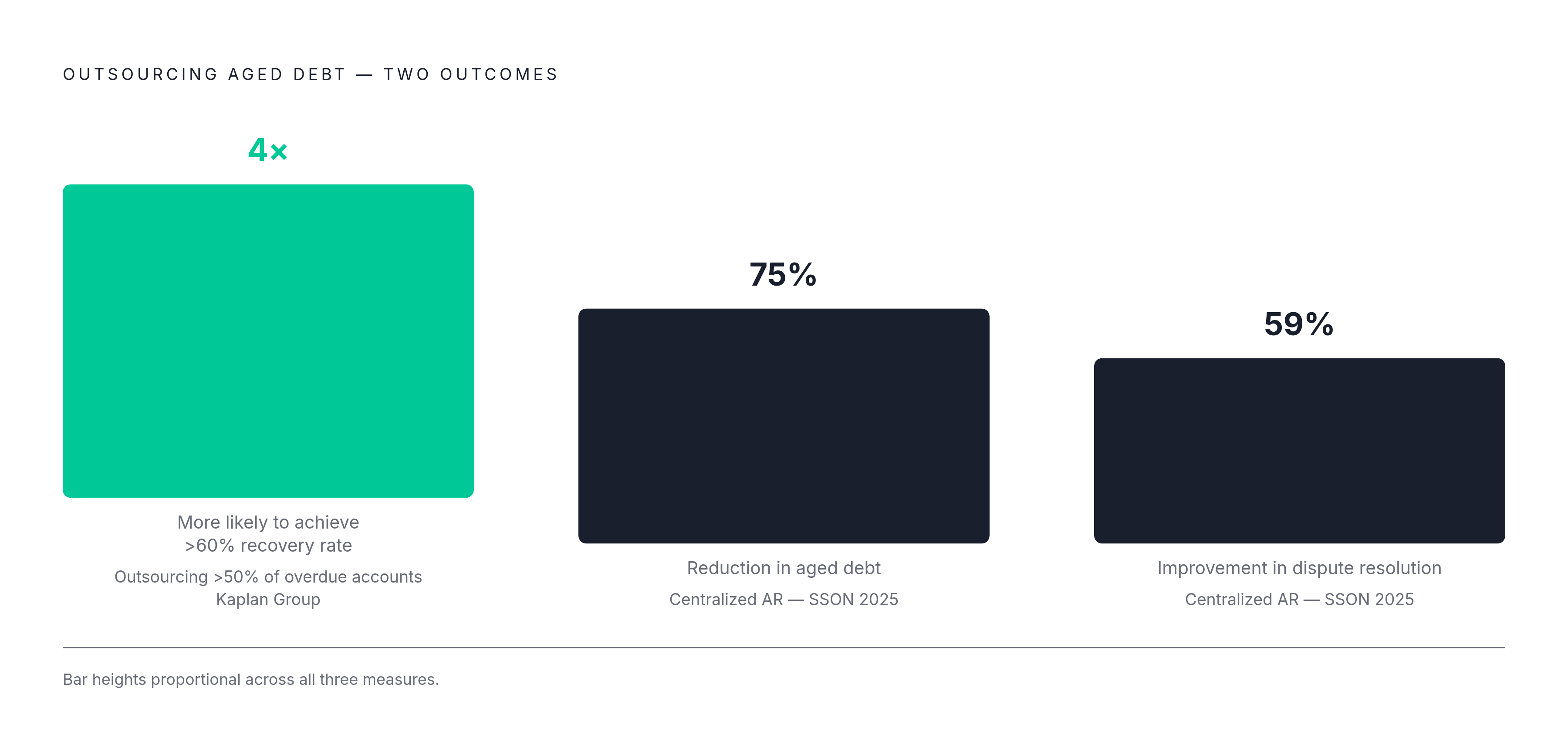
Recovery performance on aged debt is another. A Kaplan Group analysis found that companies outsourcing more than half of their overdue accounts were nearly four times more likely to achieve recovery rates above 60%. Specialized agencies work this problem full time. It's not one of fifteen things on their list.
A 2025 global report from SSON found that centralized AR processes cut aged debt by 75% and improved dispute resolution by 59%. Those are significant numbers for a function most companies treat as back-office noise.
On technology: vendor-grade predictive payment modeling can forecast payment timing with accuracy in the high 80s to low 90s and flag at-risk accounts weeks before they miss a due date. That tooling exists. It's just priced for vendors who spread the cost across hundreds of clients. Most mid-market finance teams can't justify buying it for themselves.
On cost: most companies that outsource AR cite savings in the 30–50% range. Everest Group data from 2024 found that outsourcing AR operations to specific geographies can deliver 40–55% savings versus equivalent in-house operations in the U.S. or UK. Those numbers are real. They're also not the whole story, which is what the next section is about.
The Risks That Make Outsourcing Messier Than the Cost Slide Suggests
The savings are real. So are the risks. They just tend to disappear from the conversation when someone's excited about a vendor proposal.
Customer relationship damage is the most underweighted one. An agency that's too aggressive, or just unfamiliar with a customer's history, can damage a relationship that took years to build. For B2B companies with repeat customers, this is serious enough to be a dealbreaker on certain accounts. Not all of them. Specific ones. You need to know which ones before you sign anything, not after.
Data exposure is quantifiable and frequently underpriced in these decisions. Third-party vendor relationships account for more than a third of all data breaches globally. Breaches involving third-party vendors cost an average of $4.91 million and take the better part of a year to identify and contain. That number needs to show up somewhere in the decision-making math.
Compliance liability doesn't transfer cleanly to the vendor, either. The vendor is subject to FDCPA, TCPA, and state licensing requirements. But the company whose invoices they're collecting also carries reputational and legal exposure if the vendor behaves badly. The CFPB received more than 200,000 debt collection complaints in 2024. Your brand is on it even when your name isn't on the call.
Visibility erodes faster than people expect. One of the most consistent complaints about outsourced AR is limited real-time insight into what's happening on a given account. If you're dependent on a weekly report, you're not managing AR. You're reviewing it after the fact and hoping nothing went sideways on Tuesday.
Vendor quality also varies more than the pitch decks suggest. The market's rapid growth means new entrants with insufficient process discipline. Due diligence is not optional, and we'll get to what that actually looks like at the end.
The Variables That Actually Determine Which Model Fits Your Company
There's no universal answer, which is frustrating when you're trying to make a decision under pressure. But some variables genuinely move the needle more than others.
Invoice volume and complexity. High volume with diverse customer types points toward outsourcing or hybrid. Lower volume with a consistent, known customer base favors keeping it internal. This one's fairly straightforward.
Customer concentration. If a small number of customers represent the vast majority of your revenue, the relationship risk of handing those accounts to an outside vendor deserves real weight. More than it usually gets.
Current DSO versus your industry benchmark. The median DSO across industries sits around 56 days as of recent reporting, and it worsened for the second consecutive year per Hackett's 2025 U.S. Working Capital Survey. If you're significantly above your benchmark, you have an acute recovery problem. A specialized vendor is better positioned to close that gap than an already-stretched internal team.
Finance team capacity, honestly assessed. If the team is spending most of its hours chasing invoices rather than doing anything that resembles financial planning, the opportunity cost is real. Calculate it. Don't assume it away because the headcount is already on payroll.
Growth trajectory. Rapidly scaling companies will hit a headcount wall in AR before they hit it almost anywhere else in finance. Outsourcing or AI-augmented AR buys real runway. Plan for where you're going.
Operational complexity. Supplier portals, missing W-9s, multi-entity billing. These blockers don't resolve themselves. The question is whether internal staff or a specialist partner clears them faster.
Industry and regulatory environment. Construction, healthcare, and government contracting all have compliance dimensions that require either a specialist vendor with genuine expertise or dedicated internal resources. Neither option is obviously superior in every case. Both require deliberate resourcing.
How the Hybrid Model Resolves the Binary in Practice
Most mid-market companies running AR well aren't choosing between outsourced and in-house. They're running both, deliberately, with a clear boundary between them.
The typical setup: in-house handles current invoicing, relationship-sensitive accounts, and anything requiring deep product or contract knowledge. An external partner takes over once an invoice crosses a defined age threshold or triggers a specific risk flag.
The trigger is the thing most companies underinvest in defining. A blunt "90 days overdue" rule is better than nothing, but predictive analytics has made this more precise. When AI flags an at-risk account weeks before it misses a payment date, the handoff can happen earlier and more strategically than a calendar rule allows.
Technology-augmented in-house is its own form of hybrid worth considering. AI-powered AR platforms can act as an always-on follow-up layer, handling portal navigation, document chasing, and escalation routing without replacing the finance team's judgment on relationship-sensitive calls. The team stays in the strategic role. The platform handles the repetitive, high-volume contact work.
The hybrid works best when the internal/external boundary is explicit, monitored, and revisited as the business changes. It breaks down when it becomes the default arrangement nobody actively manages anymore. That happens more than people admit.
How to Pressure-Test a Potential Outsourcing Partner
If you've decided some form of outsourcing makes sense, here's how to evaluate a vendor without getting sold a well-produced pitch deck.
Start with the pricing model. Contingency structures (25–50% of recovered amounts) create strong incentives to collect, but they can also create incentives toward aggressive behavior on accounts you'd rather handle carefully. Choose the structure that aligns the vendor's incentives with what you actually care about, including how you want customers treated in the process.
Ask about their collections methodology directly. How do they handle relationship-sensitive accounts? What does their escalation process look like? What tone do they use, and does it change based on account type? Vague answers here are a signal. Push on it.
Data security is the floor, not a differentiator. SOC 2 certification, standard security questionnaire responses, and breach response SLAs are not nice-to-haves. With third-party breaches averaging $4.91 million in cost, this is a basic requirement before the conversation goes further.
Integration and visibility matter more than they sound. Does the platform connect to your ERP and billing systems? Can you see real-time account status, or are you getting a PDF on Friday afternoon? Lack of integration means flying partially blind on accounts that may be going sideways.
Ask for compliance documentation, not just assurances. FDCPA and TCPA compliance records, state licensing documentation, and their process for handling complaints. The CFPB logged more than 200,000 debt collection complaints in 2024. Promises don't hold up the way documentation does.
Get performance commitments in the contract. DSO reduction targets and recovery rate benchmarks should be specified. Vendors who resist specific metrics are telling you something worth hearing before you sign.
Ask for references that actually match your situation. A vendor's track record in your industry, at your invoice volume, with your type of customer base matters more than their aggregate win rate. If they can't provide references that match your context, ask why directly.
One thing worth doing before any of this: figure out what your AR function actually costs today, all in. Most finance leaders can't answer that precisely. Fully loaded headcount, technology, time spent on escalations, the revenue that walked because follow-up was slow. Until you know that number, you can't honestly evaluate whether anything else is better.