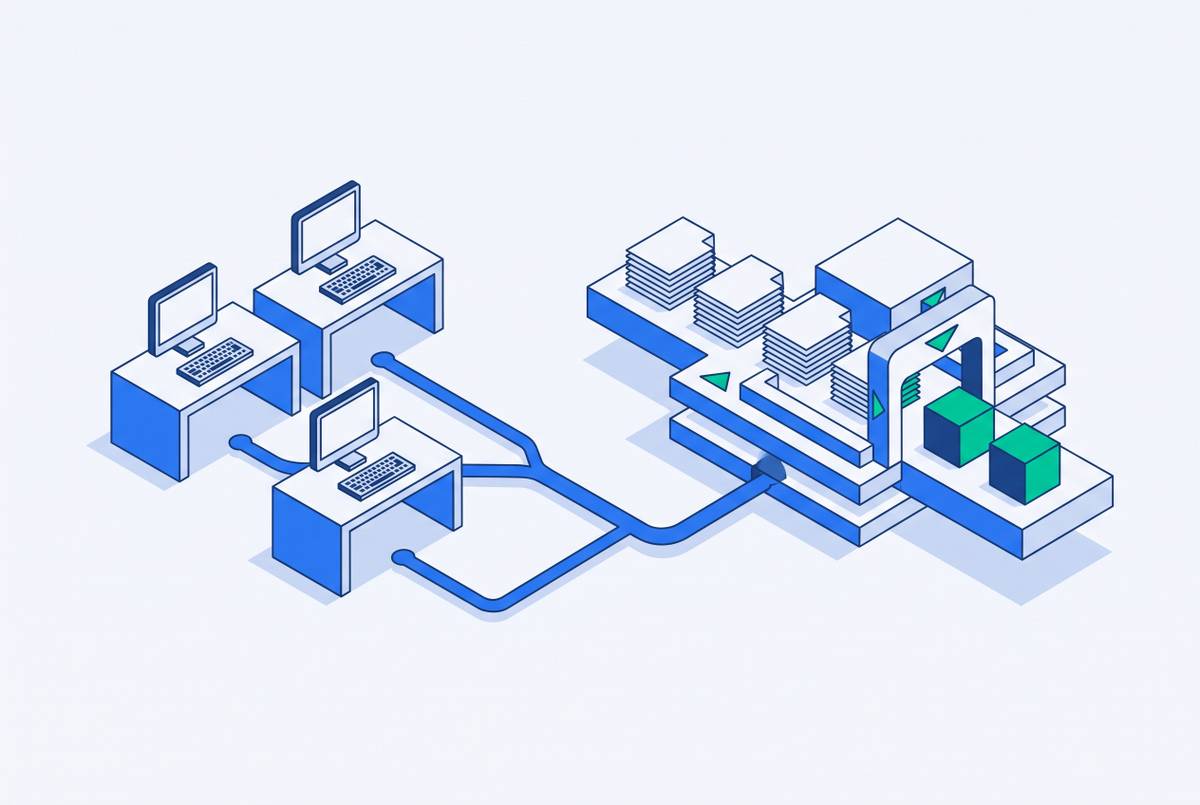
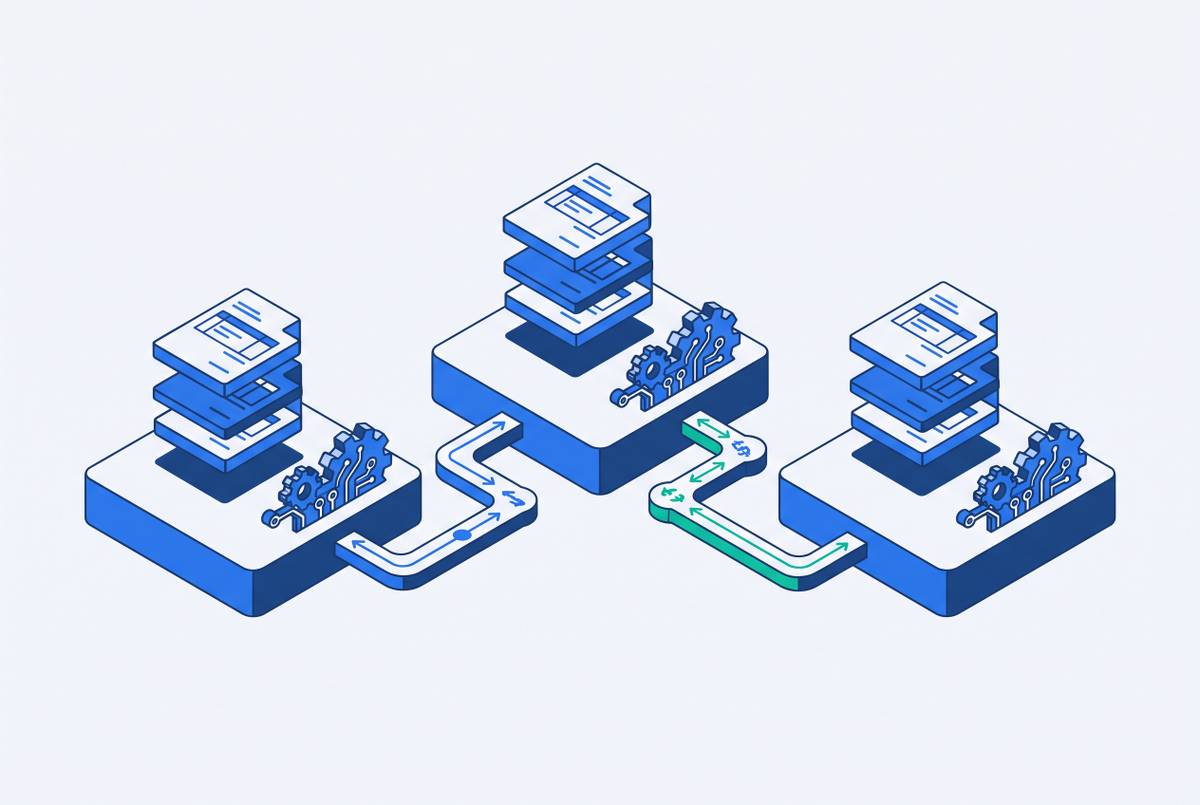
done-for-you accounts payable services vs. self-serve AP software
Outsourcing handles invoices for you; software automates them so your team keeps control.
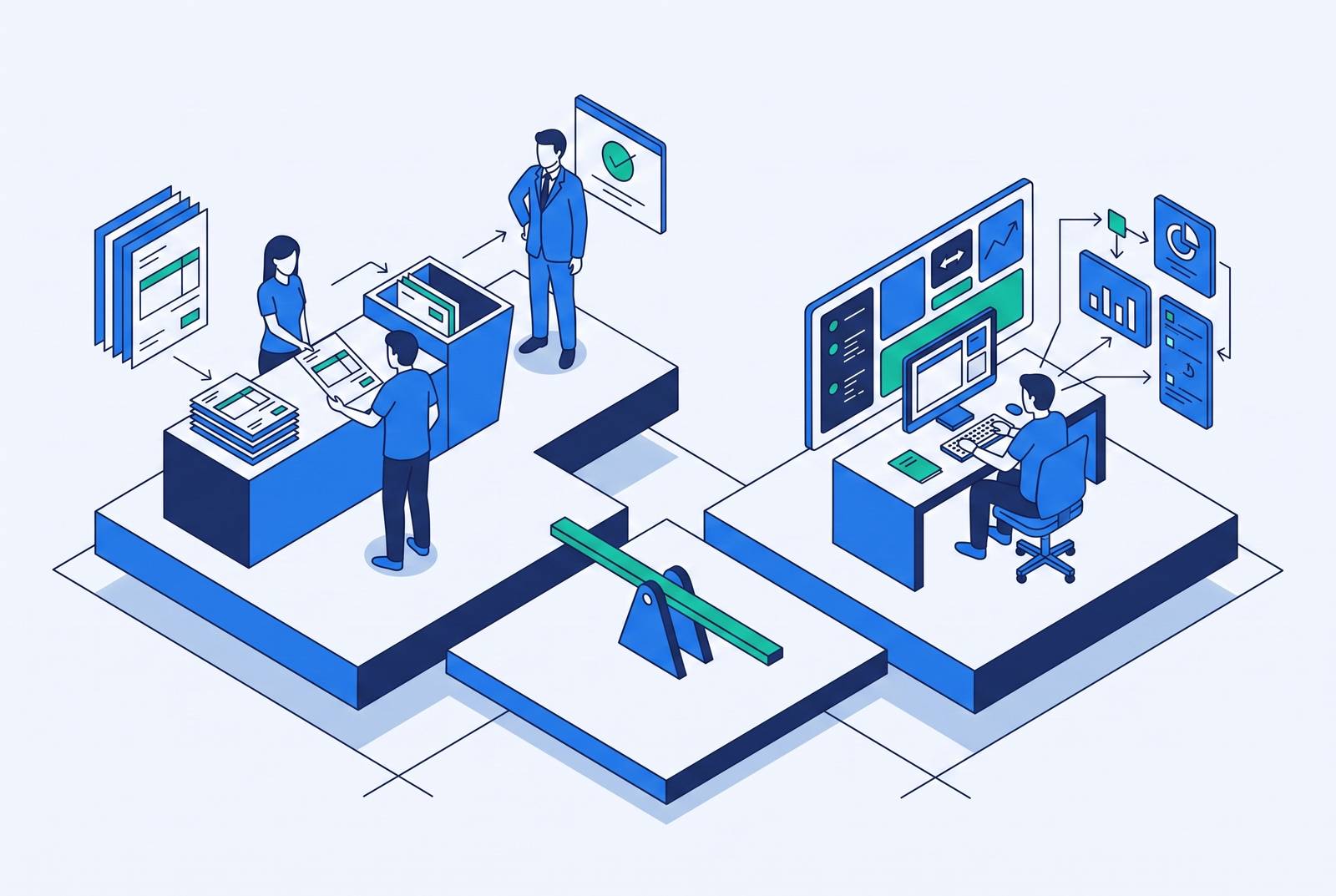
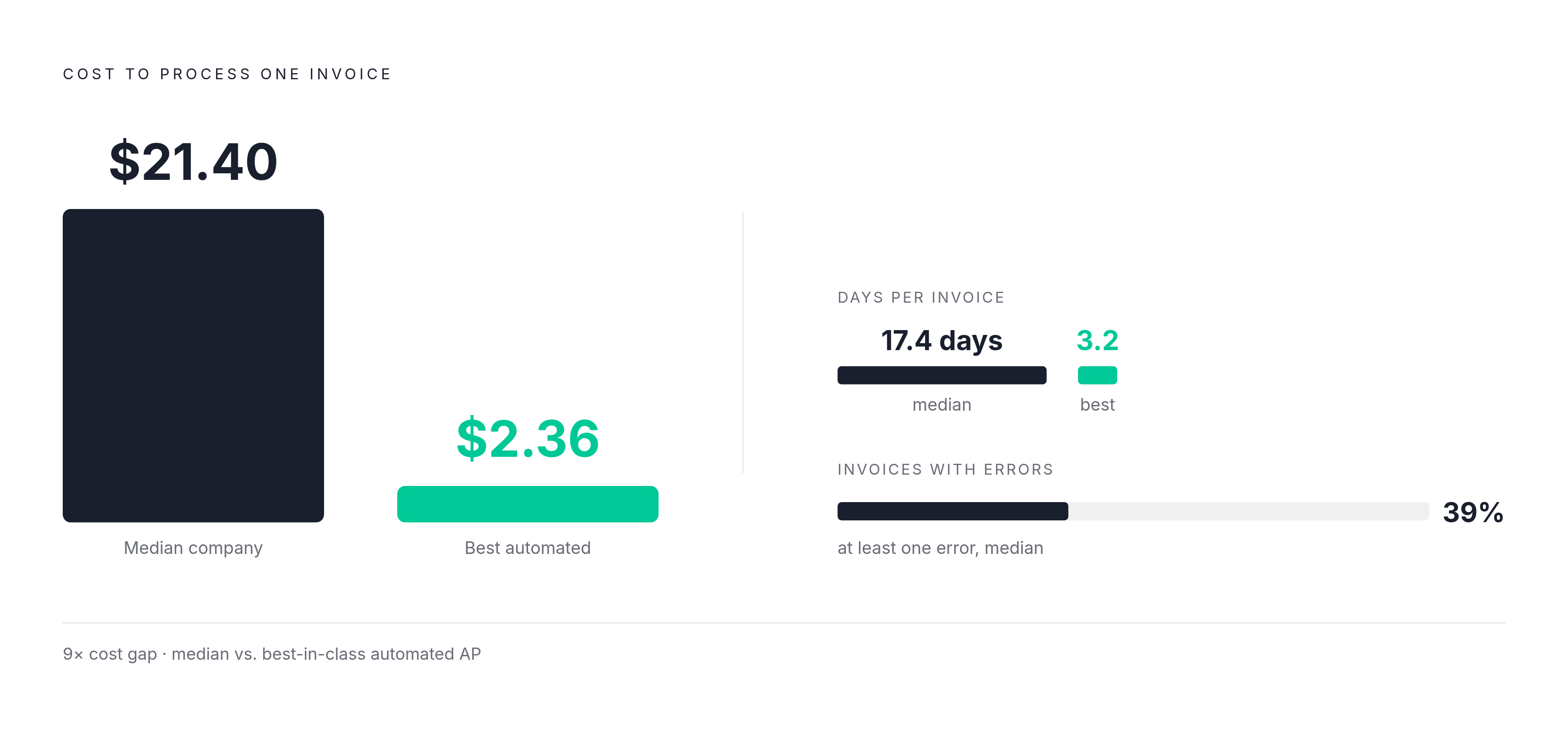
Processing a single invoice costs $21.40 at the median company, and $2.36 at the best automated ones, and that nine-fold gap is the whole story of accounts payable right now: two structurally different fixes have emerged, done-for-you outsourcing and self-serve software, and they solve the same cost problem through opposite tradeoffs. Most companies pick based on brand recognition or whatever their bookkeeper mentioned once, which is backwards. The right pick depends on invoice volume, exception rate, and how fast the company is growing, in that order, and most companies check those factors in reverse or not at all.
Ardent Partners found the manual process takes 17.4 days per invoice; the leading AP teams have cut that to 3.2 days. Add in the fact that 39% of invoices carry at least one error and half of U.S. invoices get paid late, and the picture points to a process breaking under its own weight. Broken processes don't scale well, and they just fail more expensively at higher volume. Roughly 26% of finance organizations already admit their current AP setup can't handle higher invoice volume if it shows up, and that's the pressure pushing companies toward one of two paths. Picking wrong wastes real money for years before anyone notices.
How done-for-you AP outsourcing actually works
A third party takes over the daily grind: invoice receipt, matching, approval routing, payment execution, reconciliation. Some companies hand off the whole function, while plenty of others do it partially, outsourcing just the data entry or just the payment runs, because handing over the entire AP department feels like too big a leap on day one.
Who delivers this depends heavily on company size. A small business often just extends its relationship with the bookkeeping firm already doing the monthly close, since the switching cost is low and there's no new vendor to vet. At the enterprise and global level, large specialized outsourcing providers step in, built for the kind of multinational compliance and multi-jurisdiction tax work a local bookkeeper isn't set up to handle.
Regulation is quietly making this decision for a lot of companies, and it's a strong argument for outsourcing that doesn't get said out loud enough. Shifting trade policy and cross-border payment complexity push companies toward providers that bundle compliance advisory right alongside the standard AP work. Europe adds its own wrinkle: Several major European markets have introduced or announced e-invoicing mandates for domestic B2B transactions. A provider already running operations in those markets absorbs that compliance lift so the client doesn't have to build it from scratch. That's a real reason 70% of finance leaders say they're actively considering outsourcing right now, and treating this as a fringe move is increasingly a mistake.
How self-serve AP automation software actually works
Software takes a different approach: it sits on top of the existing ERP or accounting system and automates invoice capture, coding, matching, approval routing, and payment. The internal team keeps ownership of the process throughout, even as day-to-day labor shrinks.
Cloud deployment now runs the show, accounting for 61.7% of the AP automation market as of 2025, largely because distributed teams need approval paths that don't require everyone sitting in the same building. Adoption of AP automation has grown steadily across finance departments in recent years. Here's the catch worth sitting with, though: a large share of finance teams still manually key invoice data into their ERP despite having automation tools in place. Adoption is wide, but depth is another matter entirely, and that gap is where most of the wasted software spend hides. A company that bought a platform and still pays someone to retype invoice numbers all day has added a subscription bill on top of the labor cost it already had, with little automation to show for it.
The platform landscape splits cleanly by company size. Small businesses tend to land on BILL, QuickBooks Online, or Xero, tools built for simple setup and tight accounting integration. Mid-market companies often land on AvidXchange, which has particularly deep roots in real estate and construction invoice-to-pay workflows. Companies paying suppliers across dozens of countries look at Tipalti, which is built for global supplier payments across a wide range of currencies and geographies. Large enterprises with complicated approval hierarchies and audit demands tend to land on Coupa's spend management suite.
Pricing here works differently than outsourcing. Software charges a subscription, per-user or per-transaction, plus whatever internal labor it takes to run the thing, and that labor cost doesn't disappear just because the software's automated. Most companies start seeing a clear return once they're processing 200 to 500 invoices a month, especially if approvals are spread across departments or the exception rate runs high. Below that line, the subscription fee often buys little more than a nicer-looking spreadsheet.
The tradeoff that defines each model: control, cost structure, and operational lift
Control is the first fork in the road. Software keeps the internal team inside the approval chain, with direct visibility into every invoice's status at every moment, which matters a lot to finance teams that want tight audit control or need a human judgment call before money moves. Outsourcing hands execution to someone else, which thins out internal visibility unless the provider's reporting is genuinely strong, and it creates a dependency on someone else's staff and someone else's process.
Cost structure is the second fork. Outsourcing usually prices per invoice or through a monthly retainer with volume tiers, so cost scales predictably, but it never drops to near-zero per invoice the way automation eventually can. Software carries a fixed platform fee plus ongoing internal labor; at high enough volume, the per-invoice math tilts toward software, but that labor line is real money, every month, without exception. At extremely high volume, outsourcing can actually pull back ahead, once someone fully costs in the internal team it would take to run and maintain a platform at that scale.
Operational lift is the part people underestimate, and it decides most of these calls in practice. Software needs someone in-house to configure it, maintain it, chase down exceptions, onboard new vendors, and keep ERP integrations from breaking, and none of that is a one-time setup cost. Outsourcing moves that burden onto the provider, but the company still has to manage the relationship, set the service-level terms, and handle whatever exceptions the provider bounces back.
Exception handling is the hidden variable underneath everything, and it's the one that actually separates the two models. Both handle a clean, straight-through invoice just fine, but the real difference shows up in how each one handles the 39% of invoices that aren't clean: the missing purchase order, the mismatched line item, the approval stalled in someone's inbox, the vendor portal that won't cooperate. Neither model wins outright here, and the right one depends on where a company sits on three things: invoice complexity, internal team capacity, and how fast it's growing.
Which AP complexity profile favors outsourcing
Outsourcing earns its keep in a few recognizable situations. A cross-border vendor base with multiple currencies, import documentation, or exposure to e-invoicing mandates across various jurisdictions is one. A high exception rate is another: if a large share of invoices need manual digging, dispute resolution, or back-and-forth with vendors, that eats internal time no matter what software sits underneath it.
Compliance-heavy industries fit here too, especially ones juggling multi-entity structures or shifting VAT and withholding rules, where a provider's built-in expertise cuts real risk. Small finance teams without the bandwidth to own a software platform lean this way almost by default, and separately, 37% of small businesses already say they're looking to their accountant for help managing bill payments. That's a real signal about how much appetite exists for a human-run process over a self-managed one.
Growth stage matters too. A company scaling fast but without the finance headcount to build real AP infrastructure can buy itself runway through outsourcing, without making a hiring decision it's not ready for. The catch: outsourcing creates dependency, and if the provider's quality slips or the relationship ends, the internal capability to pick the function back up may simply not exist. Partial outsourcing works as a middle path here, handing off just the data entry or payment runs while keeping approval authority in-house, trading some lift for less control given up.
Which AP complexity profile favors self-serve software
Software makes the most sense once invoice volume clears that 200-to-500-a-month mark, especially with approvals spread across several departments. It also fits companies with a domestic or narrow-geography vendor base, where compliance stays manageable without needing outside expertise. And it fits a finance team that actually wants to own the platform, where internal control over workflows, audit trails, and ERP integration reads as a feature rather than a chore. Companies where cash flow timing really matters, where finance wants direct say over exactly when and how payments go out, tend to prefer this route too.
Large enterprises have driven significant AP automation adoption, pushed by invoice volume, layered approval hierarchies, and audit demands that software handles in a way a fixed-cost retainer just can't flex with. Meanwhile, smaller companies now have real, low-overhead software options that simply didn't exist five years back, and adoption is climbing in that segment too.
The risk with software is subtler, and it's the one worth taking most seriously. Software doesn't fix what it can't automate, so a team running a platform but still hand-managing exceptions, vendor disputes, and portal logins hasn't actually cut its workload as much as the invoice bill implies. That figure from earlier, the share of finance teams still manually entering invoice data despite calling themselves automated, makes the point directly: using software and being automated are not the same claim, and conflating them is exactly how companies end up paying for two systems (the platform and the manual labor underneath it).
Where AR complexity compounds the AP decision for high-growth companies
Fast-growing companies rarely deal with just one side of this. Vendor payments scale on the AP side while collections friction piles up on the AR side, often at the same time. A finance team that picks self-serve AP software to stay in control of outgoing payments can still get buried by manual work on the inbound cash side: navigating collections portals, chasing missing documentation, running follow-up cycles that never seem to end.
The same operational-lift logic that applies to AP applies to AR just as directly. When collections require a person to sit there and push, working through vendor portals like Coupa and Ariba, answering customer questions, escalating invoices that have stalled, software alone doesn't close that gap. The real question at this stage is where operational capacity should sit across the whole finance function. Increasingly, done-for-you managed services on the AR side are what free up a finance team to run the AP software model without getting swamped, and The managed-service model has been proving itself on the revenue side, just as it has on the cost side. That's the managed-service model proving itself on the revenue side, alongside the cost side.
A practical decision framework: matching model to company profile
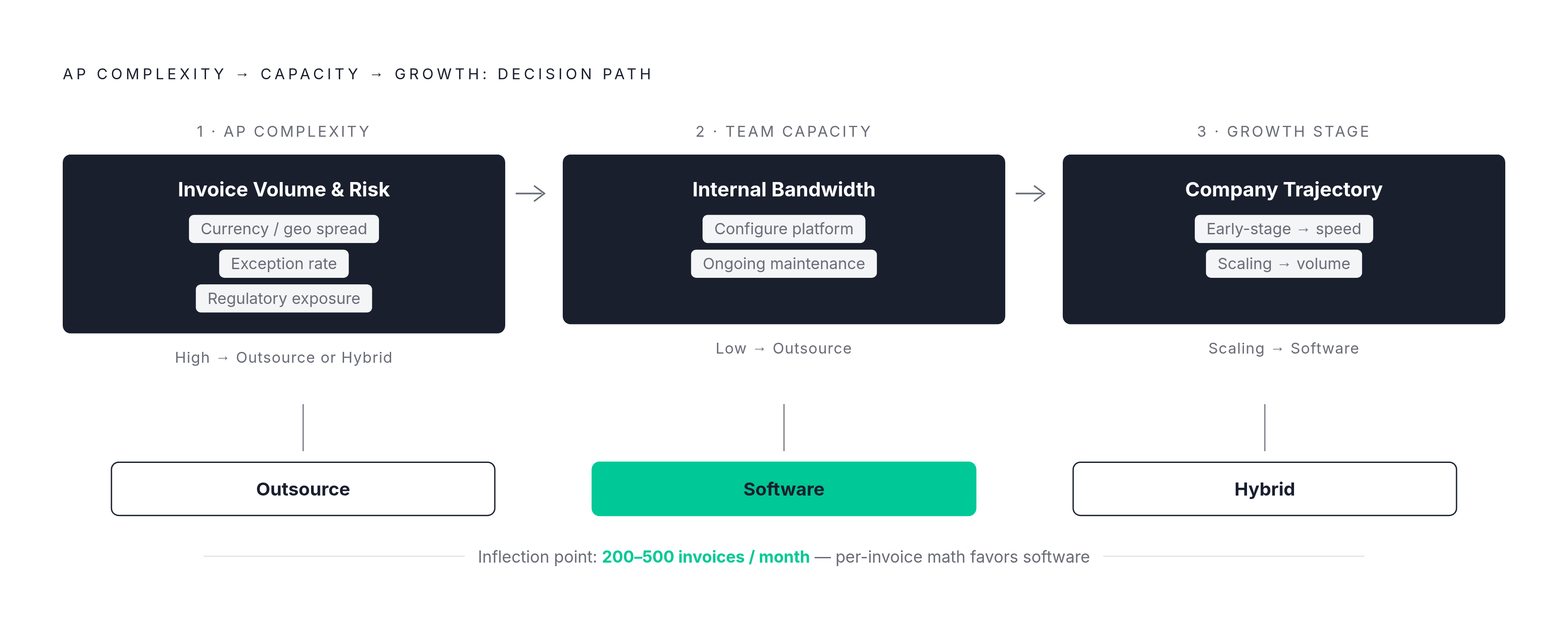
Three things decide this, and they're worth checking in order. First, AP complexity: invoice volume per month, currency and geographic spread, exception rate, regulatory exposure. Higher complexity tilts toward outsourcing, or toward a hybrid setup. Second, team capacity: how much internal bandwidth exists to configure, run, and maintain a software platform, and whether the finance function is actually growing or just holding steady. Low capacity tilts toward outsourcing. Third, growth stage: early-stage companies trading some cost for speed often prefer outsourcing, while scaling companies building out real finance infrastructure often prefer software that gets more valuable as volume climbs.
Hybrid setups are a legitimate answer in their own right; this was never a strict binary choice to begin with. Plenty of mid-market companies run software for the straight-through invoices and outsource exception handling, cross-border payments, or vendor onboarding to a provider.
Run the total cost of ownership check either way. Software's real cost includes the internal labor to operate it, while outsourcing's real cost includes the overhead of managing the provider relationship, and neither sticker price tells the whole story on its own.
Two moments are worth watching for as a company grows. Crossing that 200-to-500-invoice-per-month line is the natural point to ask whether manual work or outsourcing still makes financial sense compared to software. Adding new geographies or entity structures is the natural point to ask whether software alone can absorb the compliance load, or whether it's time to bring in provider expertise. The AP outsourcing market is projected to reach $13.46 billion by 2032, growing at a 12.33% compound annual rate, and AP automation software is on its own parallel growth path. Neither model is fading out, and the decision comes down to fit, not fashion, since treating it as a brand choice is how companies end up stuck with the wrong one for years.