SAP Concur vs Tipalti vs Stampli for AR Teams
How AP automation platforms create hidden friction points that delay your payments.
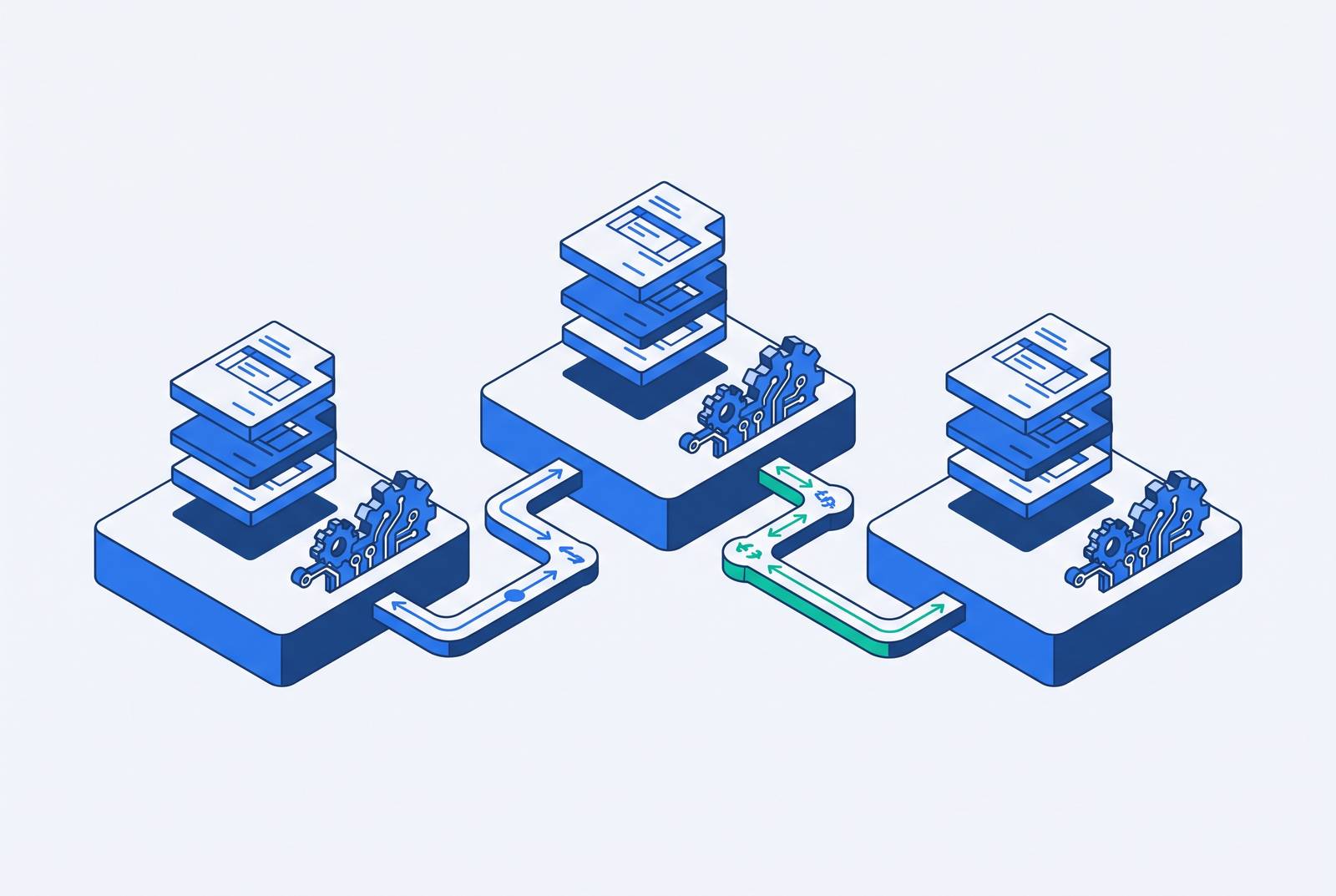
AR teams don't buy SAP Concur, Tipalti, or Stampli. Their customers do. But every one of those platforms sits between an invoice an AR team sends and the payment they're waiting on, and that makes it the AR team's problem whether they asked for it or not. Think of it like being a passenger on someone else's flight: you didn't choose the airline, the seat, or the layover schedule, but you're the one stuck at the gate when the connection gets delayed. This piece is written for the AR practitioner who keeps getting surprised by what's happening on the other side of the invoice, and who'd rather see it coming next time, not for someone shopping for an AP tool.
The cash flow equation runs in both directions. Delays in payment approval on the buyer's side become late payments on the seller's side, and that connection rarely gets named for what it is. Portal requirements, approval queues, missing tax forms, payment timing quirks: these are all AP-side mechanics, built to solve AP-side problems, with zero regard for how they ripple downstream. AR teams absorb that ripple as collections friction, and most never get a clear look at the machine that produces it.
What these three platforms do and who they are built for
SAP Concur, Tipalti, and Stampli all automate the inbound side of the invoice lifecycle: capturing vendor invoices, coding them, matching them against purchase orders, routing approvals, and pushing payment out the door. That's the mirror image of what an AR team does on the outbound side. These platforms matter to AR even though none of them were built with AR in mind.
SAP Concur runs on three integrated modules: Concur Expense handles automated receipt capture and policy enforcement, Concur Travel manages global booking with policy controls, and Concur Invoice covers AP automation, including data capture, automated routing, and duplicate billing detection. G2's 2026 AP automation guide calls it "best for managing travel, expenses, and employee reimbursements," which tells you where its center of gravity sits. It's an expense and travel platform first, an AP tool second. Concur is strongest inside SAP-centered enterprise environments. Medius's 2026 comparison rates its ERP integration depth as "Standard," limited to the SAP ecosystem. SAP has poured recent investment into Joule, its AI assistant, expanding it across travel and expense products to handle automated expense-report preparation, receipt capture, travel assistance, and policy-compliance checks. Concur Invoice captures data, automates routing, and flags duplicate billing, but it doesn't execute payments on its own. That requires a separate integration. An aerial firefighting and environmental services company used SAP Concur, and it cut out paper-based processes, improved spend visibility, and sped up approvals. At Recordati Rare Diseases, staff accountant Karen Grobert described the company's AP process before Concur as "a nightmare," and automation through Concur Invoice changed that.
Tipalti runs the full AP cycle inside one cloud platform: supplier onboarding, invoice processing, approvals, global payments across more than 120 currencies, and reconciliation. Tipalti was founded in 2010, it's headquartered in Foster City, California, and it now serves thousands of businesses. Medius's 2026 comparison rates Tipalti's payments capability as "Most capable," the top tier in that evaluation. Gravie, a healthcare company, used Tipalti to speed up approvals and connect the platform to NetSuite.
Stampli takes a different approach: an invoice-centric collaboration platform covering AP, procurement, vendor management, payments, and cards across the full procure-to-pay cycle. Every communication, approval, and supporting document stays attached to the invoice itself, rather than scattered across email threads and shared drives. Its AI assistant, Billy the Bot, learns coding patterns (GL accounts, cost centers, approvers) from vendor, amount, and historical data, and gets sharper the longer it runs. G2's 2026 guide calls Stampli "best for better visibility and collaboration in AP workflows." Like Concur, it doesn't execute payments natively. Customers route payment through a partner or a Bill.com integration. Ambrosia QSR, a restaurant franchise operator, gave Stampli its Outstanding Partnership Award after AP automation helped the company scale to more than 200 restaurants. On G2's Summer 2026 AP Automation Grid, Stampli posted the highest satisfaction score in the category, 99, with a payback period that runs about 10 months.
Friction and Opportunity for the AR Team
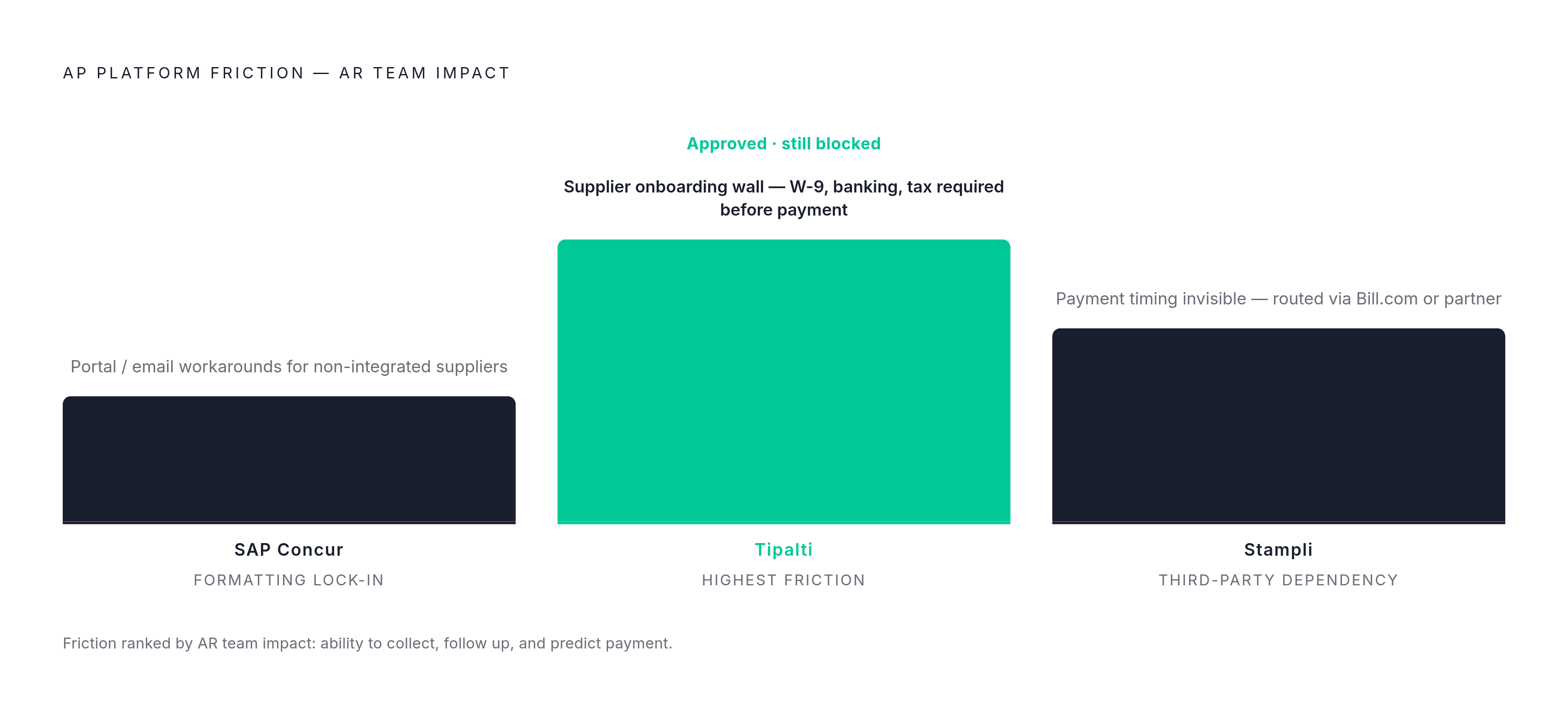
Every design choice an AP platform makes, how it takes in invoices, how it routes approvals, what it demands from suppliers before money moves, lands on the AR team as either friction or something closer to predictability. Knowing which one you're dealing with is the whole game.
In SAP Concur environments, Concur Invoice's automated routing and duplicate detection mean invoices move through a structured, repeatable workflow. That structure cuts both ways. AR teams submitting into a Concur environment can generally count on a predictable approval path, but Concur also demands strict formatting, and the platform's deep SAP-ecosystem dependency means suppliers who aren't integrated with SAP often get stuck working through portal submissions or email-based workarounds that slow everything down. RFP.wiki's comparison of Tipalti and SAP Concur notes that public Trustpilot feedback on Concur skews heavily negative on UX speed, login friction, and support responsiveness, and that frustration lands on suppliers chasing payment and not just the internal staff clicking through the software. Concur doesn't execute payments without a separate integration, so if you work with Concur customers you should expect some unpredictability in payment timing, depending on what that customer has wired up on the back end.
Tipalti runs on a formal, structured supplier onboarding process, and that process is where most of the friction lives. A supplier who hasn't completed onboarding, with a W-9, banking details, and tax validation on file, cannot get paid. It doesn't matter if the invoice is approved, coded, and sitting in the queue. This is the single highest-friction point an AR team will hit across all three platforms: a missing document blocks payment regardless of invoice status, and the AR team usually has no idea it's happening until someone starts chasing down why a payment never landed. The flip side is real too. Tipalti's global payment infrastructure covers numerous countries with more than 26,000 banking rules and built-in OFAC and AML screening, so payment execution is highly reliable once onboarding is actually done. If you work with a fully onboarded Tipalti customer, you can expect payment timing to hold steady.
Stampli's collaboration model keeps every communication and document attached directly to the invoice, giving AP teams a complete, auditable trail. Disputes and approval delays appear in a visible record instead of disappearing into someone's inbox, a genuine advantage for AR teams on the other side of it. Billy the Bot also learns patterns, so invoices from known suppliers get coded and routed faster the longer the relationship runs, and if you have a long history with a Stampli customer, you may see payment timing improve over time. Stampli doesn't execute payments natively, so timing depends on whatever payment partner or Bill.com integration the customer has set up, a variable the AR team can't see or predict from the platform alone. G2's Tipalti alternatives page also notes that Stampli is easier to set up than Tipalti, so Stampli customers may be more recent converts. If you work with a newly migrated Stampli customer, you need to re-establish your supplier records from scratch.
The operational gaps none of these platforms fill for AR teams
All three platforms exist to automate the buyer's side of a transaction. Generating invoices, following up on them, navigating supplier portals, resolving disputes, and applying incoming cash sit entirely outside that design, for all three, by design. None of them builds in native AR capability. SAP Concur has no outbound billing or collections function, so G2's 2026 guide tells you to look at separate tools, Sage Intacct among them, if you need both AP and AR in one stack. Stampli carries no AR module either, no billing, no collections, and Medius's 2026 comparison confirms that even payments require an outside integration on Stampli's end.
That gap creates a specific set of blockers AR teams have to solve on their own. Supplier portal navigation is one: both Tipalti and Stampli run supplier portals, but those portals exist to feed supplier information into the buyer's system, not to help the supplier track or manage its own receivables. Missing document collection is another. W-9s, tax forms, banking details, an AP platform will hold a payment hostage until those are on file, but no AP tool actually chases the supplier down to get them. That job defaults to the AR team, or no one does it until a payment fails and someone notices. Collections follow-up, escalating overdue invoices, resolving disputes, and communicating with a customer's AP or procurement staff sits outside the scope of all three platforms. Cash application rounds out the list: when Tipalti processes a payment run spanning multiple entities or currencies, somebody on the AR side has to reconcile those payments against open invoices by hand, and that workload only grows as payment complexity increases.
None of this is a knock against Concur, Tipalti, or Stampli. They're doing precisely what they were built to do. But an AR team working with customers on any of these three platforms needs its own system built to match how that platform actually behaves, not one that pretends the platform isn't there.
Tipalti's SMB Retreat and Stampli's Counter-Move
AP platform choice isn't static, and when it shifts on the buyer's side, the AR team is the one who has to re-navigate onboarding, portal access, and payment workflows all over again. Tipalti's pullback from small business customers is a shift worth tracking closely.
In July 2025, Tipalti CEO Chen Amit told Calcalist the company was "focusing on mid-market customers and reducing our exposure to small customers." That's a formal repositioning of the business, not a pricing tweak. Two rounds of layoffs followed. The first hit dozens of employees worldwide, including 40 in Israel. A second round in January 2026 cut more than a hundred more. For AR teams whose SMB customers run on Tipalti, that pullback raises the odds of weaker platform support for those accounts, which can mean more portal friction, slower onboarding, or an eventual migration to a different AP platform. RFP.wiki's 2026 comparison also flags pricing complexity and add-on fees as a recurring complaint among Tipalti users, and that pressure is likely to push more small customers off the platform over time.
Stampli moved into that exact opening. Around the same time Tipalti announced its workforce reduction, Stampli released Stampli Edge, an AP automation product built specifically for prospects in the fast-growing SMB market, aimed squarely at the segment Tipalti was stepping away from. AR teams with SMB customers should expect to see some of them migrate from Tipalti to Stampli, and when that happens, supplier onboarding starts over. AR teams will need to rebuild invoice submission workflows inside Stampli from scratch rather than assume anything carries over.
SAP Concur, meanwhile, isn't chasing either end of that market: its investment through 2025 and 2026 is going into expanding Joule's AI capabilities across travel and expense products. Concur's complexity, implementation timeline, and pricing structure keep it anchored in large enterprise accounts. If you deal with Concur customers, you're almost by definition dealing with bigger buyers who run procurement-heavy processes, and that isn't likely to change soon.
Closing the Receivables Gap
None of these three platforms will chase a W-9, follow up on a stalled approval, or tell you why a payment got stuck in a supplier portal. That work doesn't disappear just because it isn't built into the software. It lands on whoever's managing receivables, invoice by invoice, until they build something to handle it.
If you navigate AP platforms you don't control, you end up managing friction that adds to your own collections work. Missing documents, portal complexity, and approval queues all live on the customer's side of the fence, but they become your problem when a payment doesn't arrive on time. A dedicated AR service is built to absorb exactly that kind of friction, combining AI-driven follow-up with human collections expertise to work through supplier portals and handle the unglamorous blockers, W-9s, missing tax data, portal access issues, that platforms like SAP Concur and Tipalti introduce as a matter of course.
None of these three platforms offers native supplier communication or follow-up. No one forgot to build it, the absence runs structural. AR teams submitting invoices into a Concur, Tipalti, or Stampli environment often have zero visibility into approval status or onboarding blockers until a payment simply fails to show up, at which point they're troubleshooting backward instead of catching the problem early. Pairing one of these AP platforms with an AR-focused tool closes that blind spot. An AR-focused tool automates follow-up across email, phone, and SMS, and can track commitments inside supplier portals, giving AR teams a real view into where an invoice sits in the customer's workflow and what's actually holding up payment.
SAP Concur, Tipalti, and Stampli will keep running the buyer's side of the transaction well, each in its own lane, each with its own friction points and its own strengths. None of them was ever going to solve the seller's side of that same transaction, and none of them claims to. The job for AR teams is building the system that does.