Remittance Advice Reconciliation in B2B AR
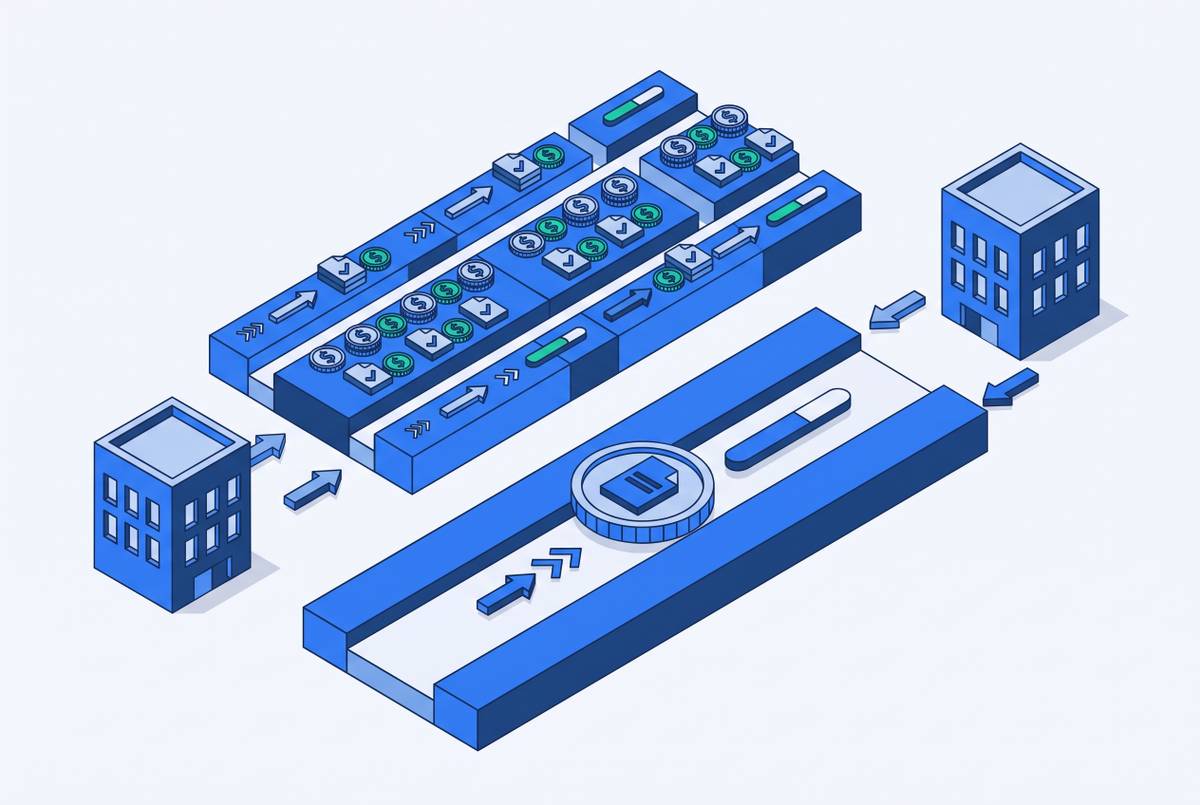
Money and its explanation travel separately in B2B, slowing reconciliation.
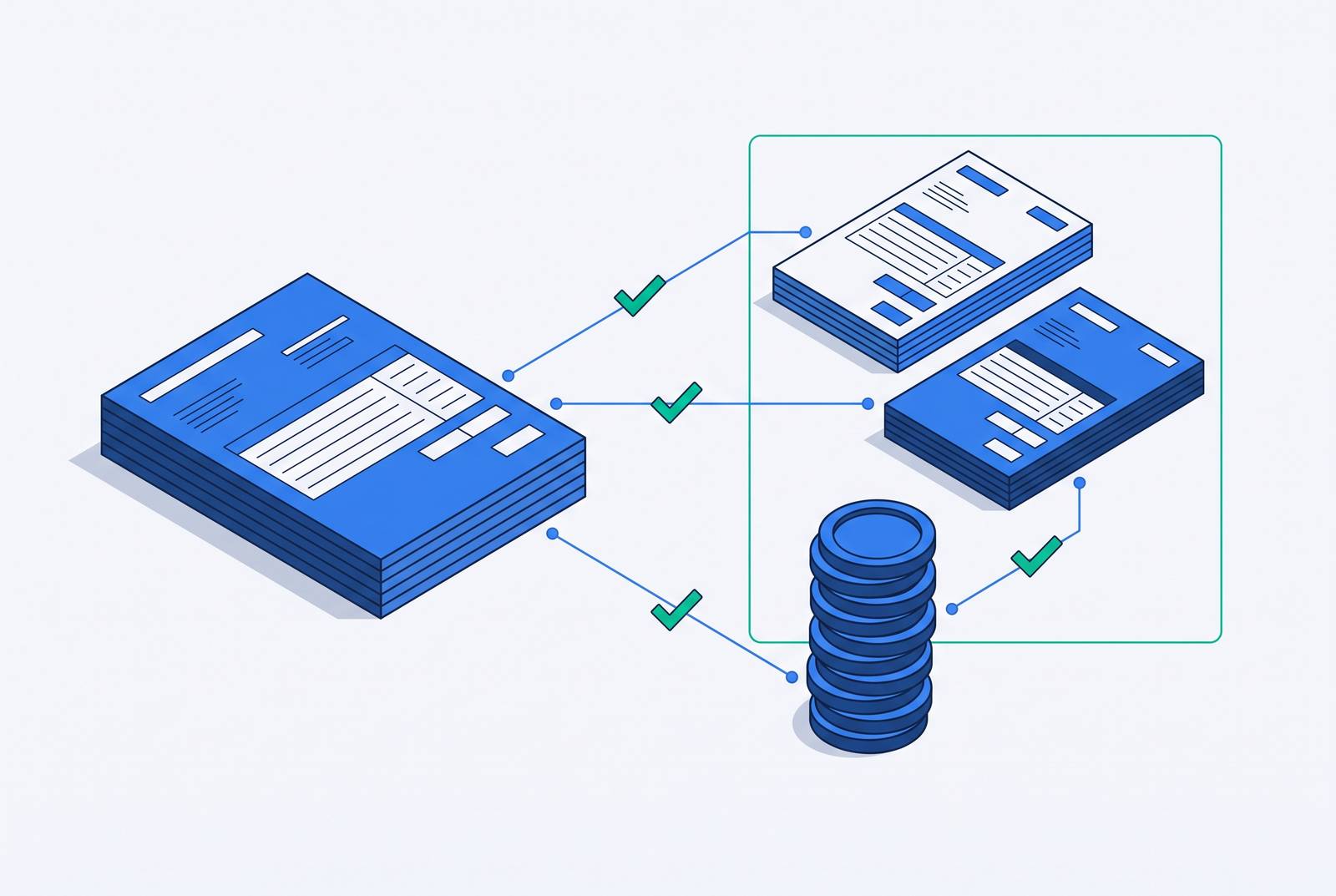
A remittance advice document tells an AR team what a payment is actually for. Without it, cash lands in the bank and nobody can say which invoices it clears, so reconciliation stalls before it even starts. That gap between money arriving and its explanation appearing is the entire reason cash application is slower and messier than most finance leaders expect.
Start with the basics. A remittance advice is a note from the payer listing which invoices a payment covers, what got deducted, and how the money moved. It is not proof of payment. Proof of payment is bank-side evidence that funds actually left one account and hit another, a wire confirmation or an ACH trace number. Remittance advice is the payer's own explanation of what that money was supposed to settle. One is a receipt. The other is a packing slip. You need both, and they rarely travel together.
The money and the explanation move through completely different pipes, which is what trips people up. Payment travels by ACH, wire, check, or virtual card. The remittance advice rides separately, by email, by portal, by whatever the payer's AP system decided to spit out that day. In consumer transactions this never comes up, because your grocery receipt shows up in your hand at checkout. In B2B, the payment can land today and the explanation can arrive days later, or never.
It wasn't always this fragmented. Back in the paper-check era, the check and the remittance stub arrived together in the same envelope. You opened it, you had both pieces, you moved on. Electronic payments sped up the money but cut the string holding the explanation to it. The check got fast. The story behind the check did not, and that mismatch is what every AR team inherited.
A complete remittance advice, when it does show up in full, carries the payer name and vendor ID, the payment amount and date, the payment method, a line-by-line invoice list with gross amounts, credits, discounts, short pays, and net applied, plus a transaction reference number and deduction codes. That's a lot of structure to hope for from a PDF attachment. When it's missing, the AR team is left holding a lump sum against a ledger full of open invoices with no map connecting the two. Cash application at that point isn't math, it's detective work.
The formats remittance advice arrives in, and why no two look alike
Ask five different customers how they send remittance advice and you'll get five different answers, sometimes from the same customer in the same month.
PDF attached to an email is common, generated straight out of the buyer's ERP. Sounds tidy, except the tables inside are sometimes rendered as images rather than text, so the file has to be read like a picture, not parsed like data.
Plain email body text appears just as often, no attachment at all, no fixed layout, invoice numbers dressed up in whatever reference format the buyer feels like using that day. The supplier's own invoice number, say INV-40118, might arrive back as something like 4500912233-40118, buried in a paragraph with no punctuation to help a computer find it.
Then there are buyer AP portals, Coupa, Ariba, SAP Business Network, and a long tail of customer-specific systems that require someone on the AR team to log in manually just to see payment detail. Multiply that by however many major customers use their own portal, and login time alone eats a chunk of the week.
Bank files bring their own quirks. A BAI2 statement or an EDI 820 or an ACH addenda record can carry remittance detail, but the quality swings wildly depending on what the payer's treasury team decided to include, a decision the supplier has zero say in. ACH CCD addenda records hold roughly three invoice numbers and no amounts. ACH CTX, by contrast, can carry a full EDI 820 inside the payment itself, invoice-level detail and all. Nacha reported close to 8.1 billion B2B ACH payments in 2025, up roughly 10% from the year before, and every single one of those needed its explanation to travel some other way or squeeze into a addenda field never built to hold much.
And sometimes, nothing arrives at all. Money lands, silence follows.
The EDI 820, the X12 standard for Payment Order/Remittance Advice, is the closest thing to a workhorse for high-volume B2B in North America. It carries invoice-level detail and coded adjustment reasons a matching engine can actually consume without translation. But setting one up takes trading-partner configuration on both sides, which is why EDI 820 relationships tend to exist only with the biggest accounts. Enterprise customers lean toward portals and EDI. Mid-market customers lean toward PDFs and email text. The mix shifts as the customer base shifts, and there's no locking it down.
A bank rolling a lockbox deposit into a summary statement erases invoice-level detail before the AR system ever sees it. No software fixes that after the fact. Someone has to go back to the bank or the payer and ask for it directly. The number of these channels a team's tools can actually read without a human touching them is, in practice, the number that decides how heavy the week gets.
The four payment shapes that break matching even when remittance is present
Having the remittance document doesn't guarantee a clean match. Four payment shapes cause trouble on their own, document or no document.
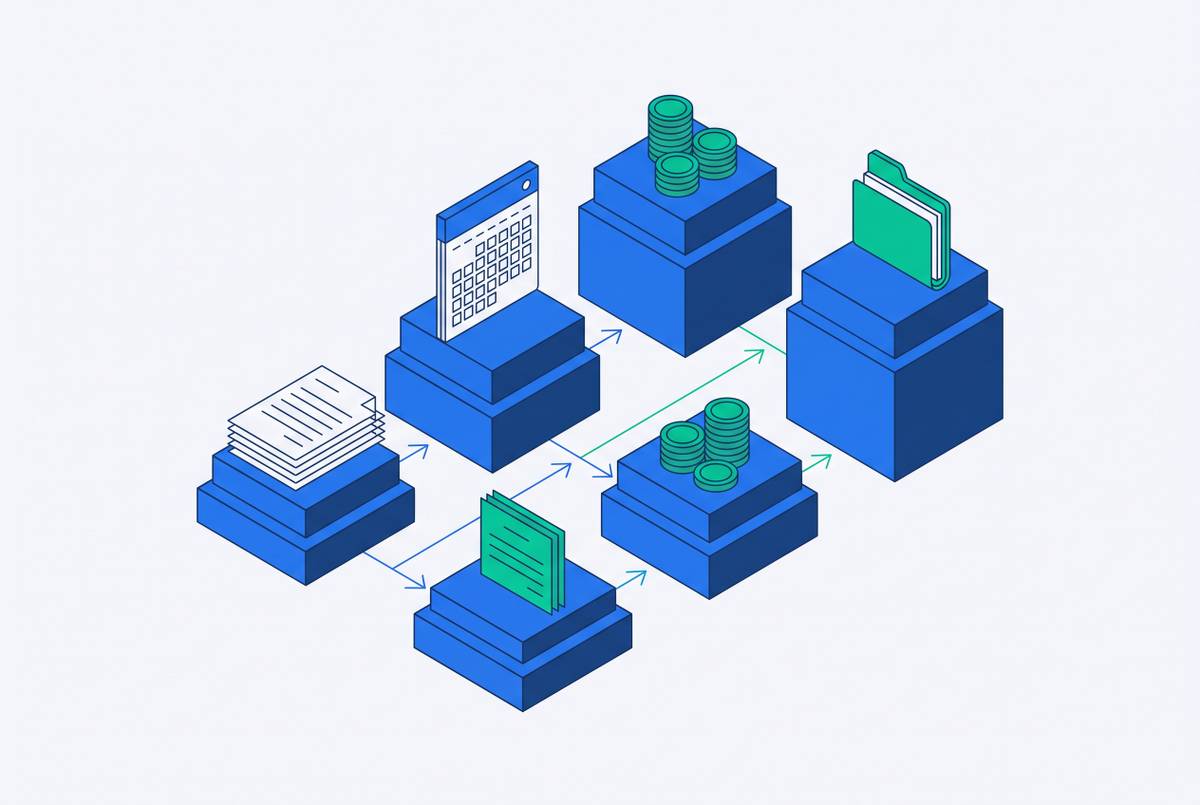
One payment covering many invoices is the most common. A customer settles dozens of invoices in a single wire, the remittance lists every line including credit notes, and the matching engine has to find the exact subset of open items that adds up to the payment amount, apply the credits correctly, and absorb whatever rounding difference or bank charge nudges the total off by a few cents.
Short pays with a deduction are worse, because the invoice can't close until someone figures out why. The remittance might say "freight." It might say nothing. Either way, the gap between invoice and payment has to get coded as a freight charge, damaged goods, an early-payment discount the customer took without earning, or a live pricing dispute, and figuring out which one it is sits with a person, not a piece of software.
Payments quoting a purchase order instead of an invoice number cause their own headache. The buyer's AP system pays against its own PO. The supplier's invoice number is nowhere in the file. Somebody has to cross-reference PO to invoice, and that mapping frequently doesn't exist cleanly inside the ERP to begin with.
Then there's the payment that arrives with no remittance at all. Money lands, no explanation follows, and AR has to reach out and wait, holding the cash unmatched the entire time.
Each of these shapes adds time in the exception queue, delays posting, and inflates the unapplied cash balance sitting on the books. According to Serrala research, invalid deductions alone can eat 1 to 3% of annual revenue at organizations without a structured process to catch and recover them. Exception handling, in other words, is a revenue leak with a paper trail.
What happens inside the AR team when remittance data is fragmented or late
Remittance often arrives after the payment does, which means cash sits unmatched in the meantime, quietly inflating the unapplied cash balance and distorting what the business thinks it's actually owed.
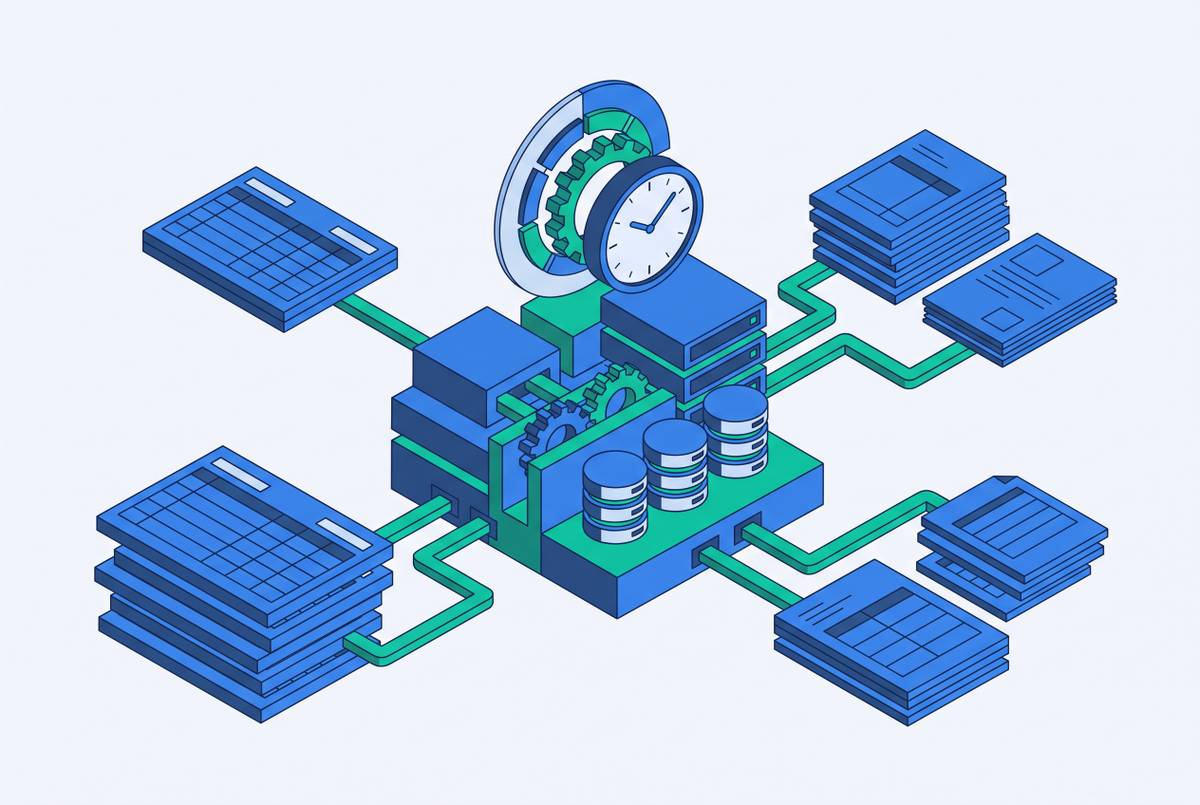
Before any matching even starts, someone has to monitor bank portals, email inboxes, EDI feeds, and customer portals, download the attachments, copy data out of email bodies, log into each portal separately, consolidate everything into a spreadsheet, and key it into the ERP. That's the warm-up lap, not the race.
Then comes customer identification. Missing or inconsistent payer references mean an analyst has to dig through ERP records, bank references, customer master data, and old payment history just to figure out who actually sent the money. Enterprise customers make this worse by bundling bulk payments across dozens of invoices while simultaneously taking early-payment discounts, applying credit memos, and short-paying select lines, stacking exceptions on top of exceptions.
The delay doesn't stay contained to AR. It ripples into bank reconciliation, financial forecasting, and month-end close, and it tightens the screws during close cycles when everyone's already under pressure. IOFM benchmark data puts the cost of processing a single invoice manually at $12 to $35, versus $1 to $5 with automation. Run that across 100,000 invoices a year and the gap clears $700,000 annually, before counting the staff hours spent correcting errors after the fact.
According to NACM's State of AR Automation Survey, 44% of organizations still run on little to no automation, leaving teams to match payments by hand across data scattered between emails, PDFs, lockboxes, and portals. Virtual card volume piles on a different flavor of manual work: a flood of one-off emails, each with its own card number and its own PDF remittance, someone opening every message, keying the number into a terminal, applying the payment one at a time. Fine at low volume. Falls apart the moment volume spikes.
Why the working capital cost of slow reconciliation is larger than most AR teams realize
Zoom out, and the dollar figures get uncomfortable fast. A major research firm's 2025 national Working Capital Survey covering a large set of publicly traded nonfinancial companies found $1.7 trillion trapped in excess working capital, 35% of gross working capital and 11% of aggregate rev... Working Capital Survey, covering the top 1,000 publicly traded nonfinancial companies in one country, found $1.7 trillion trapped in excess working capital, 35% of gross working capital and 11% of aggregate revenue.... publicly traded nonfinancial companies, found $1.7 trillion trapped in excess working capital, 35% of gross working capital and 11% of aggregate revenue.
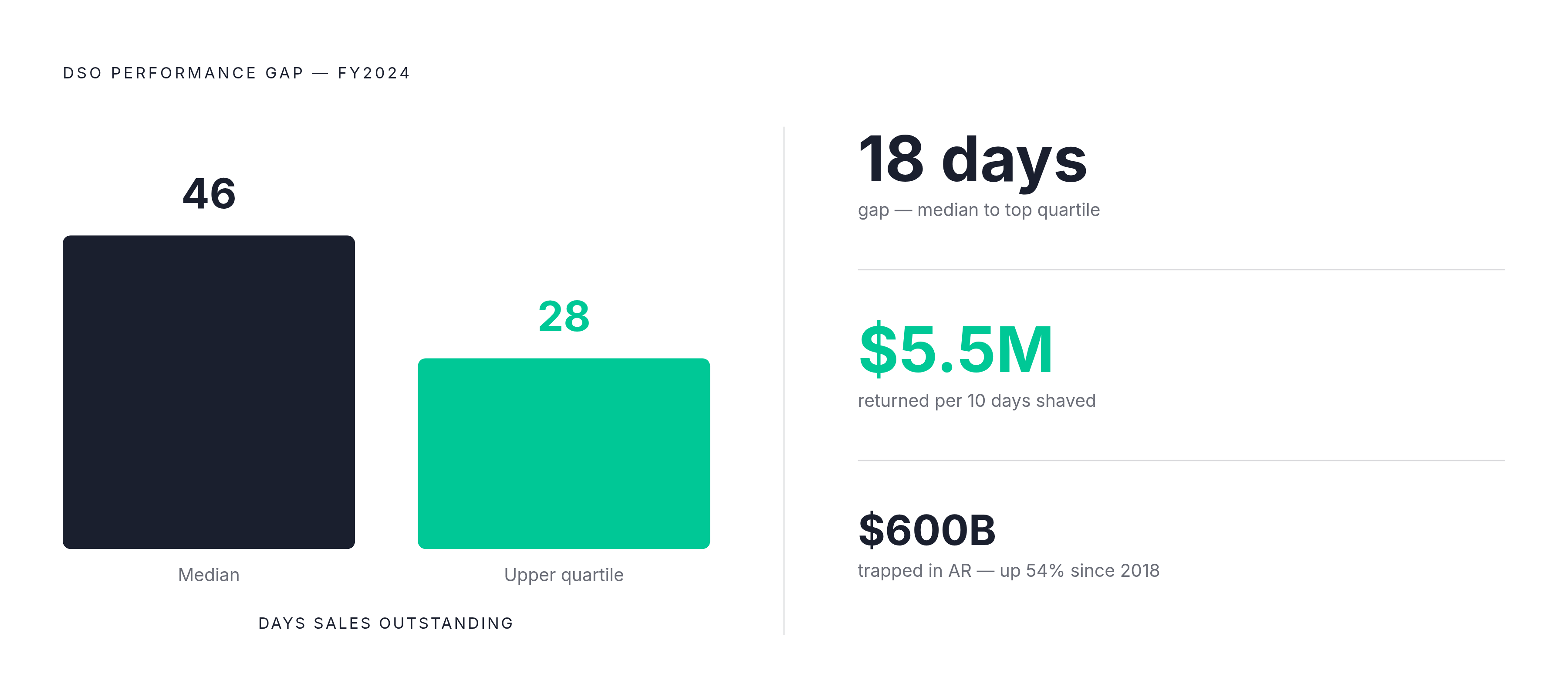
Accounts receivable carries the largest share of that trapped cash. Hackett Group data put that opportunity at $600 billion, up 54% since 2018 from $389 billion. The gap between top performers and everyone else says a lot about what reconciliation speed is actually worth: upper-quartile companies averaged 28 days DSO in FY2024, while the median sat at 46 days, a 40% performance gap. Upflow's State of B2B Payments data puts the median B2B DSO across industries at 56 days.
Put a dollar figure on a single day of DSO for a substantial-revenue company, and it comes out to a meaningful sum tied up in cash for every extra day. Shave 10 days off, and $5.5 million comes back into working capital, with no new customers, no new product, and no new headcount required.
That's likely why working capital optimization has climbed to the top of the corporate priority list in recent years. The pressure to fix reconciliation delays is coming from the top of the org chart, not from AR itself anymore. It's coming from the top of the org chart. Unapplied cash and slow posting inflate reported DSO directly, which makes accurate, timely remittance reconciliation one of the few levers AR can pull that shrinks DSO without touching payment terms or credit policy at all.
How the reconciliation process works step by step
Reconciliation runs in seven stages, and the data is fragmented at nearly every one of them.
Receive and locate: monitor every inbound channel at once, bank portal, email inbox, EDI feed, customer portals, lockbox, and confirm a payment landed and that remittance data exists somewhere, or confirm it doesn't.
Capture and consolidate: pull the remittance data out of whatever format it showed up in and normalize it. If the table is an image, that means OCR or manual keying. If the email body has no fixed layout, invoice numbers have to be parsed out of a wall of unstructured text.
Identify the customer: match the payment to a customer record using bank reference, vendor ID, payer name, or historical payment patterns. Missing references mean an ERP search or a direct call to the payer.
Match payment to open invoices: apply the remittance line by line against open AR, handle one-to-many matches, apply credit memos, absorb rounding, and flag anything that doesn't tie out, short pays, references that only carry a buyer's order number, unmatched lines, for human review.
Code and route exceptions: every exception, short pay, disputed deduction, unearned discount, has to get categorized and sent to the right owner, whether that's collections, sales, or finance, before the invoice can close.
Post to ledger: once matched and the exceptions are cleared, apply the cash to the right invoice lines and post to the general ledger. Anything that still can't be matched sits in a suspense account until it's resolved.
Reconcile to bank: confirm the posted amounts match the bank statement, resolve any differences, and feed that into month-end close, bank reconciliation, and revenue reporting.
Research on AP departments found automated cash application significantly cutting the time from payment receipt to ledger posting. That gap exists partly because most ERP systems weren't built for high-volume, multi-format remittance in the first place. They lean on a human to extract data from non-standard formats, and that's exactly where the errors occur.
Where automation changes reconciliation outcomes and where it still requires human judgment
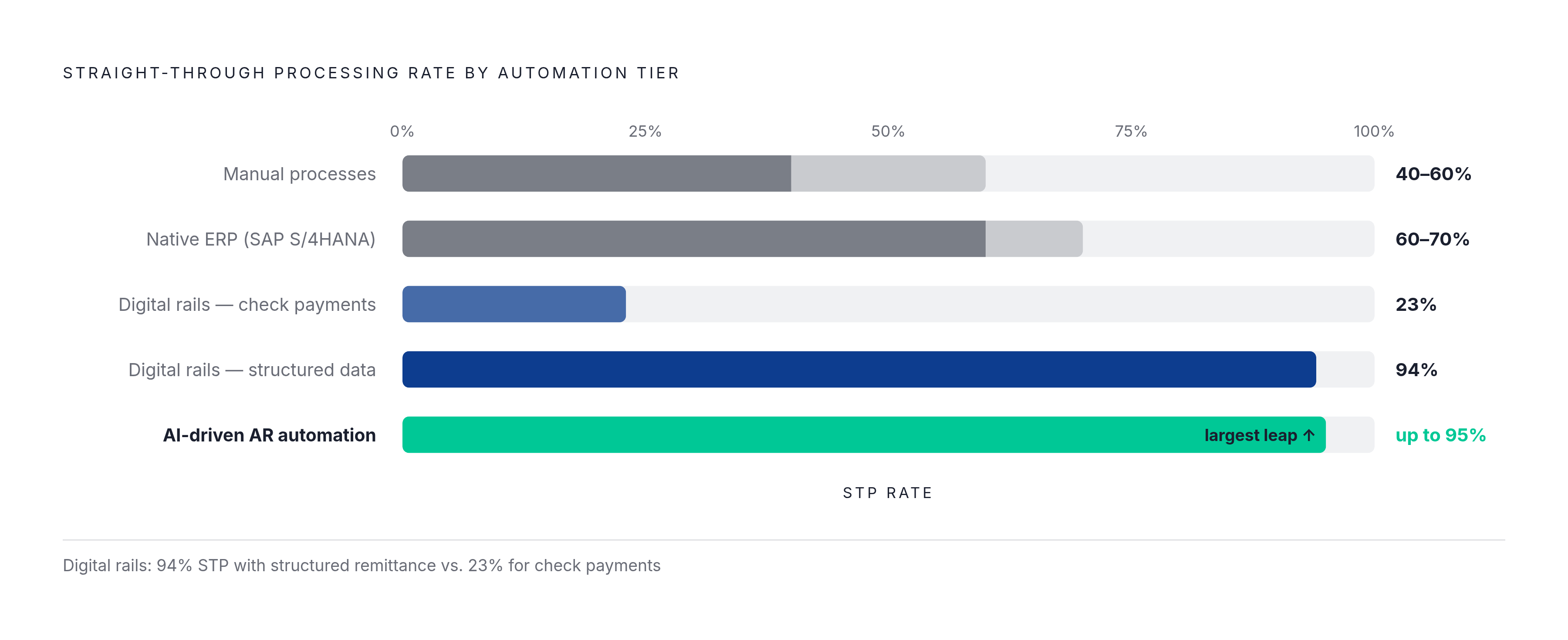
Straight-through processing rates tell the clearest story of what automation actually buys. Baseline research puts manual processes at 40 to 60% STP. Native ERP modules, SAP S/4HANA without AI assistance being one example, get to 60 to 70%. AI-driven AR automation, per Emagia's 2025 vendor report, pushes as high as 95%.
Payment rails that carry structured remittance data alongside the money make the difference obvious. The 2025 study of 380 AP departments processing 12.4 million B2B payments found 94% straight-through reconciliation on digital rails carrying structured data, against just 23% for check payments, with a 74% cut in reconciliation labor and a 61% drop in exception handling.
What AI-native tools do differently from older rule-based matching comes down to reading things a rule can't anticipate. They read PDF tables rendered as images without someone keying it in by hand. They recognize a reference formatted around a buyer's own order number and map it back to the supplier's own invoice number. They handle one-to-many matches and credit memo netting without a person assembling the subset manually. And they can navigate customer-specific portal interfaces, Coupa, Ariba, SAP Business Network among them, cutting down the login-and-read cycle that used to eat an analyst's morning.
Judgment still belongs to a person in a few specific spots. Deduction coding, deciding whether a short pay is freight, damage, a pricing dispute, or an unearned discount, requires context that often lives outside the ERP entirely, in an email thread or a sales rep's memory. Dispute escalation, once something is coded, is a relationship task, routing it to the right owner and following it through to resolution, not a matching task. When no remittance arrives at all, software can trigger the outreach and track it, but it can't manufacture information that was never sent. And portal friction, missing W-9s, stalled tax forms, compliance documents buried inside a procurement system, still needs a human to log in, upload the file, and confirm it went through.
PYMNTS Intelligence's "From Friction to Flow: AR Automation in 2025" found that 83% of firms have yet to fully automate their AR operations, and companies running an average of three ERP systems face data silos that make a single unified view of payment history and exception patterns hard to build. The appetite to close that gap is there. According to a PYMNTS study, 90% of CFOs surveyed said they want to widen the scope of automation in their AR operations, which suggests the fragmentation isn't going unnoticed. It's just taking longer to fix than anyone would like.