ACH Payment vs Wire Transfer for B2B Collections
Choose based on settlement speed, fees, and remittance data quality.
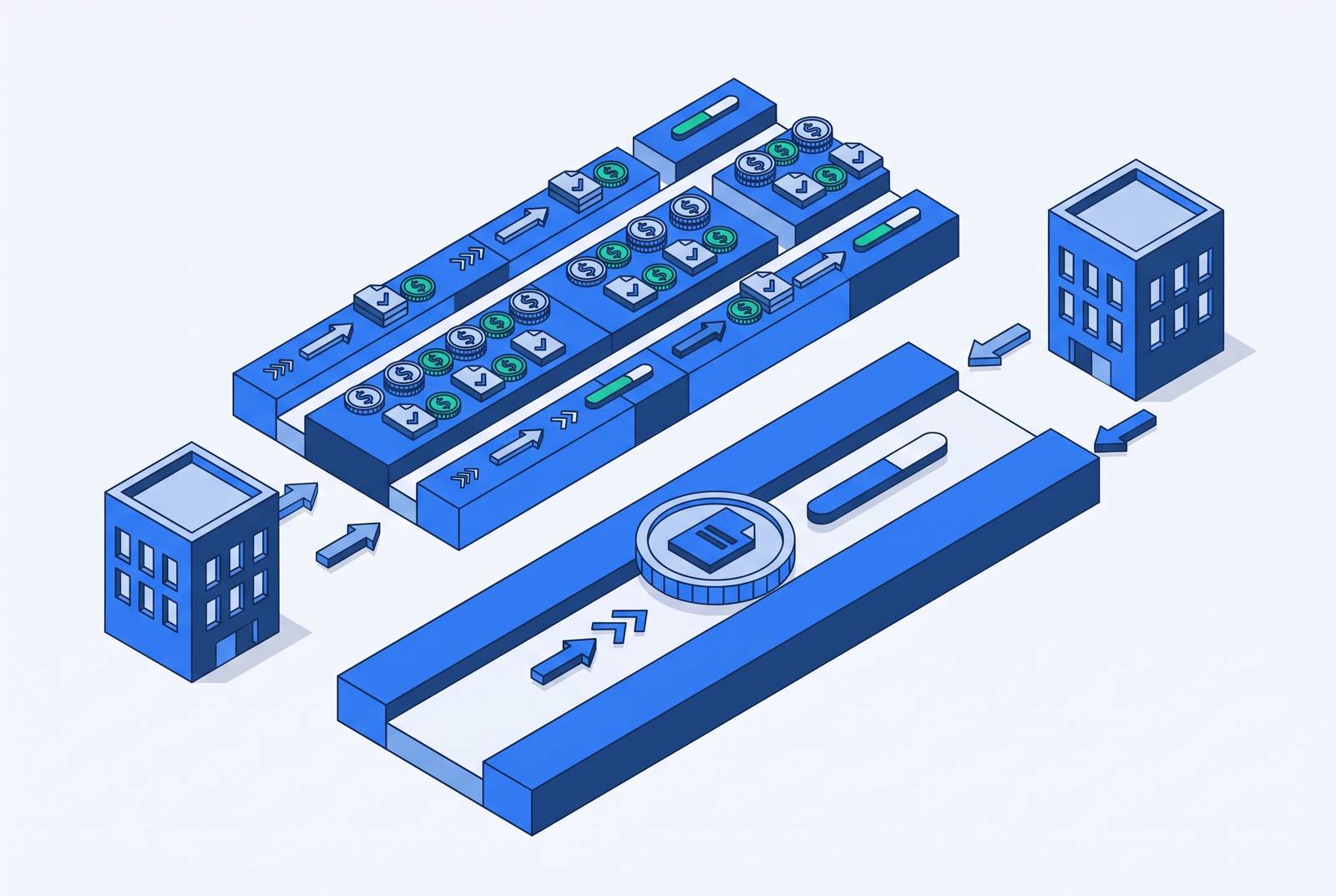
ACH and wire aren't a coin flip. They're two different plumbing systems, each with its own settlement math, fee structure, and reversal risk, and picking wrong shows up later as late invoices, mystery cash, or a reconciliation team quietly losing its mind.
Most finance teams don't actually choose, if we're honest about it. They default. Whatever the vendor used last time, whatever an intern set up back in 2019, whatever the bank's relationship manager pitched over a lunch nobody remembers. That habit-based decision-making has real consequences: how fast an invoice closes, how clean the remittance data comes in, and how many hours the AR team spends chasing down "who sent this $47,000 and what's it for."
B2B ACH hit 8.1 billion payments in 2025, according to Nacha, up almost 10% year over year. Fedwire moved an average of $4.5 trillion in value per day in 2024, according to Federal Reserve data reported by melio.com. So ACH won on volume. Wire still owns value. Neither number tells you which one belongs on the invoice sitting in front of you right now, which is the actual point here.
Three questions decide it every time: what settlement timing does to cash position, what the fee does to margin at scale, and what the data traveling with the payment does to the AR workflow. Walk through each one and the "ACH vs. wire" debate stops being a debate. It becomes a checklist.
How each rail actually moves money, and why the mechanics matter to AR
ACH is a batch system. Think of it like a mail sorting facility, not a courier. The originating bank (the ODFI, in the jargon) bundles a pile of payment instructions and hands them to the ACH operator, either the Fed or The Clearing House. The operator sorts everything by receiving bank and settles in batches across a few windows each business day. Nothing moves instantly because nothing moves alone.
Two flavors of ACH matter here, and people mix them up constantly. ACH credit is the payer pushing money out, which is what most customers use to pay an invoice. ACH debit is the payee pulling money in, which needs the customer's advance authorization and works best for recurring billing, the kind where the amount and date rarely surprise anyone.
Wire runs on the opposite philosophy. Every wire is its own individual, real-time instruction, no batching, no netting with the payment behind it in line. Domestic wires travel through Fedwire, which settles in real time and finally, or through CHIPS, which nets transactions once a day at a lower relative cost and carries the cross-border dollar leg of a bigger transaction. International wires ride on SWIFT, and this part trips people up: SWIFT is a messaging network connecting institutions in over 200 countries, not a settlement system. It tells banks what to do. It doesn't move the money itself.
Once a wire settles, that's it. Domestic wire settlement is final and irrevocable the same day it's sent. No do-over window, no grace period, no phone call that fixes it.
One mechanical update worth flagging: Fedwire has migrated to the ISO 20022 message format, which carries richer, structured data. For AR, though, the real question centers on something else entirely. It's whether the sending bank and the customer actually bother filling in the invoice reference field. ACH remittance data usually rides in the addenda record, and wires can now carry richer reference data post-ISO 20022. But "can carry" and "does carry" are different sentences, and cash application teams live in the gap between them.
Settlement speed: what "same day" means on each rail, and when it actually matters
Standard ACH settles in one to two business days. Same Day ACH settles inside defined windows, the Fed runs submission cycles at 10:30 a.m., 2:45 p.m., and 4:45 p.m. Domestic wire settles same day, often within minutes during banking hours, final the moment it clears. International wire beats a paper check or a slow local rail easily, but time zones, intermediary banks, and compliance checks routinely tack on hours, sometimes days.
What matters is not which rail moves faster in the abstract. It's whether the speed difference changes anything about the specific invoice on someone's desk right now.
A net-30 invoice with five days of runway left doesn't care about any of this. Standard ACH does the job fine. A past-due invoice where the customer swears they'll pay today to dodge a credit hold is a different story, and there, Same Day ACH or wire is the only option worth trusting. Quarter-end revenue recognition cutoffs are their own trap: that one-to-two-day ACH float can push cash that arrived "on time" into the wrong reporting period, the kind of clerical detail that turns into an uncomfortable conversation with the controller.
Same Day ACH's growth backs up how businesses are actually behaving. B2B Same Day ACH hit $585 billion in Q3 2025 alone, according to Nacha, up 15% year over year. That's a lot of companies deciding they want ACH's price tag with wire's urgency.
One caveat that trips people up: the Fedwire cutoff isn't the binding constraint. The sending bank's own cutoff is. Most banks stop accepting outbound domestic wires by early-to-mid afternoon, which means "wire it today" sometimes means "wire it before lunch."
The transaction limit gap, and how it's closing faster than most finance teams realize
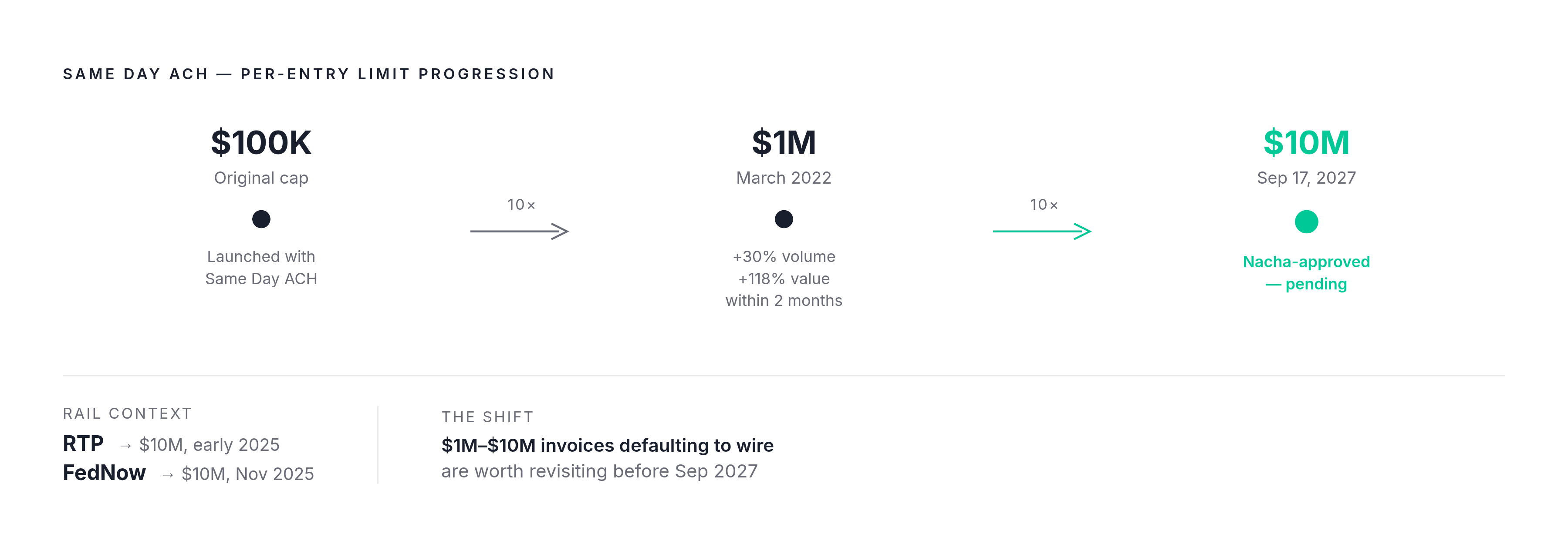
Wire has no practical ceiling from Fedwire or CHIPS. Whatever limit exists comes from the sending bank's own policy, not the rail itself, and that's exactly why wire stays the automatic pick for genuinely large transfers. Same Day ACH, by contrast, caps out at $1 million per entry today. Anything above that falls back to the slower standard cycle.
That ceiling is about to move, and finance teams planning multi-year AR strategy should already be penciling this in. Nacha has approved a rule raising the Same Day ACH per-entry limit to $10 million, effective September 17, 2027. Last time this kind of change landed, when the cap moved from $100,000 to $1 million in 2022, Same Day ACH volume rose 30% and value jumped 118% within two months, per Nacha. There's no real reason to expect 2027 to behave differently, and Nacha has said invoice and tax payments specifically are among the use cases the new limit targets, not a side effect of some other change.
Other real-time rails already moved first. RTP raised its own limit to $10 million in early 2025, and FedNow followed in November 2025. Same Day ACH's 2027 date brings it into the same neighborhood. For AR teams, the takeaway is simple: invoices in the $1 million to $10 million range that default to wire today, mostly because ACH couldn't handle the size, may not need to default there much longer. Anyone building AR automation or negotiating payment terms right now should build that shift into the plan instead of discovering it in 2027.
Cost per transaction, and what it adds up to across a real AR portfolio
Standard ACH runs cheap. Per AFP data cited by Nacha, median business cost sits somewhere between $0.26 and $0.50 a payment, and high-volume processors can negotiate meaningfully lower per-transaction rates. Same Day ACH costs more, low single digits per transaction depending on the bank or platform, a fair price for the extra speed. Domestic wire runs the sender roughly $20 to $35, and the receiving bank often tacks its own fee on top. International wire climbs higher still: base fees that can reach into the tens of dollars, plus an FX markup that depends on the currency corridor and how many correspondent banks the payment passes through along the way.
Run the scale math and the picture gets obvious fast. A finance team processing hundreds of payments a month on ACH can spend less in total fees than one company spends on a single international wire. Flip the scenario, though: on a $2 million invoice, a $25 wire fee is 0.001% of the invoice's face value. At that size, the fee is a rounding error. What matters is whether the money lands today, cleanly, with zero chance of clawback.
The better cost question was which rail offers greater value." It's what it costs to not close this invoice today, measured in DSO, in credit exposure, in the hours someone burns chasing it down next week instead.
Checks still set the low bar everyone's grateful to have cleared. Checks carry their own costs in processing time and manual handling, which explains the steady migration off paper: checks made up 81% of B2B payments in 2004 and had fallen to just 26% by 2025, per the AFP Digital Payments Survey. ACH didn't win because it's exciting. It won because it's cheap and checks are slow, and slow costs money.
Reversibility and fraud exposure: the risk profile each rail carries into your AR process
ACH's reversibility cuts both ways, and both sides are worth sitting with. On the AP side, it's a safety net: an erroneous payment gets caught and corrected inside the return window before it fully clears. On the AR side, that same window is a liability. A payment that looked like it closed the invoice can get clawed back by the sending bank, and suddenly a receivable marked closed is open again, DSO clock quietly restarting. Nacha's rules govern who can initiate a return and under what conditions, and unauthorized returns remain the most common source of friction in B2B ACH disputes.
Wire doesn't have that problem, because wire has no undo button. Once sent and settled, it can't be reversed unilaterally. Reversing a wire needs the receiving bank's cooperation and the recipient's consent, both of which a scammer is, understandably, reluctant to provide. That's precisely why some AR teams insist on wire for customers with a history of payment disputes: cash in hand, no reversal risk, no asterisk attached.
That same finality is also why business email compromise fraud goes almost exclusively after wire transfers. The absence of any clawback to fall back on once the money's gone is the whole appeal to the fraudster. A substantial share of corporate practitioners report experiencing payment fraud each year, and wire's irrevocability sits at the center of both its usefulness and its risk. ISO 20022 on Fedwire sharpens the screening on the front end, but it changes nothing about what happens once the money's out the door.
Here's the operational judgment call this boils down to for AR specifically: accepting ACH from a customer with disputed invoices or a shaky credit profile means the cash applied today might not stay applied. Requiring wire from higher-risk accounts is a prudent, sensible precaution. It's a legitimate collections posture, and any AR lead who treats it as optional is gambling with someone else's DSO.
Where each method fits in a B2B collections workflow, and where each creates hidden work
ACH earns its keep with recurring, predictable invoices, stable customer relationships, high enough volume that the per-transaction savings actually add up, and remittance data that reliably shows up in the addenda record. Line up all four and cash application runs on autopilot.
Pull any one of those away and ACH starts generating quiet, invisible labor. Payments show up with missing or mismatched remittance data, and someone on the cash application team manually matches a deposit to an open invoice. A return reopens what looked like a closed invoice with no flag telling anyone it happened, so DSO drifts upward for no obvious reason. Standard ACH timing lands wrong against a quarter-end close, and the float becomes a reporting problem instead of a minor inconvenience.
Wire earns its place on large invoices where settlement finality is worth the fee, on past-due balances where the AR team needs certainty before releasing goods or services, on international payments where ACH simply isn't on the table, and whenever a customer's AP department has standardized on wire as its outbound method of choice.
Wire has its own blind spots, though. A wire that arrives labeled "payment from XYZ Corp," no invoice number attached, forces the same manual matching a thin ACH addenda record does, even when the money landed the same day. Incoming wires that arrive after the bank's cutoff for same-day posting create a float nobody budgeted for. And plenty of ERPs simply don't auto-match on wire reference fields the way they do on ACH addenda data, so someone's opening a spreadsheet regardless of how fast the money moved.
Automation hasn't caught up to any of this, not even close. Only 5% of midsize businesses have fully automated their accounts payable and accounts receivable, according to PYMNTS data cited by Zip HQ. That gap, between what the rails can technically do and what workflows actually do with it, is where most of the hidden cost in AR quietly lives. Underneath all of it sit the boring, unglamorous blockers that have nothing to do with ACH or wire at all: missing W-9s, vendor portal submission rules, remittance disputes, duplicate payment flags. Those show up no matter which rail carried the money, and they're what keeps DSO stubbornly elevated even when the payment technically arrived on time.
A practical decision framework for choosing between ACH and wire on a given invoice
Three questions do most of the work. What's the settlement deadline, and does missing it cost something real, such as revenue recognition, a service hold, or a credit limit getting reset? If yes, reach for wire or Same Day ACH. If there's slack in the calendar, standard ACH is fine, and reaching for wire anyway is just paying for speed nobody needed.
What's the invoice value relative to the wire fee? Above a certain size, the fee disappears into rounding. Below it, ACH's cost efficiency is hard to beat, and paying $25 to move $800 is a bad trade no matter how urgent it feels in the moment.
What's the reversal risk on this particular customer? A disputed history, a brand-new relationship, or a credit-watch flag all argue for wire's finality. An established, low-risk customer is a fine ACH candidate, and paying a premium for certainty nobody needs is just money left on the table.
A few secondary checks matter too. Is the customer domestic or international? ACH is U.S.-only, and cross-border payments need wire or an international ACH transaction with slower settlement and thinner coverage. Does the customer's AP system force a specific rail? Large enterprises and supplier portals sometimes standardize on one method, and fighting that standard usually delays payment more than the rail choice itself ever could. And will remittance data actually travel with the payment? If it won't, someone's doing manual cash application no matter which rail carried the funds.
Build in one more adjustment for the calendar: that $10 million Same Day ACH cap lands in September 2027, so any invoice defaulting to wire purely because of size deserves a second look as that date gets closer.
These decisions recur. They don't happen once and stay decided. AR teams that set payment method preferences at the customer level, then actually revisit them once a year instead of setting and forgetting, consistently carry cleaner AR aging than teams that picked a rail back in 2019 and never thought about it again.
And whichever rail wins the argument on a given invoice, it still doesn't do the part of collections that actually eats the calendar: following up, navigating a client's payment portal, matching a stray remittance to the right invoice. ACH and wire move the money. They don't chase it. That operational layer, the persistent, unglamorous follow-through, has to exist regardless of which rail carried the payment there.