Common Causes of Overdue Invoices
Most late payments stem from multiple interconnected failures, not a single breakdown point.
Overdue invoices are almost universal in B2B. That's not an exaggeration. According to Chaser's 2026 AR Report, 92% of businesses are typically paid after their invoice due date. Allianz Trade found that more than half of all global B2B invoices were paid late in 2024. The QuickBooks 2026 Small Business Late Payments Report puts 59% of small businesses carrying invoices overdue by 30 or more days. That number was 47% the year before.
These are not numbers from companies in trouble. They describe normal operating conditions for normal businesses.
That prevalence is worth sitting with for a second. If late payment is this common, the causes can't be random. They have to be structural. Recurring. Built into how most businesses operate. And if that's true, then the right question isn't whether your invoices will go overdue. It's understanding exactly why they do. And the answer, almost always, is not one thing.
Why Overdue Invoices Are Almost Never One Person's Fault
Finance teams tend to treat late payment as a cash flow problem. And it is. But the causes stretch across documentation, internal process, communication, and buyer behavior. That's a wide net.
Here's what makes it tricky. Each breakdown stalls payment at a completely different point in the AR cycle.
- Some problems stop an invoice from being valid in the first place
- Some bury it inside the buyer's approval system
- Some freeze payment silently because of a dispute nobody said out loud
- Some are just the result of nobody following up
Fix one of those without touching the others, and most of the problem is still there. That's the core idea this whole piece is built around. The causes are distinct. They stack. And they each need their own fix.
Invoice Errors and Missing Information That Stop Payment Before It Starts
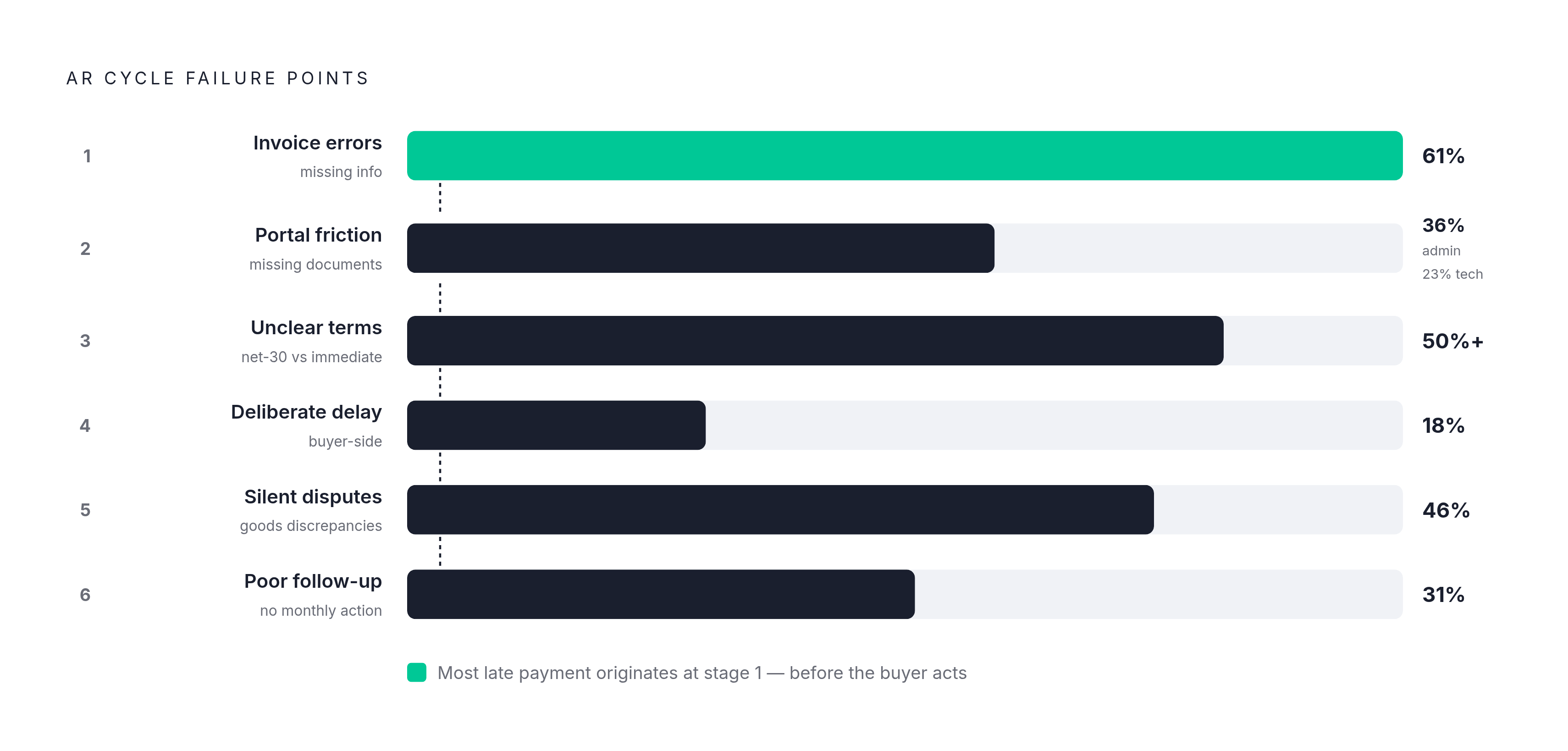
Here's a number that should reframe how you think about late payment: 61% of late payments are caused by incorrect invoices, per Skynova invoicing statistics. That means the majority of late payment events start with the sender, not the recipient.
Common culprits:
- Wrong amounts
- Mismatched or missing PO numbers
- Invoices missing line-item detail
- Invoices sent to the wrong contact or department
Versapay surveyed 1,000 C-level executives and found that human error in the payment process was the most frequently cited cause of invoice disputes, named by 50% of respondents. A separate PYMNTS Intelligence figure (via WEX Inc., 2024) found that 35% of mid-sized firms still rely entirely on manual AR processes. On average, 57% of invoice data is entered manually, per Skynova.
Manual entry is not just slow. It is the direct production mechanism for most of these errors.
What this means practically: an incorrect invoice doesn't just get rejected. It restarts the clock. The correction and rebilling cycle can easily add weeks to a payment that was already on a net-30 or net-60 timeline. By the time the corrected invoice goes out, the buyer's AP team has already moved on to something else.
Missing Documents and Supplier Portal Friction That Stall Processing
This one gets overlooked a lot because it doesn't feel like a real problem. But it is.
Large buyers increasingly require invoices to be submitted through procurement portals. Coupa, Ariba, and similar platforms are standard at enterprise-level companies. To get paid, you don't just send an invoice. You register as a vendor. You upload documentation. You navigate their system. And if anything is missing or wrong, the invoice never reaches an approvable state.
A missing W-9. An incomplete vendor setup. A portal registration that never got finished. None of those are disputes. The buyer fully intends to pay. But the invoice is stuck in pre-processing limbo, and often nobody tells you.
UK Department of Business and Trade research from September 2024 found that administrative errors account for 36% of delayed and unpaid invoices. Technical issues add another 23%. Skynova's research found that 49% of businesses require two to three internal approvers for an invoice on the buyer's side alone, and each of those handoffs is a potential stall.
The distinction here from the error category is important. The invoice can be perfectly correct and still be completely stalled because it doesn't meet the buyer's system requirements. These are operational blockers. Not relational ones. They can be cleared, but only if someone is actively tracking them down.
Unclear Payment Terms That Leave Buyers Room to Delay
The structure of your payment terms shapes what happens before a single follow-up call is made.
The QuickBooks 2026 Report found that more than half of businesses on net-30 terms carry overdue invoices, compared to 26% of those on immediate terms. Among businesses with no overdue invoices at all, 64% require immediate payment.
The pattern is consistent. Longer runways produce more drift. Sometimes that drift is genuine oversight. Sometimes it's something else entirely (more on that in the next section). But the terms themselves are the frame that makes delay possible.
Ambiguous terms add a second layer of risk. Confusion over due date calculation, acceptable payment methods, or whether a discount applies gives a buyer's AP team a legitimate reason to sit on an invoice. And terms that omit any consequence for late payment remove the cost of delay entirely.
This isn't about blaming the seller. It's about recognizing that the terms document is doing more work than most people realize. When the terms are tight and clear, there's less room for anything to slide.
Buyers Who Deliberately Extend Payment to Manage Their Own Cash Flow
Okay. Here's where it gets a little less sympathetic.
Some buyers pay late on purpose. The UK Department of Business and Trade survey found that 18% of businesses reported their customers purposely pay late, treating it as a form of free finance. The mechanism is straightforward: by withholding supplier payments, larger buyers effectively take a short-term, interest-free loan from their supply chain.
The most documented extreme case of this is Carillion plc, the UK construction giant that collapsed in 2018. Carillion had imposed 120-day payment terms on smaller contractors. When it went under, it owed approximately £2 billion to around 30,000 creditors. Those contractors weren't late-payment statistics. They were funding Carillion's operations.
Atradius 2025 research found that customer cash-flow pressures are the primary cited contributor to overdue B2B invoices in the US, at 43%. But that figure includes both genuinely constrained buyers and strategic delayers, and the distinction matters enormously.
The UK government has since announced what it's calling the most significant overhaul of payment legislation in over a generation. Late payments are estimated to cost the UK economy £11 billion per year. That's not a rounding error.
When delay is strategic, chasing harder doesn't fix it. Escalation, leverage, and terms enforcement are the only things that move the needle.
Disputes Over Goods, Services, or Contract Terms That Freeze Payment Silently
This is the one that ages the worst.
The Versapay survey of 1,000 C-level executives found that issues with goods or services provided and discrepancies between proposals and invoices were each cited by 46% of respondents as frequent causes of invoice disputes. UK Department of Business and Trade research attributed 31% of delayed or unpaid invoices to disputed invoices.
Here's the pattern worth naming. A buyer stops responding to reminders. They're not ignoring you because they forgot. They have a problem with the work or the terms, and they never said so out loud. No formal dispute raised. No email sent. Just silence.
By the time an invoice is 30 or more days overdue with no response to reminders and a phone call, the issue is usually no longer administrative. It signals a dispute, a relationship issue, or a decision-maker change.
Silent disputes are harder to resolve than declared ones. The clock runs while the seller assumes it's an oversight and keeps sending the same polite reminder email. The invoice ages. The relationship frays. And the conversation that could have solved it in week one becomes a much harder conversation in week eight.
The absence of a response is itself a signal. It's diagnostic information. Treat it that way.
Poor Follow-Up Practices That Allow Overdue Invoices to Age Without Resolution
A lot of late invoices aren't late because of anything the buyer did. They're late because nobody went after them.
Chaser's 2026 AR Report found that 31% of businesses do not act on all overdue invoices each month. Of that group, 46% leave between 10% and 30% of overdue accounts completely unaddressed each month. An eBizCharge survey of 553 finance professionals in 2025 found that 20% don't track past-due invoices at all. No visibility. No aging report. No idea how much AR is sitting past 30 days.
The same eBizCharge research found that 69% of businesses have only one person handling all AR and collections. One person. A single-person operation cannot maintain a consistent follow-up cadence across a growing receivables ledger. Not sustainably. Something gets missed every month.
And then there's this: a Gateway Commercial Finance survey of 500 SMBs from June 2025 found that 60% of small business founders avoid confronting customers over delinquent bills because they're afraid of damaging the relationship.
Put all of that together:
- No tracking system
- One person responsible for everything
- Genuine reluctance to escalate
That combination creates a follow-up vacuum. Invoices don't just sit. They age. And aging is not passive. Invoices that drift past 60 or 90 days become progressively harder to collect. The cost of inaction compounds every week.
How Buyer-Side Administrative Breakdowns Bury Invoices That Were Never Disputed
This one doesn't need a dramatic statistic. The mechanism is boring, which is exactly the point.
Invoices get lost in inboxes. They get sent to the right company but the wrong person. They sit in a multi-step internal approval queue while the supplier assumes they're pending payment. Nobody disputes the invoice. Nobody has a problem with the work. The invoice is just stuck somewhere in the buyer's internal process, and no signal comes back to say so.
Skynova's finding that 49% of businesses require two to three internal approvers per invoice means every handoff is a potential stall. When you follow up by email to the original contact, you are reaching someone who forwarded it to finance in week one and has completely forgotten about it. The person who actually needs to approve the payment never sees your follow-up.
This is different from strategic delay. Intent is absent here. The fix isn't enforcing your terms. It's figuring out how the buyer's internal process actually works and navigating it, which usually means getting on the phone and asking directly who needs to touch this before it gets paid.
The Downstream Cost That Accumulates When These Causes Stack
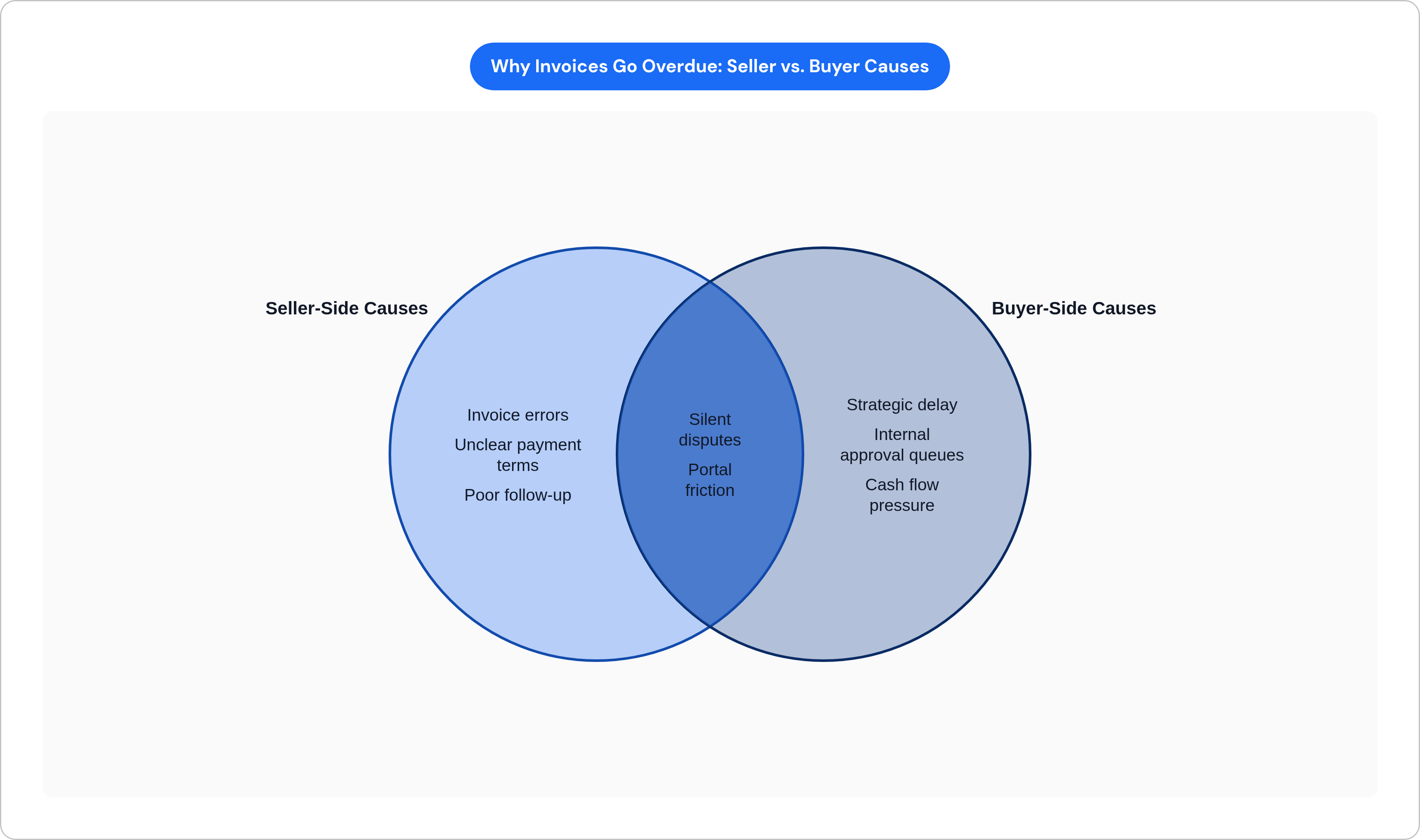
Each cause above doesn't just create its own problem. It adds load to a running total.
Errors trigger rebilling cycles that add weeks. Portal friction delays acceptance before the approval clock even starts. Disputes freeze payment silently while the invoice ages. Poor follow-up lets all of it sit. Buyer-side admin breakdowns bury invoices that nobody disputes but nobody processes.
Here's what that total looks like in aggregate. The average annual cost from late payments is $39,406 per company, with 10% of companies suffering over $100,000 in expenses related to late payments, per figures cited by Kaplan Collection Agency. Businesses waiting on unpaid invoices are owed an average of $17,700 (QuickBooks 2026). Outstanding invoices represent an average of 11% of total revenue, per the Gateway Commercial Finance June 2025 survey.
39% of owners said one late payment made it hard to cover payroll or bills in the past year. 65% of businesses spend 14 hours per week on collections administrative tasks. And Allianz Trade estimates that late or unpaid invoices cause up to 25% of bankruptcies.
The part that should bother you most: these causes are predictable. Every single one of them. They're not random bad luck. They're a fixed set of failure modes that occur at known points in the AR cycle, in known combinations, with known consequences.
That predictability is the argument for building systems around them instead of chasing one invoice at a time, and it's what tools like Invoice Butler, an accounts receivable automation platform that uses AI agents and human collections experts to follow up on overdue invoices across email, phone, and SMS, are built to handle at scale.