Accounts Receivable Process Fundamentals
Understanding AR fundamentals prevents collections problems from starting in the first place.
How the AR Cycle Fits Inside the Broader Order-to-Cash Process
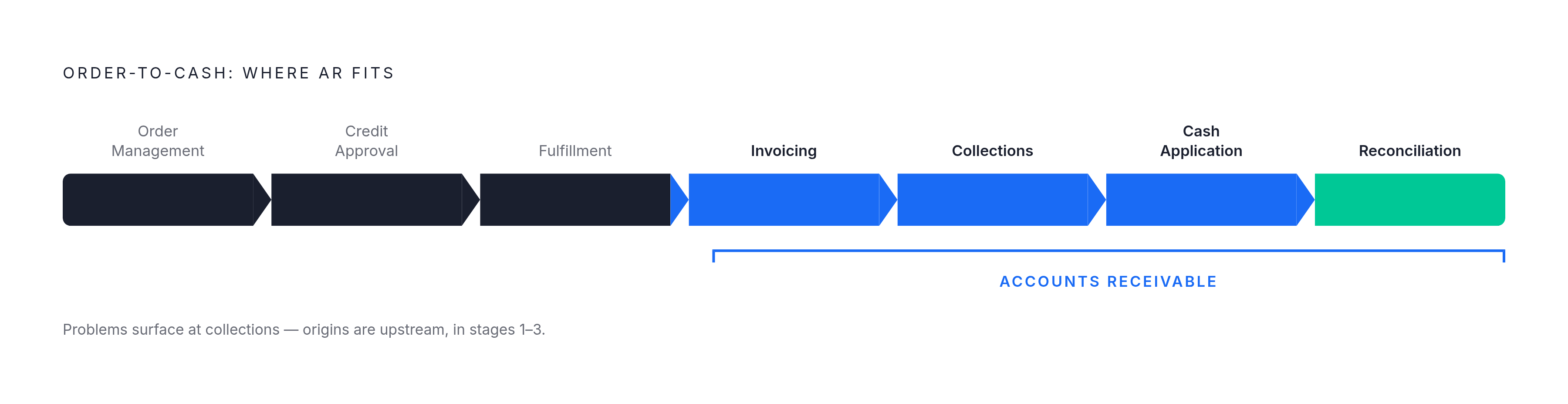
Order-to-Cash (O2C) is the full arc from the moment a customer places an order to the moment cash lands in your account and gets recorded properly. It covers order management, credit approval, fulfillment, invoicing, collections, cash application, and reconciliation.
AR picks up at invoicing and runs through the end.
That distinction matters more than most people realize. A lot of AR problems that look like collections failures started as fulfillment failures, credit failures, or documentation failures. They just don't show up until the invoice is out and the due date is close. If you only manage AR from the invoice forward, you're already playing defense against problems that were baked in weeks ago.
The AR cycle begins the moment an invoice is generated. It ends when payment is received, applied to the right open item, and reflected accurately in the books. Everything in between is where cash can stall. And it stalls in the same places, for the same reasons, at company after company. O2C is a handoff game — AR doesn't run the whole track, but if the baton gets fumbled before it reaches you, the rest of the race doesn't matter.
Credit Evaluation and Customer Onboarding: The First Line of AR Defense
The single most effective thing you can do to improve collections is evaluate credit before you extend it. Not after the sale. Not when the invoice hits 45 days past due. Before.
Credit evaluation happens at onboarding. And it shapes every AR interaction you'll ever have with that customer. A useful framework is the five C's:
- Character. Does this customer have a history of paying on time?
- Capacity. Can their cash flow actually support the payment obligation they're taking on?
- Capital. What financial reserves do they have?
- Collateral. Is there anything securing the debt?
- Conditions. What's the external environment doing to their business?
A well-defined credit policy tells your team which customers get net terms and which pay upfront. It removes the guesswork and the awkward sales-finance tension where a rep wants to close the deal and finance isn't sure what terms make sense. Document the policy. Communicate it. Ambiguity at this stage becomes a dispute six weeks later.
Onboarding is also when you collect the documents that will otherwise block payment down the road. W-9s. Tax exemption certificates. Supplier portal registrations. If you're discovering at the 60-day follow-up call that a required document is missing, that's not a collections problem. It's an onboarding problem that just showed up late.
Purchase Orders, Sales Orders, and the Documentation Chain That Makes Invoicing Clean
In B2B, most enterprise customers operate with purchase orders. A PO is the customer's formal, documented intent to buy. Once approved, the seller generates a sales order capturing the goods or services, quantities, prices, and agreed terms.
Here's where this gets painful in practice: many AP departments will reject or delay any invoice that doesn't reference a valid PO, or that doesn't match the PO exactly. Wrong quantities. Wrong item descriptions. Wrong pricing. Any of it can kick the invoice out of the approval queue.
And when that happens, the clock doesn't stop. Your net terms keep counting down. The customer's AP team will likely say nothing. You wait, wonder, and eventually chase.
Getting PO and sales order documentation right isn't glamorous. But it dramatically reduces dispute volume downstream. Every dispute adds days to your collection time, and those days stack fast across hundreds of invoices. A mismatched PO is a small error with a surprisingly long tail of consequences — the kind of thing nobody thinks is a big deal until they're staring at a 90-day-aged invoice that traces back to a single line-item description that didn't match.
Invoice Generation and Delivery: How You Send Matters as Much as What You Send
A good invoice covers the basics:
- Clear payment terms and due date
- Itemized charges
- Accepted payment methods
- PO reference numbers the customer requires
- Correct billing address and contact information
Generating a clean invoice is only half the job. Delivery is the other half, and it's where a surprising number of invoices quietly disappear.
Many enterprise customers now require vendor invoices through procurement platforms like Coupa or Ariba. Emailing a PDF to your contact doesn't count. The invoice needs to go through the portal. If it doesn't, it never reaches the AP team that approves it. It's effectively invisible — like mailing a letter to a house that's already been demolished.
Errors, wrong amounts, missing PO numbers, incorrect addresses, are a leading cause of payment delays. Delivery failures push out your entire collection timeline with no fault sitting on the customer side. They never got the invoice. The payment clock hadn't started.
The clock starts when a correct invoice lands with the right person through the right channel. Not when you hit send.
Payment Terms: They Set Expectations and Create Risk Before Anyone Is Ever Late
Payment terms are a credit decision dressed up as a sales accommodation. Treat them that way.
Common structures:
- Net 30, 60, 90. Customer pays the full invoice within 30, 60, or 90 days of the invoice date.
- 2/10 Net 30. Customer gets a 2% discount for paying within 10 days. Otherwise, full amount is due at 30.
Longer terms increase working capital burden on the seller. And right now, that burden is significant. Global working capital levels hit their highest point since 2008 in early 2025. That's the environment you're operating in when you casually offer a new customer Net 60 without thinking hard about it.
Terms should reflect the actual credit risk of the customer. A new account with no track record getting Net 90 isn't a favor. It's a risk exposure with a friendly name attached. Don't extend it reflexively just because someone asked.
Early payment discount programs (sometimes called dynamic discounting) are worth building into your terms framework. For customers with available cash, a small discount creates a real incentive to pay faster. That shortens your effective collection time without waiting around for the due date to pass.
Whatever terms you agree on, put them on every invoice and confirm them at onboarding. Disputes over what was agreed are more common than they should be, and they almost always trace back to nothing being written down clearly the first time.
Payment Monitoring and the AR Aging Schedule: Your Collections Control Panel
The AR aging schedule is the most useful document in receivables management. It buckets outstanding invoices by how long they've been unpaid:
- Current
- 1 to 30 days past due
- 31 to 60 days past due
- 61 to 90 days past due
- 90-plus days past due
This is your real-time picture of the receivables portfolio. It tells you who needs follow-up now, who's trending the wrong direction, and who's quietly heading toward bad debt.
The hard truth about aging: the older a receivable gets, the harder it is to collect. Full recovery probability drops meaningfully once an invoice crosses 60 days. That matters more than it sounds given how much of the average receivables portfolio now sits in that range.
But aging alone isn't a prioritization system. A $500 invoice 15 days late is a very different situation from a $50,000 invoice 45 days late. You need to segment by dollar value and customer risk profile. Otherwise you're burning real effort on low-value accounts while a high-value balance quietly ages into a write-off. That's a bad trade, and it happens more than people want to admit.
The Collections Follow-Up Process: From First Reminder to Escalation
The goal of collections isn't just to chase late invoices. It's to prevent them from getting late in the first place.
A proactive reminder seven days before the due date is standard practice for a reason. It surfaces blockers early — missing documents, portal issues, wrong contacts — while there's still time to fix them before the due date passes. Once the date passes, you're playing catch-up.
A tiered follow-up structure looks roughly like this:
- Reminder seven days before due date
- Notice on the due date
- Escalating follow-up at seven, fourteen, and thirty days past due
- Account review at sixty-plus days
Tone matters. Early reminders can be friendly and automated. Later-stage follow-up on large balances needs a real human involved. Sending a polite automated email to a customer who owes you $80,000 and hasn't responded in five weeks isn't a strategy — it's activity wearing a strategy's clothes.
Common blockers that delay payment even after follow-up:
- Missing W-9s or insurance certificates
- Portal submission errors
- Invoice sent to the wrong contact
- Invoice in active dispute
Collections often stalls on operational problems, not customer unwillingness. Knowing the difference changes how you respond and how fast you resolve it.
Define your escalation triggers in advance. At what point does a past-due account move from AR staff to a finance manager? When does the sales rep get pulled in to protect the relationship? When does it go to legal? Without defined triggers, every situation gets handled ad hoc. Which means slowly, inconsistently, and with a lot of unnecessary stress.
Dispute Resolution: What Happens When a Customer Pushes Back on an Invoice
Disputes are normal. The question is whether your team has a defined process for handling them or is improvising each time.
Common dispute types:
- Billing errors. Wrong amount, duplicate invoice, incorrect terms.
- Delivery disputes. Goods not received, or not as described.
- Contractual disagreements. Scope, pricing, terms.
- Missing documentation. Customer requires something you didn't include.
A documented dispute resolution process tells AR staff exactly what to do when an issue comes in: who owns it, what information is needed, what the resolution timeline looks like. Without that, disputes sit in someone's inbox while the invoice ages.
Some disputes are valid and require a credit note or invoice revision. Others are delay tactics. Experienced AR people develop a feel for which is which fairly quickly. A good process helps your team tell the difference without endlessly accommodating customers who are just buying themselves another billing cycle.
Track dispute root causes. If the same type of dispute keeps recurring, faster dispute handling isn't the fix. The fix is upstream, in invoicing, contracting, or delivery documentation. A dispute management process that never feeds back into process improvement is just organized firefighting. Efficient, maybe. But still firefighting.
Cash Application: Matching Payments to Invoices Once Money Arrives
Cash application sounds simple. Money comes in, you match it to the invoice, you update the account. Done.
In practice, it's one of the messier parts of the cycle.
Customers often pay multiple invoices in a single remittance. They send partial payments. Remittance details come in inconsistent formats, or don't come at all. A wire transfer arrives with a memo that says "June invoices" and nothing else. Now someone has to figure out which invoices that covers. That someone is usually an AR analyst who has forty other things to do and genuinely does not find this fun.
Misapplied payments create a cascade of downstream problems:
- False credit holds on customer accounts
- Inaccurate aging reports
- Customer disputes triggered by incorrect account status
- Reconciliation delays that hold up financial close
This is one of the highest-ROI areas for automation in AR. Not because the work is intellectually hard, but because it's high-volume, repetitive, and deeply unpleasant to do manually at scale. AI-powered matching tools use reference numbers, invoice amounts, and payment history to improve match rates. The manual work of hunting down remittance details is exactly what software handles better than people, and it frees up the people for the work that actually requires them.
Reconciliation and Reporting: Closing the Loop on the AR Cycle
Reconciliation confirms everything is accurate. Payments match invoices. Account balances reflect what's actually owed. The AR ledger agrees with the bank.
Done well, it ensures your balance sheet is telling the truth. Discrepancies here — cash misapplication, unapplied credits, duplicate payments — distort financial reporting and make cash forecasting unreliable. You think you have more or less cash than you actually do. Neither version is good.
A regular reconciliation cadence catches errors before they compound. Weekly is better than monthly. Monthly is better than quarterly.
Reporting outputs from this stage:
- Updated aging schedule
- Bad debt reserve adjustments
- DSO calculations
- Audit trail of collections activity
Reconciliation is the official close of the cycle for a given invoice. It's the moment a receivable becomes realized revenue. Until it's done, the work isn't done. Even if the cash is already sitting in your account.
The KPIs That Tell You Whether Each Stage of the Cycle Is Working
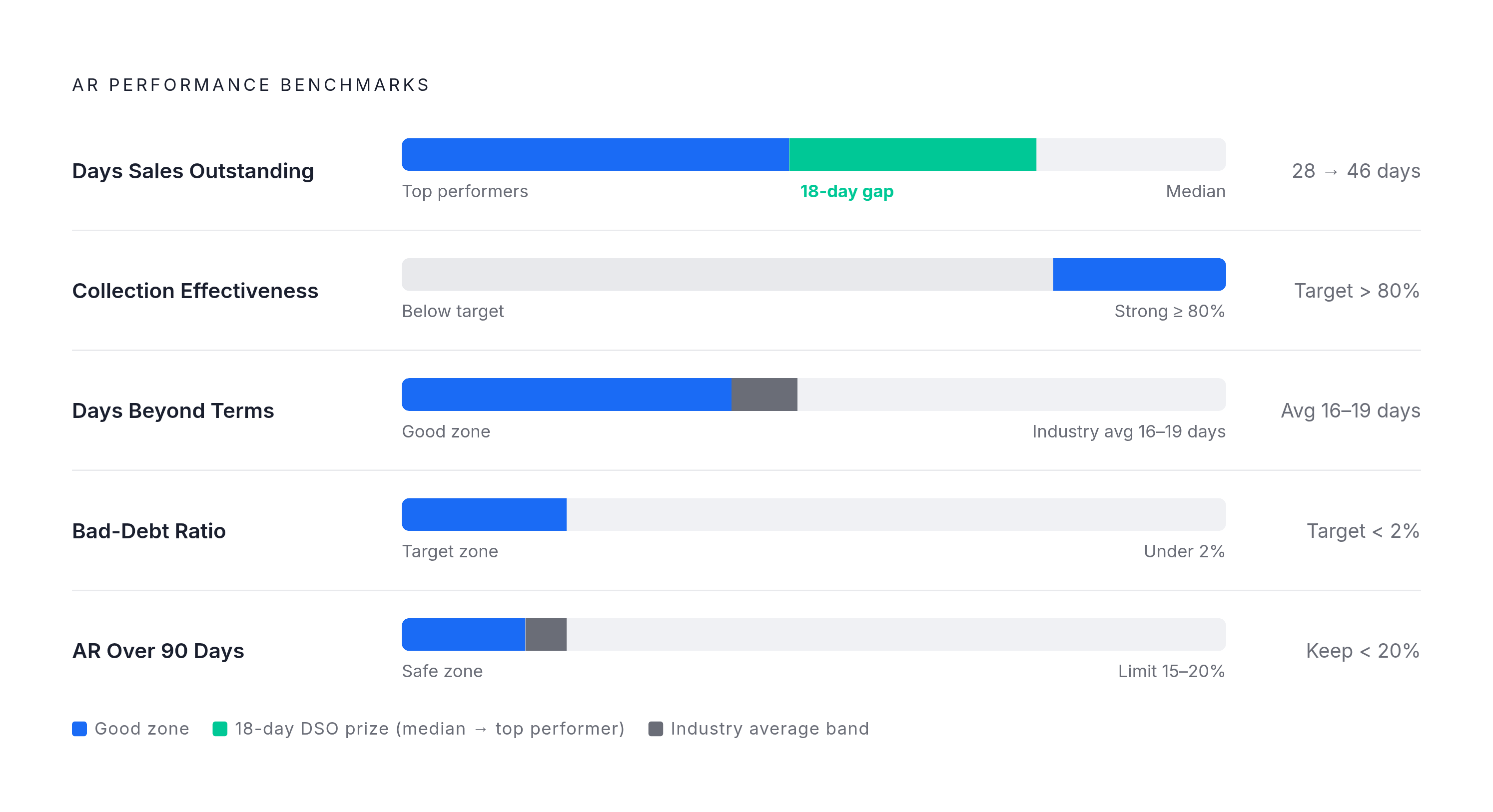
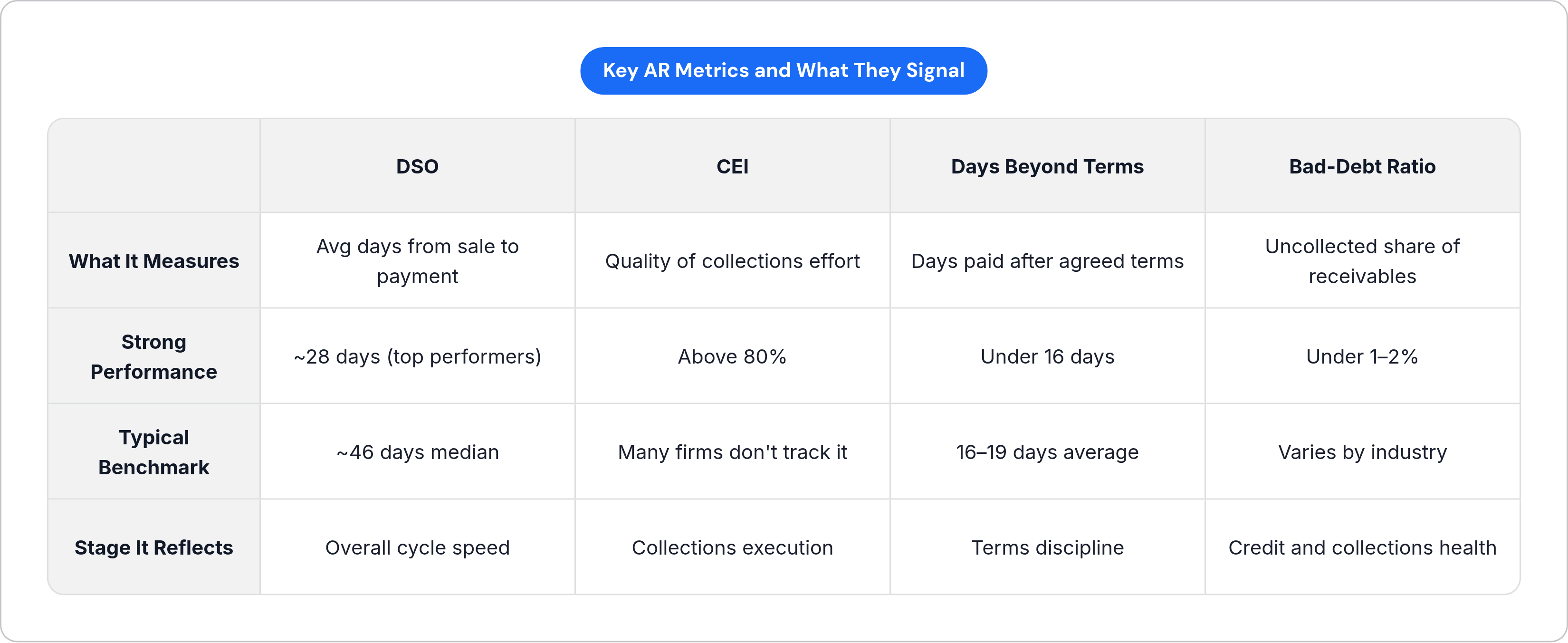
Each metric maps to a specific stage. Together, they give you a working dashboard for the whole cycle.
Days Sales Outstanding (DSO). The average number of days between a sale and collecting payment. Median benchmark is around 46 days; top performers are closer to 28. This is the most commonly tracked AR metric, and it reflects overall cycle speed.
Collection Effectiveness Index (CEI). Measures the quality of collections effort, not just speed. A CEI above 80% generally signals strong performance. A significant share of companies don't track this one at all, which tells you something about how much room there is to improve.
Days Beyond Terms (DBT). How many days past the agreed due date payments actually arrive. If your terms say Net 30 but payments are arriving at day 49, your DBT is 19. Industry benchmarks put that average around 16 to 19 days.
Average Days Delinquent (ADD). The companion metric to DSO. Tracks how long delinquent invoices have been sitting unresolved.
Bad-debt ratio and AR turnover. Secondary but useful. A bad-debt ratio under 1 to 2% and AR turnover of 6 to 12 times per year are solid targets for most businesses.
Cash application match rate and aging bucket distribution. These reflect how the back end of the cycle is functioning. Keeping AR over 90 days below 15 to 20% of the portfolio is what most teams are working toward.
If something's off, these numbers tell you where to look. They don't tell you what to do about it. That part is still yours.
Where Cash Actually Stalls: The Real Friction Points Across the Cycle
Late payments aren't evenly distributed. Some industries are reliably slower than others. Office facilities management stretches toward triple-digit days to payment. Manufacturing suppliers regularly report payment timelines close to two months. Industries with complex delivery documentation or high customization see more dispute volume and longer collection timelines. That's just the terrain.
But stalled cash isn't always about slow-paying customers. Operational blockers account for a significant share:
- Missing documents that no one collected at onboarding
- Portal submission errors that nobody caught
- Invoices sent to the wrong contact
- PO references that don't match what's in the customer's system
These aren't customer problems. They're process problems. And they're fixable, which is the part people sometimes forget when they're frustrated and chasing the same customer for the third time over the same issue.
The costs compound. Late payments run tens of thousands of dollars per company per year in direct and indirect costs. In fast-scaling sectors like SaaS, defaults can wipe out a material percentage of annual revenue. And at the macro level, U.S. companies are sitting on enormous pools of earned-but-uncollected cash. Revenue on paper that isn't revenue yet.
What Automation and AI Can (and Can't) Do
Automation has genuinely changed what's possible in AR. A few areas where it delivers real, documented value:
Invoice delivery and status tracking. Automated systems can submit invoices through supplier portals, confirm delivery, and flag rejections without a human touching each transaction.
Collections outreach. Early-stage follow-up, pre-due-date reminders, day-of notices, first-touch past-due emails, can be systematized and personalized at scale. This frees AR staff for conversations that actually require judgment: large balances, escalated disputes, relationship-sensitive accounts.
Cash application. AI-powered matching tools have meaningfully improved straight-through match rates. The reference-number-hunting and spreadsheet-matching work that used to eat hours per day is increasingly handled automatically.
Reporting and aging. Automated dashboards update in real time and surface prioritization flags without someone manually rebuilding the aging report each week.
Where automation runs into trouble is more important to understand than where it excels.
It doesn't fix bad processes. If your credit policy is unclear, if your onboarding misses required documents, if your PO matching is inconsistent, automation scales those problems faster than you'd like. The software doesn't know your process is broken. It just executes faster.
It also doesn't replace judgment on complex disputes, sensitive customer relationships, or escalation decisions that carry real commercial stakes. The collections call where you're trying to preserve a significant customer relationship while also recovering a past-due balance isn't something anyone has automated yet. It's a conversation. It requires knowing the history, reading the room, and making a call on the spot.
The best AR teams understand where those lines are. They use automation to clear the volume and repetition off their plates, so that when a situation genuinely needs a person, there's actually a person available to handle it.