Early Payment Discounts and Dynamic Discounting Programs
A 2% discount compounds to 36% annualized returns, reshaping supplier-buyer cash management.
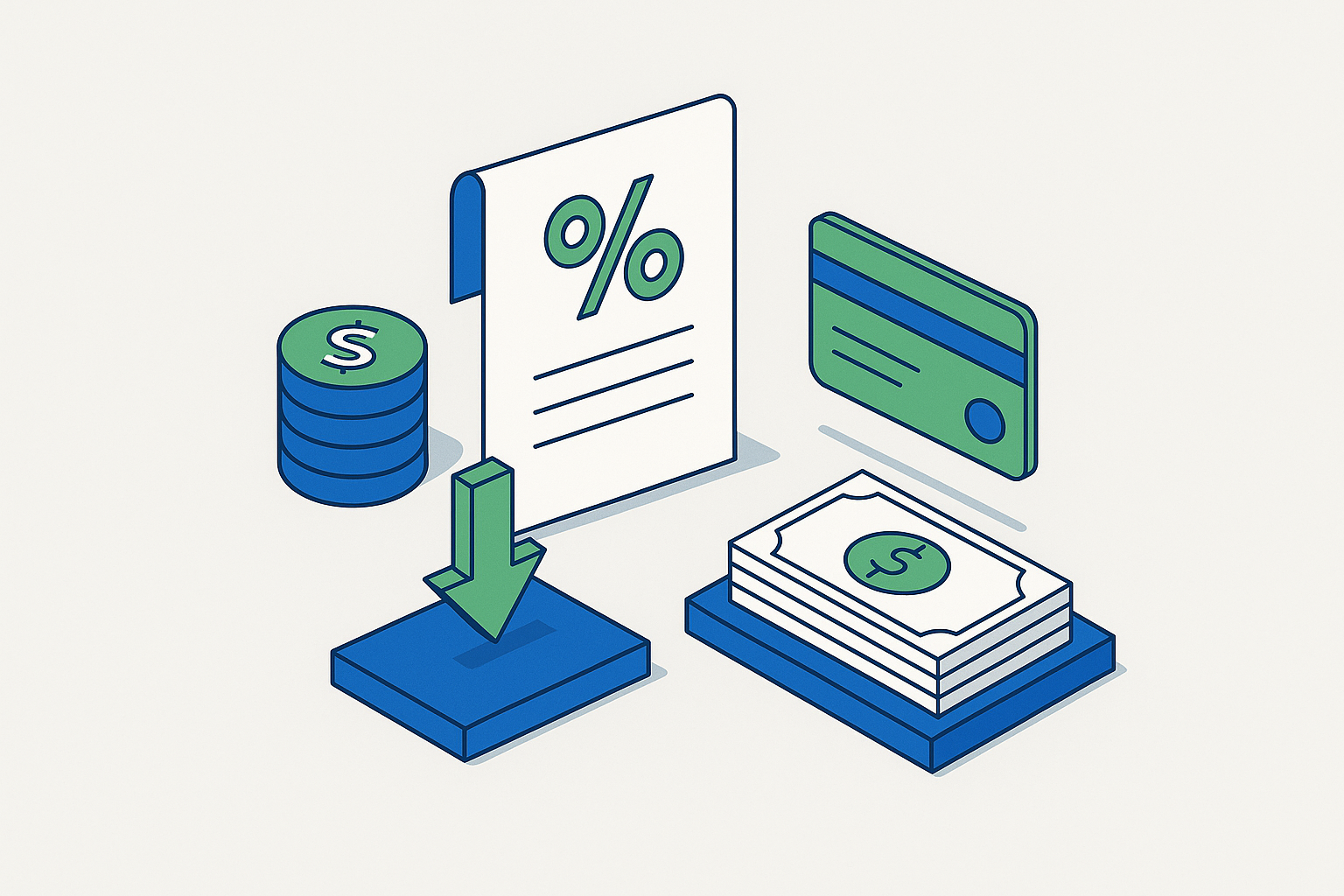
Two percent doesn't sound like much. Offer it on a 30-day invoice, though, and the annualized return clears well into the double digits. Banks don't pay that. The gap between how small the discount looks and how big the return actually is explains most of what's happening in early payment programs right now.
Quick vocabulary check, because this corner of finance loves three names for the same thing. An early payment discount, sometimes called a prompt payment discount or an early settlement discount, is a price cut a supplier offers if the buyer pays before the invoice comes due. The classic version shows up written as "2/10 Net 30": pay within 10 days and knock 2% off the bill, or pay the full amount by day 30. Most real terms sit somewhere in that 1-2% range on 30 to 60 day schedules.
There are three ways to build this, and each one hands more control to the buyer than the last. A static discount is fixed and binary; take it or leave it, written straight into the terms. A sliding-scale discount tiers the incentive down over time, maybe 2% within 5 days, a lower rate within 10, 1% within 15. Dynamic discounting goes further. The discount moves every day based on exactly when payment lands, so 2% on day 5 might drift down to a lower rate by day 12. There's no cliff, no fixed deadline, just a rate that tracks the calendar. This isn't the same thing as supply chain finance, even though people mix the two up constantly. We'll untangle that further down.
The annualized return math that makes early payment discounts financially significant
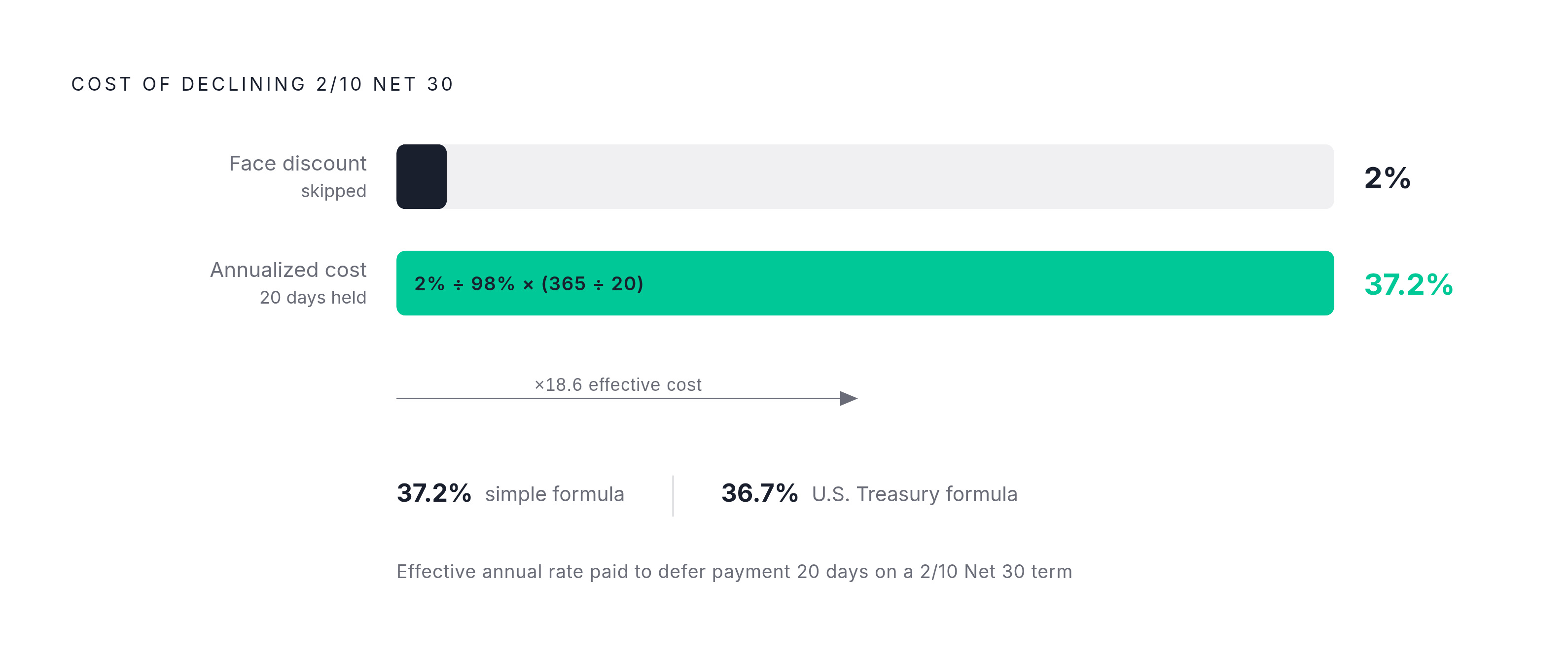
A 2% discount looks like pocket change until you annualize it. Take the discount percentage, divide by one minus that discount, then multiply by 365 divided by the number of days you're saving.
Run 2/10 Net 30 through that and you get 2 ÷ 98 × (365 ÷ 20), which lands around 37.2%. The U.S. Treasury runs a version of this same formula for its own prompt payment guidance and gets about 36.7%. Close enough that the two numbers basically shake hands.
Flip it around and it stops feeling harmless. Declining that discount isn't "holding onto your cash." It's paying an annualized rate of roughly 36-37% to keep a small sum, or a very large one, sitting in your account for 20 extra days. Nobody signs up for a loan at that rate on purpose, yet companies do the equivalent of it constantly, just by letting discounts sit on the table.
Scale it up and the number stops being a fun fact. A company buying $10 million a year under 2/10 Net 30 terms saves a significant sum each year if it captures every discount offered. Bigger spend, bigger miss.
One catch, and it's the whole thing: that 37% return only shows up if you've got cash sitting around to deploy, and if invoice processing moves fast enough to act inside a 10-day window. Most companies fail on the second part, not the first, and we'll get into why in a minute.
How dynamic discounting works as a program, not just a term structure
Dynamic discounting isn't a fancier discount schedule bolted onto an invoice. It's a running program, usually built on top of an AP automation or treasury platform, with its own software layer doing the work underneath.
Roughly how it plays out: the buyer uploads approved invoices, the supplier sees them, and the supplier can request early payment whenever it wants, at a rate that adjusts daily depending on how far ahead of the due date the payment lands. Ask on day 3, get one rate. Ask on day 9, get a smaller one.
The money comes straight off the buyer's own balance sheet. No bank, no outside financier. That's the defining feature, and it's what separates this from supply chain finance. The buyer earns a return on cash that would otherwise sit in a low-yield account doing nothing, and the supplier gets cash on demand instead of waiting out the full net terms.
The platform handles the parts that used to make static discounts painful to run at scale: calculating the daily rate, notifying the supplier, settling the payment. Automation does the coordination work that used to eat someone's whole Tuesday.
The real win here is optionality. Suppliers choose, invoice by invoice, whether early payment makes sense. Buyers choose how much cash to put to work on a given day. Nobody's locked in, which is a real departure from a static 2/10 Net 30 term forcing the same fixed schedule on everyone whether or not either side's cash position that week actually calls for it. Several large platforms run this model at real scale. Smaller tools fill a narrower gap, helping suppliers track early payment offers across several buyer portals instead of juggling logins and spreadsheets by hand.
Why working capital pressure on both sides is driving adoption
Trillions of dollars sit trapped in excess working capital across large companies right now. Hackett Group's 2025 U.S. Working Capital Survey, covering the top 1,000 publicly traded nonfinancial U.S. companies, put the figure at $1.7 trillion, about 35% of gross working capital and 11% of aggregate revenue, even as the average cash conversion cycle improved 4% to 37 days.
Europe looks worse. Hackett's European survey for the same year found working capital efficiency actually got worse in 2024, with €1.4 trillion tied up, 37% of gross working capital and 14% of revenue. Working capital optimization has climbed sharply as a finance priority heading into the year.
Buyers are sitting on idle cash earning next to nothing. Suppliers are waiting on payment and would rather not take on debt just to keep the lights on. Early payment programs sit right in that gap: buyer puts spare cash to work, supplier shortens the wait on receivables.
The pain on the supplier side runs deeper than most people assume. Rabbet's 2024 Construction Payments Report put the cost of slow payments in that industry at $273 billion in 2023 alone, roughly 14% of total construction spend. Construction just happens to have good data on this. The same cash-stuck-in-the-pipeline problem shows up in any sector with long payment cycles.
So what's actually in it for the supplier, beyond getting paid a little sooner?
What suppliers actually gain from early payment programs — and how it changes buyer relationships
Suppliers aren't just tolerating these programs; they're benefiting, and the numbers back it up. 85% name improved cash flow as the top advantage of participating.
The operational upside is real too. Early payment cuts accounts receivable processing costs by an average of 20%, and suppliers working with early-paying buyers report 27% fewer cash flow gaps, which means fewer awkward calls to the bank asking for a bridge loan.
There's a relationship shift here that a lot of buyers underestimate. 76% of suppliers say they offer better terms or priority service to buyers who pay early, and 70% report more loyalty toward those same customers. Call it leverage, not goodwill. Pay early consistently, and you move up the list when a supplier has to decide who gets served first.
Almost half of suppliers, 48%, report faster innovation once payment speeds up, which tracks: free up working capital and it tends to get reinvested instead of parked. In a shortage scenario, buyers who pay early tend to get higher prioritization on materials or product allocation, a supply chain resilience benefit hiding inside what looks like a plain treasury tactic. Early payment programs have also been linked to a 30% reduction in supplier disputes and delays, according to Phoenix Strategy Group.
This isn't just a finance department optimization. It's a lever on the actual health of your supply chain relationships. One wrinkle worth naming: suppliers juggling multiple buyer programs, each with its own portal, its own timing window, its own discount schedule, deal with real coordination overhead. That's the coordination gap supplier-side AR tools try to close.
The AP processing gap that causes most discount capture to fail
A 37% annualized return sounds like a no-brainer, right up until you try to actually capture it. Doing that means approving an invoice and cutting a payment inside a window that's often 10 days or less, and most AP departments simply can't move that fast.
Industry benchmarking data suggests top-performing AP teams process an invoice in a matter of days, while the average organization can take several times longer. Sit with that gap for a second: a 10-day discount window comfortably survives the first number and gets flattened by the second.
The cost side tells the same story. The cost gap between average and best-in-class invoice processing is substantial, adding up fast across thousands of invoices a month. Manual entry is a big part of why. Manual invoice entry is time-consuming by nature, and a meaningful share of invoices need rework, with every rework cycle eating further into an already tight discount window.
AI adoption is climbing across AP departments, but adoption alone doesn't fix timing. Slapping AI onto a broken workflow doesn't get you to 3.1 days. The implementation and the process design around it are what actually move the needle.
So here's the blunt version: a financially sound discount program is worthless if your AP team can't move fast enough to act on it. This is a process problem wearing a finance costume, and it's exactly why the platform and program model matter as much as the discount rate itself.
Dynamic discounting versus supply chain finance — how to choose between them
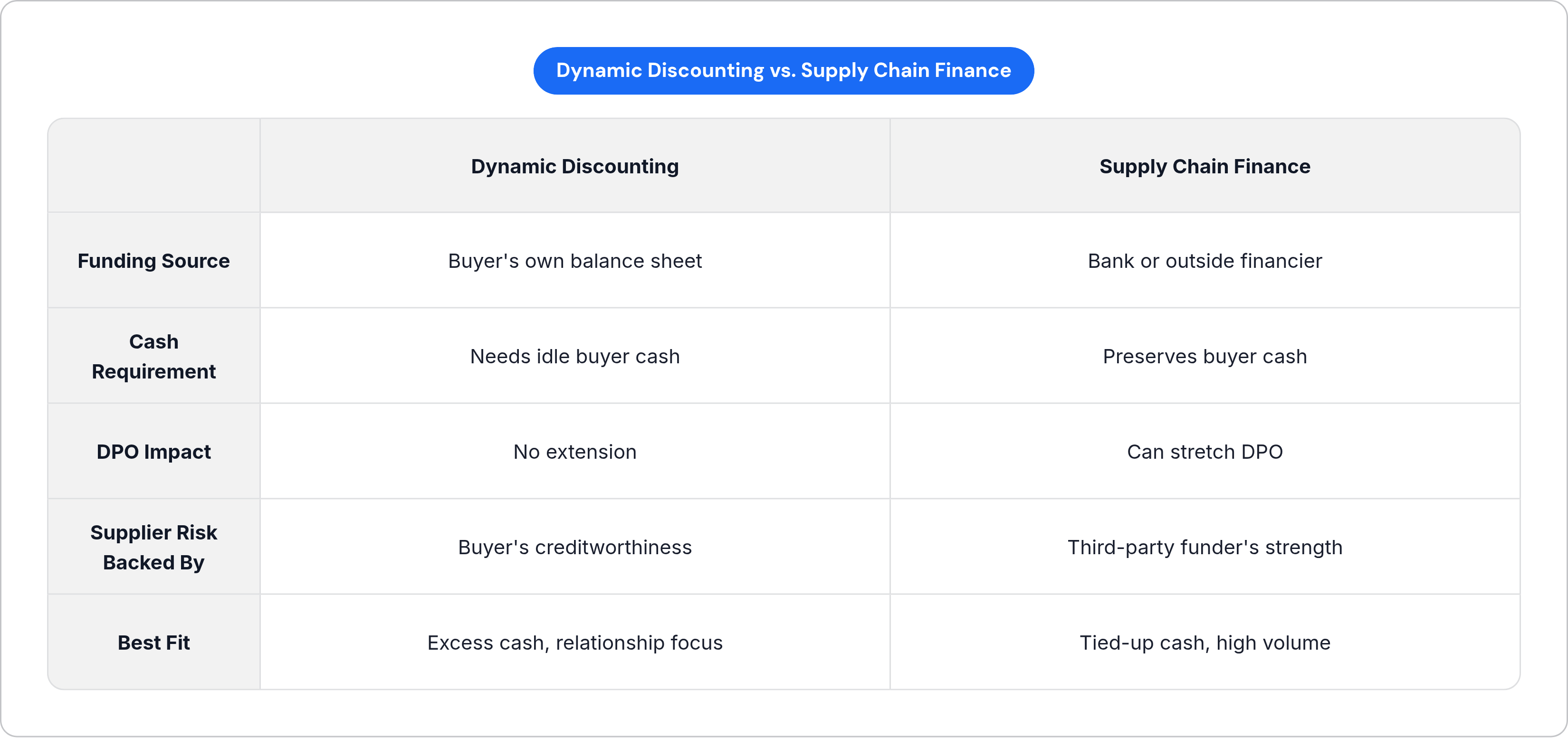
These two get lumped together constantly, and they shouldn't be. The core difference is where the money comes from. Dynamic discounting pulls from the buyer's own balance sheet, while supply chain finance, also called reverse factoring, brings in a bank or outside financier who pays the supplier early, with the buyer settling up with the financier later.
That one difference cascades into everything else. Dynamic discounting needs surplus cash sitting around; no idle money, no program. Supply chain finance preserves the buyer's cash and can actually stretch out days payable outstanding, since the buyer isn't the one funding early payment.
It changes the risk picture for suppliers too. Under supply chain finance, the outside funder is on the hook, so supplier risk shifts to that third party's credit strength. Under dynamic discounting, it's the buyer's own creditworthiness backing the early payment, and suppliers may weigh that differently depending on who the buyer actually is.
Dynamic discounting fits best when the buyer has excess cash earning weak returns and wants a safe way to improve on that yield, when the goal is deepening supplier relationships without pulling in a bank, and when the program is small enough to run out of available cash without a committed credit facility behind it.
Supply chain finance fits better when the buyer wants to stretch DPO while still letting suppliers get paid early, when the buyer's own cash is tied up elsewhere, or when volume is large enough that a bank facility handles it more efficiently than a treasury team could by hand.
Some companies run both: dynamic discounting for strategic, high-touch suppliers where the relationship matters most, supply chain finance for the long tail of smaller vendors. Neither model wins outright. It comes down to your cash position, your DPO goals, and how much weight you put on the supplier relationship versus the balance sheet mechanics.
How the market for dynamic discounting platforms has grown and where it is heading
The dynamic discounting platform market was valued around $4.2 billion in 2024, with forecasts putting it at $13.8 billion by 2033, a compound annual growth rate of about 13.6%. A narrower slice, platform software specifically rather than total spend running through these programs, was valued at $2.19 billion in 2024, projected to reach $5.43 billion by 2033 at a 10.7% CAGR. Different research firms slice this market differently, so treat the range as a matter of definition, not disagreement.
The fastest-growing corner is AI-powered dynamic discounting specifically: $1.15 billion in 2024, climbing to $1.43 billion in 2025, a 24.5% CAGR that outpaces the rest of the category by a wide margin.
North America holds roughly 38% of the market as of 2024, which tracks given how mature the fintech ecosystem is there and how much attention U.S. treasury teams pay to working capital. Asia-Pacific is growing fastest, projected at a 16.2% CAGR through 2033. Large enterprises have driven most of the revenue historically, about 68% in 2024, but cloud-based platforms, already over 62% of the market, are opening the door for mid-market and smaller companies who couldn't have afforded this a decade ago.
Manufacturing, retail, healthcare, and BFSI lean into this hardest, all industries with high invoice volume and supply chains complicated enough that cash timing actually moves the needle. AI isn't a side feature here; it's the thing making a 3.1-day invoice cycle possible at all. Automating discount identification, cash deployment decisions, and supplier communication is where platform investment keeps piling up.
What finance teams need to evaluate before launching either type of program
Start with your cash position. Dynamic discounting only makes sense if you've got idle cash earning weak returns sitting around, since that 37% annualized math is only real if there's actual money available behind it.
Then look hard at your current AP cycle time before committing to anything. If your organization is averaging closer to 17 days per invoice than 3, any discount terms you set up, static or dynamic, will expire before payment gets authorized. Fix the process before you design the program, not after.
Check supplier concentration too. These programs only deliver real value when a meaningful chunk of your spend sits with suppliers who actually want to participate. Ask your key suppliers before you launch anything; building a program nobody uses wastes everyone's time.
Get clear on the objective before picking a structure. Chasing yield on excess cash points toward dynamic discounting, while wanting to stretch DPO while keeping suppliers liquid points toward supply chain finance. Strengthening ties with a small group of strategic suppliers might not need either; a plain static or sliding-scale discount could do the job just fine.
Factor in the supplier's side of the burden too. Suppliers running multiple buyer programs across different portals deal with real coordination friction, and buyers who keep their program simple, clear terms, reliable communication, no surprise changes to the portal, see more suppliers actually show up and use it. For suppliers stuck managing offers across several buyers at once, certain tools exist specifically to track invoice status and handle the follow-up work, so that friction doesn't become a reason to sit a program out.
The programs that work aren't the ones with the cleverest spreadsheet model. They're the ones executed well day to day: invoices approved on time, terms communicated clearly, payments settled reliably. That gap, between a program that looks great on paper and one that actually captures the money, is where most of these efforts quietly succeed or fail.