AI-powered accounts receivable assistants for automated follow-ups and escalations
AI agents handle portal logins, paperwork requests, and dispute routing that email alone cannot.
Fifty-five percent of B2B invoiced sales in the U.S. sit past due right now, according to the Atradius 2025 Payment Practices Barometer. Flip a coin on whether an invoice gets paid on time, and the odds are worse than a coin flip. That's the actual state of B2B collections in 2025, not some worst-case scenario someone dreamed up in a planning meeting.
Western Europe runs at a similarly high overdue rate in the same report. Asia and the Americas sit in the low-to-mid 40s. This isn't one bad region dragging down an average. It's structural, baked into how B2B credit terms work everywhere they exist.
The cost isn't just write-offs, either. The EU Payment Observatory's 2025 Annual Report found companies burn close to 10 hours a week on manual follow-up, per company. Ten hours a week, every week, is the kind of cost that hides in plain sight until someone bothers to add it up on a spreadsheet.
Pull back further and the Hackett Group's U.S. Working Capital Survey found more than a trillion dollars stuck in excess working capital, with receivables the biggest single piece of it. That gap has grown two years straight, mostly because customers keep pushing for longer payment terms and, frankly, keep winning that argument.
None of this means AR teams are asleep at the wheel. Manual follow-up, even the genuinely diligent kind, can't keep pace with how messy modern B2B collections actually is. Too many invoices, too many portals, too many one-off exceptions nobody wrote a rule for. Diligence doesn't scale well. Systems are supposed to.
What "automated follow-up" actually means — and what it has historically missed
Ask most finance people what "automated AR" means and you'll get some version of: reminders go out on day 15, day 30, day 45. Same sequence every time, no matter who the customer is or what's actually happening with that invoice.
That model has blind spots, and they're the expensive kind.
Take a supplier portal like Coupa or Ariba. An invoice sits there, stuck, and no reminder email touches it, because the email was never the problem. The portal is. Or a customer needs a W-9, a purchase order number, or remittance details before releasing payment, and nobody flags it, because the automation has no idea a blocker exists. It just knows it's day 30.
Worse: a customer replies to a reminder, and instead of the sequence pausing, the dunning clock keeps running anyway. Three days later they get a sterner email demanding money they already tried to sort out. Disputes work the same way. If the system doesn't register that a dispute exists, it can't route it anywhere. It just keeps nudging into the void.
Rules-based automation runs off a script. It either matches a condition on the checklist or the invoice falls off the workflow, unresolved and invisible to everyone until a human happens to notice. PYMNTS Intelligence found the large majority of firms hadn't fully automated their AR operations as of 2025, and that's not because the tools don't exist. Partial automation, the reminder-cadence kind, simply doesn't close the gaps that hold up payment in the first place. Closing them takes a system that reads what the customer actually said, adjusts timing on the fly, works the portal itself, chases missing paperwork, and knows when to hand a case to a person, and which person.
How AI AR assistants move through the full follow-up lifecycle
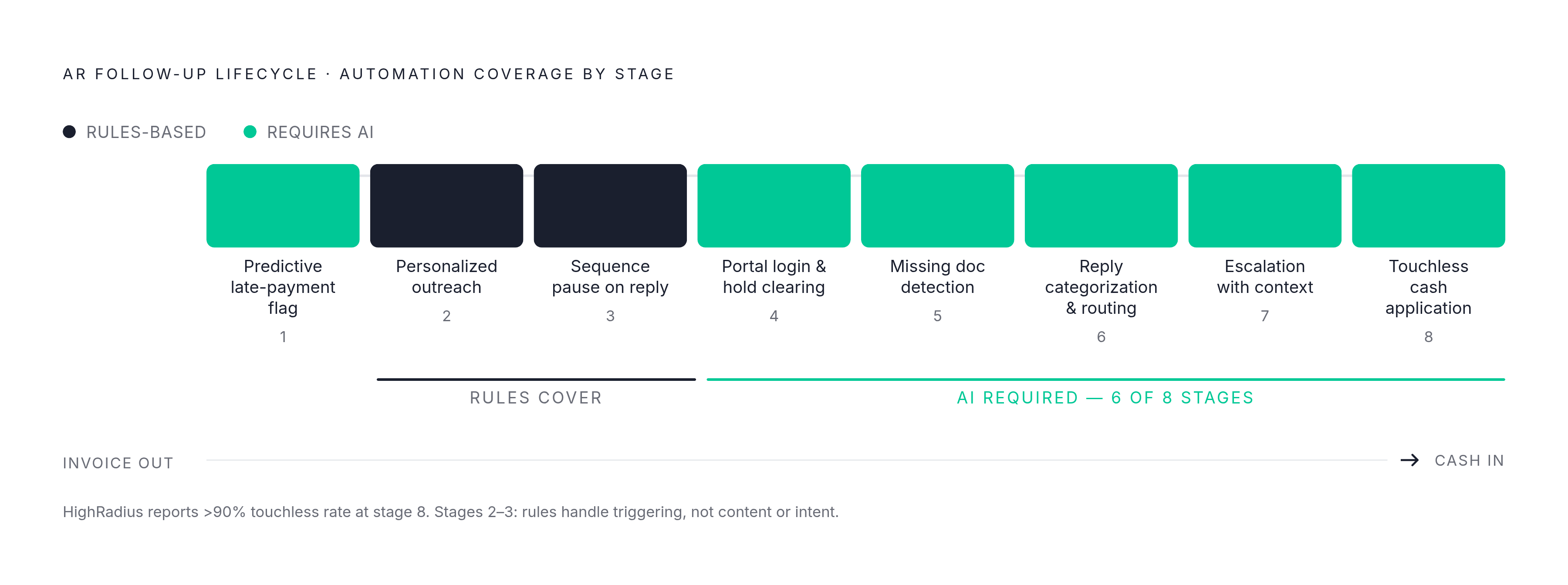
Automation starts earlier than most people assume, and it keeps going well past the point where a reminder email would've given up.
Before an invoice is even late, machine learning models trained on payment history can flag accounts likely to pay late. That buys time for something softer than a collections email, a nudge that heads off the problem instead of chasing it afterward. Prioritization runs on account value, payment behavior score, and dispute history, not just how many days something's sat in an aging bucket.
Initial outreach shifts by customer instead of blasting one template at everyone. Generative AI drafts messages that reference the specific invoice, name what's missing, and match tone to the relationship, so a longtime enterprise buyer and a first-time customer don't get identical emails. The sequence pauses the second a customer replies, disputes, or pays part of the balance. No more demand letters chasing money that already landed in the account three days ago.
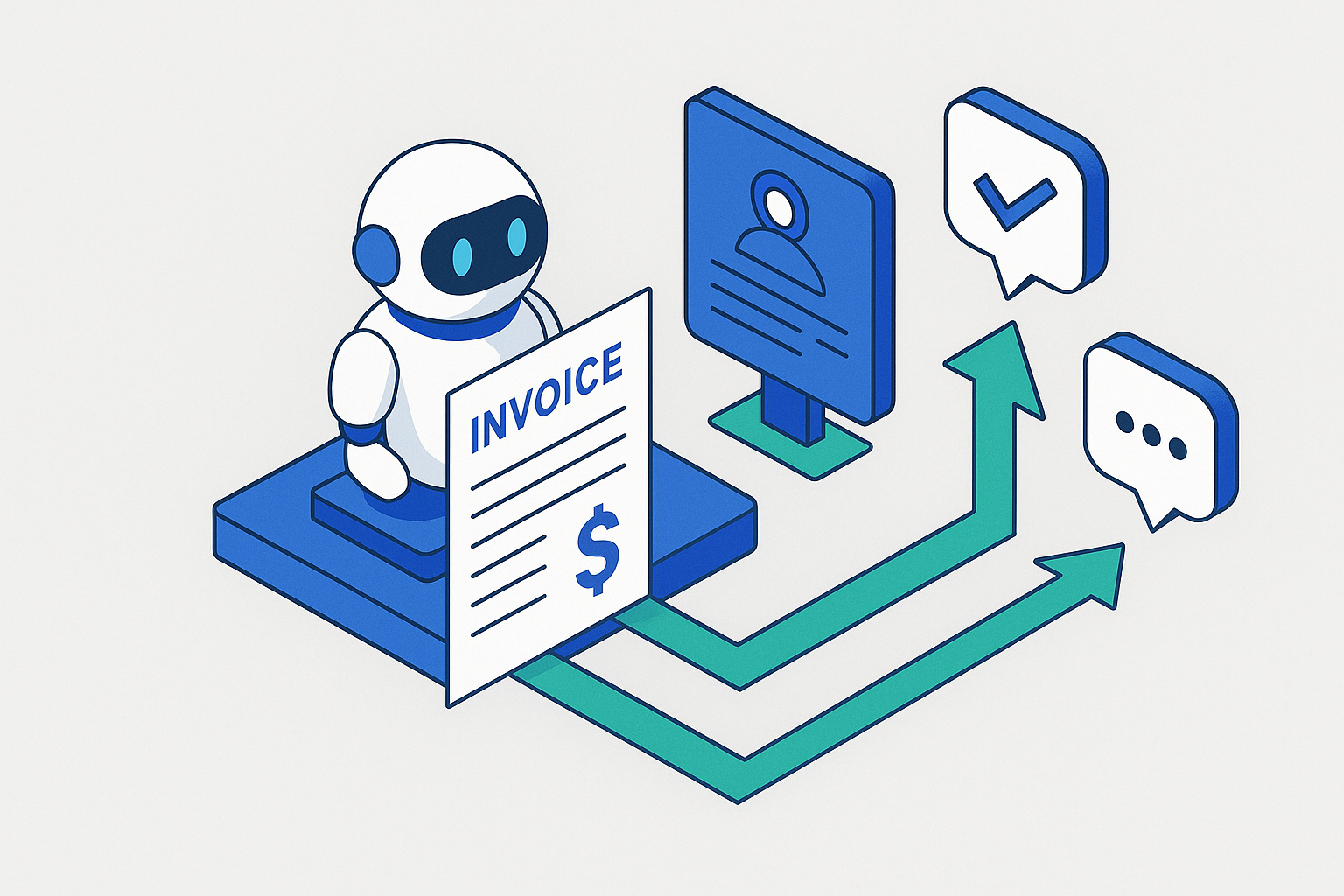
Clearing the actual roadblocks is where most automation quietly taps out. AI agents log into portals like Coupa or Ariba, submit invoices, check status, and clear holds, work no email has ever been able to touch. On the paperwork side, the system spots a missing W-9 or PO number and starts the request itself instead of waiting three weeks for a collector to notice. Inbound replies get sorted automatically into dispute, partial payment, confirmation, or question, and routed from there. Accounts receivable automation platforms that chase overdue invoices across email, phone, and SMS using AI agents backed by human collections specialists handle this kind of multi-channel triage as a core function rather than an add-on. Quadient's machine-learning categorization approach is a working example running in production right now, not a slide deck promise.
Escalation happens with context attached, not just a deadline ticking down. More on that below, but the short version: it's a calibrated handoff at the right moment, full picture included, rather than a last resort thrown at whoever's free. Sidetrade's Aimie can run escalation steps on its own, including outbound calls, without waiting for a person to say go.
Once the payment shows up, AI matches it to the right invoice, cutting the reconciliation lag that makes DSO look worse than it actually is, even after the customer's already paid. Touchless cash application rates above 90% have been reported in some enterprise deployments. That's the kind of number that makes a controller's Friday.
The escalation logic that separates capable systems from basic automation
Escalation is where most automation falls apart, quietly, usually before anyone notices. Rules-based systems escalate on a timer: day 60 hits, escalate, no matter what's actually going on with the account. That's a calendar reminder wearing a nicer suit. Calling it intelligence would be generous.
Real escalation needs things a calendar can't provide. Risk scoring that tells a first-time slow payer apart from a chronic offender, so a good customer's rough month doesn't get treated like a red flag. Dispute detection that reroutes the account the second a dispute shows up, not three reminders later, so the deductions team gets the alert while it still matters. Partial-payment recognition that recalculates the balance instead of demanding the full original amount. Account-tier logic that keeps a strategic relationship from eating the same blunt pressure a delinquent small account might actually need.
Forrester's March 2025 report names collection management the highest-impact AI use case in AR, and the reason is simple: predictive models flip the posture from reactive to proactive. The system starts anticipating what's about to go sideways instead of only reacting once it already has.
The handoff to a human matters as much as the timing of it. Agentic AI is there to support the collector, not replace them, and the goal is making sure a collector's time actually gets spent on things that need a person. That means the case arrives with context already attached, a recommended next step, and a clear reason it needed a human's judgment in the first place. Collectors stop burning hours on accounts that were always going to pay on their own, and they spend that time where their judgment changes the outcome. That's really the whole point of doing any of this.
What the performance evidence shows — and what it still leaves open
Adoption is mainstream at this point, not early-stage. Reanin's 2025 research puts AR automation adoption at close to 60% of companies, mostly to speed up invoice processing and tighten payment accuracy.
The cost gap between automated and manual processing, per IOFM data, is wide enough to change the math on collections at scale. It's not a marginal efficiency bump, it's a different cost structure entirely. SNS Insider's 2025 research found 76% of businesses that adopted AR automation cut invoice processing costs by 35% and improved collection efficiency by 45%.
One of the more credible figures in the mix is an IDC 2025 study commissioned around a large AR automation provider's customer base: a several-hundred-percent return on investment, with payback averaging around nine months. It's one of the few figures here that's been through independent, third-party review instead of sitting on a vendor's own case study page.
DSO is the number everyone reaches for first, and automated firms genuinely do run lower than non-automated peers. Yet DSO is a lagging indicator. It tells you what already happened. It won't show you the portal blocker that ate three weeks, or the misrouted dispute that sat untouched, or the missing W-9 nobody caught in time. Those are exactly the frictions AI assistants exist to remove, and DSO alone can't tell you whether they're actually removing them.
Worth saying plainly: most of these numbers come from vendors, or from research firms vendors paid to commission. Independent, cross-industry benchmarks are still thin. Weight the third-party-audited figures, like IDC's study, more heavily than the self-reported ones, and treat vendor case studies as examples, not proof.
How the vendor landscape is currently structured and what each tier is built for
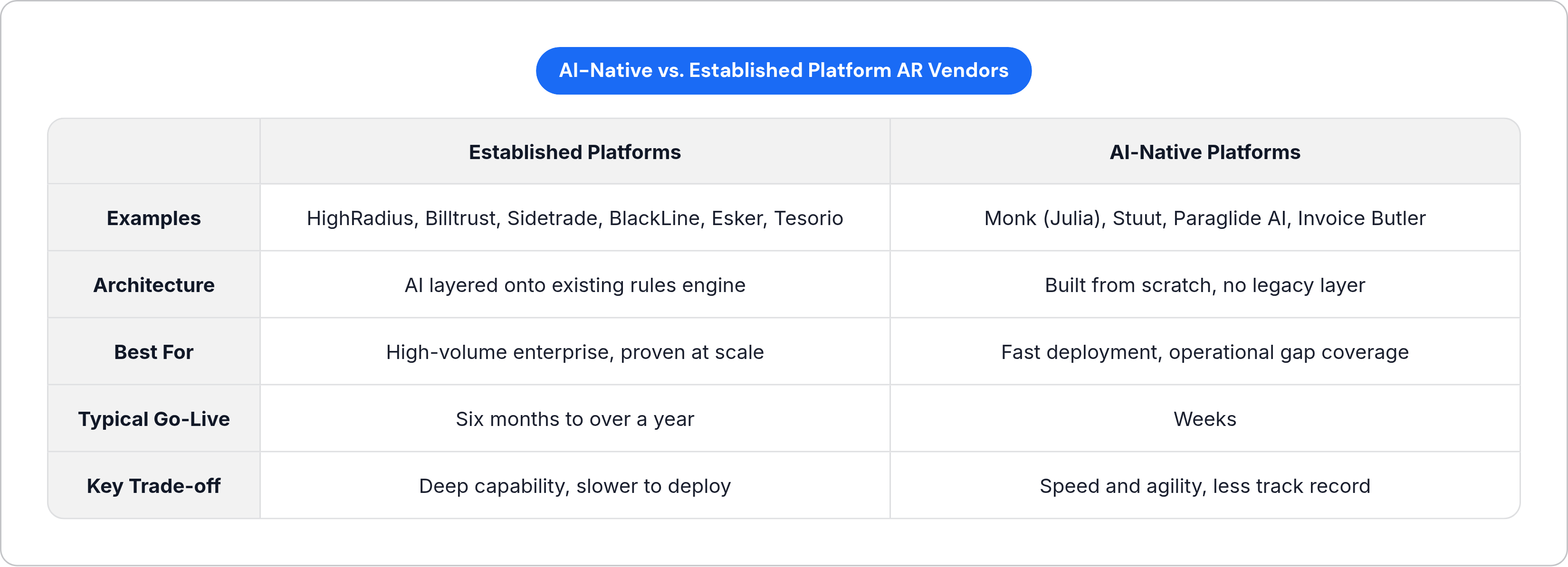
Two camps exist right now: established platforms that bolted AI onto an existing rules engine, and AI-native systems built from scratch with no legacy layer underneath.
Sidetrade has trained finance-specific AI models since 2015, and its Aimie orchestrator, launched in 2025, runs phone calls and escalations on its own, pulling from more than a trillion dollars in behavioral payment signals in its data lake. BlackLine introduced a Cash Application Automation module in November 2024 and leans hardest into reconciliation and financial close. Esker covers the full order-to-cash cycle, from sales order through collection, which suits companies that want one platform end to end.
On the AI-native side, a few names stand out. Stuut, founded in 2024, focuses on invoice creation, cash application, and payment automation, and has raised a meaningful seed round. Paraglide AI, based in Sweden and built for European AR teams, closed a seed round in early 2026 co-led by Bessemer Venture Partners and DN Capital.
Timelines split sharply between the two camps. Legacy enterprise platforms can take six months to over a year to get running. AI-native platforms are typically live within weeks. If DSO pressure is immediate, that gap alone might decide the vendor conversation before anything else does.
A few questions worth asking before signing anything: where's the actual bottleneck, cash application volume, dunning sequences, portal navigation, or dispute routing? No platform leads on all four at once. Does the team need a tool to operate, or an operational team acting on its behalf? And how much ERP complexity needs bridging, weighed against how fast this has to go live?
What finance teams should expect when they move from reminder emails to a full follow-up system
The real shift shows up in how the AR team spends its day, more than in which tools sit on their desktop. Collectors stop babysitting accounts that were always going to pay anyway, and they put their attention on disputes, strategic accounts, and the handful of cases where relationship judgment actually changes the outcome. Finance leadership gets a real-time read on cash position, risk concentration, and escalation status, instead of piecing it together from an aging report that's already a week stale by the time anyone opens it.
Some friction never fully goes away, and that's worth knowing going in. Portal-submitted invoices sometimes need human credentials or two-factor authentication no agent can clear on its own. Certain disputes still need someone in sales or operations to dig up a document nobody scanned. Some customers simply won't respond to anyone but one specific named contact, a relationship quirk no sequence, however smart, is going to fix.
Getting the rollout right takes some groundwork first. Escalation thresholds need defining up front, so the system knows what counts as "large account" or "disputed" before it has to make that call live. ERP data quality matters more than people expect: contact accuracy, invoice status fields, payment history clean enough for the AI to actually learn from. Credit, sales, and finance need to agree, ahead of time, on what a "resolved dispute" looks like, because the system will route based on whatever definition it's handed, right or wrong.
Most organizations see real DSO movement within the first few months. That said, the learning curve, for the system and for the team adjusting around it, tends to run a full quarter before things really settle into place.
The core point holds no matter which vendor a team lands on: AI AR assistants that only send scheduled reminders solve a small slice of the actual problem. The systems moving the needle are the ones closing the operational gaps, portal friction, document chasing, escalation that actually understands what it's escalating, that sit between an invoice going out the door and cash landing in the account.