AI-powered AR assistants that automate follow-up and escalation workflows
AI agents automate collections by reading customer context and adjusting outreach in real time.
ResolutAI's 2026 CFO guide frames the gap clearly: traditional automation is a paper map that follows fixed routes, while AI for accounts receivable is a GPS that reroutes based on what's happening right now, and someone's pulling the aging report into a spreadsheet. Someone else is sending the same three reminder emails they send every week. A third person is logged into a client's supplier portal trying to remember the password. The invoices actually in trouble stay invisible to all of them until the payment fails to arrive, which is the core problem Invoice Butler, an AI-powered accounts receivable tool that automates collections follow-ups across email, phone, and SMS with human collections experts in the loop, was built to address.
Why rule-based dunning fails as a collections strategy
A fixed dunning schedule works the way a sprinkler system works. It turns on at set times regardless of whether it's raining. Reminder A goes out on day five, escalation hits on day twenty, and the system never asks whether any of that still makes sense. What it's missing is the stuff that actually predicts whether an invoice gets paid: the customer's payment history, a change somewhere in their approval chain, a document that never showed up, a pattern of disputes on past invoices. None of that lives on a calendar. All of it lives in the account.
ResolutAI's 2026 CFO guide puts the contrast in terms that stick: traditional automation is a paper map, good for fixed routes and nothing else, while AI for accounts receivable works more like a GPS, rerouting based on what's actually happening on the road right now. A paper map doesn't know about the accident up ahead. A fixed dunning sequence doesn't know the client's billing contact quit last month.
That's the failure mode in practice. An invoice can look perfectly current on a rule-based schedule while already quietly falling apart behind the scenes, because the contact changed, a W-9 went missing, or the payment is stuck in a supplier portal that nobody's checked. A timed reminder has no way to see any of that. It just sends the next email in the sequence and waits.
They can explain the aging report, walking through every line item without hesitation. But ask them what collections look like three weeks out, and the room goes quiet: the system they're running doesn't forecast, it reacts. Add in the fact that this work is usually split across several people, one pulling the aging report, another sending reminders, another checking the bank, a partner stepping in only when a client relationship gets sensitive, and there's no single view of the account and no consistent action behind it. It's a relay race where nobody can see the other runners.
AI AR Assistants at the Workflow Level
The shift from rule-based automation to agentic AI isn't a speed upgrade. Instead of a calendar firing off the next scheduled message, the system reads the account's actual context and decides what to do, when to do it, and how.
Three technologies make that decision possible, and they work as a set rather than individually. Natural language processing lets the system read and respond to inbound customer emails instead of just blasting reminders outward. Predictive analytics scores accounts for payment risk before an invoice is even overdue, catching trouble early instead of after the due date has already passed. Cognitive automation, machine learning paired with business logic, decides when to escalate, when to soften the tone, and when to pause outreach entirely rather than annoy a customer who's already engaging in good faith.
That's the job description for a prioritization engine. ResolutAI makes the same point from a different angle: when the system is working, AR stops treating every account the same and starts directing attention toward the invoices most likely to slip or turn into a dispute. Quadient's 2026 blog post on implementing AI in accounts receivable captures the practical decision logic: AI should help AR teams decide who to contact, when to contact them, what to say, and what risk to act on first.
This is why 2026's dominant direction in the space is agentic AI specifically, meaning systems that act independently inside a defined set of rules, running pieces of the invoice-to-cash workflow on their own, sending follow-ups, adjusting tone, escalating risk, without a human needing to kick off each individual step. Gartner told finance leaders in March 2026 to shift investment toward accounts receivable and predictive analytics, putting AI for cash flow forecasting and collections on its list of top finance technology priorities for the year. Gartner's position tells CFOs this isn't optional anymore; it's infrastructure.
Running Follow-Up from First Reminder to Inbound Reply
Speed isn't the selling point here. Responsiveness is. An AI agent reads what the customer actually says and adjusts its next move, instead of firing off the next message in the sequence no matter what happened in between.
The workflow usually runs like this. The invoice syncs automatically from the ERP or billing system the moment it goes out the door. From there, the AI tracks the account continuously, scoring it against payment history, invoice details, and whatever communication signals have piled up so far. Outbound reminders get personalized, not just with a mail-merge name field, but in timing, tone, and channel, shaped by how that specific customer tends to behave.
The real test comes when the customer writes back. A question, a dispute, a document request, or a payment commitment, whatever it is, the AI reads the inbound message and responds directly, instead of dropping it into a shared inbox where it waits for whoever checks that folder next. If a reply goes unresolved, or a payment commitment doesn't actually show up in the bank, the agent follows up on that specific thread. It doesn't reset to some generic reminder like nothing happened.
Paraglide's Collections Agent is a clean example of this in motion. It treats collections as an ongoing conversation with a customer, not a pile of disconnected one-off reminders, sending personalized outreach based on history and behavior, handling replies as they come in, chasing unresolved threads, and keeping the conversation alive until the invoice is settled or the money lands. Paraglide reports customers using it have cut days sales outstanding by an average of 34%. ChatFin describes a similar logic in its 2026 overview: smart dunning sequences that adjust automatically to how a customer responds, pausing when someone engages, escalating when they go quiet, and tuning timing for effectiveness without torching the relationship in the process.
None of this lives on one channel. Follow-up can run over email, voice, SMS, or messaging apps; the system picks the channel based on where that customer has actually responded before. It also doesn't stall out on the boring stuff that usually gums up manual collections, a missing W-9, a portal that demands manual document upload, a billing contact who left the company and nobody updated the record. The agent works around those blockers or flags them for a human, rather than letting the whole sequence freeze.
Escalation logic when follow-up produces no response
Escalation in a rule-based system means one thing: a louder, more urgent version of the same email, sent because a calendar date arrived. Escalation in an AI system is a decision, built on a risk score, about which accounts need a different kind of intervention and when a human needs to step in.
A handful of signals typically trigger it. An account goes silent past a threshold, not a fixed number of days, but a number calculated against how that specific customer usually responds. A payment commitment gets logged and then doesn't materialize. An inbound message contains a dispute, an outright refusal to pay, or some legal or compliance wrinkle, and the AI flags it for a human to look at rather than handling it solo. Or a risk score simply crosses a line set by the business, driven by a high invoice value, a payment history that's trending the wrong way, or a sudden change in who's even handling the account on the customer's side.
Quadient's platform claims up to 94% forecasting accuracy predicting payor behavior, and that prediction layer is the reason escalation can happen before an invoice is formally overdue rather than after the fact. HappyRobot's AI workers, as described in research on the space, verify identity, present the invoice, capture a payment commitment, and escalate disputes or exceptions straight to a person, with escalation built into the same workflow rather than bolted on as a separate manual step.
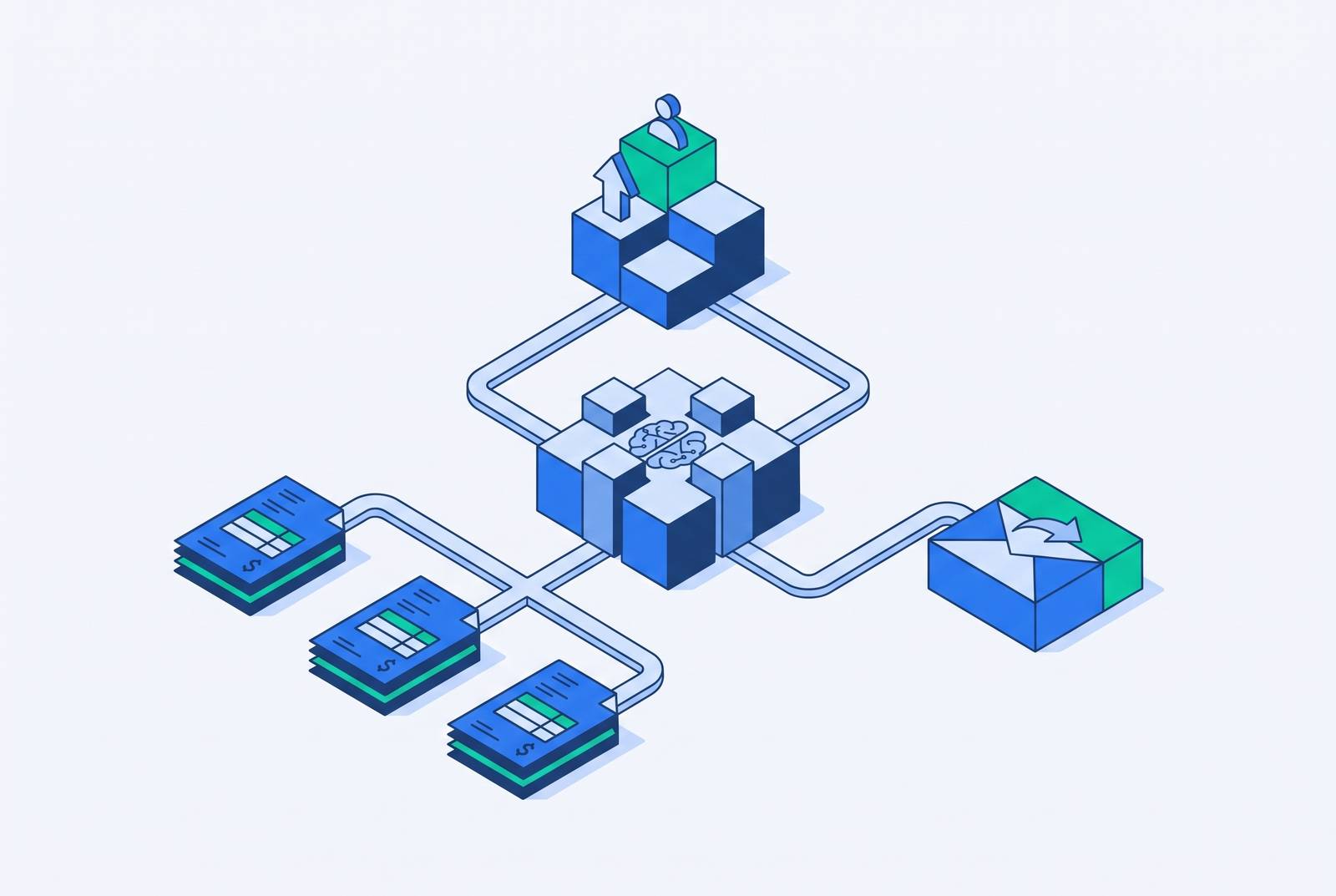
The handoff itself can run in tiers. A relationship-sensitive account might go first to a senior collector. A high-value or legally sensitive one goes to management. Either way, the account history and every prior AI interaction travel with it, so whoever picks it up isn't starting cold. That handoff quality is where the "always-on" pitch actually earns its keep: a human stepping into an escalated account inherits full context instead of a half-read email thread and a shrug.
What the leading implementations reveal about production use
A handful of 2026 deployments show this running at real scale, and each one also exposes a different constraint on how far it can safely go.
Esker unveiled its Synergy Agentic Framework in September 2026, a governed agentic layer built on top of its existing Source-to-Pay and Order-to-Cash solutions, and the company has been recognized as a Leader in Gartner's Magic Quadrant for Invoice-to-Cash Applications. Esker's design philosophy is spelled out directly: agentic reasoning gets anchored in transactional foundations, meaning workflows, business rules, permissions, validations, and audit trails, so every approved action executes consistently, inside clearly defined boundaries, with an outcome that can be traced back afterward. The company trains its own large language model for targeted use cases, alongside third-party models including Microsoft Azure's ChatGPT. Governance is the feature at Esker's system, built to answer "why did the AI do that?" before a regulator ever has to ask.
HappyRobot runs multi-channel agentic execution, deploying AI workers across voice, email, and messaging that verify identity, present invoices, answer questions, capture commitments, and escalate disputes, all wired back into the ERP and billing systems a finance team already runs. DHL Supply Chain put HappyRobot's voice and email agents to work across regions in November 2025, handling appointment scheduling, driver follow-up calls, and high-priority warehouse coordination autonomously, aiming for communication that's faster, more consistent, and easier to scale. HappyRobot raised a Series C in August 2026 and crossed into unicorn valuation. The constraint that comes with that growth is legal rather than technical: outbound voice carries real exposure under the Telephone Consumer Protection Act, sharpened by the Supreme Court's ruling in Facebook v. Duguid, plus the TCPA's separate rules on artificial or prerecorded voice, both of which create ongoing litigation risk for any outbound AI voice call using that kind of technology.
Between the two, the operational blockers that software alone can't wave away, missing documents, clunky portals, a contact who left without a forwarding address, still get handled inside the same workflow rather than stalling it. And for the genuinely sensitive cases, a dispute, a relationship worth protecting, a human reviews before anything goes out, which is how these systems scale without scaling the damage too.
Governance and explainability as the limiting factor in agentic AR
By 2026, nobody serious is debating whether AI agents can run collections workflows. They can. Whether an organization can answer "why did the AI take that action?" on demand, and in regulated finance environments, that question now comes with teeth.
Once an AI agent can send a communication, shift a treatment path, reorder a queue, or trigger an escalation on its own, the controls around it have to grow to match. The organization needs to know why the action happened, whether it followed policy, whether the customer actually qualified for that treatment, and whether the outcome created any pattern that looks unfair or unintended once someone goes looking.
The relationship risk cuts both directions here. An AI agent that responds fast and stays consistent makes a customer's experience of the finance function better than most manual collections ever managed. An AI agent that misreads tone, contacts the wrong person at the company, or mistakes a legitimate refusal to pay for just another slow customer can damage that relationship at automation scale: the mistake doesn't happen once, it happens everywhere the same pattern applies. That's the tradeoff written into the whole category: the thing that makes these systems valuable, acting without waiting for a human, is the same thing that makes a bad call expensive fast.
Outbound voice is where this risk gets sharpest and most concrete. Practitioners have flagged continuing litigation exposure under the TCPA following Facebook v. Duguid, and the core problem sits in a place software still struggles to reach: an AI system can fail to recognize that an unusual, offhand statement from a customer legally counts as a refusal to pay, something an experienced human collector would catch instantly. That gap, between what a model can parse and what a trained person can sense in a single sentence, is the reason governance and explainability have become the real constraint on this category. The technology got good enough to act on its own a while ago. Whether it can be trusted to explain itself afterward is the part the industry is still building.