Days Sales Outstanding Reduction Strategies
Fix upstream invoice problems and payment friction to unlock faster collections.
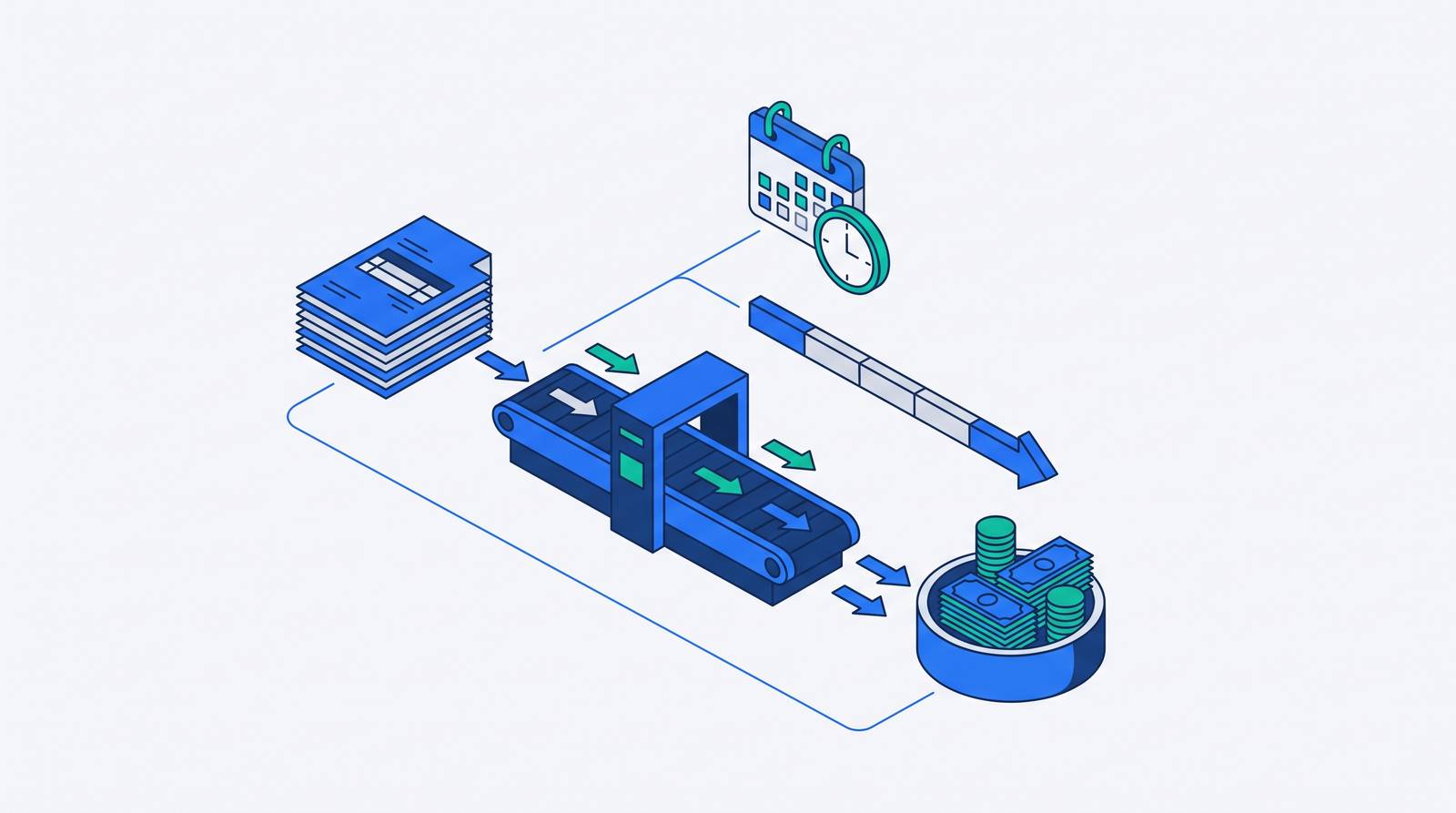
Most finance leaders treat Days Sales Outstanding like a speedometer. Glance at it, notice it's higher than you'd like, and start looking for ways to invoice faster. That instinct is understandable and almost always wrong. The real reason DSO stays stubbornly high usually lives downstream of the invoice, in the unglamorous world of portal rejections, missing W-9s, and follow-up emails that vanished into someone's spam folder.
The macro picture is genuinely bleak right now. Global DSO hit 59 days in 2023, the steepest single-year rise since the 2008 financial crisis, based on Allianz Trade's survey of roughly 45,000 listed companies. The Hackett Group's 2025 U.S. Working Capital Survey found that DSO worsened for the second consecutive year and that receivables represent the single largest source of trapped working capital on corporate balance sheets. J.P. Morgan estimated hundreds of billions in trapped working capital across the S&P 1500 in 2024. Atradius found that more than half of U.S. B2B invoiced sales were overdue in 2024. That's a widespread condition across the environment, affecting the vast majority of participants.
There's also something that gets acknowledged far too rarely: large buyers are deliberately stretching payment terms as a working capital strategy, essentially handing their cash flow problem to their suppliers. No amount of operational discipline fully neutralizes that. But according to PYMNTS's 2024 B2B Working Capital Survey, a strong majority of mid-market CFOs now treat DSO as a primary liquidity input. It has moved from a back-office metric to a board-level conversation. The practices that kept DSO acceptable five years ago no longer clear the bar.
The formula itself is not complicated. Divide Accounts Receivable by Total Credit Sales, multiply by the number of days in the period. Two main approaches exist. The simple method works fine for businesses with stable, predictable revenue. The countback method works backward from the most recent period's invoices to match them against outstanding receivables, and it's more accurate when revenue is seasonal or lumpy. Neither requires a finance degree.
The mistake that quietly ruins the analysis is using total revenue instead of credit sales. If any portion of your revenue is collected immediately at point of sale and you include that in the denominator, DSO looks lower than it actually is. You get a number that flatters you. Collection problems get masked. Decisions get made on faulty data, and nobody notices until the aging report looks ugly six months later.
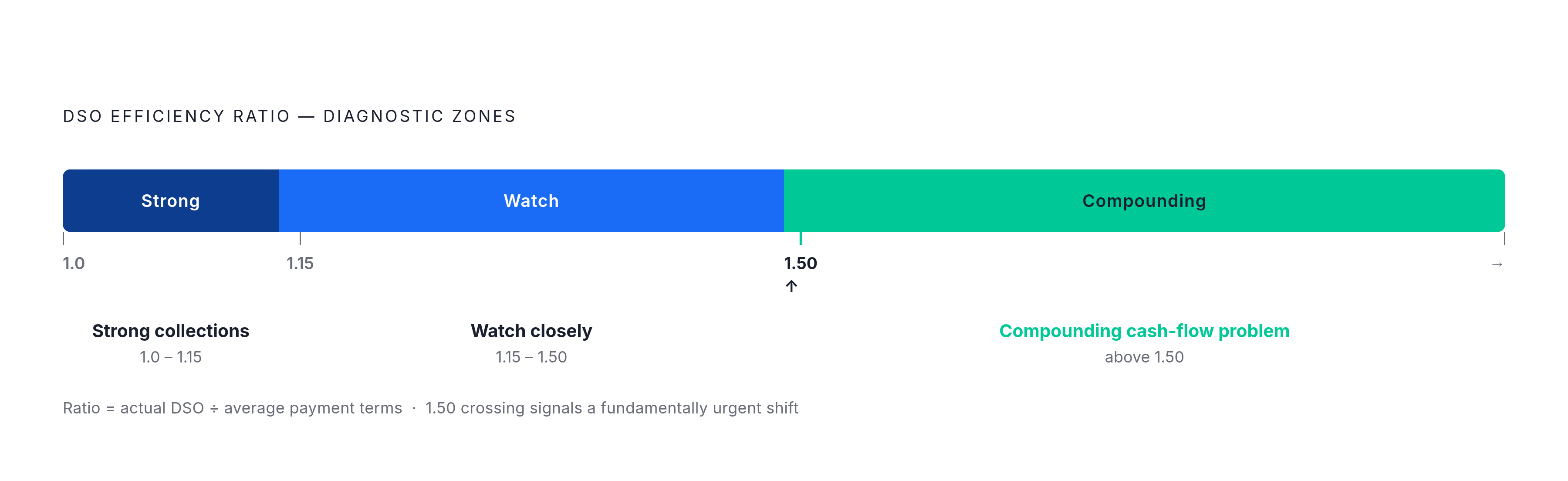
A more useful diagnostic is the DSO Efficiency Ratio: divide actual DSO by average payment terms. A result between 1.0 and 1.15 means collections are strong relative to the terms you're offering. Above 1.50, you have a compounding cash-flow problem. Two companies can have identical raw DSO numbers and completely different collection health depending on what terms they're running. The raw number alone doesn't tell you much.
One more benchmarking trap worth naming. Industry averages blend companies on short terms with companies on long ones. Construction sits at the long end. SaaS and education sit at the short end. A raw industry median is nearly useless without knowing the terms behind it. Compare your DSO to your own best-possible DSO first. What would the number be if every customer paid exactly on time? Then compare to peers running similar terms.
Teams that skip this step often end up optimizing the wrong part of the cycle entirely. Totally fixable, but only if you know you're doing it.
The Operational Friction That Actually Extends Collection Cycles After Invoices Are Sent
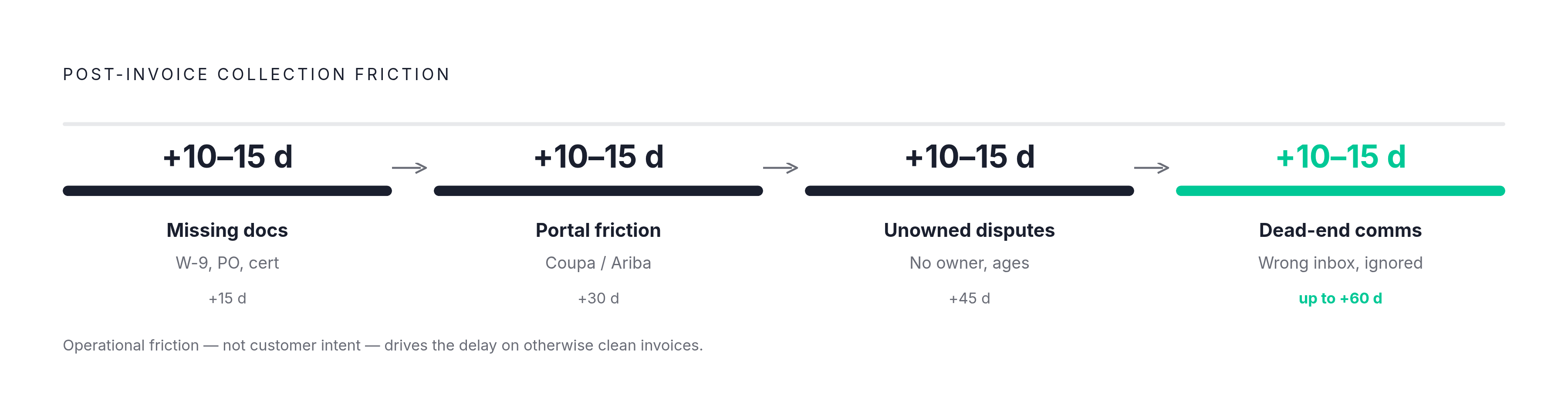
A misconception that costs companies real money: once an invoice is sent, the outcome is mostly in the customer's hands. A meaningful share of collection delays trace back to what happens between when the invoice leaves your system and when payment actually moves, with no bearing on whether the customer even intends to pay.
The blockers cluster in predictable, almost boring ways.
- Missing documentation. The buyer's AP team needs a W-9, a purchase order number, or a vendor certificate before they can process anything. Nobody told the supplier. The invoice sits.
- Portal friction. The invoice was submitted through Coupa, Ariba, or a similar procurement platform. It was rejected on a technicality or is sitting in a pending queue with no notification sent outbound.
- Unacknowledged disputes. A question was raised about a line item somewhere. Nobody owns the resolution. The invoice ages.
- Communication dead ends. A follow-up email landed in the wrong inbox or was generic enough that no one felt urgency to do anything about it.
These are operational problems with direct financial consequences. They don't show up in the DSO formula anywhere. But they directly extend the collection cycle, often by ten to fifteen days on invoices where everything else was done correctly.
Finance teams that focus only on terms and billing speed tend to plateau at a DSO that feels close but not quite right. That last chunk of delay almost always lives here. Any DSO reduction effort that fails to map what happens after the invoice leaves will leave real time on the table, and it'll be frustrating because there's no obvious culprit to point at.
Upstream Practices That Set the Ceiling on How Low DSO Can Go
Before any collection strategy can work, the upstream conditions have to give it room to work. There is a ceiling on how low DSO can go, and that ceiling is largely set before the invoice ever goes out. This part of the problem is unsexy but consequential.
Invoice timing is an easy fix that many teams still haven't made. Billing at delivery or project completion instead of waiting for month-end can remove days from the cycle before any collection action is needed. The math is straightforward.
Invoice clarity matters more than most people give it credit for. Payment terms need to be visible and unambiguous. Vague due dates generate disputes. Disputes add days. This is a solvable problem that keeps reappearing anyway.
E-invoicing versus paper is worth examining carefully. Electronic invoices process substantially faster and generate fewer disputes. The gap is large enough to move DSO on its own, independent of anything else you do downstream.
Payment terms are a lever, not just a policy line in a contract.
- Early payment discounts, even a small percentage off for paying within ten days, shift behavior for price-sensitive buyers.
- Dynamic discounting offers a sliding scale tied to the exact payment date, more flexible than static early-pay discounts.
- Partial payments on large invoices reduce the cash-flow burden on the payer, which often accelerates partial receipt before full settlement.
Credit terms for new customers deserve their own moment. Shorter standard terms or deposit requirements reduce exposure before a payment relationship is established. Most new customers expect some version of this. It's a reasonable ask and worth making consistently.
The hard ceiling these upstream choices create: a company running net-90 terms will always have a higher DSO than a comparable company running net-30, regardless of how well the collections team performs. The terms set the theoretical floor, and no amount of execution excellence gets you below it.
Upstream optimization alone cannot fix the customer who agreed to net-30 and consistently pays at 50 days. That gap is an execution problem, which is where the next section picks up.
How Automated Follow-Up and Structured Dunning Sequences Close the Gap Between Due Date and Payment Date
Manual follow-up is inconsistent by nature. That's what happens to manual processes when invoice volume gets high. Reminders slip. Tone varies based on who's having a rough week. High-volume AR teams genuinely cannot maintain cadence across hundreds of open invoices without something falling through the cracks. Anyone who's managed a large AR function knows this feeling intimately.
Automated reminder sequencing changes what's possible. Structured touchpoints before the due date, on the due date, and at escalating intervals past due deliver consistent cadence in a way that manual chasing can't. Timing matters as much as the automation itself. A reminder sent five days before the due date performs differently than one sent the day after it passes. Calibrating the sequence to how buyers actually behave improves response rates in ways that are measurable and real.
Escalation logic is where judgment still matters. Every overdue invoice warrants a response calibrated to where it sits.
- Early stage (first weeks past due): Automated, friendly reminders. Preserve the relationship. The invoice might be stuck in a portal. Don't blow it up yet.
- Mid-stage: Personalized outreach that names the specific invoice and offers to clear any blockers. Some combination of human and system works well here.
- Late stage: Escalation to an account manager or senior contact, with clear next steps and a defined timeline. This one should feel like a human wrote it, because it should be.
Dispute resolution deserves specific attention because unresolved disputes are one of the primary reasons invoices stay open past due. The fix isn't complicated: surface disputes early, route them to whoever can resolve them, track to closure. Teams that let disputes sit are choosing a longer DSO, whether they realize it or not.
Thumbtack reduced DSO by a substantial margin after deploying automated payment solutions. The mechanism isn't mysterious. Consistent follow-up compresses the collection cycle because it eliminates the lag between when action is needed and when it actually happens. In a manual environment, that lag can stretch surprisingly, almost embarrassingly, long.
Portal Navigation and Missing-Document Management as a Hidden DSO Driver
Enterprise buyers increasingly require invoice submission through procurement portals rather than email. Suppliers who navigate these correctly get paid. Suppliers who don't experience something worse than a dispute. They experience silence, which is much harder to respond to.
The most common portal failure modes look like this.
- Invoice rejected on a technicality, wrong format or missing PO match, with no proactive notification sent back to the supplier.
- Invoice marked as "submitted" but sitting in a pending queue the supplier has no visibility into.
- A buyer-side approver hasn't acted, and no escalation is happening inside the portal. The clock just runs.
Missing documentation runs parallel to this. Buyers routinely hold payment pending a W-9, an updated insurance certificate, or a vendor registration form the supplier didn't know was required. The invoice looks fine from your side. The buyer's system will not move it until the document shows up.
What makes this particularly maddening from a management standpoint is that these invoices don't appear in aging reports as "disputed." They show up as simply overdue. They get lumped in with invoices where the customer is genuinely slow or unresponsive. The diagnosis gets missed. You send more reminders into a portal that isn't reading them. Nothing happens. The invoice ages further.
Finance teams that can distinguish between invoices stuck in portals, genuinely disputed invoices, and invoices that are just late can triage and resolve much faster than teams treating all aging buckets identically. In an enterprise-customer environment, reducing DSO requires operational capacity to navigate buyer systems. Sending strongly worded emails into a Coupa queue is a waste of everyone's time.
What to Measure Alongside DSO to Know Whether Interventions Are Actually Working
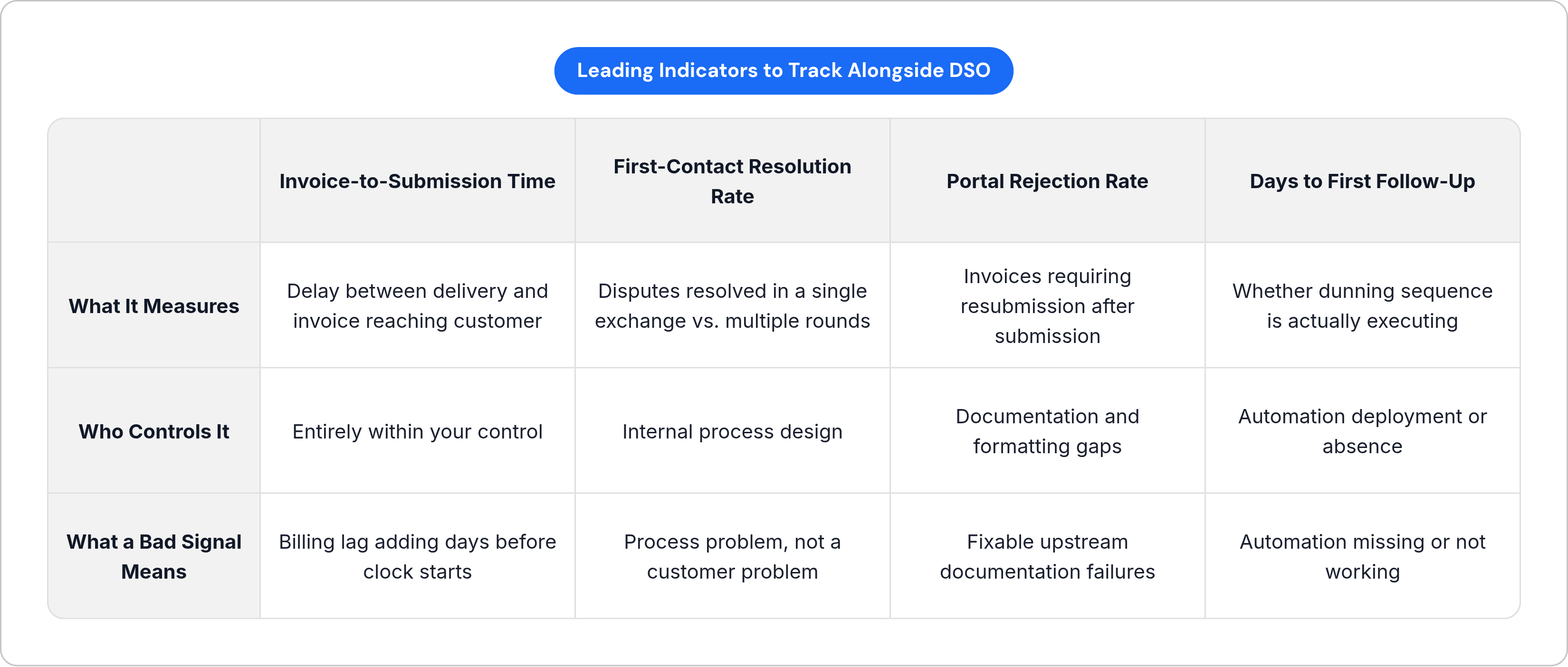
By the time DSO moves, weeks of operational change have already happened, or failed to. Watching only DSO means you're always working with old information. You're reading last month's newspaper and calling it intelligence.
Leading indicators give you something to act on in real time.
- Invoice-to-submission time: How long between delivery and the invoice reaching the customer or portal? Delays here are entirely within your control and should be zero.
- First-contact resolution rate on disputes: What share of disputes get resolved in a single exchange versus dragging across multiple rounds? Low rates signal a process problem, not a customer problem.
- Portal rejection rate: What share of submitted invoices come back requiring resubmission? A high rate points directly at documentation or formatting gaps that are fixable.
- Days to first follow-up on overdue invoices: This measures whether the dunning sequence is actually executing. If this number is high, either the automation isn't working or it hasn't been deployed at all.
The Collection Effectiveness Index (CEI) is worth tracking alongside DSO. It measures what percentage of collectible AR was actually collected in a given period. A rising CEI alongside a flat DSO tells you something precise: the constraint is terms, not execution. That's a different problem with a different fix.
Aging bucket distribution is often more actionable than the DSO average itself. Watch the share of AR moving past 60 and 90 days. When that share grows, the problem is compounding. When it shrinks, something is working.
Segmenting DSO by customer tier or invoice type surfaces which relationships or invoice categories are actually driving the number. Aggregate DSO hides this. A handful of large enterprise customers may account for most of the delay while mid-market customers are paying cleanly. The segment view reveals what the average obscures, and on a meaningful revenue base, a single day of DSO improvement frees material working capital. Measurement isn't just operational hygiene. It's a financial argument worth making explicitly to leadership.
How AR Teams and Technology Can Address Operational Blockers at Scale
The core problem with manual AR at volume is inconsistency. Follow-up timing degrades. Dispute routing breaks down. Portal monitoring falls through the cracks. This happens not because the team doesn't care but because humans have finite attention and high invoice counts exceed it. At some point, something is going to slip. That's just arithmetic.
Automation handles the high-frequency, repeatable work well.
- Triggering reminder sequences without requiring human initiation every time.
- Matching payments to invoices to reduce reconciliation lag.
- Flagging invoices that have gone quiet so someone can investigate before they age into a real problem.
Automation alone doesn't resolve the judgment layer. Navigating a portal rejection requires someone who understands why it happened. Figuring out why a customer has gone silent requires context about the relationship and history. Deciding when to escalate to an account owner requires knowing what's actually at stake. Rules-based systems struggle with all of that. Context-aware follow-up is what moves DSO in accounts where relationships and friction both matter.
AI-powered AR platforms add a useful capability on top of basic automation: identifying which invoices are likely to age based on payer behavior patterns. That allows teams to act before an invoice becomes overdue, rather than after the damage is already in the aging report.
For teams figuring out where to start, the honest answer is that the right intervention depends entirely on what's actually broken. Is DSO high because invoicing is slow? Because follow-up cadence is inconsistent? Because portal and documentation friction is silently aging invoices nobody's watching? Buying automation for a portal problem doesn't help. Fixing portal navigation when there's no dunning sequence in place doesn't help either. Get the diagnosis right first. Everything else follows from that.