AI Collections Software Comparison for Mid-Market Companies
Focus on which AI tool actually solves your collection blockers.
Most AR software will tell you it "automates collections." What it usually means is that it sends emails on a schedule. That's not nothing. But if your invoice is stuck because a buyer portal needs resubmission, or because someone needs a W-9 before they'll cut a check, a drip sequence isn't going to fix it. The real question for any mid-market finance team is whether the tool handles what happens when the reminder doesn't work.
Mid-market companies sit in an awkward spot. Too much invoice volume to manage manually. Too lean to staff a dedicated AR operations team. And too small to absorb a year-long enterprise implementation. The result is a squeeze: AR teams manually action somewhere between 30 and 40 percent of overdue invoices in any given week, leaving the rest sitting. Nearly half of all B2B invoices are paid late, and a significant share of those delays trace back to simple oversight, not inability to pay. Late payments are an execution problem, and execution problems have solutions.
The cost of doing nothing is quiet but real. AR process inefficiency runs mid-market companies an estimated 2 to 5 percent of revenue annually. That's a number that shows up in your cash flow and your working capital, even when nobody in the business is talking about it.
This comparison is built for that context. It covers five platforms, what they actually do well, and where they stop. The goal is to help you match the right tool to the blockers that are actually stalling your invoices.
What actually stalls invoices before they're paid
Before evaluating any software, it helps to name the thing the software needs to fix. There are three categories of operational blockers that show up repeatedly in mid-market AR. They're unglamorous. They're also the reason invoices don't get paid.
Portal friction. Supplier portals like Coupa and Ariba require manual logins, status checks, and resubmissions. When a collector is stretched across hundreds of accounts, these tasks fall through the cracks. An invoice submitted through a portal isn't collected until someone confirms it was received, processed, and isn't sitting in a rejected queue somewhere.
Missing documents. W-9s, purchase orders, remittance details. Invoices get stuck waiting on paperwork that no one is actively chasing. The AP team won't tell you they're holding an invoice because of a missing document. You have to go find it.
Communication gaps. Emails get buried. AP inboxes are noisy. Without a follow-up cadence and a clear escalation path when silence continues, outreach just stops. The invoice sits. Time passes. Someone eventually asks why it isn't paid.
These blockers matter because most AR automation addresses outbound messaging and stops there. Dunning emails go out. If they go unanswered, most tools surface the account for a human to handle. Only a small subset of tools actually do something about it autonomously.
The useful question to ask any vendor is: when the email goes unanswered, what does your tool do?
How AI capabilities in collections software actually differ from each other
AI adoption in debt collection jumped from 49 percent in 2023 to 93 percent in 2025, according to TransUnion's 2026 Debt Collection Industry Report. That sounds like the problem is solved. It isn't. That number blends four very different capability levels into one headline — like calling a flashlight and a floodlight the same thing because both involve electricity.
Here's how they actually break down:
- Repayment scoring and risk ranking. The oldest and most common. Tells you which accounts are most likely to go delinquent.
- NLP-driven messaging and dunning automation. Generates and sequences outbound communication. Better than a static template, still fundamentally passive.
- Predictive segmentation. Prioritizes which accounts a collector should work first. Useful for capacity management, but still puts a human in the action seat.
- Agentic AI. Systems that decide and act autonomously. Navigate a portal. Reply to a dispute. Escalate without a human queuing the task. This is the only tier that actually handles the operational blockers above.
The gap between tier three and tier four is significant. And the fact that virtual negotiator and AI-powered self-service capabilities jumped 35 percentage points in a single year, reaching 64 percent of the industry by 2025, tells you the market is moving fast toward agentic expectations.
The practical test: ask vendors whether their AI acts on accounts or surfaces accounts for a human to act on. That one question tells you exactly which tier you're looking at. Most tools that claim to "work autonomously" are really just very good at telling you what to do next — a GPS that gives directions but won't turn the wheel.
On the infrastructure side, cloud-based deployment now makes up roughly 71 percent of the market. For mid-market companies, this matters because it removes the infrastructure burden and compresses implementation timelines.
What good performance looks like before evaluating any tool
Go into any vendor conversation knowing your benchmarks. Otherwise their case studies become the benchmark, which is not a fair fight.
Best-in-class AR teams run DSO (days sales outstanding) in the 25 to 35 day range. Industry average sits in the 40 to 55 day range. That gap is the addressable opportunity. But sector context matters, so benchmark against your own segment: B2B SaaS averages 45 to 60 days, professional services 50 to 70 days, manufacturing 55 to 75 days.
The cash impact is concrete. For a $1 billion revenue company, each single day of DSO reduction frees roughly $2.7 million in working capital. That scales proportionally for smaller businesses. The math is worth running on your own numbers before any sales call.
Research from PYMNTS found that B2B companies with automated AR collect payments 15 to 30 days faster than those on manual workflows. The Institute of Finance and Management reports DSO falling from an average of 67 days to somewhere in the 33 to 40 day range with modern automation. Well-implemented intelligent collections platforms typically reduce DSO by 20 to 40 days and cut manual AR work by 50 percent or more.
Use those numbers as sanity checks against vendor case studies. Vendor-reported outcomes come from best-case deployments. Ask for comparable customer references in your own revenue band and industry. If a vendor can't produce them, that's information too.
HighRadius: enterprise-grade depth with mid-market trade-offs
HighRadius is the most analyst-validated option in this comparison. It's recognized as an IDC MarketScape Leader for AR Automation Software, with multiple Gartner and IDC MarketScape recognitions. For buyers who want third-party validation, this is the strongest signal in the set.
The core capability stack for mid-market is deep:
- AI-driven worklist prioritization using more than 20 risk parameters
- Automated dunning and virtual call attendant agents
- AP portal automation across a substantial network of portals
- Deep ERP integration
Claimed mid-market outcomes include a 30 percent increase in collector productivity, a 20 percent reduction in past-due balances, and a 10 percent reduction in DSO. The pricing model is outcome-based, meaning fees tie to measurable results rather than seat licenses. That's a meaningful risk reduction for buyers worried about paying for shelfware.
Implementation runs 3 to 6 months for most mid-market customers through their Speed to Value methodology. Faster than a full enterprise rollout. Still a real commitment.
The limitations are worth naming plainly. Reviewers cite support gaps, including slow response times after go-live. Some framings of total cost for full deployment reach into the hundreds of thousands annually. Mid-market buyers should pressure-test scope, ongoing admin requirements, and what "full deployment" actually means for their use case before signing anything.
Best fit: mid-market companies with existing collector headcount who want deep AI-driven prioritization and portal automation, and have the runway for a multi-month implementation.
Billtrust: high invoice volume throughput with legacy integration constraints
Billtrust has been in AR automation for more than two decades and processes over $1 trillion in invoice dollars annually through its Business Payments Network. That network connects suppliers and buyers at a scale no other platform in this comparison can match. If network effects matter to your business, Billtrust has the strongest one here.
The platform launched agentic AI workflows in late 2025, allowing collections tasks to execute based on customizable rules and priorities. That's a meaningful step forward from rules-only dunning. Pricing starts at $65 per month with enterprise tiers scaled by invoice volume and modules, making it one of the more accessible entry points for mid-market testing. User sentiment is strong, with an 87 rating based on a large base of reviews.
The structural constraint worth understanding: Billtrust relies on SFTP batch integration rather than real-time APIs. Data updates overnight. A payment received at 9 a.m. isn't reflected until the next batch run, which means follow-up cadences can misfire. You might be chasing a payment that already came in. That's a support burden, not a disaster, but it's real.
The platform also still requires AR staff to operate dashboards rather than acting fully autonomously on accounts. It augments a team more than it replaces one.
Best fit: mid-market companies pushing high invoice volumes who want strong ERP ties and are comfortable with some manual oversight. Less suited to teams that want persistent, hands-off outbound follow-up.
Versapay: collaborative portal model with gaps in autonomous collections
Versapay pioneered what it calls Collaborative AR: a shared portal where buyers and sellers communicate directly. Instead of one-way dunning, the model turns collections into a joint conversation. It processes well over $170 billion annually across a high volume of transactions. The collaborative framing is genuine differentiation, not just a marketing angle.
Typical mid-market implementation cost runs $25,000 to $60,000 annually. The model is purpose-built for companies where invoice disputes and buyer relationship management are the primary friction, and where customers are actually willing to engage through a self-service portal.
The limitations connect directly to the operational blockers framed earlier. Collaborative portals improve invoice visibility. They don't automate cash application, deductions management, or credit workflows. And portal adoption requires the buyer to participate. When AP contacts don't log in, the model doesn't have an answer.
Versapay also doesn't autonomously navigate third-party supplier portals like Coupa or Ariba on the seller's behalf. If your AR is stuck because of portal submission issues on your customer's procurement system, this tool doesn't fix that.
Best fit: mid-market companies with strong buyer relationships and dispute-heavy AR. Less suited to teams that need persistent outbound follow-up across unresponsive AP contacts.
Gaviti: fast setup, focused on dunning sequences and promise-to-pay tracking
Gaviti is a dedicated AR collections platform built around automated dunning sequences, customer-facing payment portals, and promise-to-pay tracking. Its standout characteristic is speed: finance teams can get dunning sequences running in days. That's the fastest time-to-value in this comparison.
Setup and onboarding are well-regarded. For a lean team without a dedicated AR administrator, that lower friction matters. You're not spending weeks configuring the thing before it does anything useful.
The AI depth question is one buyers should probe directly. Gaviti is strong at structured, rules-based dunning automation. Whether its AI layer makes autonomous decisions or executes configured sequences is worth asking explicitly, because the answer changes how much manual oversight you'll still need.
The practical ceiling is scope. Gaviti doesn't address portal navigation, document collection, or escalation paths when dunning sequences go unanswered repeatedly. It does what it does well. It just doesn't do everything.
Best fit: mid-market teams that need structured dunning and payment tracking stood up quickly, and don't yet need autonomous portal navigation or document-gap resolution.
Invoice Butler: managed AR execution for teams that need the work done, not just orchestrated
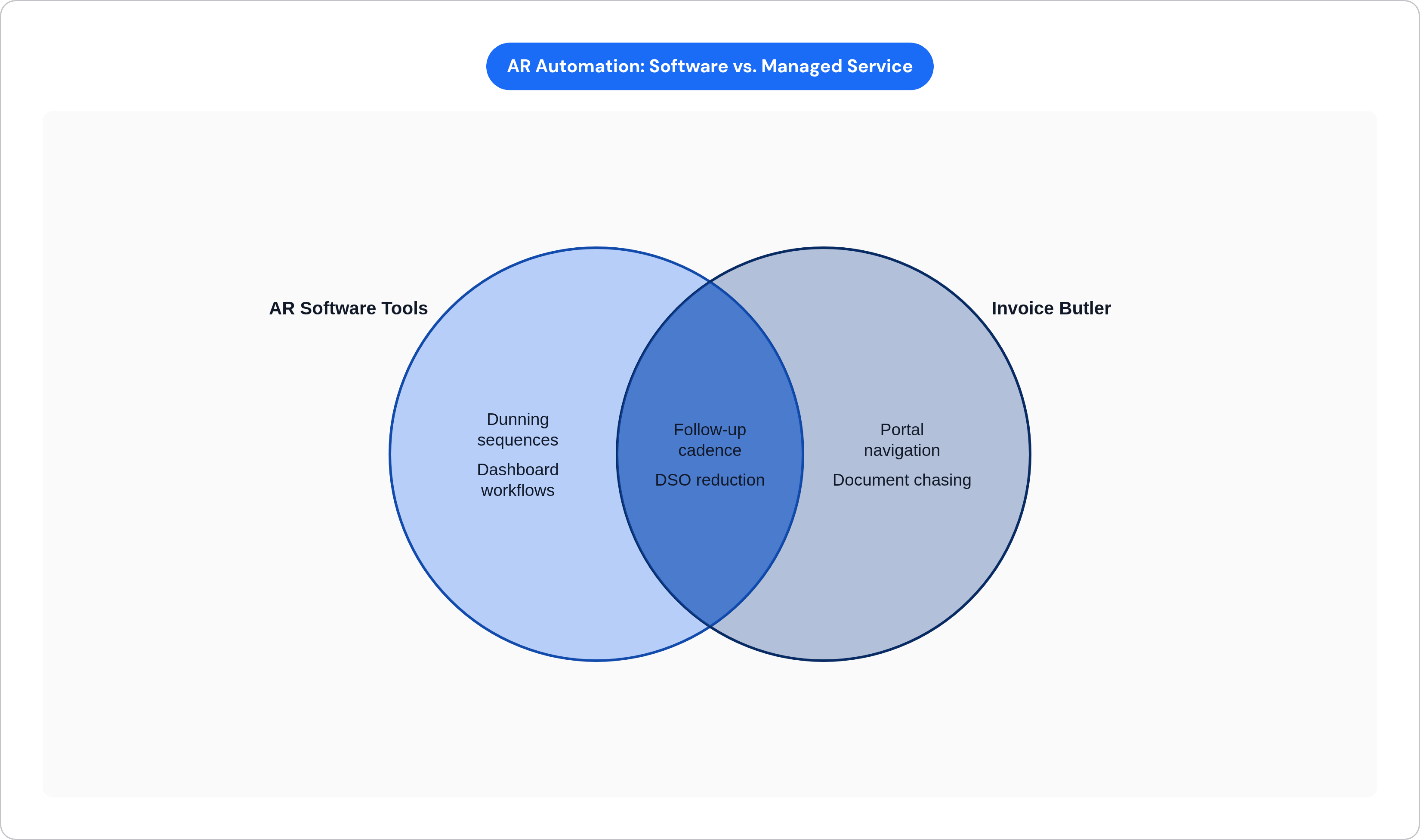
Invoice Butler operates differently from everything else in this comparison. It acts as an outsourced AR team for companies that don't have one, or whose current team is already at capacity, rather than as software that augments an existing AR team.
That distinction matters for mid-market companies where the CFO or controller is currently the de facto collector. The goal is to get the work off their plate entirely, rather than to give them a better dashboard.
This model directly addresses the three operational blockers identified earlier:
- Portal navigation. Works inside Coupa, Ariba, and similar supplier portals on the client's behalf. Not just outreach. Actual portal execution.
- Missing documents. Chases W-9s and required paperwork rather than waiting for someone to notice the invoice is stuck.
- Persistent follow-up. Automated outreach across email, phone, and SMS, backed by human collections experts who escalate when silence continues.
The platform positions around $3 billion or more in receivables under management, which signals operational scale, not a proof-of-concept stage. It deploys quickly, without a year-long implementation or a dedicated internal administrator to run it.
The combination of AI agents and human collections experts also allocates effort differently. Instead of paying for software and hoping your team uses it, the work is handled on the client's behalf.
Best fit: mid-market companies with limited or no collector headcount, significant portal-based customers, or invoice portfolios where follow-through, not just outreach, is the gap.
How to match tool type to the operational gaps you actually have
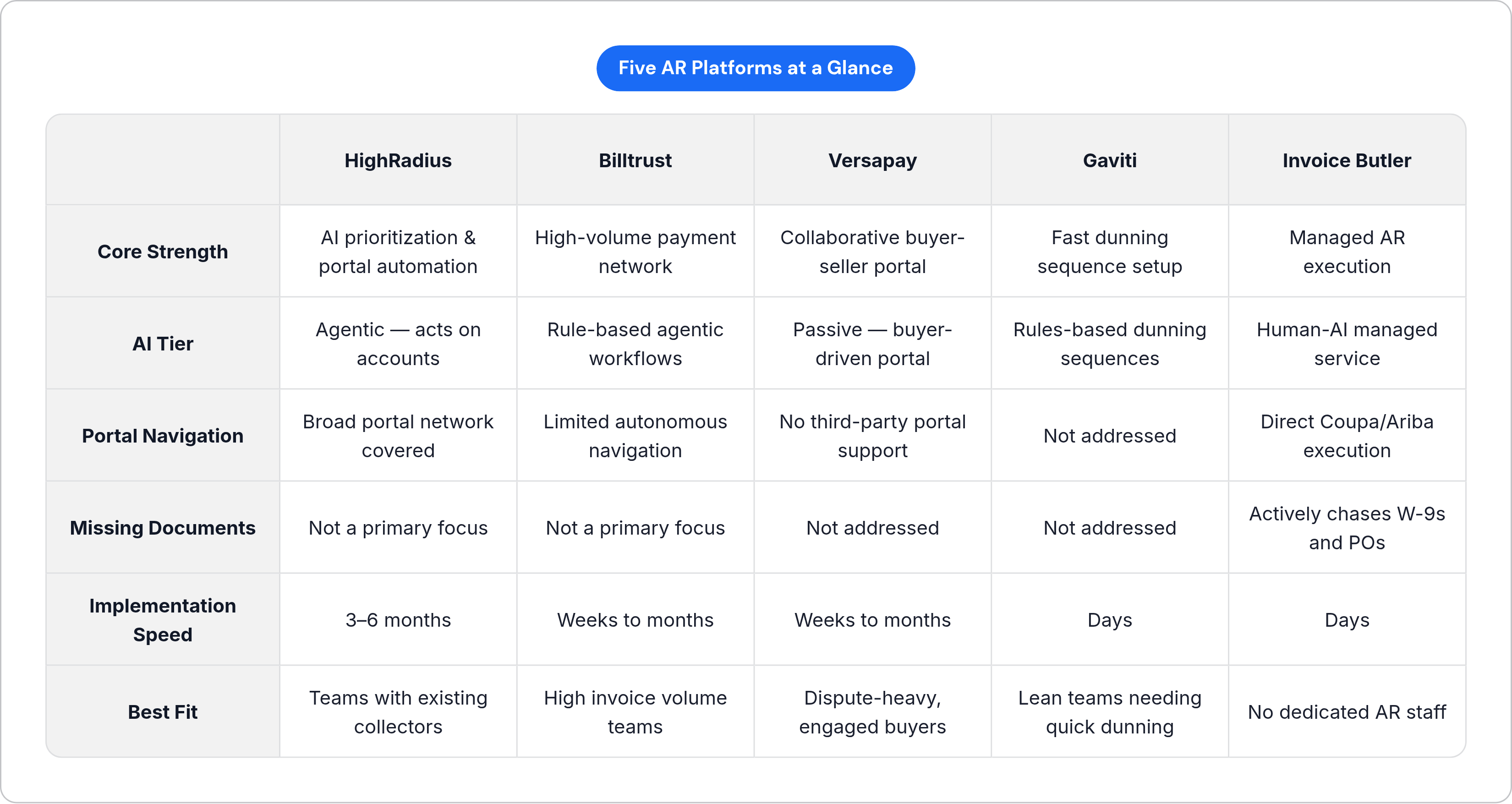
The right tool is the one that addresses your actual blockers. Not the one with the longest feature list or the most analyst coverage.
Work through these decision dimensions honestly:
- Do you have collectors who need better prioritization and workflow? HighRadius or Billtrust add the most leverage on top of existing headcount.
- Is dispute resolution and buyer communication your primary friction? Versapay's collaborative model is purpose-built for that.
- Do you need dunning sequences live in days with minimal admin? Gaviti is the fastest path to structured outreach.
- Do you have no dedicated AR staff, or face persistent portal and document blockers? A managed AR service that automates collections follow-up across email, phone, and SMS and handles portal execution may be the right fit, handling work that would otherwise fall to a human collector.
Implementation timeline is a real constraint, not a footnote. A tool that takes 3 to 6 months to go live carries a different risk profile for a mid-market company than a managed service that deploys in days. Model that gap. The invoices don't stop aging while you're implementing.
Pricing model matters as much as price. Outcome-based pricing like HighRadius, volume-tiered SaaS like Billtrust and Versapay, and managed-service pricing each allocate risk differently. Run the cost against your current DSO and the working capital you'd free by closing it. The comparison looks different when you do that math.
Final stress-test question for any vendor you shortlist: when a dunning sequence runs and the invoice still isn't paid, what happens next? Does the software handle it, or does your team?
The answer to that question tells you more than any feature comparison will.