Natural Language Processing in Accounts Receivable
AI reads customer messages to extract payment data and automate cash matching.
Let's skip the textbook definition and just talk about what this technology actually touches.
NLP is the branch of AI that handles human language. Not structured database fields. Actual text. The kind a customer types when they're annoyed, or tired, or working from a template their AP department built in 2011 and never updated.
In AR, that means NLP is reading customer emails, dispute notes, remittance PDFs, portal status messages, and chatbot logs. What it does with that text falls into three buckets:
- Extraction. Pulling meaning out of unstructured content. Invoice number from an email body. Reason code buried inside a paragraph-long dispute note.
- Classification. Figuring out intent. Is this a dispute? A payment promise? A document request? A "I'm on vacation until the 15th" autoresponse that should be ignored?
- Generation. Writing back. A contextually appropriate reply, a summary for the analyst queue, an escalation note.
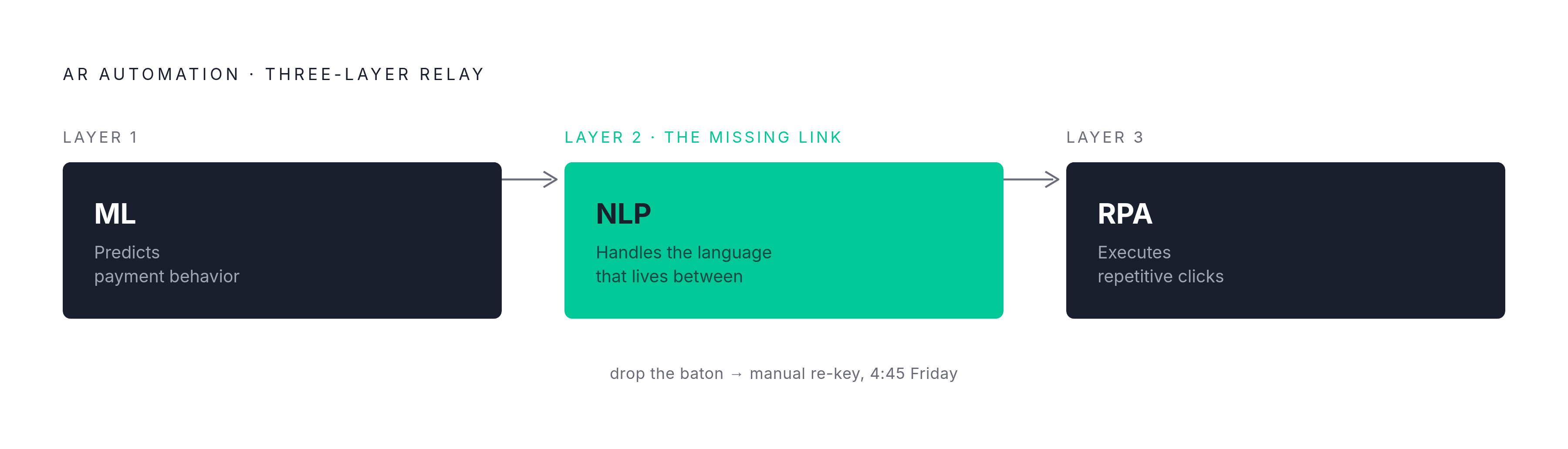
NLP doesn't operate alone. It sits alongside machine learning and RPA in the AR automation stack. ML predicts payment behavior. RPA executes the repetitive clicks. NLP handles the language that lives between those two things. Each layer has its lane — think of it as a relay race where dropping the baton means someone, somewhere, is manually re-keying data at 4:45 on a Friday.
One architectural point worth getting clear on: the generative part of NLP, the large language model layer, should only serve as the communication interface. Reading messages, drafting responses. It should not be running financial calculations. Math belongs with deterministic models that operate inside accounting guardrails. Language errors are recoverable. Math errors in a ledger are not.
The net effect is that NLP converts the conversation layer of AR into structured, actionable data. That layer was invisible to every previous generation of automation tooling. Now it isn't.
How NLP Processes the AR Inbox — Parsing Emails and Remittance Data at Scale
AR teams at mid-to-large companies receive somewhere between 50 and 150 customer emails per week. At 1,000 to 10,000 invoices per month, manually reading and triaging every single one isn't a real option. Someone is perpetually behind, and usually that someone knows it.
The more surprising stat: 60 to 80% of payment delays trace back to email-based communication failures. Not the invoice terms. Not the customer relationship. The email that sat unread for four days, or got read but never got logged. ERPs don't have inboxes. Nobody built them to. That's the gap.
What an NLP email parser does with an incoming message:
- Reads the full email body, not just subject line and sender
- Extracts referenced invoice numbers, payment intent, dispute signals, and document requests
- Classifies the email type: promise-to-pay, dispute, information request, out-of-office, escalation flag
- Syncs extracted data back to the ERP as structured updates, no manual entry required
Remittance parsing extends this same logic to PDFs, EDI files, portal screens, and bank lockbox files. NLP reads across formats using fuzzy matching on amounts, PO numbers, and customer-specific patterns it has learned over time. A customer who references "INV-2024-0089" in their remittance when your system calls it "Invoice 89" stops being a problem. It just quietly resolves, which is the kind of communication-layer friction that Invoice Butler, an AI-powered accounts receivable tool that automates invoice follow-ups and collections across email, phone, and SMS with human expert backup, was built to eliminate.
Emagia documented a result worth flagging here: an NLP-powered email parser reduced manual entry by 70% and lowered mismatches by 85%, cutting reconciliation time and accelerating cash posting.
Email parsing sounds administrative. It isn't. It's the mechanism by which AR teams stop losing cash inside their own inboxes.
Invoice Data Extraction — What NLP Contributes Beyond OCR
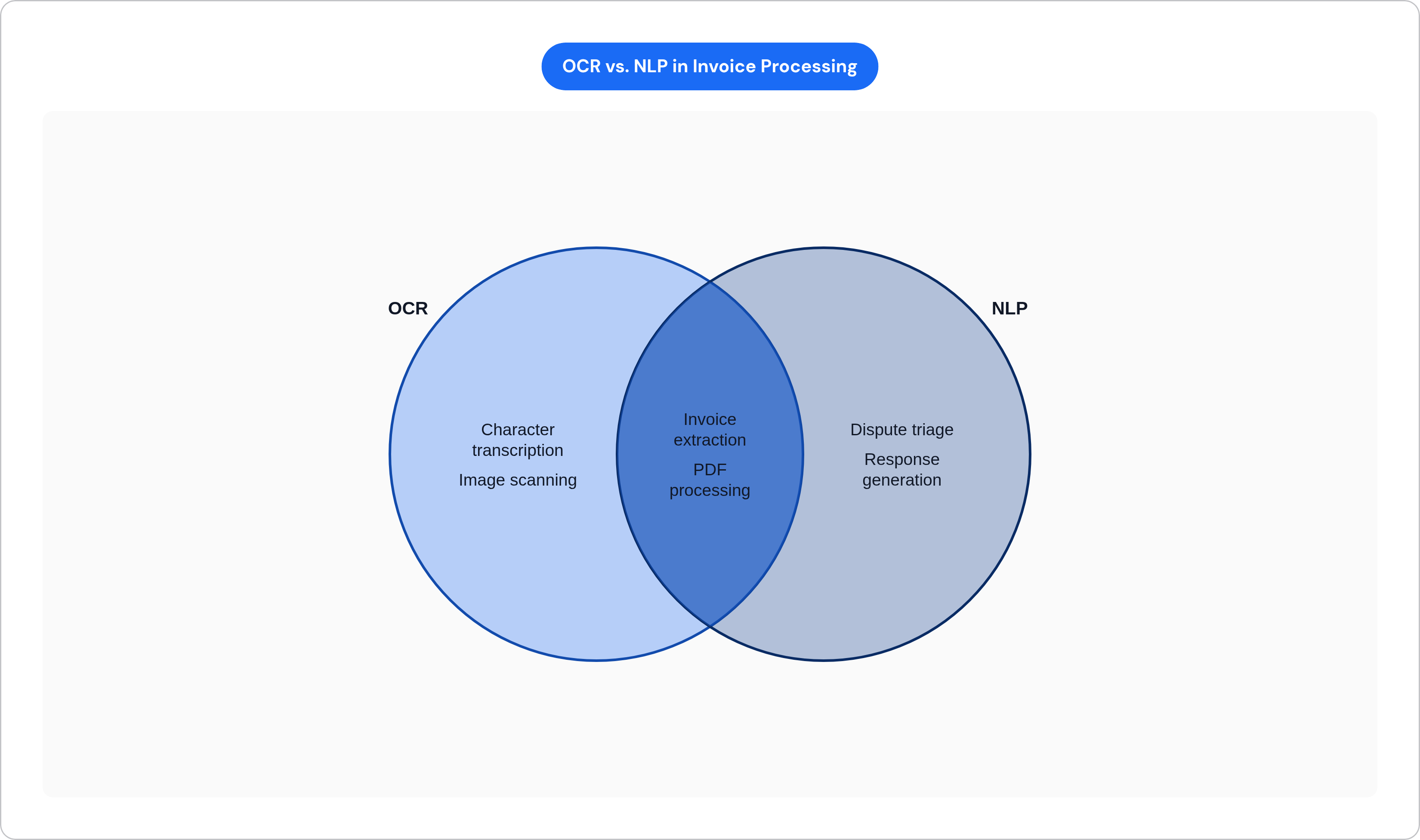
OCR reads characters. NLP understands what those characters mean in context. That distinction is the entire game.
OCR looks at a PDF and transcribes what it sees. NLP looks at the same PDF and understands that "consulting services re: Q3 implementation" is a line-item description, not a PO number. That "Net 30" is a payment term, not a date. That the number sitting in the upper right corner is an invoice number, not a phone number. If OCR is a camera, NLP is a reader — one actually knows what it's looking at.
What NLP extracts from an invoice: vendor name, line items with descriptions, amounts, dates, PO references, tax IDs, payment terms. Even when field labels differ from one sender to the next. Even when the document was scanned at an angle and the columns are a mess.
Generative AI-powered extraction from PDFs, email remittances, and scanned paper has been documented at accuracy rates above 96% in vendor studies. That number matters in both directions. A 4% error rate across high-volume processing creates a serious manual cleanup backlog, so don't let the headline figure do all the work for you.
Edge cases NLP handles that pure OCR simply cannot:
- Invoices where line-item descriptions are written as narratives rather than codes
- Remittance notes where the payment reason is buried three sentences into a free-text field
- Multi-language invoices from international counterparties
Extraction accuracy does degrade when document quality is poor or when a vendor quietly changes their format. Human review queues still exist. They're just much smaller, and the cases routed to them arrive with context rather than as blank mysteries.
Cash Application — Where NLP's Matching Logic Converts Payments Into Closed Invoices
Cash application is where extraction meets payment matching. The system has read the remittance, pulled the relevant fields, and now needs to connect the payment to the right open invoice or invoices.
This is harder than it looks. One payment might cover 200 invoices. Remittances arrive days after the payment clears. Customer reference numbers don't always match your internal numbering. Someone on the customer side typed something slightly wrong and now the match fails. This isn't exotic. It's the normal volume of a normal week.
NLP's role in the match: it reads remittance detail at the line level, applies fuzzy logic on amounts and PO numbers, accounts for tolerance thresholds and shipping events, and factors in customer-specific payment patterns learned over time.
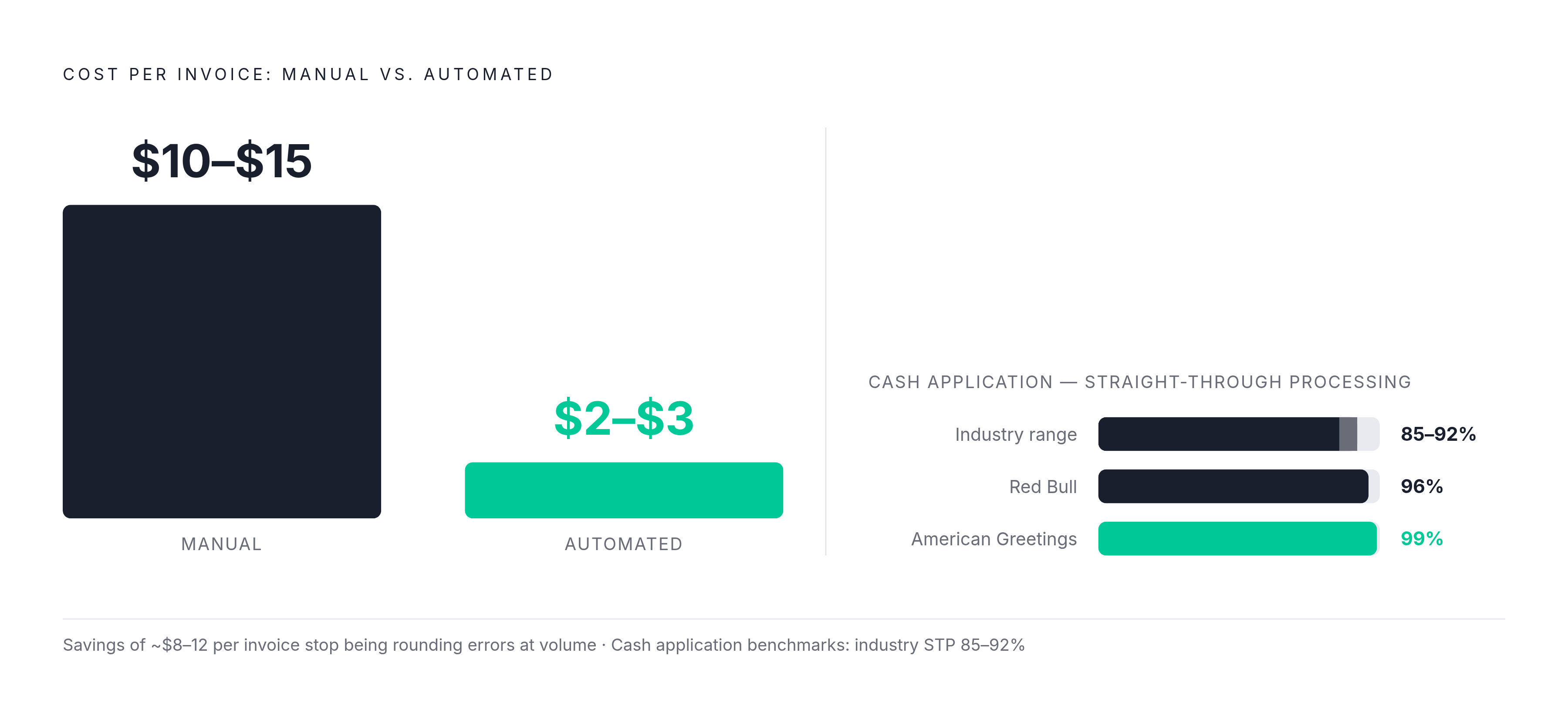
The benchmark numbers from Esker clients show what a mature deployment can achieve. Red Bull reached 96% straight-through cash application. American Greetings hit 99% automated cash application with a 96% hit rate. Those aren't typical starting points. Industry-wide, vendors including YayPay, Versapay, and HighRadius report straight-through processing rates of 85 to 92% on payment matching for enterprise clients, with annual savings of $1.2 to $3.8 million for large enterprise deployments.
The remaining 4 to 15% that doesn't match automatically isn't just dumped into a queue. It gets routed to a human with NLP-generated context already attached. The analyst sees why the match failed rather than starting from scratch. That's the difference between a five-minute fix and a thirty-minute investigation.
The cost math compounds quickly. Manual invoice handling runs $10 to $15 per invoice. Automation brings it down to roughly $2 to $3. At any meaningful volume, those numbers stop being rounding errors.
Dispute Interpretation — Reading What a Customer Actually Means When They Don't Pay in Full
Disputes are expensive and annoying in roughly equal measure. AR teams spend about 30% of their day on them. Roughly 150 hours per month per team. Businesses faced an average of $65 million in new dispute cases in 2023, with total pending amounts hitting $150 million by year-end. That's not a niche problem hiding in a corner of the industry.
The core issue is that disputes arrive as language. An email explaining a short payment. A portal note flagging a pricing discrepancy. A deduction taken with a description that says something like "damaged per warehouse." None of that is structured data until a person reads it and categorizes it. NLP does that reading.
What NLP actually does in dispute triage:
- Classifies the dispute type: pricing error, duplicate invoice, damaged goods, missing POD, quantity discrepancy, contract terms disagreement
- Assigns a reason code automatically rather than waiting for an analyst to do it
- Pulls relevant context: contract terms, prior email thread, shipping and delivery confirmation
- Summarizes dispute history for whoever picks it up next
- Drafts a customer reply and recommends a resolution path, whether that's a re-bill, credit memo, or POD resend
When a customer emails about a short payment due to a damaged shipment, the generative layer reads the email, extracts the intent and invoice number, writes a professional response, and automatically opens an internal deduction claim. The analyst opens their queue and finds a completed first draft with context already attached. That's running in production today, not a future-state demo.
HighRadius, Billtrust, and Versapay have embedded LLM-powered dispute root-cause classification that reduces analyst investigation time by up to 70%.
One thing NLP genuinely cannot do: resolve disputes that require a judgment call on contract interpretation or customer relationship management. It surfaces the information. The decision often stays human. That's appropriate, not a gap to apologize for.
Collections Follow-Up — NLP-Driven Communications That Adjust to Customer Context
Traditional dunning is blunt in a way that would embarrass most sales teams. A scheduled email template fires at fixed intervals regardless of customer history, dispute status, or payment pattern. It doesn't know you already have an open dispute with this customer. It doesn't know they go quiet every December and catch up in January. It just sends, because that's what it was told to do when someone set it up three years ago. A dunning template has all the situational awareness of a parking meter.
NLP makes the message responsive to context instead. Before generating a collections communication, the system reads:
- The prior email thread. Has this customer already flagged a dispute?
- Payment history. Is being late unusual for them, or is this their established pattern?
- Open disputes. Is chasing payment premature right now?
- Invoice status. Has the customer even confirmed they received it?
An agentic AR platform uses NLP to autonomously read customer emails, identify dispute reasons, and prioritize collections based on predicted payment behavior. Instead of sending a nudge, it investigates why payment is late and takes the next logical step.
HighRadius's FreedaGPT does something worth calling out specifically. It identifies the customer from the email address or content, assigns the email to the right collector, summarizes the thread, drafts a tailored response with relevant attachments, and can adjust tone or translate for international counterparties. That last part gets underestimated. B2B AR is relationship-based. You interact with the same counterparties repeatedly, and an email that reads like a human wrote it, because it was generated with full context behind it, lands differently than a template.
Per a Billtrust and Wakefield Research study of 500 finance decision-makers at North American companies with revenue over $250 million, 99% of companies using AI successfully reduced their average DSO. Seventy-five percent reported a reduction of six days or more. Against a 46-day median DSO from Hackett Group benchmarks, six days is real compression. It's driven largely by faster communication loops. The customer was often willing to pay the whole time. They just needed the right message at the right moment.
The Missing Document Problem — How NLP Detects and Pursues What's Blocking Payment
Here's a scenario that plays out constantly: an invoice sits unpaid not because the customer is disputing it, not because they don't have the cash, but because someone in their AP department is waiting on a W-9. Or a certificate of insurance. Or an updated banking form. And nobody told you.
This is a language detection problem. The signal that a document is missing might appear in a portal status field. It might show up in an automated AP rejection email. It might be an offhand line in a payment hold message. In almost none of those cases does it say plainly "we need your W-9 before we can process this." It says something like "vendor record incomplete" or "pending compliance documentation" or just "on hold."
NLP reads these signals across channels. Portal status updates, email replies, chatbot interactions. It flags the specific blocker rather than treating the invoice as simply "unpaid." That distinction matters. "Unpaid" tells you nothing actionable. "Unpaid because buyer's AP portal flagged a missing W-9" tells you exactly what to do next.
Once the blocker is identified, the same generative layer that handles collections drafts the outreach. A targeted message asking for exactly the document needed, addressed to the right contact, not a generic "please advise."
Supplier portal navigation adds another layer. Coupa, Ariba, and similar platforms have their own status language and rejection codes. NLP-capable systems read portal-specific messaging and translate it into an actionable internal task. That translation step sounds small. Without it, someone has to log into each portal, decode the status, figure out what's actually needed, and manually route it. At scale, that is a full-time job for someone who deserves better work to do.
A W-9 that takes three weeks to chase because nobody caught the request is three weeks of DSO. NLP eliminates it not by making anyone pay faster, but by catching the blocker before it ages into a problem.
What the Performance Numbers Actually Show — and What They Don't
The headline numbers are strong. Emagia documented a 70% reduction in manual entry. Straight-through processing rates of 85 to 92% appear across multiple vendor reports. HighRadius's 2026 benchmark report across more than 1,300 customers cites a 40% productivity boost and up to 68% DSO reduction. Their ML models hit 91% payment-date prediction accuracy on a 30-day horizon, processing over $3.8 trillion in AR transactions. The scale of training data behind that last number is relevant. Accuracy claims built on $3.8 trillion in transactions carry more weight than claims built on a six-month pilot.
It's also worth grounding the DSO claims in what "median" actually means. Hackett Group puts median DSO around 46 days. Best-in-class sits in the high 20s. That gap is the improvement opportunity. It's real, but it has a floor. And it doesn't close through NLP alone.
A few things the numbers don't show:
Implementation lift is real. Connecting NLP tools to ERP systems, training on your customer base's communication patterns, and building exception workflows takes time and budget. Vendors don't lead with this in their case studies. You have to ask directly.
Results reflect deployment maturity. The Red Bull and American Greetings cash application numbers are best-case outcomes from mature implementations with clean data pipelines. A first-year deployment on a messy ERP will not hit 99%. It probably won't be close.
NLP handles language. Humans handle relationships. When a key customer calls to work out a dispute personally, that call is still a human call. NLP can prepare whoever takes it. It cannot take it.
The picture that emerges is this: NLP closes a gap that every previous generation of AR automation left completely unaddressed. The communication layer, the emails, the disputes, the missing documents, the remittance notes, always required a person. Now it requires fewer people, and the people it does require spend less time on routine processing and more time on the exceptions that actually need judgment.
AR is paperwork and communication, repeated at scale, forever. NLP finally handles the communication part.