AI Finance Chatbot Use Cases in AR and Collections
Chatbots handle the routine questions and first-response disputes that clog AR teams' schedules.
Gartner's benchmarking found that 83% of finance firms still haven't fully automated accounts receivable, the baseline rather than the exception. That's the baseline. Most teams run some mix of spreadsheets, email threads, and workflow tools that break the moment a customer does something the rules didn't plan for: sending a PDF from a different email address, or deducting a shortage nobody flagged ahead of time.
This piece walks through what AI finance chatbots actually do in AR and collections, use case by use case. Not the pitch deck version. The version where things break, and what happens after they do.
What distinguishes an AI finance chatbot from workflow automation
AR technology moved through four rough phases: manual work, workflow automation, robotic process automation (RPA), and now agentic AI. Each phase fixed the last one's failure point. Each one hit a new wall built from a different flavor of exception.
Workflow automation runs on rules. If X happens, do Y. Fine, until a customer pays through a channel the rule never covered, and the whole thing stalls out waiting for a human to notice. RPA bots automated the clicking and typing, but the rigid rules driving them make the bots just as literal. If a portal's login screen changes, the bot sits there, confused, like a navigation device recalculating after it loses signal in a tunnel.
Agentic AI is the first version that reasons through an exception instead of freezing on it. Inside guardrails someone actually sets, it can read a debtor's response, update what it knows about that account, and propose a counteroffer, without a human clicking "approve" first. That's the real dividing line, not smarter reminders. A dunning email sends the same line to a customer who's three days late and one who's genuinely underwater. It has no idea it's doing anything wrong. Agentic AI does, because natural language processing lets it pick up on whether a customer sounds anxious, hesitant, or flat-out annoyed, and shift its tone to match.
Real-time invoice status inquiries: replacing the "where's my payment?" call
Most inbound AR questions don't need a human brain behind them. Did you get invoice #4521? When's this posting? These are lookups, and they eat hours of a collector's week that could go toward accounts that actually need judgment.
Chatbots wired into the ERP answer these instantly, any hour, with no agent involved. Vendors like ChatFin and Emagia have built entire product lines around exactly this: real-time payment integration paired with a customer-facing chat layer that never sleeps.
None of this is a hard sell to customers, either. People already text a chatbot to check a bank balance or dispute a card charge. AR is just catching up to a habit banking normalized years ago. Checking an invoice's status just used to require a phone call, and phone calls are where good afternoons go to die. It just used to require a phone call, and phone calls are where good afternoons go to die.
How AI decides who to contact, when, and how
Forrester's report on AI use cases in AR automation puts collection management at the top of the list for impact. That's a little funny, since collections is the part of AR everyone assumes stays manual the longest. Turns out it's the one with the most room to move.
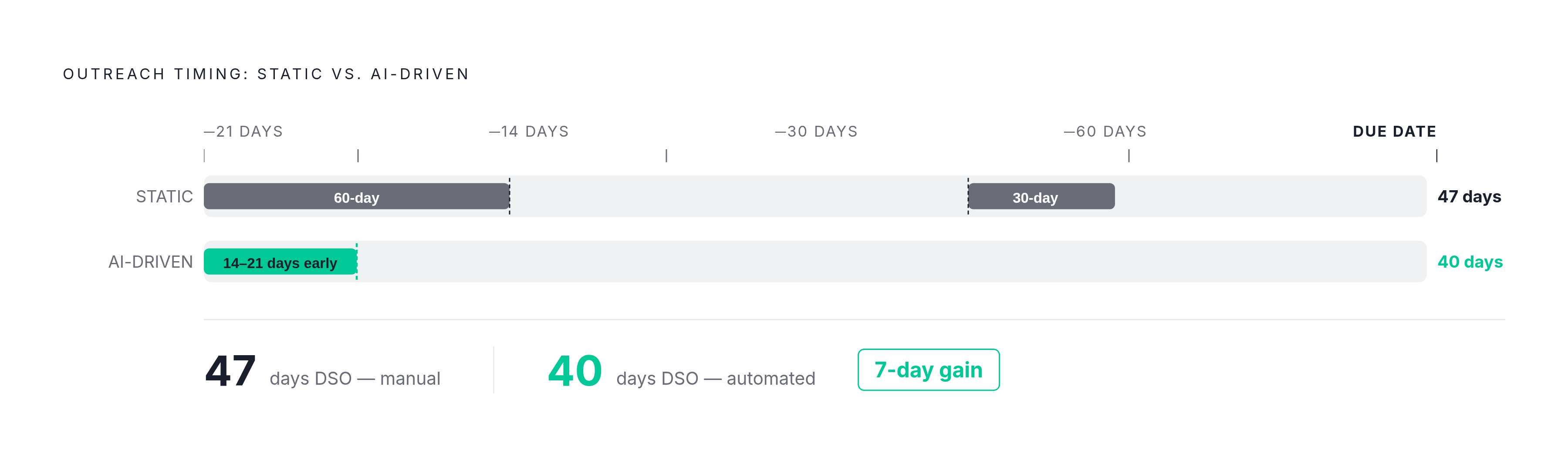
The real shift is timing. Outreach used to fire off a static aging bucket: 30 days late, send a letter. 60 days, escalate. That's the whole strategy, and it treats a customer who's a week from bankruptcy the same as one who just misplaced an invoice. Now outreach runs on live risk signals: payment probability, behavior patterns on the account, quirks of the specific invoice itself. Predictive models trained on payment history can flag an account likely to go past due 14 to 21 days before it happens. That's the window where a proactive nudge does something, before the account turns into a problem instead of a reminder.
Automation cuts DSO, and not by a rounding error. Companies running automated AR average 40 days DSO, versus 47 for firms still doing it by hand. Seven days doesn't sound dramatic until it's multiplied across a whole receivables book. Then it's just cash sitting somewhere it shouldn't be, doing nothing for anyone.
Debtor engagement and negotiation: what conversational AI handles when the conversation gets harder
Gartner research points to AI agent chatbots handling 75% of customer interactions in debt collection by 2025. That's most of the conversation happening with no human on the line. Sounds like a customer service disaster waiting to happen. It would be, except a tone-reading layer catches frustration and adjusts the response before things go sideways.
The same NLP that flags anxiety or frustration in a customer's message shifts the system's tone in response. A generic dunning email treats a customer who just lost a major client the same as one who simply forgot to pay. It treats them the same, because it doesn't know any better.
The negotiation loop is where this gets genuinely interesting. A debtor rejects the first payment plan offered. Instead of routing that straight to a human, the system reads the response, updates its understanding of the account, and comes back with a counteroffer, still with nobody intervening. Banks have started piloting AI built specifically for these sensitive conversations, with debt recovery as the obvious testing ground. Sensitivity here is the whole point of the design. It's the whole point of the design.
Dispute intake and deduction management: using AI to absorb the friction before it becomes a write-off
Disputes are expensive at scale, full stop. Dispute volumes have grown to a scale that strains any manual process. Every dispute needs a person to read it, categorize it, and route it to the right resolution path, and that person is usually already three tasks behind.
Visa launched new AI-powered dispute tools in April 2026, covering areas including case intake, document analysis, and recovery automation. It's a direct response to dispute volumes that have outpaced what manual processing can absorb. When a payments network that size builds AI tooling specifically for dispute volume, the old manual process clearly wasn't built for this much traffic.
In AR specifically, NLP-based intake pulls structured information out of unstructured customer messages, whether that's an email, a portal note, or a voice call transcript. It figures out what kind of dispute it's looking at, pulls the matching invoice and PO data, and routes it down the right path. Deduction management tools in this category go a step further, resolving short payments or invoice discrepancies automatically and flagging recurring disputes for a human to review the pattern later. Over time the system learns which deduction types it can close out by itself, and which ones genuinely need a person's judgment.
Document collection and missing-information resolution: the unglamorous bottleneck that holds up cash
Most stuck invoices are missing a piece of paper. They're missing a piece of paper. A W-9 never got sent. A PO number's blank. Proof of delivery never got attached. None of that is a collections failure. It's an admin gap, but it holds up cash exactly the same way a real dispute would, which is the annoying part.
AI chatbots handle this by figuring out which invoice is blocked and by what, sending a targeted request through whatever channel fits (email, portal message, text), tracking whether the document comes back, and releasing the invoice the moment it does. Tools like Emagia's GiaDocs AI are built for intelligent document processing in the AR context, handling unstructured documents and extracting the data that matters for the AR record.
This gets overlooked because it looks like paperwork instead of collections. A payment stuck over a missing form still inflates receivables the same way unapplied cash does, feeding DSO from a different angle, appearing on no dashboard as a "collections problem."
Supplier portal navigation: how AI agents handle the platforms that humans find most tedious
Plenty of enterprise buyers won't take an invoice any other way than through their own portal: platforms like Coupa or Ariba, each with its own login rules, document formats, and status screens. It's the AR equivalent of needing a different key for every door in the same building, and nobody labeled the doors.
That work costs real time, and none of it uses the judgment AR staff are actually good at. Log in, check status, upload the right document in the right format, respond to whatever the portal's asking for this week. It's clicking, not thinking, a task that drains a smart person's afternoon for no good reason.
AI agents built for this navigate the portal interface directly: submitting documents in the required format, checking status, flagging anything that looks off, pushing updates back into the AR system, all without a person parked at the keyboard for every click. The distinction that matters is the same one from earlier. RPA bots are rule-bound in the same way earlier automation was, a changed screen can stop them cold. Agentic systems apply the same contextual reasoning that handles a debtor negotiation, just pointed at a login page instead of a difficult conversation.
Cash application and payment matching: where AI handles the volume that manual teams never could
Cash application sits among the highest-impact AR use cases alongside collections, and that pairing makes sense. It's the back half of the same story. Outreach gets the payment moving. Cash application is what actually closes the loop once the money lands.
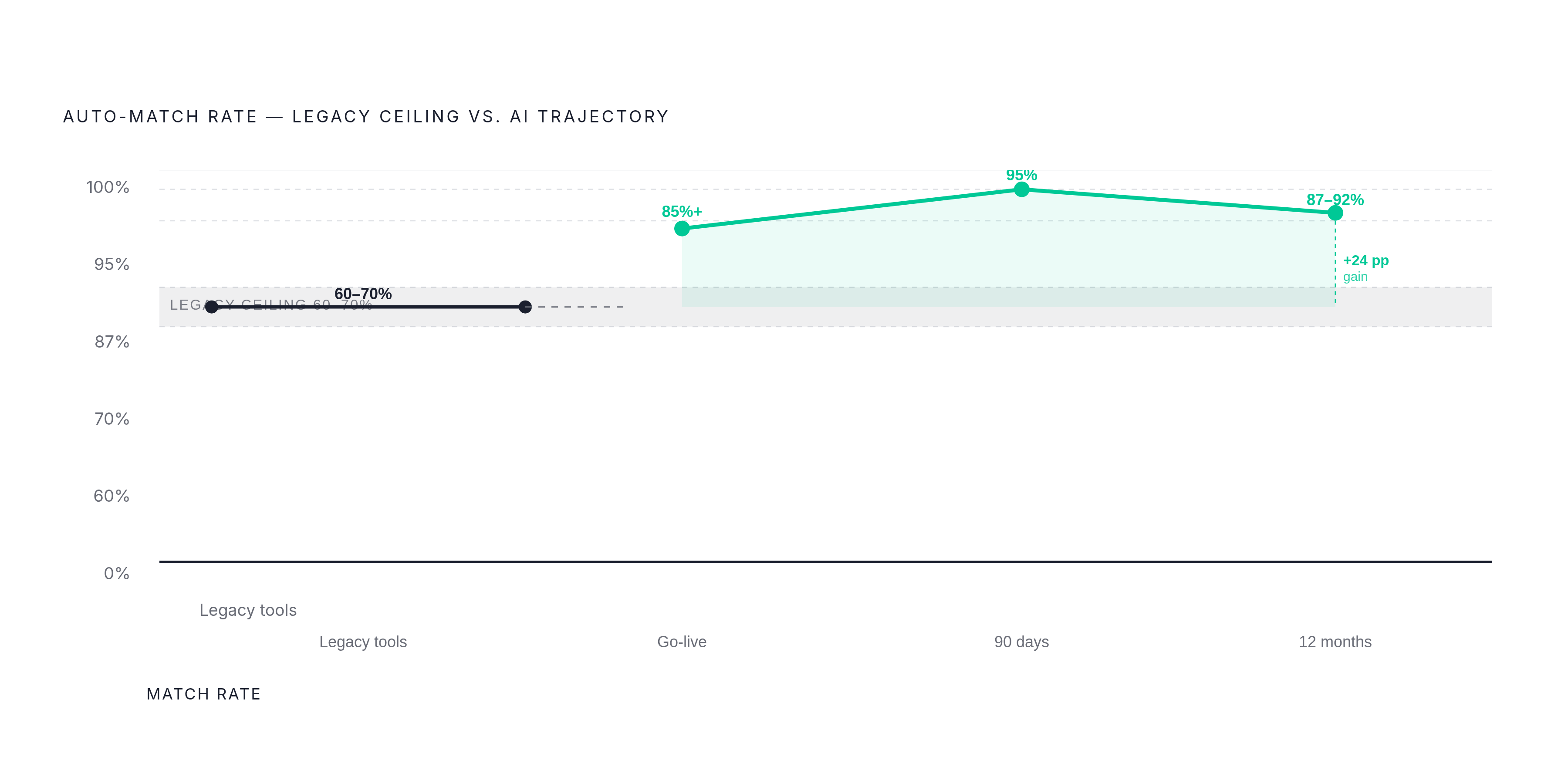
Legacy matching tools plateau around 60 to 70% auto-match rates, and that ceiling doesn't move no matter how much anyone tunes the rules. AI-native platforms clear 85%+ right out of the gate, and push past 95% within 90 days of going live. In deployments running 12 months or more, match rates settle around 87 to 92% for AP payment matching and 89% for AR cash application. That's not an incremental gain; it's a different category of performance.
Time tells the same story from another angle. Manually reconciling a large batch of payment records takes more than four times as long as AI-assisted matching on the same volume, a 78% reduction. And the errors AI catches aren't hypothetical: Manual processing at scale reliably produces matching and posting errors that accumulate unnoticed until someone reconciles them too late. At any real scale, that's a stack of accounts sitting wrong until someone happens to notice, and someone always notices too late.