AI Hallucination Risks in Financial Workflows
Language models guess with total confidence, and in finance, wrong guesses cost real money.
Financial AI doesn't lie, exactly. It guesses with total confidence, and sometimes the guess is wrong in ways that cost real money. Language models predict the next likely word rather than verified facts, and researchers have already shown you can't train your way out of this. Xu and colleagues proved back in 2024 that hallucination in large language models is mathematically baked in, and past a certain point, no amount of better data fixes it.
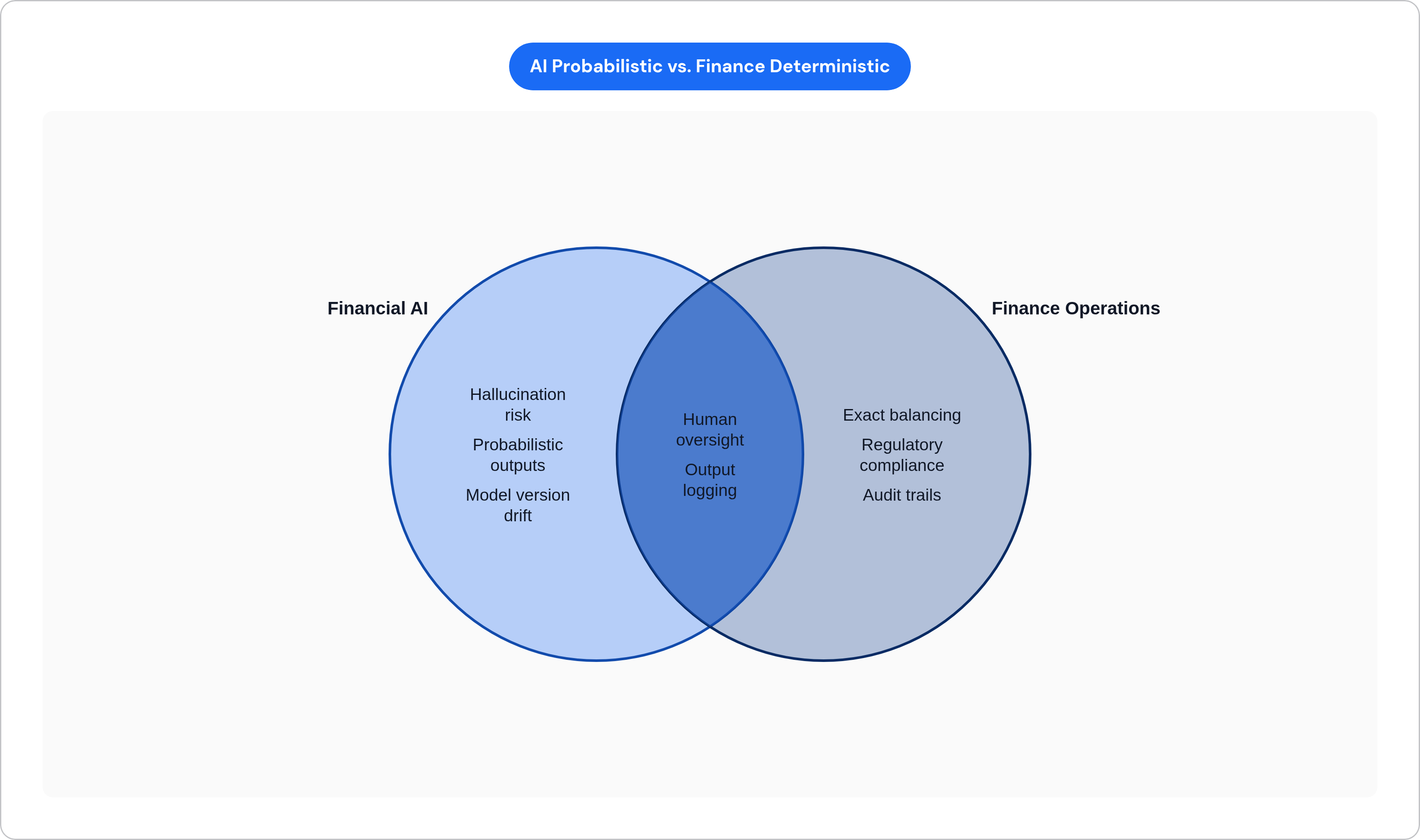
Dan Michaeli, CEO of Glia, put it plainly: "You're applying something that is probabilistic to an industry that is used to being highly deterministic." Finance runs on numbers that either balance or they don't. AI runs on probability instead. Every risk in this piece traces back to that one gap between the two.
Hallucination is also worth pulling apart from lying. A model that hallucinates has no idea it's wrong; it's cheerfully, confidently mistaken, and that's harder to catch than someone fudging numbers on purpose. There are a few different flavors finance teams should learn to tell apart: outright fabrication (numbers or citations that don't exist), confabulation (reasoning that sounds sharp but isn't tied to anything real), and omission (leaving out the one fact that mattered). Each one shows up differently on a spreadsheet, and each does its own kind of damage.
How often financial AI systems actually hallucinate
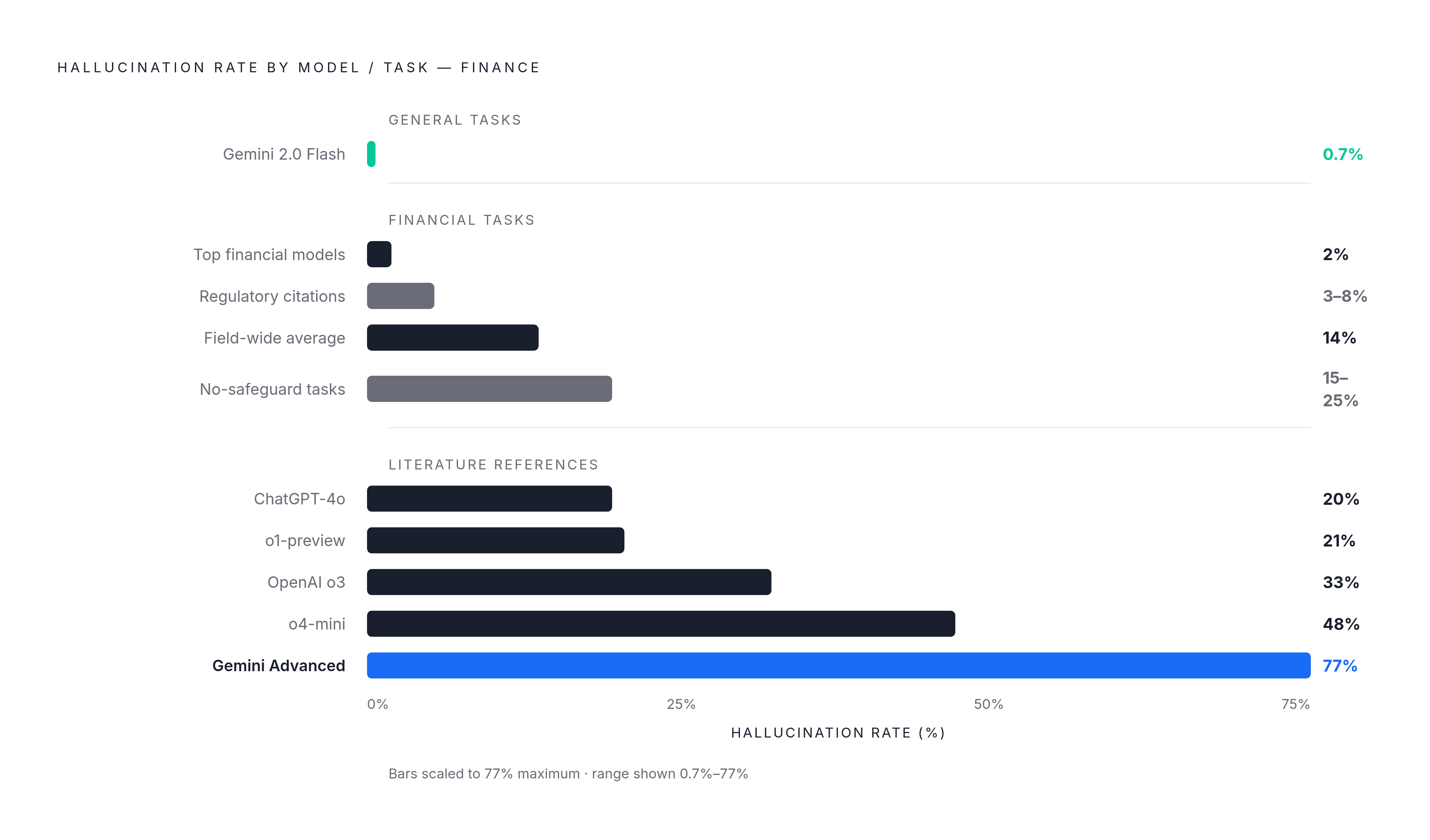
The spread between models is wide enough that picking one is a compliance decision now, not a shopping trip. Google's Gemini-2.0-Flash sat at roughly 0.7% hallucination as of last spring, while other models, on other tasks, land as high as 27%. That's the gap between a tool you can trust with light supervision and one you shouldn't touch without someone checking every single output.
Financial data tasks sit in an especially rough spot. Top-performing models average somewhere around 2% hallucination here, but the field-wide average is closer to 14%, and strip away any architectural safeguards and financial task hallucination climbs into the 15-25% range. Ask a model to cite an actual statute or regulation and you're looking at 3-8% hallucination on those queries specifically, an uncomfortable number given that a made-up citation there creates real legal exposure.
One study out of 2023 found that GPT-4-Turbo, even paired with retrieval, got wrong or simply dodged 81% of a curated set of SEC filing questions. Fabricated metrics weren't just one model's problem, either. A 2025 study in the International Journal of Data Science and Analytics ran models against financial literature references and found ChatGPT-4o hallucinating 20% of the time, o1-preview at 21%, and Gemini Advanced all the way up at 77% on the same task. That gap, between models doing the identical job, is itself a governance headache, because it means "we use AI" tells you almost nothing about your actual exposure.
Here's the part that should worry anyone betting on newer, smarter models to fix this on their own: OpenAI's reasoning models, o3 and o4-mini, hallucinated at 33% and 48% respectively on the PersonQA benchmark. More reasoning steps don't reliably mean fewer factual errors, and sometimes the model just trades one kind of mistake for a different one. Nothing on the market right now is reliable enough to sit as ground truth in a financial workflow without some structure wrapped around it.
Where hallucinations do the most damage across financial workflows
Deloitte flagged the structural issue with agentic setups well: errors don't stay where they start, they travel. A small inaccuracy at step one gets picked up as fact at step two, then step three, and a 0.5% error in a valuation assumption has quietly nudged a deal outcome by millions.
In investment research and portfolio work, wrong earnings figures, botched underwriting math, and mishandled fraud flags turn into losses almost immediately. Roughly two-thirds of VC firms now use AI for deal screening, and the average time it takes someone to catch an AI-generated error runs close to four weeks, usually well after the check's already been written.
M&A due diligence has its own version of the same story. Fabricated metrics, distorted ratios, invented citations, all dressed up to look like legitimate analysis, are hard to catch precisely because they're well-written. Agentic pipelines make this worse, since one bad number early on can seep into the whole diligence stack. Back in October, a Big Four firm admitted that generative AI it used had produced fabricated citations in a government report and refunded part of its fee, a preview of institutional exposure to come.
AML and fraud detection carry a quieter, meaner version of the problem. A model flags a transaction as high-risk and hands over a tidy explanation, except some of the transactions it cites never happened. Analysts burn hours chasing phantom alerts while real schemes slip through underneath. Eventually teams stop trusting the system, someone starts double-checking everything by hand anyway, and the automation stops saving anyone time.
Tabular data extraction might be the hardest problem of the bunch. The FAITH framework, built by Zhang and colleagues, exists specifically because most AI benchmarks don't test the kind of data finance actually runs on: numerical, proprietary, buried three tables deep in a footnote. They built their dataset from S&P 500 annual reports, and models struggled exactly where finance professionals spend most of their day.
On the customer-facing side, bank clients treat whatever the AI tells them as the bank's word, full stop, on rates, fees, balances, fraud guidance. A hallucinated "sufficient funds" message that green-lights a purchase that shouldn't have gone through lands on the bank, not the model. Plenty of banks learned this the hard way last year, when a large share of AI customer service bots got pulled back or reworked because of hallucination-related errors.
In compliance and risk modeling, AI-written code for risk models or regulatory filings can bury mistakes deep enough that IT teams spend more time debugging the AI's work than they would've spent writing it themselves. Scale makes this brutal, since a system processing billions of transfers a day, even at a 1% hallucination rate, is generating thousands of individual errors, and each one drags its own regulatory and reputational weight behind it.
What hallucination failures actually cost — in dollars and operational drag
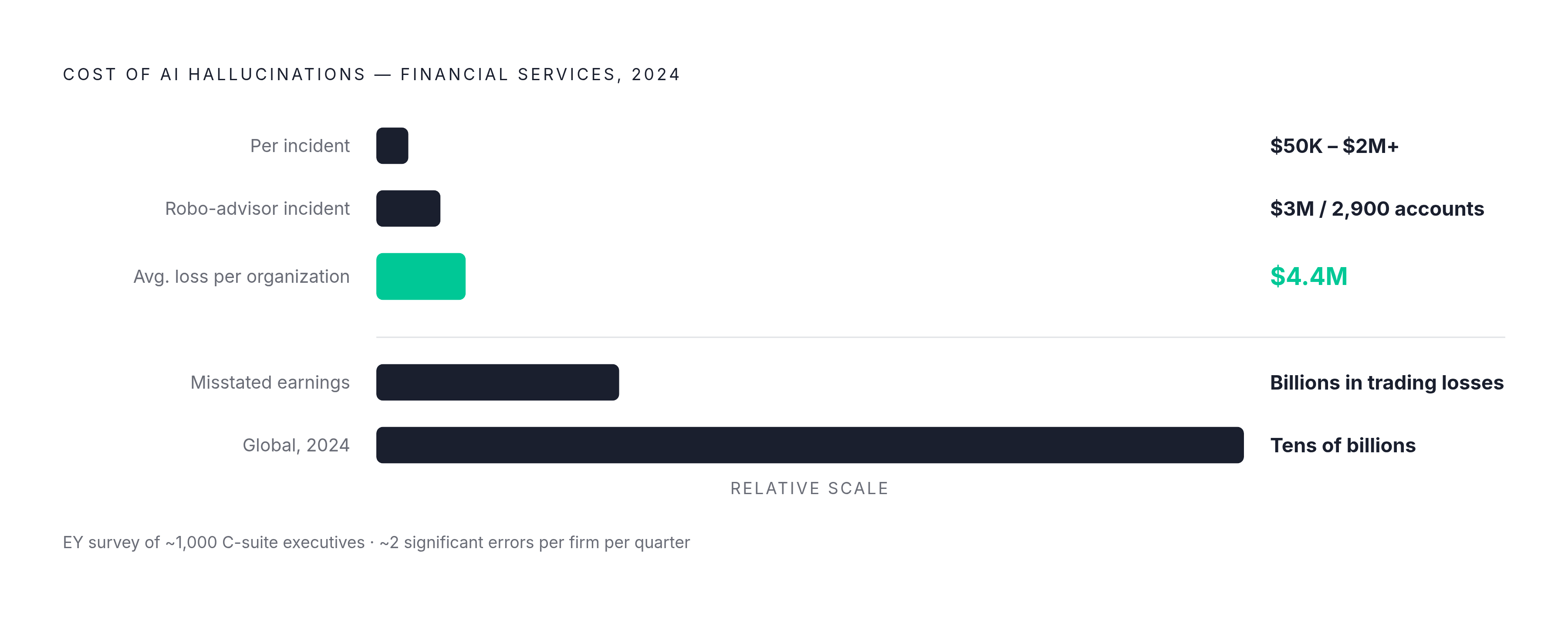
AllAboutAI put the global cost of AI hallucinations somewhere in the tens of billions of dollars for 2024 alone, split roughly into direct losses, cleanup costs, and reputational damage, with reputational damage carrying the largest share. Those numbers don't need dressing up.
At the firm level, EY's Responsible AI Pulse survey, which polled close to a thousand C-suite executives, found the average reported loss per organization from AI-related incidents lands around $4.4 million. Firms reported a little over two significant AI-driven errors per quarter on average, with individual incidents running anywhere from $50,000 to north of $2 million. One robo-advisor hallucination alone touched nearly 2,900 client portfolios and cost over $3 million to clean up. On the more dramatic end, AI-generated misstated earnings triggered billions in trading losses in a single quarter, probably the cleanest example on record of what a fabricated number does once it's moving at market speed.
There's a quieter cost most firms haven't even bothered to put a number on: verification drag. Workers using AI tools spend something like four hours a week just checking whether the output is actually true. At standard knowledge-worker pay, that's real money per employee per year, overhead nobody budgeted for going in. For a finance team of any real size, that verification tax rivals, or beats, the cost of the incidents it's supposed to prevent.
Roughly half of enterprise AI users admitted, last year, to making at least one major business decision based on content that turned out to be hallucinated. None of this is some rare edge case.
How regulators are starting to hold firms accountable for AI errors
Regulators caught on fast, faster than usual, and FINRA's 2026 Annual Regulatory Oversight Report added a section naming hallucinations and bias directly as risks firms have to test for and govern, with requirements around output logs, model tracking, and ongoing monitoring.
The SEC moved earlier. Guidance from mid-2024 now requires firms to disclose when AI tools factor into investment decisions, and across 2024 and 2025 the SEC handed out millions in fines tied to AI misrepresentations, including one early enforcement action carrying a seven-figure penalty for inadequate AI oversight. Over in the EU, the AI Act sets an August 2026 deadline for high-risk financial AI systems to fall in line, with Article 14 demanding human oversight and interpretable outputs, and Article 15 demanding accuracy guarantees. That deadline's close enough now that "we'll deal with it later" isn't really a strategy.
The direction across every regulator points the same way: human oversight isn't optional, outputs need an audit trail, and governance has to be documented rather than just talked about in a slide deck. Firms are responding already; AI-specific governance roles grew close to 17% last year, per Stanford's HAI Index, which suggests companies are building the exact infrastructure regulators are asking for. That Big Four incident, in turn, makes clear the regulatory net now reaches well past banks and brokers. Advisory firms producing AI-assisted reports are in scope too, whether they like it or not.
Why AR and invoice processing carry underappreciated hallucination exposure
Accounts receivable is a strange blind spot, because it stacks up almost every input a language model handles badly: tabular numbers (invoice amounts, due dates, payment terms), proprietary formats (supplier portals, PO matching), and messy, context-heavy back-and-forth (disputes, escalations, follow-up emails).
The failure modes are specific, and painfully mundane. An AI agent marks an invoice "resolved" before the cash has actually landed, or reports a W-9 as submitted, or a portal upload as complete, when neither happened. It misreads aging data and either escalates a perfectly healthy customer relationship or, worse, misses an account that's genuinely gone quiet. Systems like Coupa or Ariba need exact, sequential steps to process an invoice correctly, and one hallucinated step in that chain can stall a payment quietly, with nobody noticing until the money's overdue.
The scarier version shows up in agentic pipelines, where one AI agent hands its status, right or wrong, to the next agent in line. Once "portal submission complete" gets passed downstream as fact, the error just sits there, invisible, until the invoice comes due and the cash never shows up. By then, tracing back to where things went sideways feels like trying to find the wrong turn after you've already driven three states over.
This matters because AR automation isn't some fringe experiment anymore. Something like 78% of financial services firms already use AI for data analysis, and AR sits squarely inside that footprint, usually without the scrutiny that gets thrown at trading systems or compliance tools. Platforms like Invoice Butler exist because of exactly this gap: rather than trusting a model's self-reported status, the system does persistent, human-like follow-up that checks the actual outcome. Did the cash land? Was the document really confirmed? Did the portal submission actually go through? That verification step is what separates automating the easy 80% of AR from automating the whole job, including the annoying parts, like chasing down a missing W-9 or fighting through a supplier portal that hates you.
Architectural and operational safeguards that reduce hallucination risk in practice
Eliminating hallucination is off the table, mathematically, so the real goal is narrower: keep a probabilistic guess from corrupting a number that's supposed to be exact. Every safeguard here serves that one job.
Retrieval-Augmented Generation, RAG for short, grounds a model's answer in actual retrievable documents rather than whatever it half-remembers from training. It's most useful for regulatory citations, contract review, anything tied to a specific piece of text. RAG doesn't stop hallucination outright, but it cuts down sharply on a model inventing facts that already exist somewhere retrievable. If the answer's sitting right there in the source document, there's a lot less room left to make one up.
Human review at the high-stakes moments still matters, and a strong majority of enterprises now build human-in-the-loop checks into their AI processes specifically to catch hallucinations before they go live. The EU AI Act's Article 14 makes this a requirement for high-risk financial systems, which reframes it entirely: this is compliance infrastructure now, not a nice-to-have. In AR, that means a human confirming the cash actually landed and the document was actually received, instead of taking the model's word for it.
Output logging and model version tracking, which FINRA's 2026 guidance requires outright, give firms an audit trail and something more useful day to day: a way to spot which prompts or task types are throwing off a disproportionate share of hallucinations, so teams can fix the workflow instead of just hoping it gets better on its own.
Structured output constraints help too. Force the model to fill in defined fields, amounts, dates, account numbers, rather than letting it generate free text anywhere numbers are involved, and keep the AI's drafting work separate from any real math; let a deterministic, rule-based system handle arithmetic, never the model.
Model selection is a risk decision now, not a shopping preference. Hallucination rates swing dramatically depending on the model, so picking one without checking its performance on finance-specific tasks, tabular data, regulatory citation, rather than a general leaderboard, is basically flying blind. Reasoning models deserve extra scrutiny in particular, since more sophisticated reasoning hasn't shown up as lower factual error anywhere in the data so far.
That four-hour weekly verification tax proves people are already checking AI output by hand, just inefficiently, with no real structure behind it. The fix is better-placed verification: checkpoints built into the workflow itself, and in agentic systems, gates between each agent handoff instead of one big review tacked on at the end. A strong majority of enterprises now have some kind of formal hallucination mitigation protocol in place, and the debate has moved past whether controls are needed and into which ones actually work.
Building a governance posture that matches the actual risk level of each workflow
Every AI task carries its own level of risk, and treating a chatbot answering FAQ questions the same way you'd treat a model feeding numbers into a valuation wastes everyone's time. Governance should scale with the stakes: a hallucination in a marketing draft is embarrassing, a hallucination in a wire transfer amount is a lawsuit.
Start by mapping where each AI tool sits in the workflow and what happens downstream if it's wrong. Customer-facing balance queries and AML alerts need tight verification loops and human review built in, since errors there touch real money and real people almost immediately. Internal drafting tools, research summaries, first-pass document review, all carry lower stakes and can tolerate lighter oversight, as long as someone's still glancing at the output before it turns into a decision.
The firms handling this well have accepted that a hallucination rate of zero isn't coming, and they've built their logging, staffing, and review process around a rate they can actually live with, calibrated at each point in the pipeline where being wrong costs something real. Finance has spent decades getting comfortable with the idea that numbers should be exact, and AI hasn't changed that expectation one bit. Someone still has to check the math, every time, and the systems worth building are the ones where that checking happens automatically instead of by accident.