How AI Is Changing Finance Department Operations
Most CFOs believe AI matters, but few know which finance process to automate first.
Buying the tool is not the same as changing the workflow. Think of it like buying a treadmill: the purchase doesn't burn a single calorie. This gets skipped over constantly, and it's where most of the confusion lives.
Here's the honest picture: 87% of CFOs say AI will be extremely or very important to their department in 2026, but only 63% have actually deployed anything, according to Deloitte's Q4 2025 CFO Signals Survey. And plenty of those who have deployed something still aren't seeing much return on it. A General Atlantic poll found that 68% of CFOs say they've been slow to adopt because they don't know where to start.
Sit with that for a second. The bottleneck isn't access. It isn't budget. It isn't even skepticism. It's the much more boring problem of not knowing which process to aim the thing at first.
The teams closing this gap aren't running sweeping transformation programs with steering committees and roadmaps that span four fiscal years. They're making targeted bets on wherever the friction is highest. Clear one workflow, and the next one becomes obvious. It almost always goes in that order.
Where AI is removing the most operational drag in finance today
The heaviest time sinks are where AI lands first. Not a coincidence.
FP&A and forecasting
Up to 45% of FP&A time goes toward cleaning and reconciling data, per the 2025 FP&A Trends Research Paper. Nearly half the function's capacity spent on work that produces zero actual analysis. AI's biggest opening in FP&A is simply taking that back.
Teams using AI in FP&A report meaningfully higher forecast accuracy and better optimization versus teams that aren't. AI adoption in the function jumped from 6% to over 40% between 2024 and 2025. That's the fastest-moving sub-function in finance right now, which tracks: the pain was the biggest, and the fix was the most measurable.
Accounts payable and receivable
Twenty-nine percent of finance teams now use AI in AP, up from 7% in 2024, per the Accounts Payable Automation Trends 2025 report. Another 51% are actively looking at adoption in the next twelve months.
The use cases are genuinely unglamorous, which is exactly why they work:
- Invoice data extraction and entry
- Automated matching and approvals
- Duplicate detection and fraud flagging
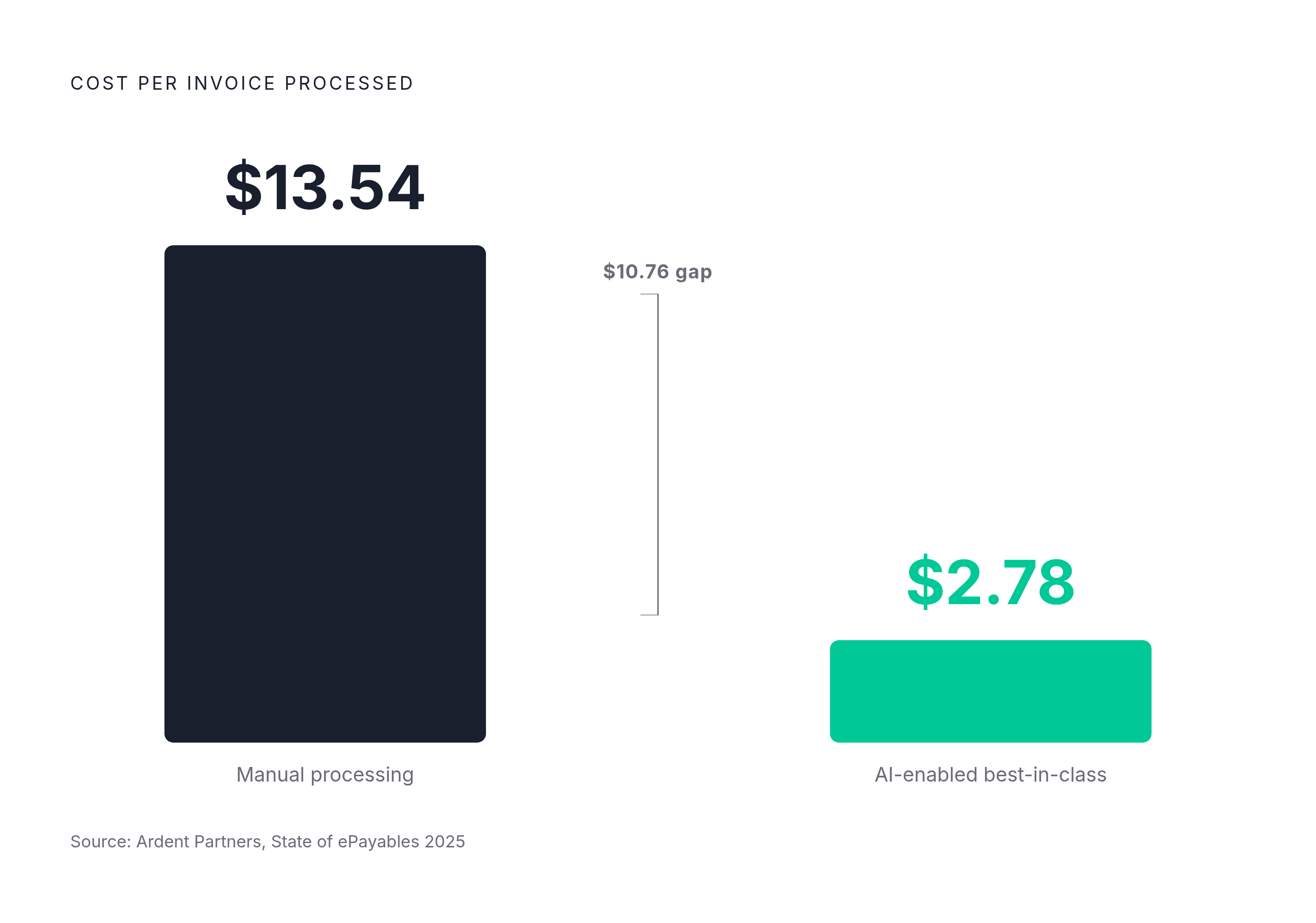
The cost gap is hard to ignore. Best-in-class AI-enabled teams process invoices at around $2.78 each. Manual processing runs about $13.54, per Ardent Partners' State of ePayables. Manual AP is essentially a tax finance teams pay to move slowly.
AR has the same friction, just on the collection side. Invoices sit in portals. Documents go missing. Follow-ups fall through the cracks. The gap between sending an invoice and receiving cash is filled with small, repetitive tasks that nobody has time for and yet everyone has to do anyway. AI-powered AR tools like Invoice Butler are built specifically for that layer. They handle follow-up, navigate supplier portals like Coupa and Ariba, respond to customer queries, and escalate when something actually needs a human.
Month-end close
Finance teams spend a cumulative 72 business days per year on reconciliations and reporting alone, per a 2025 analyst report. Call it three to four months of full-time effort, every year, just on close. AI-assisted close processes can cut cycle time by up to 30%, with accuracy improvements alongside that.
Knowledge management and compliance
Gartner's November 2025 survey found knowledge management is the most common AI use case in finance at 49%, followed by AP automation at 37% and error and anomaly detection at 34%. On compliance, generative AI monitors regulatory changes across U.S. GAAP and IFRS, surfaces updates in real time, and keeps teams current without anyone carving out dedicated research hours for it.
Fraud detection and risk management as AI's highest-stakes application in finance
This is where AI's advantage over manual processes is most visible. It isn't close.
Ninety percent of financial institutions now use AI for fraud detection, per Feedzai's 2025 AI Trends Report. That maturity makes sense given the scale of the problem. Nasdaq's Verafin unit reported $579.4 billion in global losses from bank fraud and scams in 2025. The U.S. Treasury's AI-enhanced detection prevented and recovered more than $4 billion in fraudulent payments in fiscal year 2024, up from $652.7 million in 2023. Visa's AI systems, trained on 15 billion VisaNet transactions, saved nearly $40 billion in fraudulent transactions globally in 2023.
At the firm level, companies using AI fraud prevention report meaningful reductions in fraud-related costs and significant drops in detection and investigation expenses.
Here's the part that matters for corporate finance teams specifically, not just banks: payment fraud, duplicate invoices, and vendor impersonation are everyday risks for any finance department. The detection logic protecting financial institutions applies inside the enterprise. The threat isn't abstract, and the tools already exist.
Agentic AI — the next layer that lets finance systems act, not just analyze
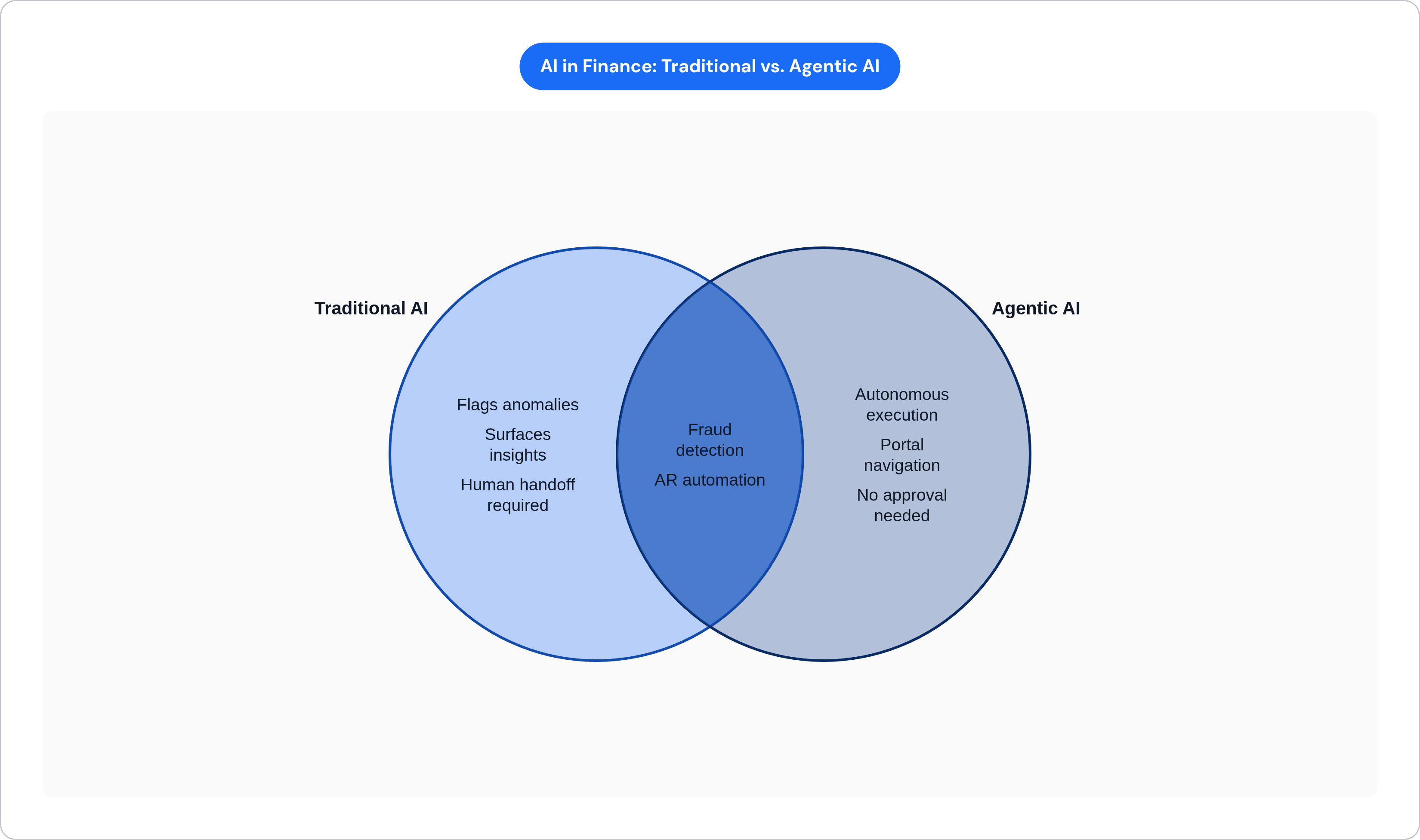
Most current finance AI helps humans decide what to do next. It surfaces an anomaly, flags an overdue invoice, highlights a reconciling item. Then a human steps in. Agentic AI removes that handoff entirely.
The distinction matters more than it sounds. Traditional AI tells you something needs to happen. Agentic AI makes it happen — like the difference between a weather forecast and an umbrella that opens itself. In finance, that means orchestrating the close process, managing exception queues, drafting reports, and chasing outstanding receivables from start to finish without waiting for someone to click approve.
NVIDIA's 2026 State of AI in Financial Services found that a significant share of respondents are already using or assessing agentic AI, with a focus on internal process optimization. The AR use case is a clean illustration. An agentic system doesn't just flag that an invoice is overdue. It follows up with the customer, navigates the supplier portal, responds to status requests, and escalates to the right person when something genuinely needs human judgment. It runs the workflow the way a dedicated AR team would, without the headcount constraint.
Worth naming the governance reality here. A large majority of organizations plan to deploy agentic AI within two years, per Deloitte's State of AI in the Enterprise. Only a small fraction currently have mature governance frameworks to oversee these systems. The technology is ahead of the oversight. That's the actual next challenge for finance leaders: not whether agentic AI works, but how to run it responsibly once it's embedded in production workflows.
What finance professionals actually do with the time AI returns to them
The productivity gains are real. The more interesting question is what teams actually do once the time comes back.
Across finance functions where AI adoption has been meaningful, professionals spend 20 to 30% less time on data crunching, per McKinsey research. At one global consumer goods company McKinsey studied, a generative AI assistant replaced manual work on budget variances and saved an estimated 30% of finance professionals' time.
A few patterns show up consistently in what teams do with that capacity:
- Continuous forecasting. Moving from quarterly cycles to rolling, real-time models.
- Scenario analysis. Stress-testing that simply wasn't realistic when analysts were buried in reconciliations.
- Business partnership. Finance as an actual input to product, operations, and growth decisions. Not a reporting function that shows up after the fact.
Kyriba's CFO Survey 2025 found CFOs directing AI toward investment analysis, strategic planning, decision-making, and risk management in treasury. All of it is higher-order work.
One stat worth sitting with: 70% of CFOs say AI helps finance teams move faster and deliver more, while 88% report no headcount reductions. The shift is redeployment, not replacement. Finance's identity is changing from scorekeeper to strategic advisor, and AI is what makes that operationally possible. Not the end goal. The prerequisite.
What separates finance teams extracting high ROI from those still waiting for it
The median ROI from finance AI initiatives is low. The gap between median and top performers is real. The difference usually isn't which tools teams are using. It's how deeply those tools are embedded in actual workflows versus sitting adjacent to them and waiting to be useful.
High-ROI teams share a few consistent traits:
- They targeted high-friction workflows first. AP, AR, close. Not showcase projects or executive dashboards.
- They treat AI as an always-on layer. Continuous close, automated follow-up, real-time anomaly detection. Not a periodic tool someone logs into on Tuesdays.
- They pair automation with persistent execution. For workflows requiring ongoing responsiveness, like supplier communications, exception handling, and portal navigation, they use AI that actually completes the task rather than triggering a rule and stopping.
The 68% who say they don't know where to start share a recognizable pattern. They're trying to design a full transformation strategy before proving out a single workflow win. The sequence that actually works is simpler: find the highest-drag process in the department and remove it. Everything else gets clearer from there.
For AR specifically, the bottleneck is rarely the invoice itself. It's everything between sending it and collecting the cash. Missing W-9s, portal friction, unanswered follow-ups, buried email threads. Some platforms are built to clear exactly that operational layer, handling the end-to-end process that otherwise falls to whoever has a free hour, which is nobody.
Gartner projects 90% of finance functions will deploy at least one AI-enabled solution by 2026. The question at this point isn't whether to adopt. It's which workflows to prioritize and how completely to embed the technology once you do. Finance teams that clear operational drag now are building capacity for strategic work that their slower-moving competitors simply won't have the bandwidth for.