Explainable AI Requirements in Financial Audit Trails
Regulators already expect both explainability and auditability, and most teams satisfy only one.

Most finance teams treating explainable AI as a future-state compliance problem are already behind. The gap between what regulators expect and what most institutions can actually demonstrate isn't theoretical. It shows up every audit cycle, right now, in documentation that satisfies one half of the requirement while leaving the other half completely exposed.
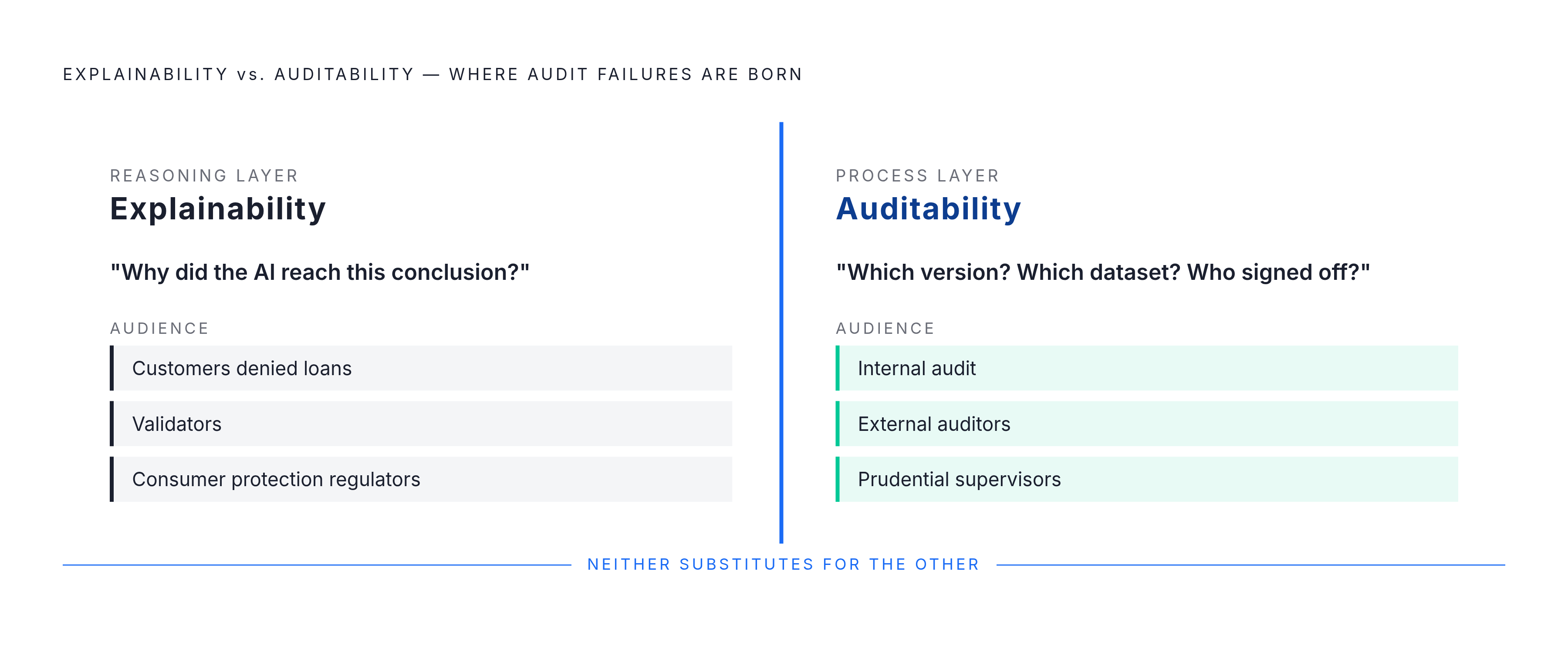
The core issue: "explainability" in a regulatory context is not one thing. It is two distinct things that get collapsed into one word, and that conflation is where audit gaps are born.
Here is the split, stated plainly.
Explainability is the reasoning layer. Why did the AI reach this conclusion? What factors drove the output? What weights did the model assign? This is what answers questions from customers denied a loan, from validators reviewing model behavior, and from consumer protection regulators asking whether the system encoded a proxy for a protected characteristic.
Auditability is the process layer. How did the system operate? Which version of the model was running? Which dataset did it train on? Who reviewed the output, who signed off, and when? This is what answers questions from internal audit, external auditors, and prudential supervisors who want to see the control functioning as designed.
Both are required. Satisfying one does not substitute for the other.
I've watched teams get this wrong in both directions. Strong model documentation, zero ability to surface decision rationale for a specific transaction. Beautiful model logic walkthroughs, no trail proving it was the approved version running on validated data at the time of the decision. Either gap is a compliance exposure, and neither team saw it coming until an examiner pointed it out.
The mistake isn't ignorance, exactly. It's assuming that doing one well covers the other.
Agentic AI makes this sharper. When an AI system executes a sequence of autonomous actions, including tool calls, intermediate reasoning steps, and a final output, both layers must cover the full chain. Explaining just the terminal decision isn't enough. The regulator wants the whole thing.
The rest of this piece treats these two layers as distinct, because they require distinct documentation strategies and satisfy different audiences. Keeping them separate is the fix.
The U.S. Regulatory Stack Is Already Asking for Both Layers, From Multiple Directions at Once
The U.S. framework for AI explainability in financial services is not one law. It is a stack of overlapping guidance documents, statutory requirements, and examination priorities. Each one approaches the same underlying question from a different angle, and they do not always agree on which angle matters most.
SR 11-7 and OCC Bulletin 2011-12: The Foundation That Is Still the Foundation
These were issued in 2011. They are still operative. They established that model outputs must be explainable to senior management and validators, not just to the team that built the model. If you are a bank, this is the baseline against which your AI models get measured in examinations today.
Worth noting: this guidance predates modern machine learning deployment by about a decade. Institutions have been applying principles written for statistical models to systems those principles were never designed to cover. That tension doesn't go away just because nobody's addressed it cleanly.
SR 26-2 and OCC Bulletin 2026-13: The Awkward Gap
The April 2026 revised model risk management guidance updated the framework but explicitly placed generative and agentic AI outside its formal scope. It noted that existing risk principles still apply, but the specific binding rules for the fastest-growing deployment category in financial services are, right now, principles-based inference rather than clear mandates.
That is not a loophole. It is actually a harder compliance environment. "Existing principles apply" means examiners have latitude and institutions don't have clear safe harbors. I'd rather have a rule I can point to.
CFPB: The Consumer-Facing Explainability Obligation
CFPB Circular 2023-03 confirmed that ECOA adverse action notice requirements apply to AI-based credit decisions regardless of model complexity. The Winter 2025 Supervisory Highlights put it plainly: there is no advanced technology exception to federal consumer financial laws.
Machine learning models drawing on large numbers of input variables, including alternative data not directly tied to financial behavior, are specifically flagged as high-risk for encoding proxies for prohibited characteristics. The explainability requirement here is not abstract. It has to produce a notice a consumer can read and understand.
BSA and AML: Where the Audit Trail Is the Compliance Artifact
SAR filings require documented reasoning that satisfies Bank Secrecy Act standards. An AI-driven transaction monitoring system that flags activity without generating reviewable rationale creates compliance exposure at every single filing. The question regulators ask is not whether a human reviewed the output. It is whether the rationale is documented to a standard that survives examination.
SOX Section 404, PCAOB, and SEC
SOX 404 mandates documentation of financial controls, including AI-driven decisions that affect reported financials. PCAOB named AI a formal inspection priority for 2025. PCAOB AS 1105, effective for fiscal years ending December 15, 2024 or later, raised the bar on sufficiency and appropriateness of audit evidence from company information systems.
PCAOB QC 1000 takes effect December 15, 2025, requiring audit firms to address technology risk at the firm level, with the first full cycles applying to calendar year 2026 audits.
One thing worth stating clearly because the public conversation around it is louder than the reality: as of mid-2026, the PCAOB Technology Innovation Alliance's strategic pillars have not been enacted as binding standards, and the June 2024 technology-assisted analysis amendments explicitly excluded AI from scope. The binding framework is thinner than the discussion implies. That matters when you are assessing actual exposure versus anticipated exposure. Don't let the noise make you think the rules are more settled than they are.
The SEC's 2025 Examination Priorities specifically target AI-powered audit systems, requiring firms to demonstrate algorithmic compliance with GAAP and IFRS, with comprehensive audit trails for AI-driven decisions. The March 2026 announcement from the SEC SOX enforcement group signals materially heightened scrutiny of firm-level quality controls and lower tolerance for ICFR failures.
The Colorado AI Act: State-Level Layering
In force as of February 2026, the Colorado AI Act requires impact assessments explaining how a system reaches consequential decisions. For institutions operating in Colorado, this is a state-level obligation sitting on top of every federal requirement above. Multistate institutions are managing a stack, not a single rule. And Colorado probably won't be the last state to add to that stack.
European and International Frameworks Are Asking for More Documentation, Not Less
The U.S. framework is already dense. European and international frameworks add granularity, and in some cases they require documentation at a level of specificity that exceeds U.S. expectations. If your institution operates in multiple jurisdictions, you are managing the intersection of all of them simultaneously, which is about as fun as it sounds.
EU AI Act (Regulation 2024/1689)
This is the most structurally demanding framework currently in force or phase-in. Prohibited AI practices began phasing in February 2025. Full high-risk AI obligations for financial services are expected by August 2026, with full application August 2, 2027.
Credit scoring, fraud detection, and automated decisions affecting financial services access are explicitly classified as high-risk systems. Required traceability documentation includes training data, testing protocols, and decision logs. Not just output-level explanations. The underlying data and process.
Penalties for the most serious violations are calculated as a percentage of global annual turnover. For a large institution, non-compliance is a material financial risk at the group level.
GDPR Article 22 and the Right to Explanation
GDPR Articles 13 through 15 require meaningful information about the logic behind automated processing. Article 22 restricts solely automated decisions with legal or similarly significant effects.
This is distinct from the AI Act. GDPR is individual-rights-facing. The AI Act is systems-facing. The same AI system, at the same institution, may need to satisfy both simultaneously for the same decision. Two frameworks, one transaction, different documentation requirements. Welcome to Europe.
EBA, FCA, FATF, and APAC
- The EBA loan origination guidelines (EBA/GL/2020/06) require documentation of how input features affect model outputs, with specific attention to features that could proxy for protected characteristics. Same concern as the CFPB, different continent, different paper trail.
- The UK FCA Discussion Paper DP22/4 requires firms to explain model decisions both to customers and to the regulator, under a principles-based supervisory regime.
- The FATF 2021 AML guidance expects documented reasoning for technology-generated alerts, consistent with BSA requirements but applied across FATF member jurisdictions.
- Singapore's MAS FEAT principles and 2025 Guidelines on AI Risk Management, Hong Kong's HKMA banking AI expectations, and Australia's APRA CPS 230 all push in the same direction. Largely aligned thematically, different in specificity.
The NIST AI RMF GenAI Profile, while not legally mandated, functions as a reference framework across many of these contexts. Its GV-1.1 control expects documentation of the rationale behind model behavior.
The frameworks converge on requiring explainability and traceability but differ substantially in what must be documented, at what granularity, for which audiences, and with what penalty exposure. No single documentation approach satisfies all of them cleanly. That's the honest situation.
What the Audit Trail Actually Has to Contain
This is where things get specific. The COSO February 2026 GenAI guidance is the most precise published articulation of what the trail must capture.
COSO's minimum content list:
- Prompts and configurations (these are part of the audit trail, not adjacent to it)
- Inputs
- Outputs
- Model version
- Configuration version
- Evidence of human review
The standard is sufficiency to reconstruct what the AI acted on and demonstrate that the control functioned as designed.
For agentic AI, the trail must extend across the full execution chain: tool calls, intermediate reasoning steps, and final outputs. Not just the terminal decision. Every step.
Per the Kognitos 2026 audit trail checklist, each AI touchpoint should be tagged to the financial statement assertion it influences: existence, completeness, valuation, rights and obligations, presentation and disclosure.
SOX documentation minimum content:
- Control objective: which financial statement assertion the control addresses
- Control description: what the AI system does, what inputs it processes, what outputs it produces, what action those outputs trigger
- Model governance: who owns the model
On retention: operational AI audit logs must be retained for a minimum of seven years under standard SOX requirements. PCAOB AS 1215, effective December 15, 2026, applies to audit evidence produced by AI systems.
There's also a meta-monitoring requirement worth flagging separately, because it catches people off guard. COSO Principle 16 on ongoing evaluations applies to AI-enabled continuous monitoring, but it also creates an obligation to monitor the monitoring system itself. Management must be able to show the AI doing the monitoring was itself functioning correctly. This is not a hypothetical edge case. It is a documented expectation. Your watchdog needs a watchdog.
Enterprise-grade explainability requires five capabilities that many platforms currently lack:
- Training data attribution
- Influence scoring
- Complete audit trails
- Contestability mechanisms
- Model certification
The gap between what frameworks require and what most deployed systems currently produce is the live compliance problem. Not ambiguity about what the requirements are. The requirements are written down. The gap is in the systems.
The XAI Techniques Finance Teams Are Actually Deploying, and What Each One Can and Cannot Do
Different situations call for different methods. Here's what is actually in use and what each one is good for, without the sales pitch.
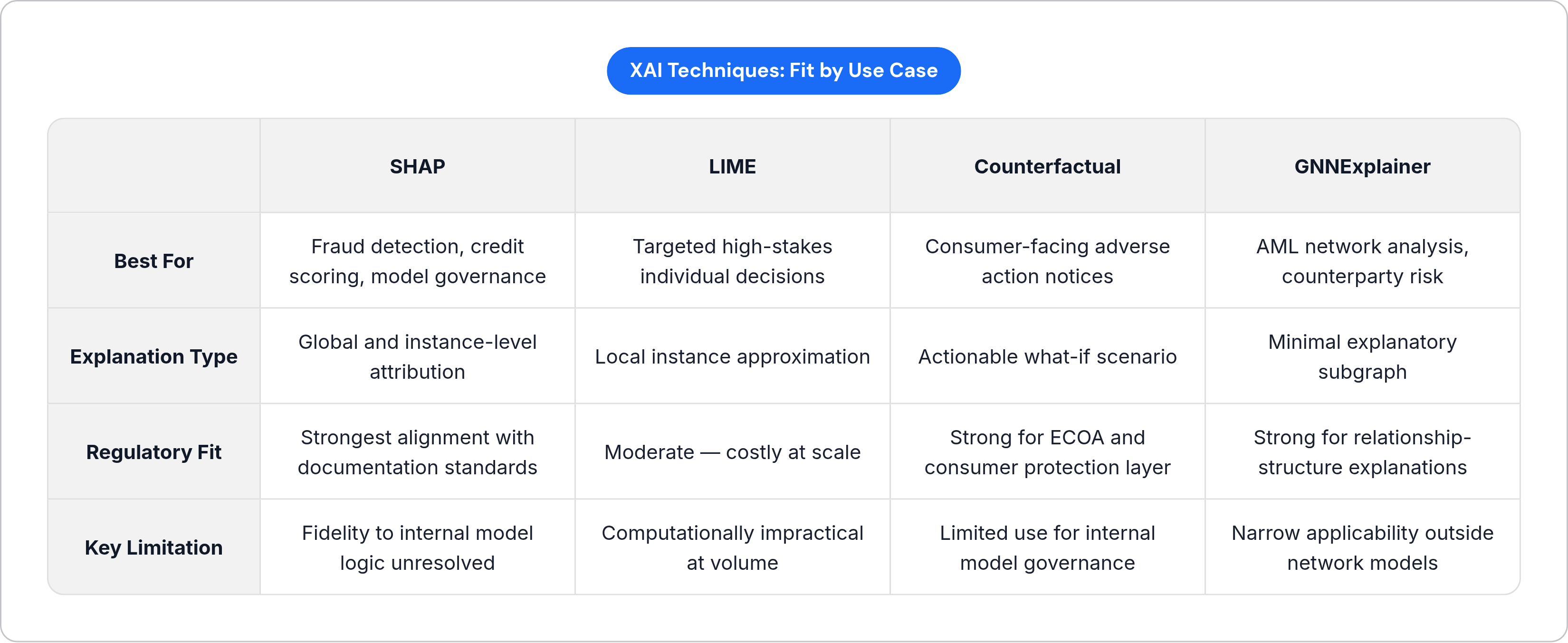
SHAP (Global and Instance-Level Attribution)
Khan et al. (2025), in a systematic review of model-agnostic XAI in finance, concluded that SHAP provides the strongest alignment between statistical attribution and regulatory documentation requirements. That makes it the dominant post-hoc explanation method in financial contexts right now.
In fraud detection, SHAP values identify which transaction attributes, including amount, location, and time since last transaction, contributed most to a risk score. It produces both global model-level explanations, useful for validators and model risk governance, and instance-level explanations, useful for adverse action notices and SAR documentation. The output maps more naturally onto regulatory documentation formats than most alternatives.
SHAP's limitation: it explains model behavior after the fact. How well that explanation represents what the model actually did internally, the fidelity question, is still an open problem for regulatory acceptance in high-stakes decisions. Nobody has fully solved this. Anyone who tells you otherwise is selling something.
LIME (Local Instance Explanations)
LIME has shown up in auditing contexts for assessing risk of material misstatement. The practical problem is computational cost. Generating a perturbed dataset and training a local interpretable model for each individual prediction is expensive. For large datasets and complex models, which is the norm in financial applications, LIME becomes impractical at scale.
Better suited to targeted, high-stakes individual decisions than to continuous monitoring at volume.
Counterfactual Explanations
Format: "If income increased by this amount, the loan would have been approved."
This format is particularly suited to customer-facing adverse action notices and ECOA compliance. It is intuitive, actionable, and auditor-legible. Less useful for internal model governance documentation, where factor-level attribution matters more. But for the consumer-protection layer of the regulatory stack, counterfactuals are often the most effective explanation format available.
GNNExplainer (Graph Neural Network Models)
Identifies the minimal subgraph that most explains a prediction. Produces network-level explanations showing specific relationship or contagion pathways. Most relevant for AML network analysis and counterparty risk, where the structure of relationships between entities is what needs explaining, not just the output value.
The Accuracy-Explainability Tension
The most accurate models tend to be the least inherently interpretable. Large ensembles and deep neural networks outperform simpler models on predictive accuracy but resist easy explanation. Post-hoc methods like SHAP and counterfactuals address this by explaining a complex model's behavior after the fact, without requiring the model itself to be simpler.
The remaining question is fidelity. This is the frontier problem for regulatory acceptance of XAI in high-stakes financial decisions, and it does not have a clean answer yet.
Technique selection is not arbitrary. It should be driven by risk tier and system type. Fraud detection, credit scoring, and AML each have different explanation audiences, different regulatory documentation requirements, and different computational constraints. Picking a technique because it is familiar rather than because it fits the use case is a compliance risk in itself.
Where AI-Driven AR Fits Into All of This, and What Finance Teams Need to Document
Accounts receivable automation is not a peripheral use case for these frameworks. This is where I see the most people surprised during an audit, and it shouldn't be surprising at this point.
AI systems that determine follow-up timing, escalation logic, payment application, or dispute handling directly influence financial statement line items: revenue recognition, aging schedules, and allowance for doubtful accounts. That puts AR automation inside the SOX perimeter, not adjacent to it.
If an AI system decided when to escalate a past-due account, that decision is a control. If it determined how to apply a payment, that is a control. If it generated a dispute resolution recommendation, that is a control. SOX 404 does not care whether the control was executed by a person or an algorithm. It cares whether the control is documented, tested, and demonstrably functioning.
What the documentation needs to cover for AI-driven AR:
- Which AI system made the decision, and which version was running at the time
- What inputs the system processed (invoice data, payment history, customer communication, aging bucket)
- What output was produced and what action it triggered
- Who reviewed the output and what the human-in-the-loop process looked like
- Which financial statement assertion the decision touches (typically completeness, valuation, or existence for AR)
- Evidence that the model was the approved, validated version operating on validated data
The audit trail must connect the AI decision to the downstream financial statement effect. If an AI-driven payment application decision caused a journal entry, the trail must show that connection explicitly. End-to-end transaction traceability is the 2026 expectation.
Platforms handling AR automation need to be evaluated against these documentation requirements before deployment, not after the first audit cycle. Tools like Kolleno, HighRadius, Billtrust, and Tesorio are among the options finance teams are evaluating for AI-driven AR workflows. The right question to ask any vendor is not whether their system uses AI. It is whether their system can produce, at the transaction level, the documentation that COSO, SOX, and your external auditor will ask for. Ask that question before you sign anything.
The allowance for doubtful accounts is a particularly sensitive area. If an AI system is influencing how the aging schedule is categorized or how collectibility is assessed, those outputs feed directly into a significant accounting estimate. Significant accounting estimates get scrutiny from PCAOB-registered auditors, especially now that PCAOB has named AI a formal inspection priority. Auditors will ask how the estimate was developed. "The AI said so" is not a sufficient answer. The trail showing what the AI considered, what version it was, and who validated the output is the answer.
The compliance pressure on AI-driven AR is real and it is current. The frameworks are already written. The examination priorities are already published. The question for every finance team running AI in their AR process is not whether these requirements apply. It is whether the documentation they would hand an auditor today actually meets them. Most teams, if they're being honest, aren't sure.