CFO Perspectives on AI Adoption in Finance
Most CFOs want AI for strategy, not just automation, but struggle scaling beyond pilots.

There is no single, clean answer to how many CFOs are actually using AI. Ask Gartner and they will tell you roughly 59% of finance leaders reported having AI in their function in 2025. Ask L.E.K. and they will tell you only about 11% of CFOs are in active production use. Both numbers are correct. They are just measuring different things. The first counts anyone who has touched AI in some capacity. The second counts people who have moved past the pilot phase and are running AI in live, operational environments.
The gap is definitional, not contradictory. And honestly, understanding that gap is the most important thing you can take from any CFO survey right now.
Here is the more meaningful signal: around 60% of CFOs now believe AI will be among the most impactful technologies in finance, up from about 50% the year prior. Among investor-backed companies specifically, 97% report some level of AI adoption, and the share describing it as broadly or fully embedded has roughly doubled in a single year. The skeptics are nearly gone. Only 3% of that group remain unconvinced that AI will pay off. The early movers are consolidating. The middle of the market is trying to figure out how to get from a working pilot to something that actually runs the business.
That transition — from experiment to disciplined deployment — is what every meaningful conversation about AI in finance is actually about right now. Think of it like learning to drive: everyone celebrates getting the license, but the real test is merging onto the highway at rush hour.
What CFOs Say They Actually Want AI to Do. And It Isn't Just Automation
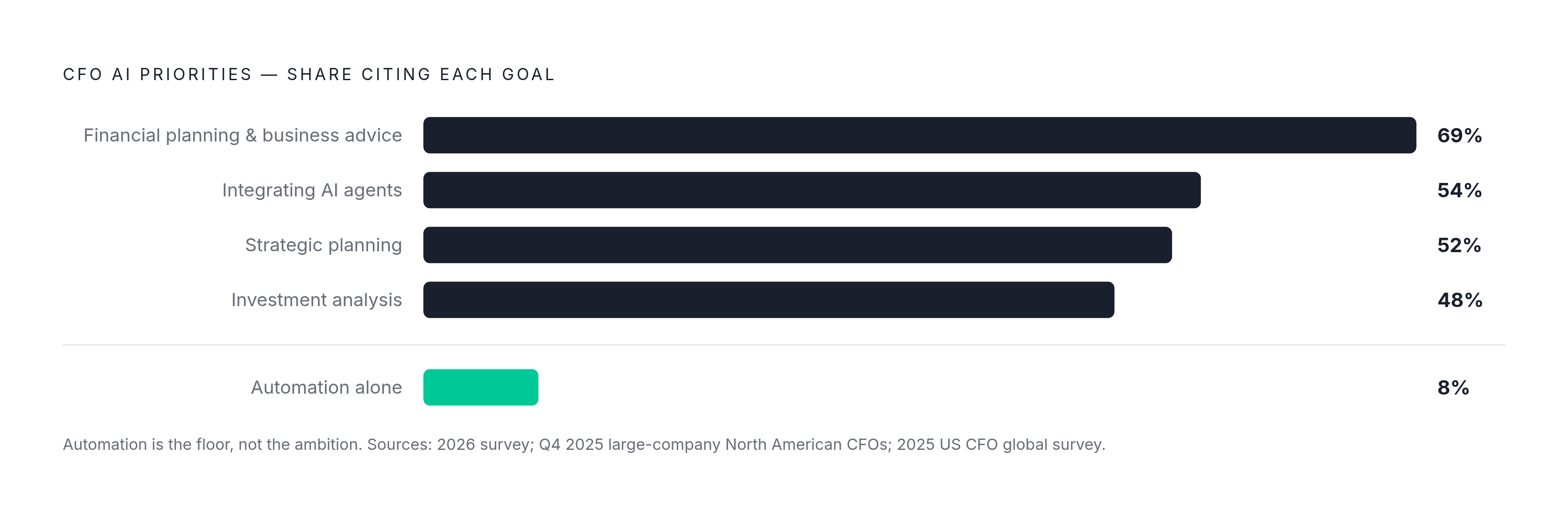
Here is a number worth pausing on: only 8% of CFOs in a 2025 global survey of finance decision-makers said they intend to use AI for automation alone. Eight percent. Automation is the floor, not the ambition.
What CFOs actually want AI to do:
- Strategic planning (cited by 52% of US CFOs in that same survey)
- Investment analysis (48%)
- Financial planning and business advice (prioritized by 69% of executives in a 2026 survey)
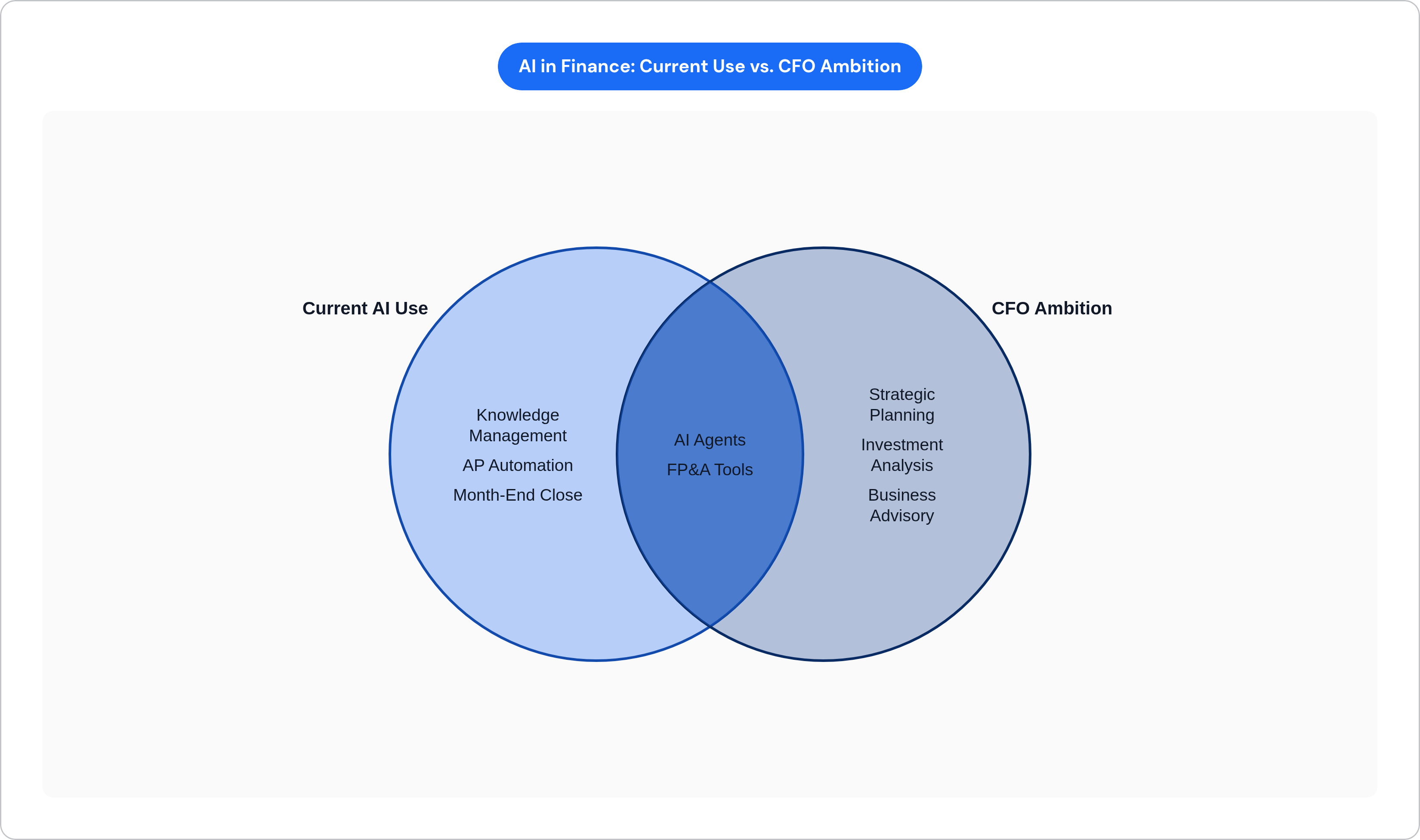
- Integrating AI agents as a transformation priority (54% of large-company North American CFOs, per a Q4 2025 signal survey)
The ranking matters. Strategy above efficiency. Advisory above operational. CFOs are not buying AI to trim headcount on invoice matching. They are buying it to shift what their function does entirely.
That is a harder problem than pure automation. If you are just automating a task, you define the task, build the workflow, measure the output. Done. But if you are trying to reorient a finance team from number production to business advisory, you have to change what people do, how they spend their time, and what the organization expects from them. That is a transformation problem, not a software problem.
One more data point that tells you where CFOs are putting their attention: in a 2026 survey of 600 finance chiefs, increasing AI investment ranked second only to supplier relationships as a top strategic priority for the year. That is not a technology budget conversation. That is a business strategy conversation.
Where AI Is Producing Results in Finance Operations Today
The most common AI use case in finance today, according to Gartner's 2025 data, is knowledge management. Forty-nine percent of finance functions are using AI there. Second is accounts payable automation. Neither of those is the glamorous "AI as strategic advisor" story CFOs say they want. But they reflect something real: AI earns its keep fastest where the work is high-volume, rule-bound, and time-sensitive.
Here is what that looks like in practice:
- In a study of 500 companies using AI in accounts receivable processing, 82% reported productivity gains.
- AP automation adoption grew from 7% to 29% in a single year among those surveyed by the Institute of Financial and Operations Leadership in 2025. That is a fourfold increase.
- Agentic AI deployments have reduced month-end close cycles by roughly three days on average. About 28%. After twelve months of use. Some enterprise deployments have gone further — cutting close from ten days to three.
OpenAI's own internal finance team is the most cited example right now, and for good reason. They operate at roughly 22% of the headcount of comparable tech firms. Their Contract Reader Bot applies accounting standard logic and auto-generates journal entries, removing most of the manual effort from close. It is a small team doing work that would have required a much larger one five years ago.
BCG put the underlying logic well in their June 2026 framing: most finance teams today spend roughly 90% of their time producing numbers and 10% advising the business. The AI-first finance function inverts that ratio. That is the destination. But you can only get there if the operational layer — the AR follow-up, the AP matching, the close reconciliation — is already handled reliably by something other than a human analyst doing it manually at 11pm on the last day of the quarter.
The path to strategic finance runs directly through the unglamorous work first.
How CFO AI Budgets Are Being Allocated and Governed in 2026
More than half of CFOs are increasing their AI investment by over 15% this year, per Bain's 2026 CFO Survey. Nearly 75% are increasing tech spend broadly, with close to half planning double-digit increases. The money is moving.
But the more interesting shift is not the size of the budgets. It is where they live now.
In 2024, most AI spending sat inside innovation or R&D budgets, with loose ROI requirements and a general understanding that this was exploratory. In 2026, that money is migrating into operational technology budgets. Which means it is being held to the same standard as an ERP investment or a headcount decision. It has to justify itself with expected outcomes, timelines, and measurable returns. That is what "disciplined deployment" actually looks like in practice. It is not a mindset shift. It is a budget category shift.
There is a governance consequence that follows from this, and it is one that caught a lot of organizations off guard. A Deloitte 2025 CFO Signals survey found that 41% of organizations discovered AI-related spending was 30 to 60% above what central finance had tracked. That is not a technology problem. That is a financial control problem. And it is now sitting squarely on the CFO's desk.
CFOs who let AI spending grow organically across business units — funded from department budgets, innovation grants, or shadow IT — now have to bring it back under the same scrutiny they would apply to any capital allocation decision. That changes how use cases get prioritized. The ones that survive that level of scrutiny are the ones with clear, measurable outcomes attached to them.
The Barriers That Are Actually Slowing Deployment. Data, Trust, and Scaling
If you ask CFOs why their AI initiatives are not moving faster, they will not tell you the technology does not work. They will tell you something like this:
- One-third of investor-backed CFOs cite data quality, accessibility, and completeness as their top obstacle (Consero 2026).
- 31% point to difficulty scaling pilots to enterprise-wide rollout.
- 28% cite unclear use case prioritization and siloed systems.
Only 38% of CFOs believe their data is fully adequate to support digital transformation. Nearly a third admit their data needs significant improvement. You can buy the best AI platform on the market and it will still fail if the underlying data is a mess. Bad data and good AI is like putting rocket fuel in a car with a broken engine — the power is real, but you are not going anywhere.
The trust and security concerns are significant too, especially among US CFOs. In Kyriba's 2025 survey, 78% flagged security and privacy as critical challenges. More specifically, 54% cited leaking of confidential information as their top concern when considering AI use. Forty-six percent flagged accuracy. Forty-two percent flagged regulatory compliance. Those are not irrational concerns. Finance handles material non-public information, compensation data, merger analysis, and board-level forecasts. The cost of a data exposure in that context is not just operational. It is legal and reputational.
The talent gap is real too, even if it is not always the biggest number in the survey results. What makes it consequential is that it compounds everything else. If your team does not have the internal knowledge to evaluate AI tools, govern their outputs, or identify when something is wrong, the data problem and the scaling problem both get harder to solve.
Here is the through-line across all of these barriers: they are not about the AI itself. They are about the organizational substrate. The data infrastructure, the governance clarity, the ability to take something that worked in a controlled pilot and make it reliable in a live production environment. Organizations that have done that work are getting results. The ones still in pilot mode are mostly stuck on these issues, not on the technology.
What ROI Evidence Actually Shows. And Where Measurement Is Still Catching Up
The headline number from Consero's 2026 report is strong: more than 75% of AI investments in finance are already generating positive returns within 12 months. But that comes from a sample of investor-backed companies with higher-than-average AI commitment. Take that number with that context in mind.
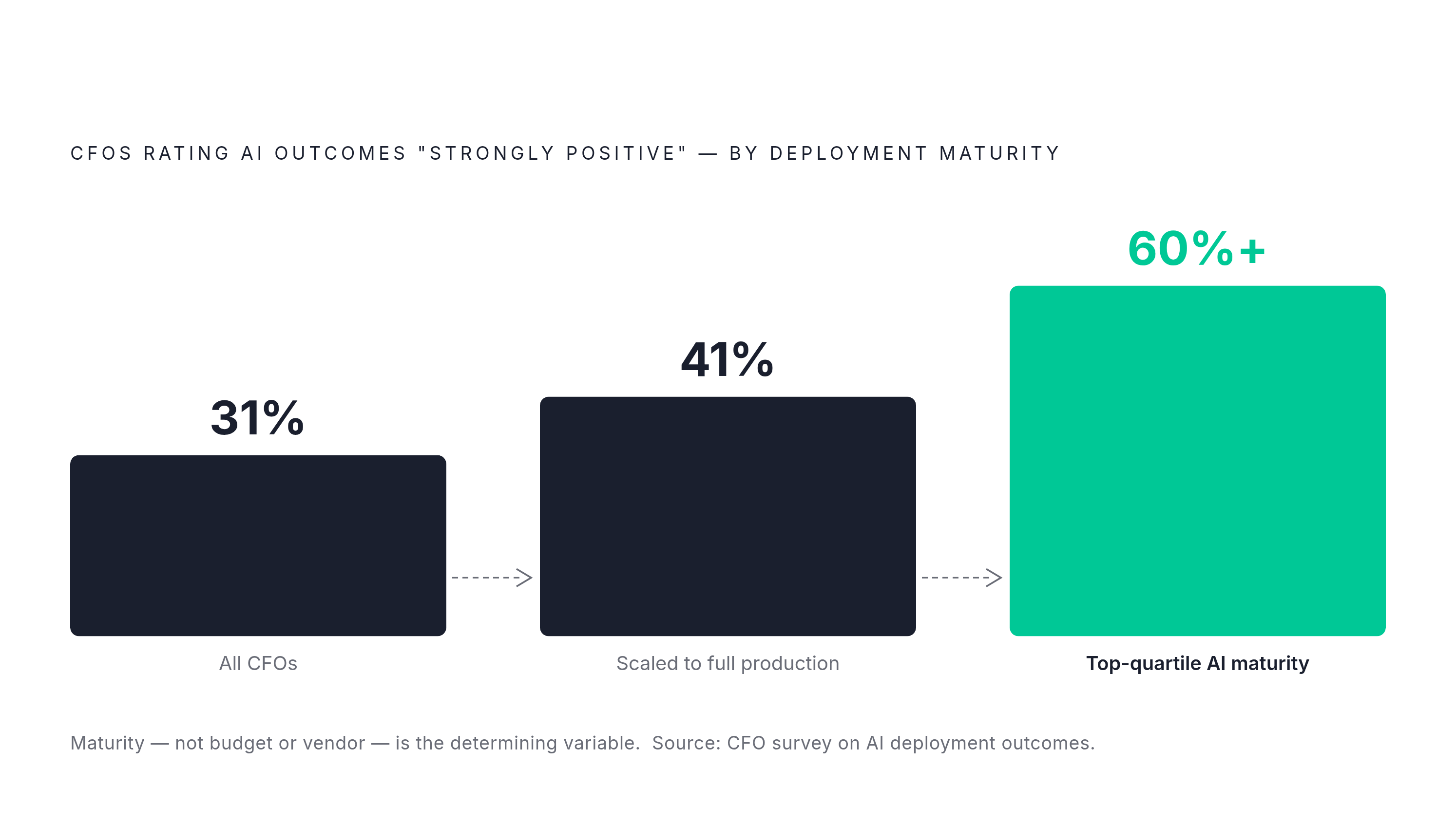
The Bain 2026 data tells a more nuanced story. Among all CFOs, 31% rate AI outcomes as strongly positive. Among those who have scaled AI into full production, that rises to 41%. Among top-quartile organizations by AI maturity, it exceeds 60%. Maturity is the variable. Not the technology, not the budget, not the vendor. How far you have actually taken the deployment is what determines whether it works.
An NC State global survey reinforces this: 73% of AI-transformed companies say AI provides a strategic advantage, compared to 27% across the full sample. The gap between "using AI" and "transformed by AI" is where the ROI story lives. And most organizations are still somewhere in the middle of that spectrum.
The measurement problem is real, and it is a little ironic. Deloitte's Q4 2025 CFO Signals survey found that 87% of large-company North American CFOs called AI extremely or very important to finance operations. Yet formal ROI measurement frameworks are still being built. Confidence is running well ahead of rigor. CFOs are certain AI matters. They are much less certain how to prove it with the same precision they would demand from any other capital investment.
The organizations generating the strongest returns are not the ones that deployed the most AI. They are the ones that picked concentrated use cases, moved them into production, and measured outcomes the same way they would measure anything else. Pick a thing. Finish it. Measure it. Then pick the next thing.
What This Means for How Finance Teams Spend Their Time Going Forward
The BCG 90/10 inversion — 90% of time producing numbers, 10% advising the business, flipped to the opposite — is the destination CFOs are describing when they talk about what they want AI to do. But the inversion does not happen just because you buy AI software. It happens when the operational layer actually works reliably enough that the humans in the function are no longer needed to hold it together manually.
That means the unglamorous work matters first:
- AR follow-up and collections
- Vendor portal navigation
- Missing document resolution
- Compliance reconciliation
- AP matching and close prep
These are the tasks that consume analyst hours today. They are also the tasks where AI-assisted workflows are beginning to produce consistent, measurable results. You have to free up that capacity before you can redirect it toward strategic advisory work. If you skip the operational foundation and go straight for the strategy, you end up with analysts doing both. Which means nothing actually changes.
The agentic AI conversation is the next inflection point to watch. About 17% of finance teams are already deploying generative agents. And around 75% of finance leaders expect routine use by 2028. That window between "early mover" and "standard practice" is narrowing faster than most organizations' planning cycles can accommodate.
The practical question for finance leaders right now is not whether AI will change the function. That question is settled. The question is which operational bottleneck to remove first, so that the capacity freed up actually flows toward the strategic work rather than just disappearing into overhead or getting absorbed by the next urgent manual task.
The CFOs generating the strongest outcomes are treating this as a sequenced program. Automate the high-volume, rule-bound work. Build the data infrastructure that makes forecasting and advisory tools reliable. Then measure whether the function's time allocation is actually changing. That sequence is not glamorous. But it is the one that works.