Data Privacy and Security in AI-Powered AR
AI-powered AR systems expose financial data through design flaws nobody's regulating yet.
AI-powered accounts receivable systems now handle invoices, payment terms, banking details, and customer records at a scale most finance teams never priced into their risk models. That data is sensitive, the volume keeps climbing, and the rules meant to protect it are still catching their breath somewhere back at the starting line.
Why financial data in AI AR workflows is more exposed than it looks
Picture the obvious risk first: a breach exposes invoices, payment terms, customer records, the stuff you'd expect to see on the evening news. Fine. Now consider the layer underneath it, which is worse.
AI AR systems don't just store records; they stitch them together across customers, vendors, and years of transaction history. A breach here leaks behavior along with numbers: payment cycles, dispute frequency, which customers stretch to 90 days and which pay net-15 like they set a calendar alarm for it. A social engineer wants that fingerprint far more than a spreadsheet of raw figures. So does a competitor doing quiet recon on your customer base.
Then there's the plumbing, which nobody photographs for the brochure. AR workflows reach into outside portals like Coupa and Ariba, into customer email threads, into cloud infrastructure the vendor doesn't fully own. Every integration is a door. Some are bolted shut. Others you'd need to go check yourself, because no one's checking by default, and assuming otherwise is how audits go badly.
The handoff moments deserve their own worry line. When an AI system escalates a case to a human analyst, or fires off an email straight to a customer contact, that's the exact spot where data slips sideways if nobody's minding the seam. It's a bit like a chain of people whispering a message down a line, except somewhere in that line is a bank account number, and nobody signed up to be careful with it.
One more thing gets skipped in most of these conversations: the vendors and customers whose data runs through these systems never agreed to AI processing anything. No form went out. No box got checked. That's a consent problem sitting quietly in the corner, and it doesn't go away just because nobody's arguing about it yet.
The specific attack vectors finance leaders should understand
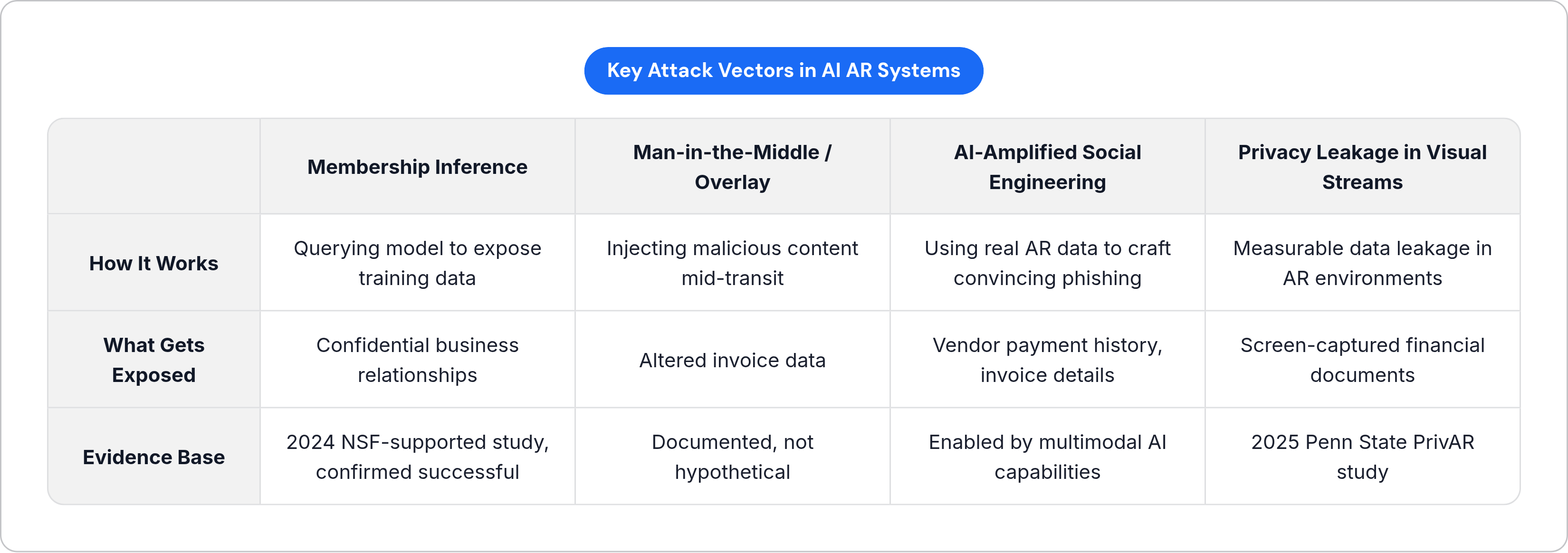
"Cybersecurity risk" is a phrase that means nothing until you can point at the mechanism. Four are worth knowing by name, and none of them are hypothetical.
Membership inference attacks lead the list, and they're documented, not speculative. A 2024 NSF-supported study, presented at the International Symposium on Mixed and Augmented Reality, found these attacks "highly successful" against AI models. Translated: an attacker queries a trained model and works out whether a specific customer's data was part of the training set. That alone can expose a business relationship somebody wanted kept off the record.
Man-in-the-middle and overlay attacks come next. Someone injects malicious content into a visual stream or portal interface, altering invoice data mid-transit. Think of a fake page slipped into your mail before it reaches your desk; you wouldn't catch it unless you were already suspicious enough to check twice.
AI-amplified social engineering is the one that should actually keep you up. Multimodal AI paired with real AR workflow data writes phishing emails that are genuinely frightening, a long way past the old "Nigerian prince" routine your spam filter laughed off years ago. An email that knows your vendor's real payment history, cites an actual invoice number, and sounds exactly like the AP contact you've emailed forty times doesn't read like a scam. It reads like Tuesday.
Privacy leakage in visual streams rounds out the technical side. A 2025 Penn State study called PrivAR found measurable leakage in AR environments even after mitigation methods got applied. That matters anywhere AR-assisted invoice review touches screen capture or document scanning, which is a bigger slice of your workflow than most people assume.
And then there's the plain old people problem: insider and contractor risk. Somebody reviews the cases the AI can't close on its own. Who is that somebody? Internal employee, outsourced contractor, someone in a country with entirely different data protection norms? Ask your vendor directly. If they hesitate before answering, the hesitation is the answer.
What regulatory frameworks currently apply — and where the gaps are
Nobody's written a rulebook for AI-powered AR specifically. Finance leaders are stretching adjacent frameworks over the gap and hoping the fabric holds.
What does apply, applies hard. GDPR covers any EU customer or vendor data moving through the system, full stop, meaning consent, data minimization, and the right to erasure need to be built into the workflow rather than bolted on after launch. CCPA and the growing stack of US state privacy laws demand something similar for domestic data. SOC 2 and ISO 27001 are the audit standards enterprise AR vendors are supposed to carry, though "supposed to carry" and "actually certified" are two very different sentences. Ask for the certificate itself. A logo on a homepage proves nothing except that someone knows how to use image-editing software.
Nobody's touched the consent gap yet, and it's the strangest part of this whole picture. If a vendor trains its AI models on customer invoice data, did that customer agree to it? Almost certainly not in any explicit sense, and there's no settled regulatory answer on whether they needed to. That question sits wide open while systems keep training on live data in the meantime.
The EU AI Act is starting to close part of this by classifying certain financial AI use cases as high-risk, which triggers transparency and audit requirements. Worth watching, though watch specifically how your vendor decides whether that classification applies to them, since it doesn't enforce itself and vendors rarely volunteer for extra paperwork.
No major jurisdiction has issued clear guidance on AI-powered AR collections specifically. That leaves finance leaders with no rule to break and no shield to hide behind. Both cut the same direction.
What responsible AI AR vendors do differently — and how to evaluate them
Some vendors build privacy into the architecture from the first design meeting. Others bolt a privacy policy onto a system that was never built to hold one, the way you'd tape a warning label onto a toaster after the fact. You find out which kind you're dealing with by what they're willing to answer, not by what's printed on the slide deck.
Ask where data actually gets processed: on-device, on-premise, or shipped to some third-party cloud you've never heard of and can't spell. Ask whether your invoice data trains a shared model used across every client or stays walled off to you specifically. Ask about retention, how long data sits around, and whether you control that window or the vendor does because it's convenient for them. Ask, plainly, who has human eyes on the data, under what conditions, and whether those people sit under NDA and audit, or whether it's a black box past a certain point in the pipeline.
On the operational side, a handful of things separate vendors who take this seriously from vendors running on faith. Encrypted communication across every portal touchpoint, not just the convenient ones. Role-based access limited to the exact workflow step that needs the data, nothing broader. Audit logs on every automated action, so a follow-up email or an escalation leaves a trail somebody can actually pull up later.
Invoice Butler is worth mentioning here, mainly for scale. The platform manages north of $3 billion in receivables and operates across portals like Coupa and Ariba, which means the surface area for something to go sideways is genuinely large. At that volume, security architecture stops being a nice-to-have and becomes table stakes, the same way a bank doesn't debate whether the vault needs a lock once real money's sitting inside. Any vendor running at that scale should hand over a data processing agreement without making you ask twice, point to a real framework like SOC 2, and give a straight yes or no on whether your data trains their models.
"Are you secure?" is a weak question to ask on a vendor call. Everyone says yes, and it costs them nothing to say it. Ask instead for the DPA and the subprocessor list, then watch how fast, and how completely, it lands in your inbox.
The internal governance moves finance leaders can make regardless of vendor
You don't need to wait on a vendor to tidy up your own side of the street. A few moves belong on every finance team's list no matter who's supplying the software.
Start with data minimization. Does the AR system actually need every field it's collecting, or did onboarding just default to "grab everything, sort it out later"? Trimming this at setup cuts exposure immediately and costs you nothing in negotiation leverage.
Contract hygiene matters more than most teams give it credit for. Your DPA should spell out AI-specific processing, name the subprocessors, set real breach notification timelines, and guarantee data deletion once the relationship ends. If your current agreement stays quiet on any of that, it needs a rewrite, not a footnote tucked in at renewal.
Internally, ask a blunter question: who on your own team can see a given customer's full payment history? AR systems pull data across your entire customer base by design, so internal permissions should match that sensitivity instead of treating every analyst as equally trustworthy with everything in the system.
Build an AR-specific breach scenario into your incident response plan now, while nobody's panicking. What data got exposed, to whom, what notification obligations kick in: work that out ahead of time, not at 2am with a lawyer on speakerphone.
And don't treat vendor onboarding as a one-time checkpoint you clear and forget. Privacy policies shift underneath you without much warning. Meta's April 2025 update, which turned on AI features by default and quietly pulled the opt-out for voice recording storage, is a decent case study in how fast the ground moves under a system you thought you understood. Build in an annual re-check of vendor data practices. Set a calendar reminder if that's the only way it actually happens.
How to think about the tradeoff between automation efficiency and data exposure
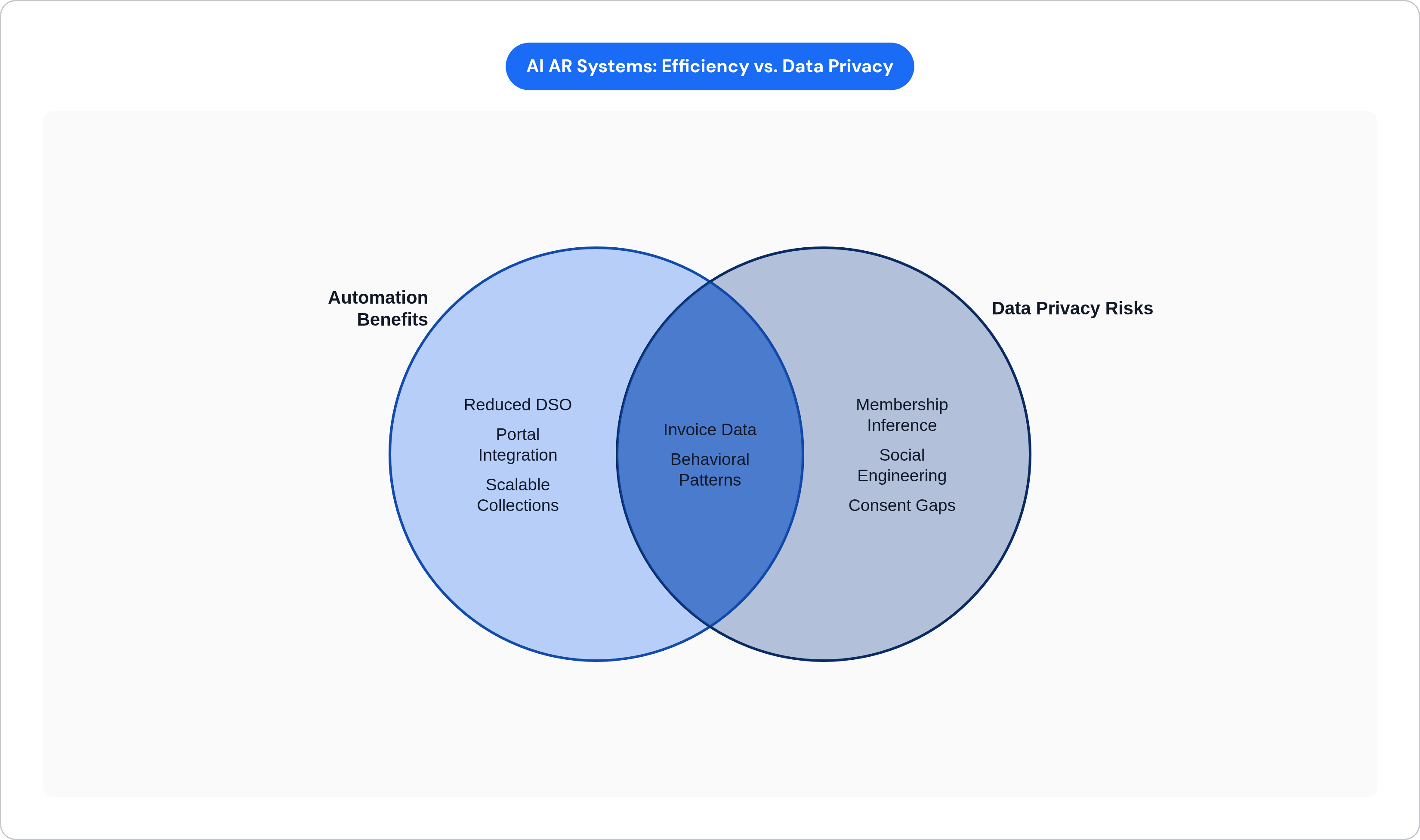
The efficiency case for AI AR rests on real numbers, not vendor optimism. Systems that send follow-up emails, work supplier portals, and clear document blockers free up finance teams for the work that actually needs a human brain behind it. That gain shows up in days-sales-outstanding and in headcount you don't have to hire this year.
The governance cost is real too, though it's bounded and fairly knowable once you map it out. Vendor evaluation, DPA review, internal access controls, ongoing monitoring, none of it is exotic or new. It's work that belongs before go-live, not after a headline forces your hand. Budget it the way you'd budget implementation time or staff training.
There's a tension worth naming plainly, even in a B2B setting where it's tempting to file privacy under "someone else's problem." The exact data that makes AI AR useful, the granular read on who pays late, who disputes often, who wants a phone call instead of an email, is the same data that demands the tightest lock and key. You don't get one without the other showing up on the same invoice.
Finance leaders who treat security diligence as a condition of deployment, rather than a cleanup job after the fact, come out ahead more often than not. They negotiate stronger DPAs because they ask before signing, not after something breaks in public. They set data minimization rules before the system ever touches a live customer record, and they skip the expensive, reputation-bruising work of cleaning up a breach in a system that touches every customer relationship the company has.
Most finance teams aren't asking whether their vendor, or their own internal governance, can actually handle what this technology demands. That's the gap worth closing before someone else closes it for you.