Evaluating AI Finance Software for the Enterprise
Most finance teams adopted AI without measuring whether it actually moved the needle.

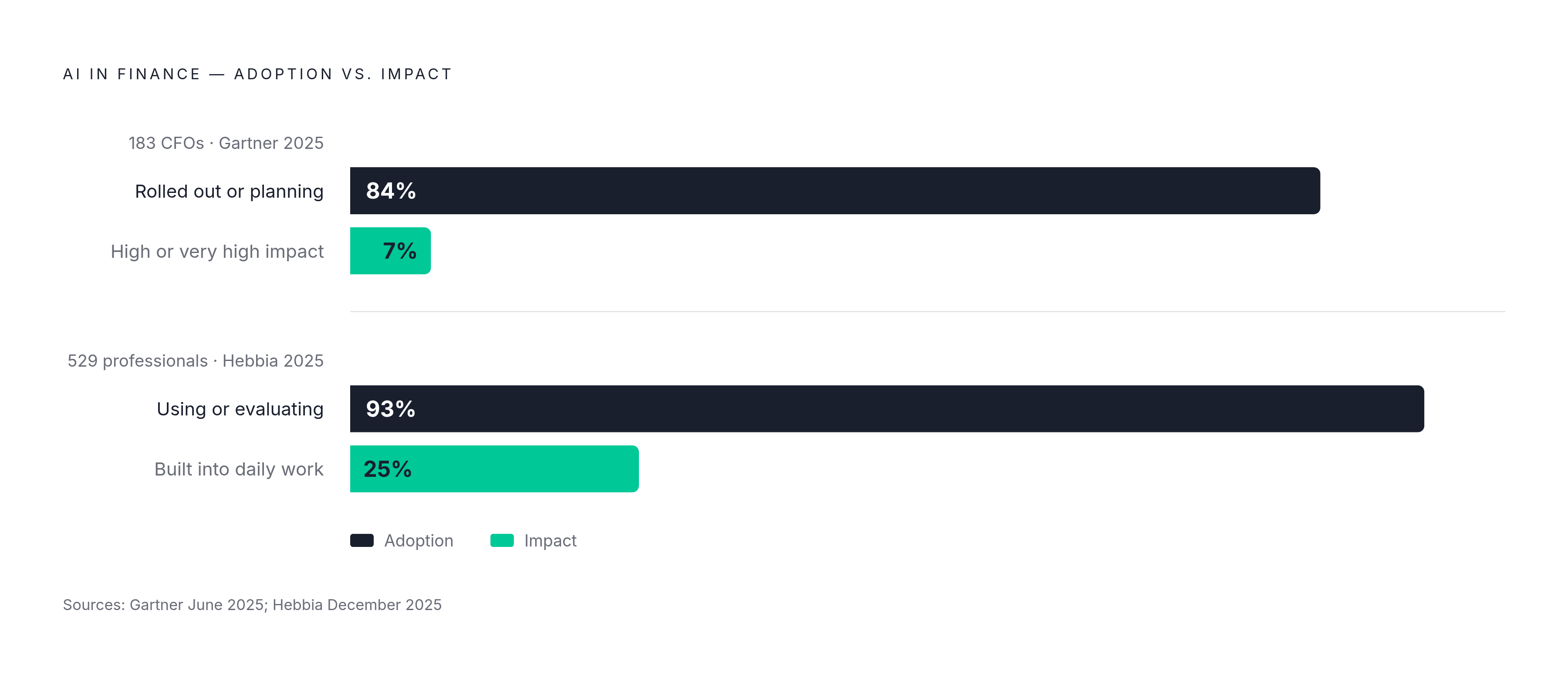
Most finance teams say they're using AI. Almost none of them can point to a dollar figure that moved because of it. Gartner surveyed 183 CFOs back in June 2025 and found 84% of finance organizations have rolled out AI or are actively planning to. Only 7% call the impact high or very high. That gap between "we bought it" and "it worked" is basically the whole article, so keep it in your back pocket as you read the rest.
The adoption curve gets stranger the longer you stare at it, too. That same Gartner survey found 59% of finance leaders using AI in 2025, flat against 58% in 2024, but a real jump from 37% in 2023. So the early adopters already adopted, and everyone left over is stuck trying to turn "we bought the software" into "the software made us money," which turns out to be a much harder trick. Protiviti's 2025 Global Finance Trends Survey backs this up from another angle: 72% of finance orgs use AI now, up from 34% the year before. Most of that use is process automation though, a lighter lift than the kind of digging that actually changes a decision somebody has to sign off on.
Then there's Hebbia's December 2025 survey of 529 finance professionals, and this is the one that should worry anyone about to sign a contract this quarter. 93% are using or evaluating AI in some form. Only 25% say it's actually built into how their team works day to day. And 70% of finance teams still lean on spreadsheets and manual processes as their main tool, which means AI runs alongside the grind in most shops rather than replacing any of it.
None of this means adoption failed. It means most of these tools never touched the boring stuff that eats a finance team's week: the missing document, the disputed invoice line, the portal login nobody remembers. So the real question isn't whether your team uses AI. It's what the 7% seeing actual impact are doing differently from the other 93%.
The landscape of AI finance tools and what each category actually does
AI finance software splits into a handful of categories solving genuinely different problems. Mix them up in a procurement meeting and you'll end up six months deep in a decision that should've taken six weeks, because you were comparing tools that were never built to compete with each other.
Financial close and reconciliation is its own lane. BlackLine has a two-decade track record here, and its Verity AI suite (Flux, Insights, Summarization Agents) leans on that history hard. The company's December 2025 acquisition of WiseLayer pushes further into judgment-based AI for accruals and payroll, the kind of work that used to mean a controller squinting at a spreadsheet at 11pm wondering where a rounding error came from.
FP&A and planning is a different animal entirely. Workday Adaptive Planning runs cloud-native and does well in headcount-heavy industries, where labor cost modeling drives the whole forecast. Oracle EPM covers more ground end to end: consolidation, close, planning, forecasting, performance reporting, all stitched together into one system.
AI-powered analytics is its own thing too. Tools like Tellius try to automate the root-cause digging that used to eat an analyst's entire Tuesday. Instead of a static dashboard telling you a number moved, it tries to tell you why.
Financial modeling assistants are a small world unto themselves. Wall Street Prep's 2026 evaluation of tools building a three-statement model ranked Shortcut first overall, with Claude close behind, and both beat Copilot and ChatGPT by a real margin on that specific task. Which tells you something worth remembering: these tools aren't interchangeable just because they all sit on top of a large language model.
And then there's AR execution, the part of finance where invoices either get collected or sit there aging like milk in a fridge nobody checks. Some tools in this space operate as a managed AR function handling the full receivables cycle: customer follow-up, portal navigation through systems like Coupa and Ariba, dispute handling, and escalation when a human actually needs to step in.
Here's the distinction that actually matters when you're buying. A chatbot bolted onto a planning tool tends to stay a narrow feature forever. Something that investigates on its own, across every data source your company owns, why results shifted, that behaves more like a platform. Treat those as the same purchase and you'll end up with five tools that don't talk to each other and one very confused IT team.
Functional depth: what a tool should actually be able to do on its own
Here's the test that matters: when friction shows up, does the tool push through it, or hand the ball back to a human and quietly vanish? Plenty of vendors demo beautifully on the easy path and go silent the second things get messy, which, conveniently, is never shown in the demo.
Hold vendors to numbers, not adjectives. You want 80%+ autonomous execution on routine tasks, extraction and classification accuracy above 90% on finance documents, and a confidence score with a line-by-line rationale behind every call the tool makes. Anything vaguer than that belongs in a pitch deck, not a spec sheet, and you should say so out loud in the meeting.
Most tools handle the clean invoice fine, and the variance with the obvious cause. Where they stall is the exception: the missing W-9, the login wall on a supplier portal, the disputed line item nobody's answered in three weeks. That's exactly where automation quietly hands off to a human, usually without anyone noticing until the invoice is 60 days late and someone's asking why. For AR specifically, this distinction is everything. A tool that fires off a reminder email is doing automation. A tool that logs into a Coupa or Ariba portal, responds to a dispute, and escalates when it hits a wall is doing resolution. Those two things get sold with identical pitch decks, and they are not remotely the same product.
Gartner's 2025 survey puts accounts payable automation as the second most common AI use case in finance, at 37% adoption. High adoption doesn't mean high effectiveness, though, not if the tool taps out the moment things get complicated. And AP tends to get complicated right around the point where it matters most.
Bring three questions into every demo. What happens when a required document is missing? Can the agent actually click through a third-party supplier portal on its own, or does a person have to do that part for it? And when the agent hits a decision it can't make alone, what's the escalation path, and how fast does a human actually get pulled in? The answers tell you more than any feature list ever will.

Integration depth and why connector count is the wrong metric
64% of large enterprises are juggling ten or more procurement tools right now. Only 8% feel like those tools deliver the ROI they were promised. More integrations, in practice, have tended to produce more dashboards nobody opens rather than more value anybody can point to.
Integration depth, looked at honestly, comes down to a few plain questions. Is the connection to your ERP, CRM, and operational systems native, or does it run through middleware sitting in between, adding a layer nobody asked for? Does the data sync in real time, or in batches, meaning the number on your screen might already be stale by the time you act on it? Is the flow bi-directional and event-driven, or a read-only pull that tells you what happened but can't lift a finger to fix it? And can the tool handle unstructured input, email threads, PDFs, portal messages, or does it only work when the data already lives in a nice clean field somewhere?
Legacy ERP systems make all of this more expensive, full stop. Connecting AI to an older ERP setup carries a real cost premium over building on something newer, and that premium almost never shows up in the first pitch. Custom middleware, prompt engineering, the ongoing grind of keeping governance running: these are the costs vendors leave out of the opening conversation, sometimes because nobody wants to be the one to bring up the expensive part.
The right question in an integration conversation isn't how many connectors a vendor lists. It's what happens the moment the data the tool needs isn't sitting where it's supposed to be. For AR, this comes up constantly: a tool that can read payment status out of NetSuite but can't log into a Coupa portal to check whether an invoice cleared approval has a real hole in it. No connector count fills that hole.
Security, compliance, and governance as threshold requirements, not differentiators
Something shifted here in the last year. Through mid-2025, a strong AI governance certification was a genuine selling point, the kind of thing you'd put on a slide to win the deal. By mid-2026, in financial services, healthcare, and the public sector, that same certification is table stakes, just the cost of getting in the room. Regulation pushed it there: DORA, the EU AI Act, the revised Product Liability Directive.
The non-negotiables now: end-to-end encryption, role-based access controls, SOC 2 Type II certification, GDPR compliance. If a vendor still treats any of those as something on the roadmap rather than something already shipped, that tells you everything you need to know before the meeting's even over.
This isn't purely an IT problem anymore either. Gartner surveys show over 70% of CFOs now carry expanded responsibility for enterprise data, analytics, and AI. When governance breaks, it lands on the CFO's desk directly, not filtered down through some help desk ticket queue nobody checks on Fridays.
Procurement conversations have shifted to match. Buyers now ask things nobody thought to ask two years ago. Can we run the agent in a sandbox before it touches live data? Can we bring our own LLM, or are we locked into the vendor's? Are prompts and completions logged and auditable? Can the platform walk through, step by step, why it landed on a given recommendation? Vendors still treating explainability and audit logging as a bolt-on feature are losing deals to vendors who just built it into the core product from day one.
One practical move: run your compliance checklist before you book a single demo. If a vendor can't clear it, don't waste a meeting finding that out the hard way.
Why data quality determines how much of the AI's potential you'll actually reach
The biggest obstacle to AI adoption, per that same Gartner survey of 183 CFOs, comes down to data literacy and bad data quality, ahead of cost, ahead of talent, ahead of everything else on the list. Only 43% of finance leaders can forecast within 10% accuracy, and no AI layer fixes that on its own. Feed a model messy inputs and it hands you confident, well-formatted, wrong answers. Garbage in, garbage out, just faster now, and with better fonts.
The evaluation question that actually matters: does the platform catch bad data, or does it just assume whatever it's handed is clean? Tools with anomaly detection, duplicate flagging, and missing-field escalation hold up a lot better once they hit a real company full of half-updated records and stale contact fields. Tools that need a separate data engineering project just to function are hiding a cost nobody mentioned on the sales call, on purpose or not.
Speaking of which: data engineering typically eats somewhere between a quarter and nearly half of total AI spend, and it's routinely missing from the initial budget entirely. Ask the vendor to walk through their data prep assumptions before you sign anything, not after.
AR shows this clearly. Incomplete customer records, missing contacts, outdated billing addresses, unresolved entity mismatches: these are what push invoices past terms in the first place. A tool that quietly skips past that mess isn't helping you, it's just hiding the problem one layer deeper where you'll find it later, angrier. The tools worth paying for surface the friction instead of pretending it isn't there.
Total cost of ownership: the gap between the license price and the actual budget
85% of organizations misestimate their AI project costs by more than 10%. A separate 2025 survey from Mavvrik and Benchmarkit found 80% of companies miss their AI infrastructure forecasts by over 25%, with only 15% landing within 10% of what they actually spend. Read that twice if you need to. The license number on the contract is not the number you should build a budget around.
A decent rule of thumb: take the headline licensing cost and multiply by 2.5 to 3.5x to land somewhere close to the real total. That gap comes from a few predictable places, and none of them are hidden exactly, they're just quiet. Data engineering and prep runs 25% to nearly half of total spend and almost never makes the first estimate. Add custom middleware for legacy systems, ongoing prompt engineering and model tuning, governance infrastructure like audit logging, and change management as the tool itself keeps evolving underneath you. These platforms don't sit still once you deploy them, which is either exciting or exhausting depending on your appetite for surprises.
Gartner predicts CFOs who deploy AI strategically will see real margin growth by 2029. Here's the catch, though: that growth comes from managing finance technology as one deliberate portfolio, not from a scattered pile of pilots run by five separate teams who never once compared notes.
Before you shortlist anyone, ask for a TCO worksheet covering data prep, integration, governance, and ongoing tuning, not just license and implementation. A vendor who won't hand that over is telling you something about their real cost profile, even if they never say it out loud. For AR tools specifically, the ROI conversation can be more direct than most: ask for customer-verified improvement in days sales outstanding, an actual drop in manual follow-up hours, a real increase in cash collected within terms. Numbers from real customers beat a projection on a slide every time.
A structured evaluation sequence that matches criteria to decision stages

The criteria above don't carry equal weight, and they don't belong on one flat checklist either. They follow an order, and it's the same order a real deal should move through if you're doing this right.
Stage one is threshold screening, before you ever book a demo. Security and compliance certifications (SOC 2 Type II, GDPR, whatever your sector specifically demands), data governance and explainability architecture, and the ability to handle unstructured data and real exceptions instead of just the clean, easy path. Fail here and you don't get a meeting, full stop.
Stage two is functional evaluation, during demos and pilots. Test autonomous execution against tasks pulled from your own workflow, not the vendor's rehearsed script that always works perfectly. Push hard on exception handling, on what actually happens at the first sign of friction. Test integration live, against your specific ERP and operational systems, not a connector list sitting on a slide somewhere.
Stage three is cost and data readiness, right before you shortlist. Build the full TCO model: data engineering, middleware, governance overhead, all of it, no shortcuts. Be honest about your own data quality, and figure out what the vendor's tooling actually handles versus what your team still has to clean up by hand. Insist on vendor-provided or customer-verified ROI numbers, not projected savings dressed up as a promise.
The order matters more than it looks like it should. Running a TCO analysis on a vendor who already failed your security threshold is wasted work, like pricing out a car you were never going to buy. Get the sequence right, though, and the crowded market stops feeling disorienting. It just becomes a filter, one stage at a time, until what's left actually does the job you needed it to do in the first place.