AI-Powered Invoice Follow-Up at Scale
AI handles complex customer situations that uniform payment reminders can't solve.
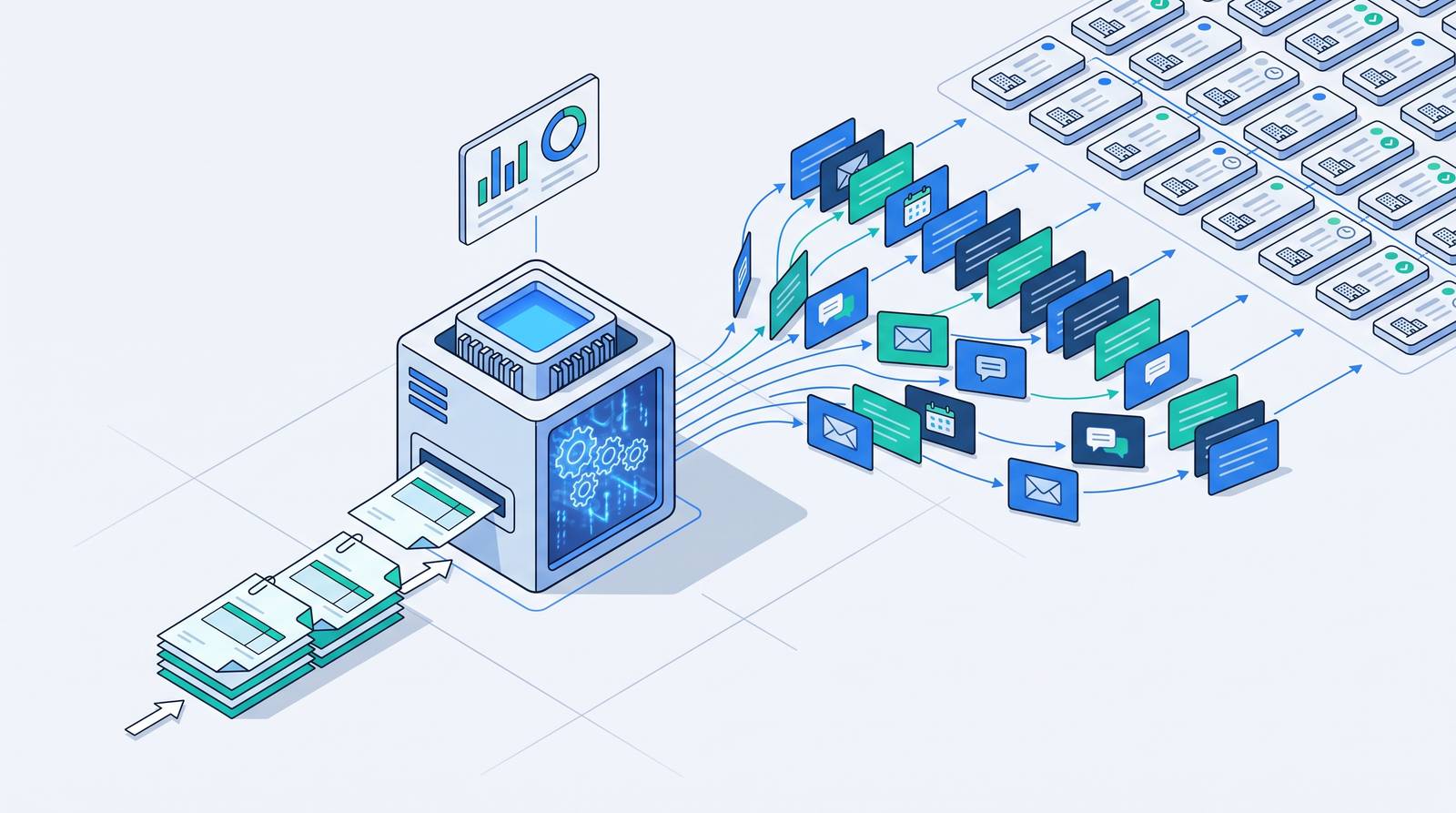
Here's the naive version of AR follow-up: send a reminder at 30 days, escalate at 60, repeat. Most teams do this manually. Basic automation replicates it. At small volumes, it more or less holds together.
Volume is where it stops holding.
When you have hundreds of open invoices, you also have hundreds of distinct customer situations. Payment history, dispute status, portal requirements, missing documents. A uniform cadence treats a longtime reliable customer exactly the same as a chronic slow-payer. Both get the same email. Neither gets the right response. The follow-up goes out, and you get back silence, because the message was built for a generic customer who doesn't actually exist in your book.
The real time sink isn't the reminders themselves. It's the manual triage behind them. Someone has to look at each invoice, figure out what's actually going on, decide what to do next, and then do it. That loop repeats across every open invoice, every week. It's a model that works when the list is short and falls apart quietly as it grows.
What actually blocks payment, at scale, falls into a handful of categories:
- Missing documents. A W-9, a purchase order, proof of delivery. The invoice sits there until the right document shows up.
- Portal friction. Platforms like Coupa and Ariba have submission rules. One rejected submission resets the payment clock entirely.
- Unanswered escalations. The initial contact goes quiet. Reaching the right decision-maker requires knowing who that is, and actually following through.
- Unresolved customer questions. A customer replies with something. Nobody answers quickly. The payment waits.
The bottleneck isn't reminders. It's clearing the specific operational blocker on each individual invoice. Most of what gets sold as "AR automation" only touches the reminders. That's treating the symptom and ignoring the thing causing it.
How AI Decides What to Do With Each Invoice
AI analyzes payment history, invoice age, customer behavior, dispute flags, and prior responses. Then it picks an action. Not the next item in a scheduled sequence. The right action for that specific invoice, at that specific moment, based on everything it knows about that customer.
Forrester's March 2025 report identified collection management as the top application of AI in accounts receivable, and the reason is exactly this: traditional automation runs a cadence, but AI decides which cadence to run, when to change it, and when to skip it entirely.
In practice, that looks like real segmentation with real consequences:
- A chronic slow-payer gets higher-frequency outreach and earlier escalation to a decision-maker.
- A reliable customer with a one-off delay gets a lighter touch and an inquiry-first tone.
- A first-time customer submitting through a portal gets a proactive document check before the due date even arrives.
That last behavior doesn't get enough credit. A proactive pre-due-date outreach approach can cut late payments by 40 to 50 percent. No human team runs that check consistently across hundreds of open invoices. It's not that people don't know it's valuable — there's simply no time for it when you're already behind on the reactive work.
The forecasting piece matters too. Waiting until something is 45 days overdue to start the conversation is always harder than catching it before the due date passes. AI-based cash flow forecasting gives you a real window to act early, because you can see which invoices are likely to run late before they actually do. Traditional methods miss a lot of what AI surfaces in time to do something about it.
Personalization at scale isn't a feature. It's the difference between a system that thinks and a fancier version of the same manual process you already have.
Multi-Channel Outreach and Why Channel Choice Is Not Arbitrary
Not every customer pays attention to the same channel. Most AR tools treat this as an afterthought. The data says it shouldn't be.
Here's what actually happens across channels:
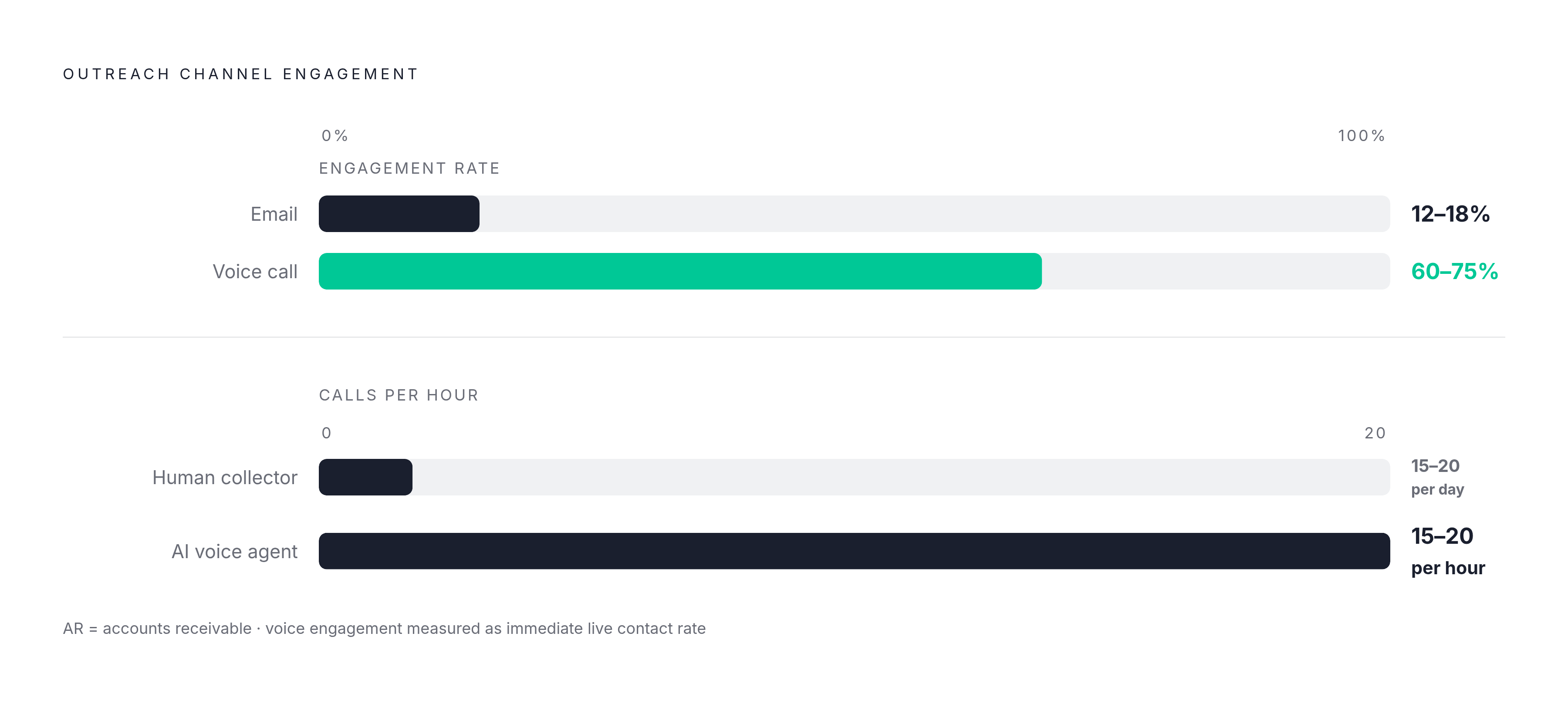
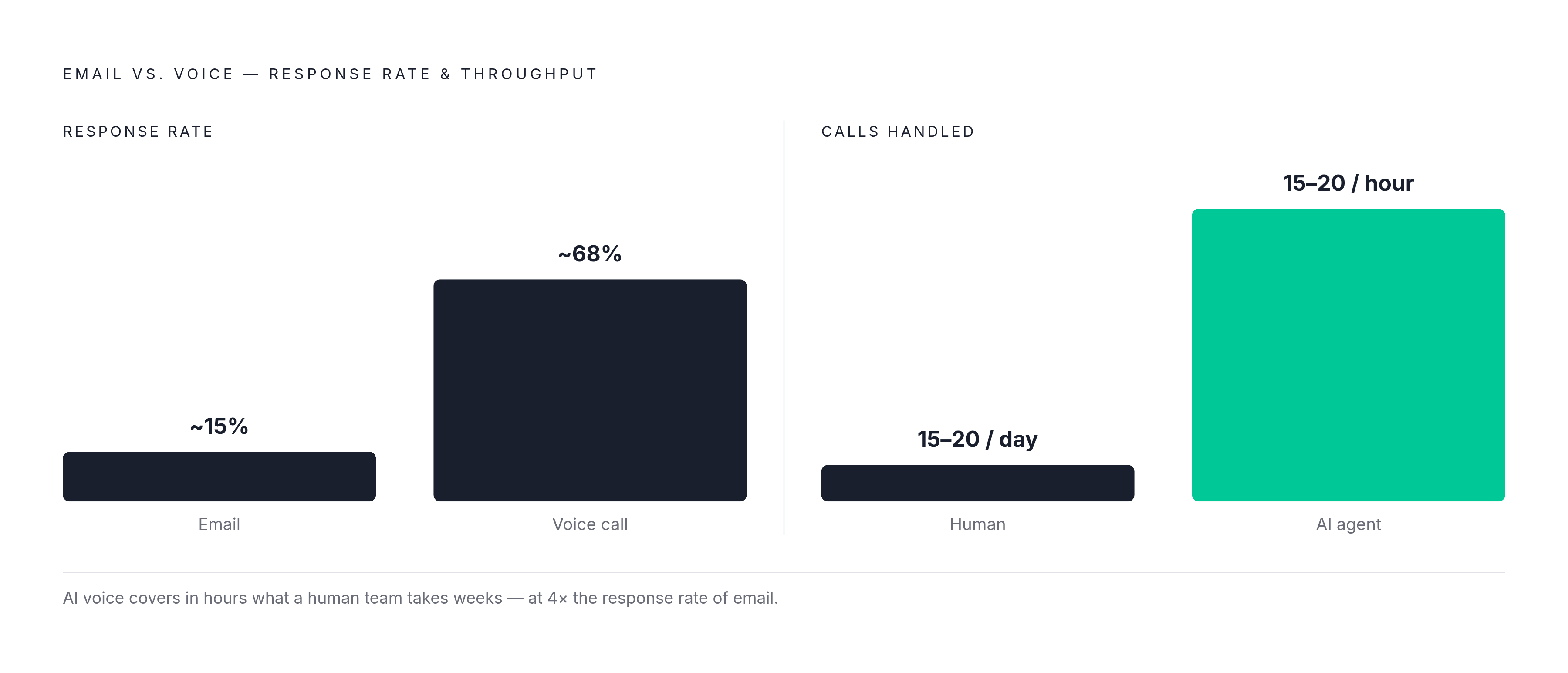
- Email is slow. Useful for documentation and low-urgency follow-up, but structurally slow. Response rates sit in the 12 to 18 percent range. If you need an answer this week, email alone won't get you there.
- Voice is different. Sixty to 75 percent immediate engagement on calls. When a customer makes a verbal commitment to a payment date, they follow through far more often than when they type the same commitment into an email. There's something about saying it out loud that creates accountability in a way a written reply doesn't.
- AI voice agents handle roughly 15 to 20 calls per hour. A human collector handles 15 to 20 calls per day. That's not a marginal efficiency gain. That's covering your entire overdue book in hours instead of weeks.
When channels work in coordination — email, SMS, phone, and portals running in sequence rather than in isolation — blended response rates climb substantially above what any single channel produces alone. The AI isn't blasting all channels simultaneously. It selects based on invoice age, prior response, and customer profile. The right message, through the right channel, at the right time, is a completely different experience than another email landing in an already full inbox.
Portal submissions deserve a specific mention. Manual submissions to platforms like Ariba and Coupa face rejection rates of 10 to 15 percent from formatting errors or missing data. Invoice Butler, an accounts receivable automation tool that uses AI agents alongside human collections experts to chase overdue invoices and navigate supplier portals, is one example of a service built specifically around clearing that kind of friction. Automated handling brings that well below 1 percent. For businesses that rely heavily on portal-based payments, eliminating rejections alone removes real days from DSO. Days that would otherwise disappear into the administrative gap between "submitted" and "actually in the payment queue."
Clearing the Operational Blockers That Hold Payments Up
Sending a payment reminder to a customer who is missing a purchase order accomplishes nothing. The customer can't approve payment without the document. The reminder arrives, gets mentally filed under "deal with later," and the invoice keeps aging. A system that identifies the missing document and requests it directly is doing something categorically different from a system that just sends the next reminder on schedule.
The same logic runs through every operational blocker:
- Portal navigation. The AI navigates Coupa, Ariba, and similar platforms. It submits invoices, corrects formatting, confirms receipt. The invoice ends up in the customer's actual payment queue instead of sitting in a rejection folder nobody monitors.
- Customer questions. A customer replies with a question and gets an immediate response. A human team managing volume lets those replies sit for days. Each day that question goes unanswered is another day of deferred payment. That delay compounds across a full book of open invoices.
- Escalation paths. When an initial contact goes quiet, the system identifies the right decision-maker and routes the escalation there. Rather than sending another email to the same inbox that's been ignoring you for three weeks.
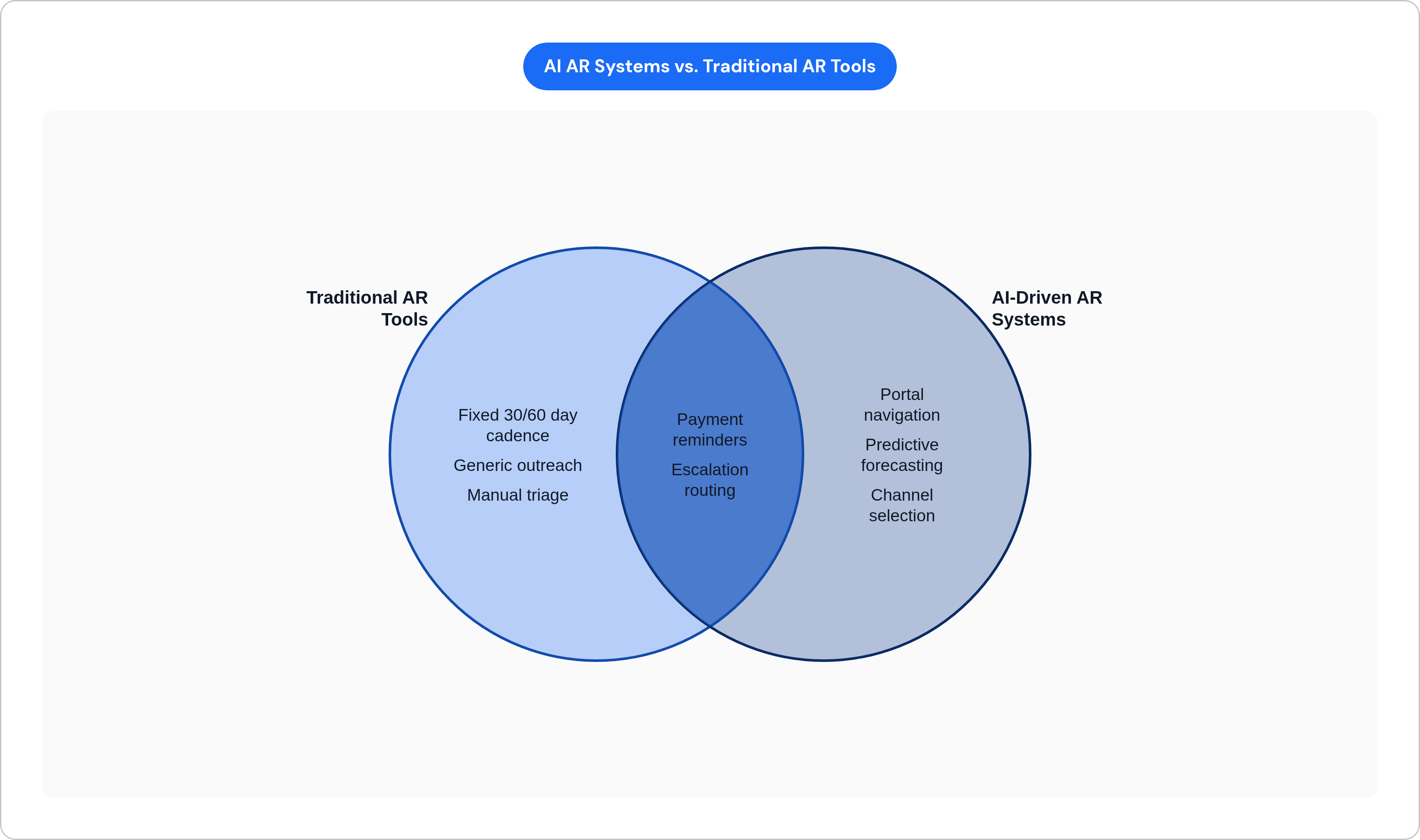
The structural difference between a reminder tool and a real AR system is this: a reminder tool sends the next scheduled message regardless of what is actually blocking the invoice. A proper AR system figures out the specific reason the invoice isn't moving, then acts on that reason. Those are genuinely different activities. One produces a paper trail. The other produces payment.
What Measured Outcomes Look Like Once the System Is Running
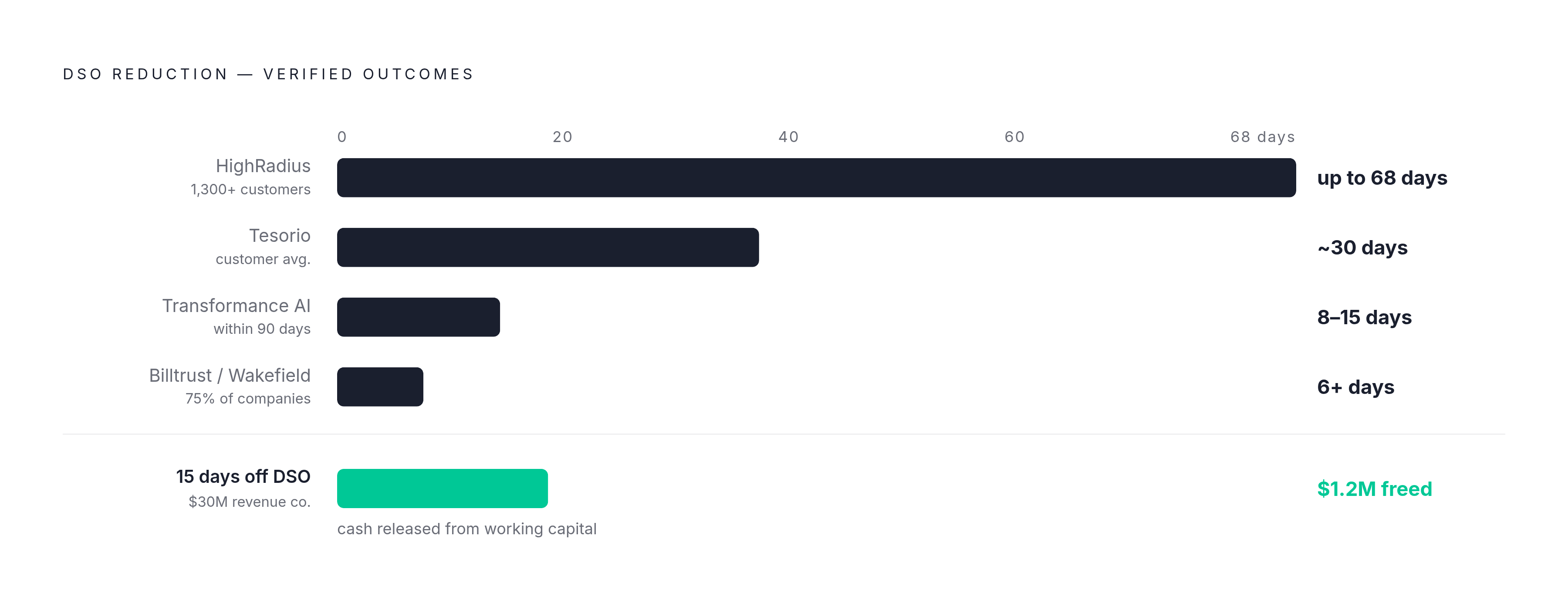
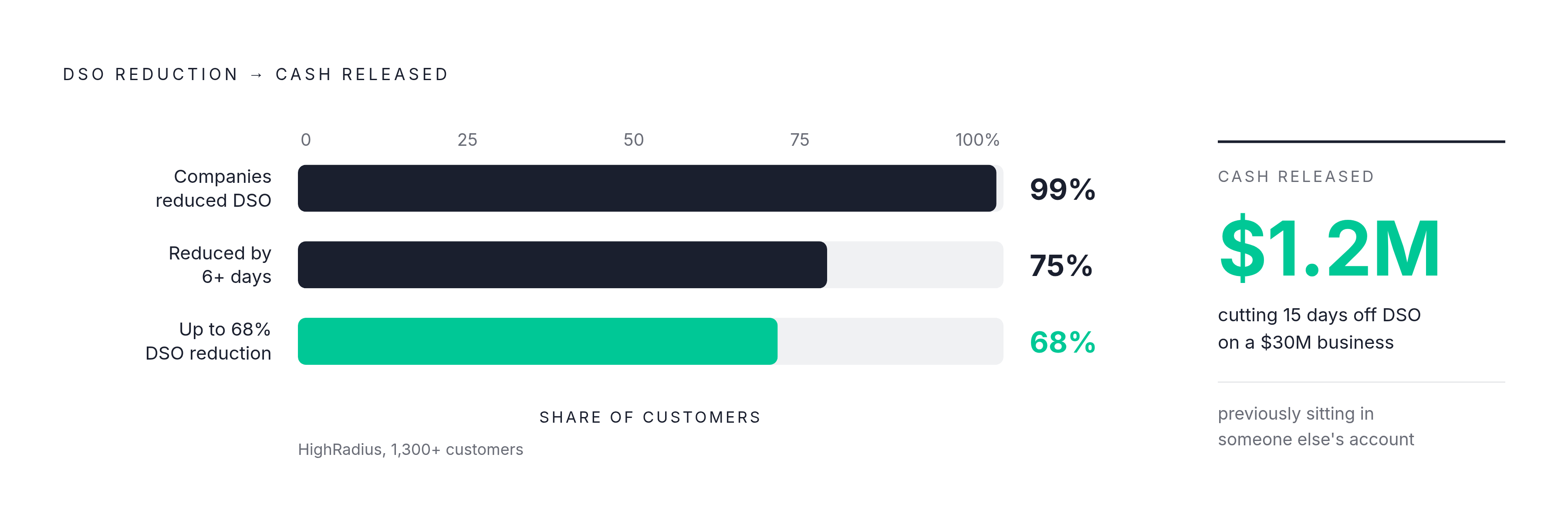
A 2025 Billtrust and Wakefield Research study of 500 finance decision-makers at large North American companies found that 99 percent of companies using AI successfully reduced DSO. Three-quarters reported a reduction of six or more days. That's a high adoption rate producing a consistent result, which is worth paying attention to.
Across platforms reporting verified customer outcomes, the pattern holds. Tesorio customers averaged roughly a month of DSO reduction with collections productivity roughly tripling. Transformance AI customers saw 8 to 15 days of reduction within 90 days of deployment. HighRadius's 2026 benchmark across more than 1,300 customers showed DSO reductions of up to 68 percent alongside a 40 percent productivity improvement.
These numbers start to feel abstract until you run them against actual revenue. For a $30 million business, cutting 15 days off DSO releases roughly $1.2 million in cash. That's money that was sitting in someone else's account, now available to actually run the business. It's not a bookkeeping change. It's a cash position change. On the bad debt side, businesses using automated invoicing have seen roughly a 15 percent decline in amounts written off. That's real losses that a better process prevents, not theoretical savings.
The adoption numbers are telling too. The AR automation market sat at roughly $4.79 billion in 2025, with projections above $12 billion by 2033, per Grand View Research. Finance leaders using AI tools in their function nearly doubled in a single year. That kind of jump doesn't happen because people are chasing hype. It happens because the numbers showed up when they went looking.
One caveat worth naming here: outcomes vary significantly by implementation depth, and this is where vendors get slippery. A tool that only sends reminders produces reminder-level results. The larger gains come from the full operational stack — document handling, portal navigation, channel orchestration, escalation routing — not just the front-end messaging. When you're evaluating platforms, that distinction matters more than almost anything else, and not every vendor makes it easy to see.
Where Human Judgment Still Belongs in the Process
Despite the AI advances, 66 percent of finance leaders reported an increase in manual work over the last year. That's a number that should give anyone pause. Automation that handles the wrong tasks creates more exceptions, not fewer. The fix isn't less automation — it's being honest about what automation should and should not own.
Some decisions genuinely belong with a person:
- Relationship calls. Whether to pause collections on a strategically important customer requires judgment about the relationship, the context, and the business implications. An AI can flag the situation. A human makes the call.
- Legal exposure. Disputes that escalate, customers in visible financial distress, invoice corrections that require internal coordination. These need a person who can read the room.
- Escalation judgment. The system can identify that an escalation is needed and route it to the right place. Whether to hold or push is a human decision, usually one that depends on context the system doesn't have access to.
Manual invoice handling is significantly more expensive per invoice than automated handling. But that savings disappears fast if humans are re-entering the process to fix what automation missed or mishandled. Poorly scoped automation creates a situation where you're paying for both the tool and the cleanup, which ends up worse than just doing it manually in the first place.
The practical model that works: AI covers the full follow-up cadence, channel selection, document chasing, and portal work. Humans own relationship-level decisions and exception resolution. This isn't about shrinking the AR team. It's about stopping the team from spending most of their time on work a system can handle better, so they can spend it on the work that actually requires them.
What Finance Teams Can Do Once Follow-Up Runs Itself
The time that goes into chasing overdue invoices is real, and recovering it changes what the finance function can actually do. That's not a productivity talking point. It's a shift in what the job looks like day to day.
Forecasting becomes a tool instead of a task. With high-accuracy AI cash flow predictions, the team is acting on information rather than spending hours generating it by hand. Working capital becomes something you actively manage rather than a number you discover after the fact and scramble to react to. Strategic finance work — customer credit analysis, pricing decisions, growth planning — gets crowded out when everyone is in reactive mode, running down invoices one by one. Take the reactive work off the plate, and there's suddenly room for the other kind.
Finance teams that delay on this aren't holding steady. They're falling behind peers who have already reclaimed that time and put it to work elsewhere in the business. The operational overhead of getting paid doesn't have to be the whole job. For teams that have made the shift, it mostly isn't anymore.