AI Document Analysis for Invoice and Remittance Processing
AI learns document structure from data, so it finds invoice fields wherever vendors place them.
If you've spent any real time in accounts payable or accounts receivable, you already know the dirty secret: the problem was never volume. It was always variety. AI document analysis is finally built to handle that variety end-to-end, from ingestion to cash application, and the numbers behind it are hard to argue with.
What AI document analysis actually does, and how it differs from OCR
Most people hear "AI document processing" and picture a smarter scanner. That's not it.
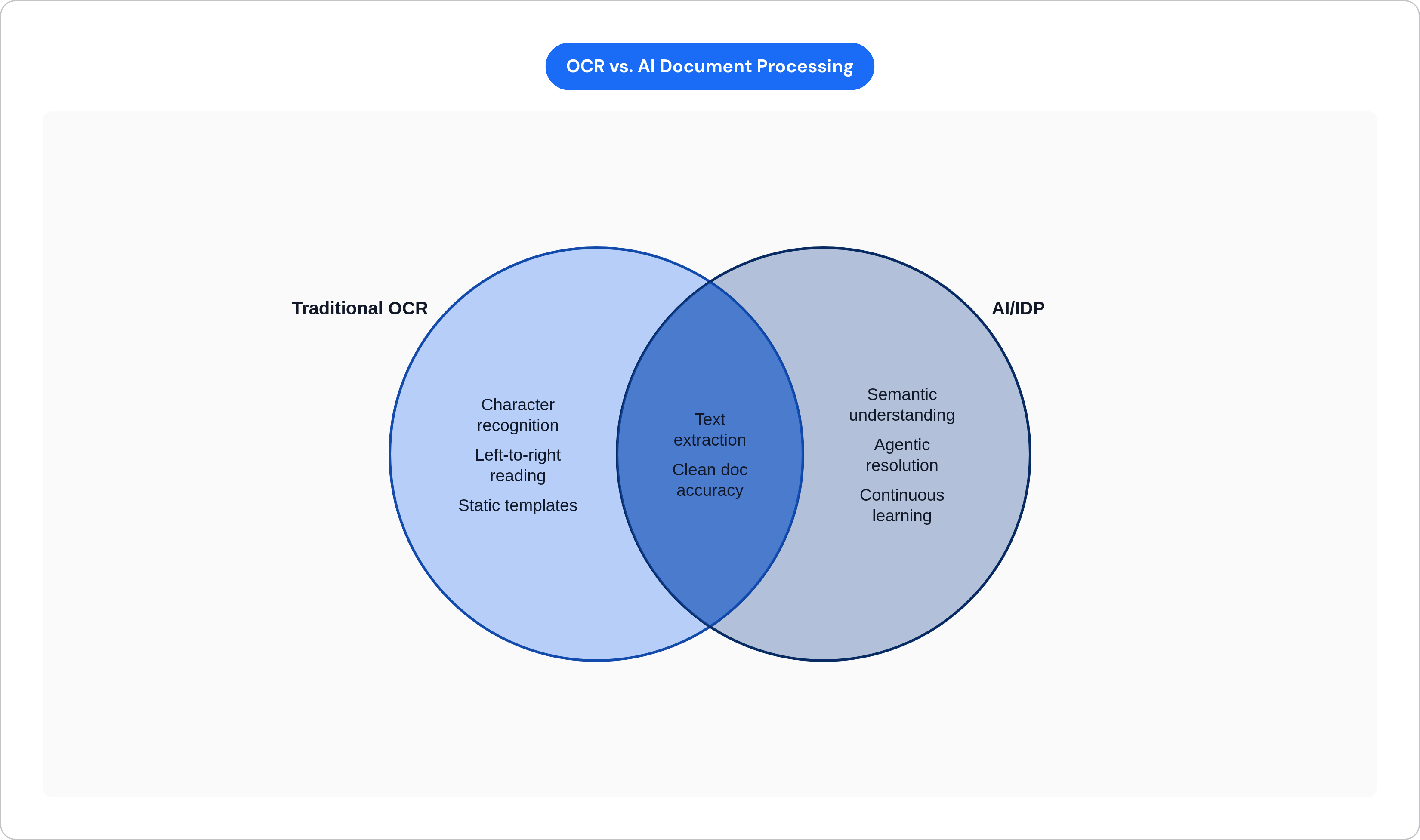
OCR (optical character recognition) reads characters off a page. That's the whole job. It doesn't know what a PO number is. It doesn't know where to look for one. And if your vendor puts it in the footer instead of the header, OCR doesn't care. It just reads left to right, top to bottom, and hands you a string of text.
Intelligent Document Processing (IDP) is a different animal. It combines OCR with computer vision, natural language processing, and machine learning. Not as separate steps bolted together. As an integrated pipeline that classifies what it's looking at, extracts the right fields, validates the output against known data, and routes the document to the right place.
The critical difference is this: AI learns field relationships from training data.
That means it can find a PO number even when it shows up somewhere unexpected. No template required. No manual setup for every new vendor format.
There are roughly three tiers of technology doing this work right now:
- Traditional OCR. Accurate on clean, typed documents. Falls apart on handwriting, odd layouts, or low-resolution scans.
- ML-based extraction models (think Azure Document Intelligence, Google Document AI, Amazon Textract). These push field-level accuracy into the 95–99% range by learning document structure from real examples.
- LLM vision models (GPT-4o, Claude, multimodal pipelines). These apply large language model reasoning directly to document images, reaching 97–99% field-level accuracy on standard invoices, per published benchmarks.
The "semantic understanding" piece is what separates the top tier from everything else. It's not just finding a field. It's interpreting what that field means — like a detective who doesn't just read the clues but understands what they add up to. An ambiguous line-item description like "consulting services Q3" gets matched to the right contract because the model understands context, not just text. Missing fields get inferred rather than flagged. Discrepancies get reasoned about rather than auto-rejected.
Cloud-based IDP holds about 63% of the market by revenue in 2025, per Grand View Research. The reason that matters is practical: cloud deployment means the model updates continuously as new vendor formats appear. You're not maintaining a static system. You're running one that gets better.
Here's the honest limitation though. Consistency across wildly varied formats is still the hardest problem in the space. Two invoices from two different vendors can share almost no structural DNA. That's why model training breadth matters more than peak accuracy on ideal documents. Any vendor showing you best-case numbers on clean PDFs is showing you the easy part.
How accurate AI extraction actually is across document types in 2025
The headline accuracy figures sound impressive. The more useful question is: accurate on what?
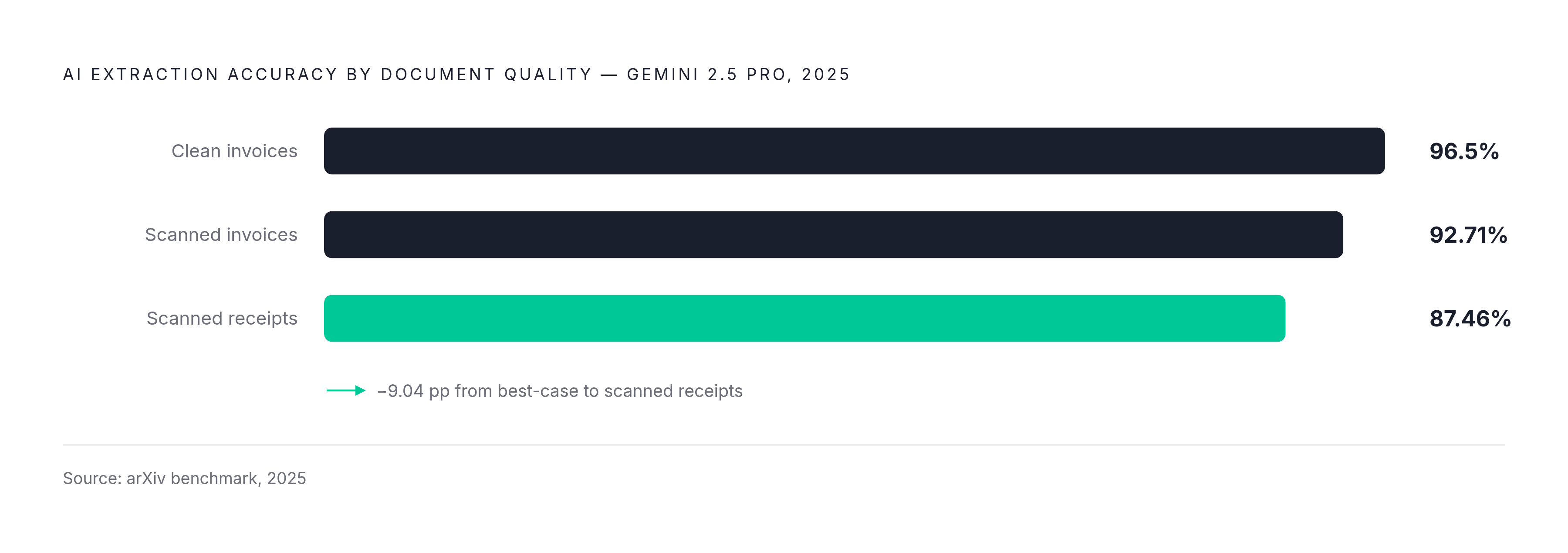
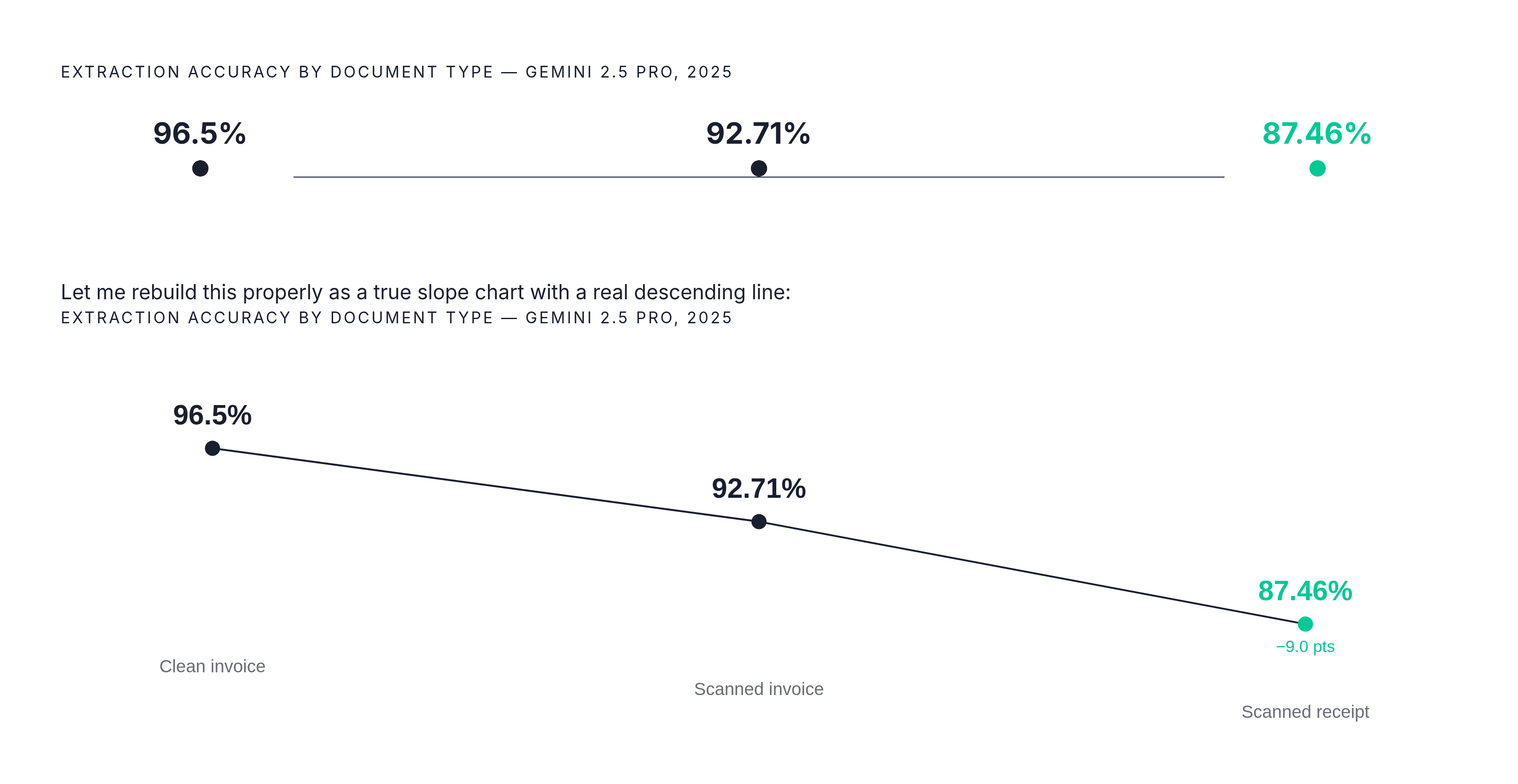
A 2025 academic benchmark published on arXiv tested Gemini 2.5 Pro across document types. Clean invoices came in at 96.5% accuracy. Scanned invoices dropped to 92.71%. Scanned receipts fell further to 87.46%.
Sit with that gap for a second. That's nearly a 10-point swing just from going paper to scanner — you could say accuracy takes a paper cut every time a document passes through a fax machine. For anyone whose AR team handles a lot of fax-to-email or scanned remittance documents, that's not a minor footnote.
Modern OCR on clean typed documents gets to 99.5%. Handwriting is closer to 92%. Table extraction, which matters a lot for multi-line invoices, runs around 95%, per industry reporting.
Combined with AI validation, most enterprise deployments hit straight-through processing rates of 60–70%. That means most documents get handled without a human touching them at all.
ABBYY has reported that organizations deploying IDP at scale achieve 99.5% field-level accuracy and up to a 400% increase in invoices processed per full-time employee. Those aren't lab numbers. That's what the technology looks like running in production.
What do these percentages mean on the ground?
On a 100-field invoice at 95%+ accuracy, errors don't scatter randomly. They cluster in predictable places: tables with merged cells, handwritten annotations, vendor shorthand that deviates from standard field labels. The remaining problem is defined, not diffuse. That's good news because it means human review isn't a fallback for the whole workflow. It's targeted handling of a specific exception class.
The competitive differentiation between systems isn't accuracy on clean PDFs anymore. That's a solved problem. The real question is how a system performs on scanned, low-quality, or structurally unusual documents. That's where the gaps between vendors show up.
Gartner's 2025 Finance Technology Report (cited in Peakflo) puts touchless invoice processing at around 85% by month six for AI agent deployments. Traditional RPA gets to 40–50%. That's a meaningful difference when you're scaling.
The specific challenges remittance advice adds on top of invoice extraction
Here's where things get genuinely messy.
Invoices are hard. Remittance advice is harder, and in a completely different way.
An invoice is a request. It has a sender, an amount, a due date, and ideally a PO number to match it to. It's meant to be read and processed. Remittance advice is a communication. It's the payer telling you what they paid and why. And it arrives in whatever format the payer feels like using that day: a structured EDI file if you're lucky, a free-text email if you're not, a PDF attachment with no consistent field labels, or sometimes just a wire and a phone call to follow up later.
The matching problem is this: a payment lands in your bank account. The remittance arrives separately, maybe at the same time, maybe two days later, maybe not at all. Your AR team has to connect that payment to the right open invoices. Often across multiple invoice numbers. Often with partial payments. Often with deductions the customer took without explanation.
Versapay has reported that remittance processing can generate over 200 unnecessary hours of additional work per week in some organizations, with cash sitting unmatched and unapplied for days or weeks. That's not an edge case. That's a cash flow problem.
A PYMNTS Working Capital Tracker report found that 45% of CFOs reported invoicing errors and discrepancies caused payment disruptions. Most of those disruptions surface at the remittance matching stage, not at invoice issuance. The invoice went out fine. The payment came in. Nobody can figure out what it's for.
Traditional systems hit specific walls here:
- Vague or incomplete descriptions. "Payment for services" tells you nothing. No invoice reference, no period, no amount breakdown.
- Unexplained short pays. The customer sent $9,400 against a $10,000 invoice and didn't say why.
- One payment, many invoices. A single remittance covering dozens of invoices across multiple entities.
- Format chaos. Remittance arriving via portal, email, fax, or not at all.
Basic OCR can extract text from a remittance document. What it cannot do is understand what that payment is settling. That gap between extraction and matching is where most AR teams lose the most time.
How AI closes the gap between remittance extraction and payment matching
The solution isn't a smarter OCR. It's a system that actually learns how your customers pay.
ML-based pattern recognition means the AI analyzes historical remittance behavior for each payer. It learns how a specific customer typically formats references. It knows they always abbreviate invoice numbers a certain way. It knows they routinely take a 2% early pay discount without noting it. The system improves the longer it runs on real data.
Semantic matching goes further. An LLM can interpret "Q3 consulting per SOW" against open invoice descriptions and infer the likely match. It doesn't need an exact string match. It understands what the description probably refers to.
ISO 20022, the international financial messaging standard rolled out broadly between 2023 and 2025, is also a meaningful structural enabler here. It adds 30–40% more structured information to remittance messages compared to legacy formats, per ABeam Consulting. More structured data means AI matching has more to work with.
What AI-assisted matching handles that rules-based systems can't:
- Partial payments split across invoice lines with no stated allocation logic
- Short pays flagged automatically for review rather than silently misapplied
- Payments arriving with no remittance at all, where AI infers probable matches from amount, payer history, and open invoice aging
The operational payoff is real. Cash application that previously sat for days compresses into a managed exception queue. The 200+ hours per week of manual remittance work becomes a fraction of that.
And the system compounds. Every confirmed match, whether auto-applied or human-reviewed, feeds back into the model. Accuracy improves over time rather than plateauing at whatever the day-one configuration could handle.
How agentic AI handles the exceptions that extraction alone can't resolve
Finance teams lose 30–40% of AP processing time to exceptions that traditional automation flags but cannot resolve, per Ardent Partners' 2025 State of ePayables Report. Not process. Just flag.
That's the distinction worth understanding. Legacy automation was good at finding problems. It was not designed to solve them.
An exception is any document or transaction the system isn't confident about: a field that doesn't match ERP records, a duplicate invoice flag, a payment that doesn't reconcile to any open balance, a missing PO number.
Agentic AI doesn't just flag these. It attempts autonomous resolution. It reasons about the exception, pulls context from the ERP and from communication history, and either resolves it or routes it to a human with a specific recommendation and the supporting context already assembled.
Per Gartner's 2025 Finance Technology Report (cited in Peakflo), AI agents reduce exception handling time from 25 minutes per exception to 3 minutes through autonomous resolution of routine variances. That's not a marginal efficiency gain. That's a workflow transformation.
Categories of exceptions agents can handle without human involvement:
- Missing PO number. Agent queries the ERP or reaches out to the vendor to retrieve it.
- Price or quantity discrepancy within a tolerance band. Auto-approved with a logged reason.
- Duplicate invoice detection. Flagged and suppressed before it reaches payment.
- Missing W-9 or tax certificate. Agent initiates outreach and tracks receipt.
The escalation boundary matters here. The value of agentic systems is in handling the routine 80%, not in replacing judgment on genuinely complex edge cases. Any well-designed deployment has clear thresholds for when the system acts autonomously and when it surfaces a decision to a human.
Gartner projects that by 2030, more than 80% of finance functions will embed AI-driven autonomy in core processes. Exception handling is where that autonomy is most immediately practical. The volume is high, the patterns are learnable, and the cost of delay is measurable.
What the processing cost and speed benchmarks reveal about where value concentrates
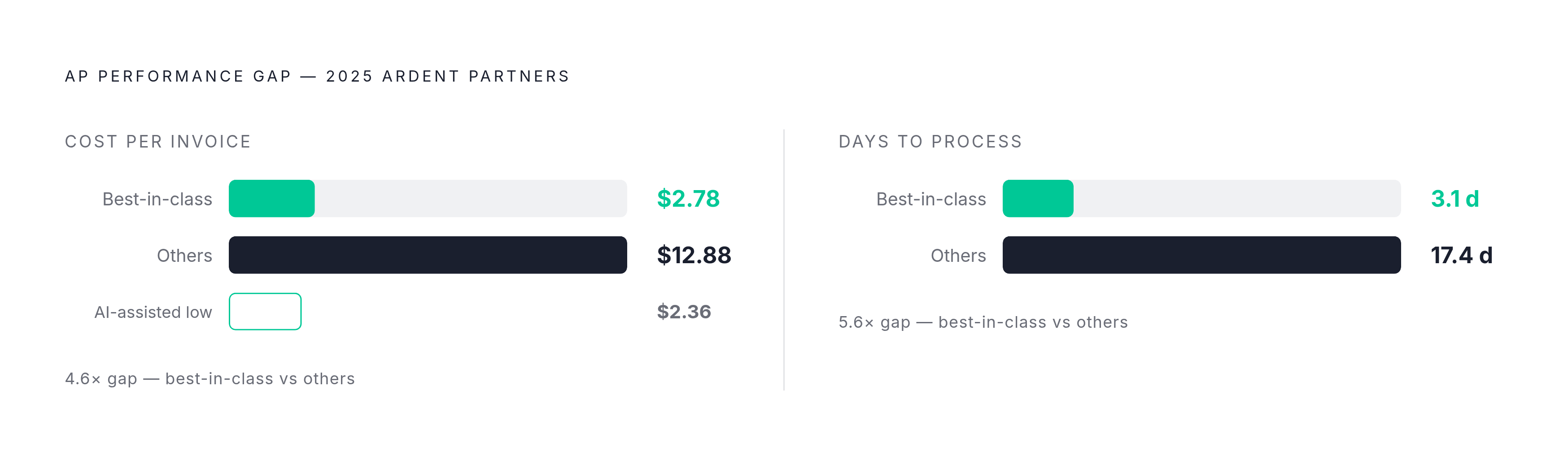
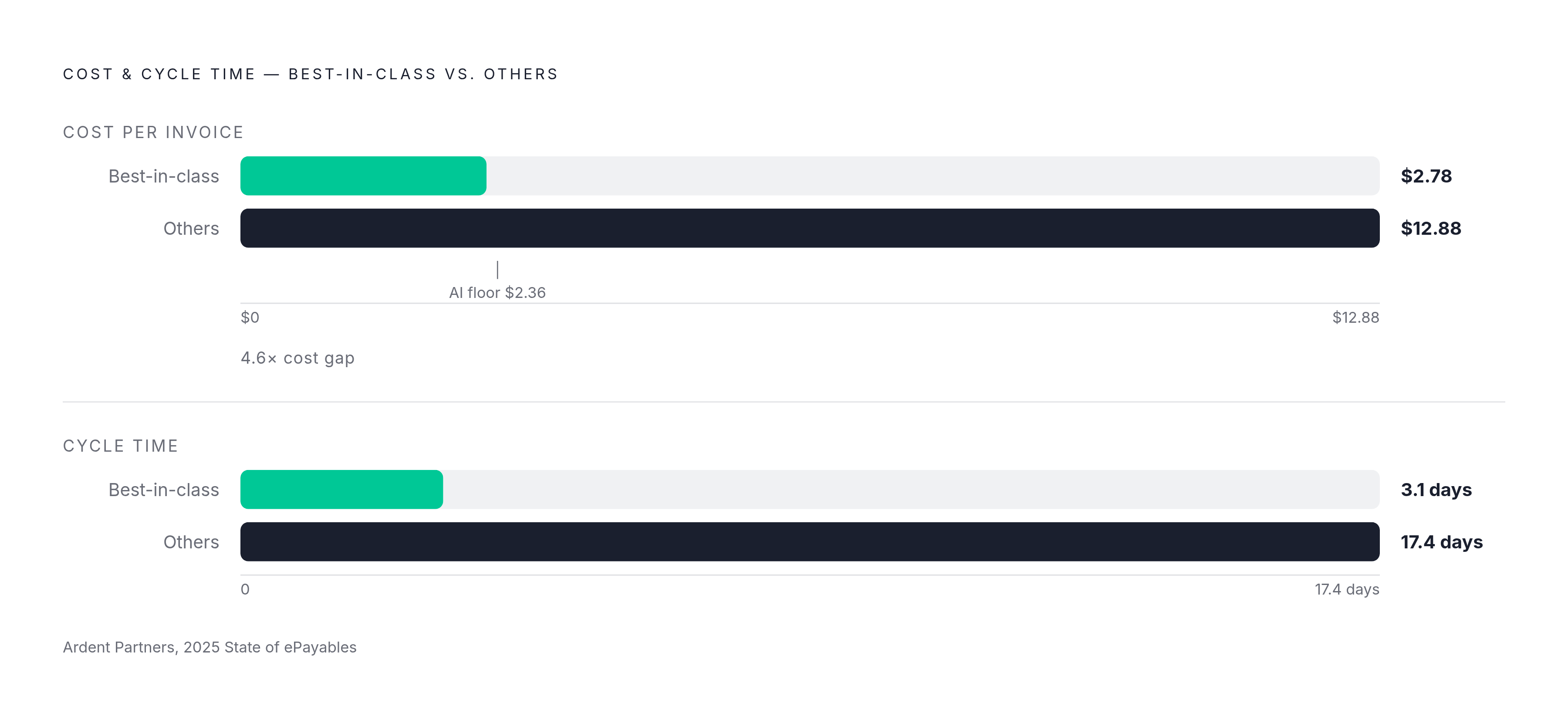
The cost numbers are blunt. Best-in-class AP teams spend $2.78 per invoice in 2025. Others spend $12.88. That's a 4.6x gap, per Ardent Partners' 2025 State of ePayables (cited in Parseur). AI-powered automation can push that cost as low as $2.36 per invoice.
Speed tracks the same way. Best-in-class teams process invoices in 3.1 days. Others take 17.4 days. Fully automated workflows handle 30 invoices per hour versus five manually.
Labor cost reduction of up to 75% when manual data entry is eliminated has been reported by Highradius (cited in Parseur). That figure needs context, though. It's only real when touchless rates are high enough that headcount redeployment or reduction is actually feasible. If you're still manually reviewing 40% of your documents, you haven't unlocked that number.
ROI timelines are faster at scale. SMBs typically see payback in 6–9 months. Enterprises often hit it in 3–6 months, reflecting the volume advantage, per Parseur.
Where the value actually concentrates is worth spelling out, because it's not where most people focus:
- Not in extraction speed on clean PDFs. That's largely a solved problem. The marginal gain there is minimal.
- In exception handling volume and resolution time. The 30–40% of processing time lost to exceptions is where cost and delay pile up. That's the high-value target.
- In remittance matching. Unmatched cash isn't an administrative inconvenience. It's a working capital problem. Days of float on unapplied payments is a measurable cash flow drag that shows up on the balance sheet.
- In portal and communication friction. An invoice stuck in Coupa or Ariba isn't an extraction problem. It's a workflow navigation problem. It requires an agent that can log in, check status, and take action, not just a model that can read a PDF.
The exception rate comparison is as telling as the cost numbers. Best-in-class teams run a 9% exception rate. Others run 22%. That gap is where document quality, vendor behavior, and system capability all converge into a single operational number.
What a closed-loop AI document workflow looks like end-to-end
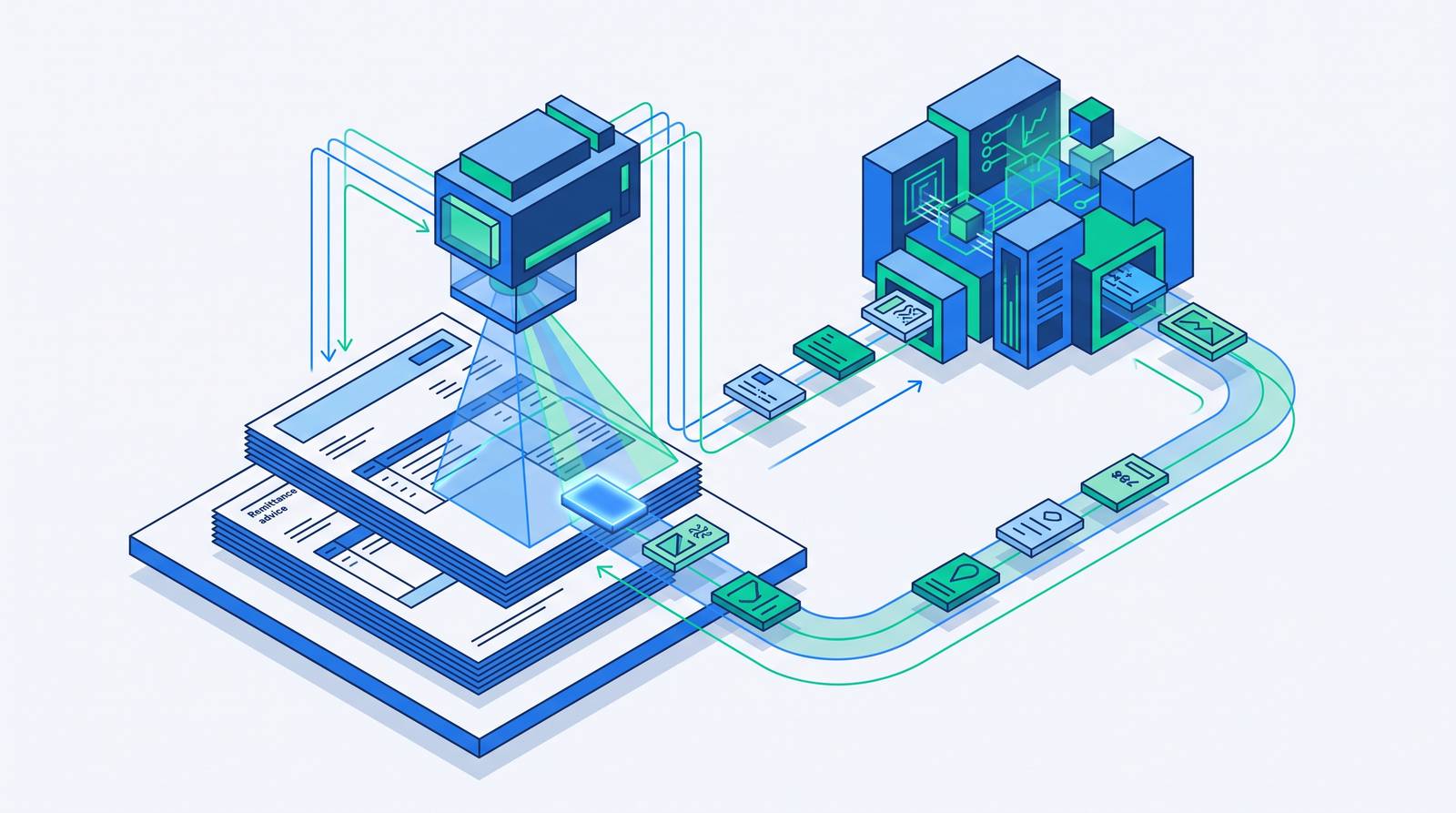
Here's how this actually runs when it's working correctly, from the moment a document arrives to the moment cash is applied.
Ingestion. Documents arrive via email, portal submission, EDI, or scan. AI classifies the document type and routes it to the appropriate extraction pipeline before a human sees it. No manual sorting. No inbox triaging.
Extraction and validation. LLM vision or ML models extract the relevant fields. AI validates them against ERP master data: vendor records, PO database, contract terms. Clean documents proceed to matching or approval queues. Flagged documents enter the exception queue with context already attached.
Exception resolution. The agentic layer handles routine variances autonomously. Missing fields, tolerance-range discrepancies, duplicates. Complex exceptions get escalated to a human, but with the context and a recommended action already assembled. The human makes a judgment call, not a research call.
Remittance matching. AI reads remittance documents alongside incoming payments. It applies pattern-based and semantic matching. It proposes cash application. Short pays and deductions get flagged for review with enough context to act on.
Communication and follow-up. For invoices stuck in portals, awaiting documents, or pending a customer response, the system doesn't wait. It initiates outreach, tracks status, and escalates on silence. This is where the difference between extraction-only tools and agent-capable platforms becomes operationally obvious.
Closed loop. Confirmed matches and resolved exceptions feed back into the model. Vendor-specific behavior gets learned: how a customer formats remittances, which fields they consistently omit, how they handle deductions. That learning applies to every future document from that payer.
What "closed loop" actually means in practice:
- No invoice loses track of its status. Every document has a known state from submission to cash application.
- Exceptions don't accumulate in a queue that grows faster than teams can work it down.
- Cash application isn't the last remaining manual step in an otherwise automated process.
The Hackett Group's 2026 Finance Key Issues Study put a number to the underlying pressure: finance workloads are rising while headcount contracts and budgets tighten. That gap between what finance teams are expected to handle and what they have the capacity to handle is exactly what a closed-loop AI workflow is designed to close.
The variety problem that broke every previous generation of automation is, finally, something AI is actually equipped to handle.