Invoice Dispute Resolution Workflows
Most disputes resolve in weeks, not months—if your team has a repeatable process.
Invoice disputes are a fact of life in B2B finance. About 39% of invoices contain some kind of error, and roughly 1 in 4 B2B invoices in North America are paid late or disputed. The average company absorbs over $39,000 a year in costs tied to late payments and disputes. For 10% of companies, that number climbs past $100,000. And late or unpaid invoices have been linked to a meaningful share of business bankruptcies. This isn't an edge case; it's a structural part of doing business.
The real problem isn't that disputes happen; it's what teams do after they happen. A dispute that gets resolved in five days costs you almost nothing. The same dispute dragging on for two months ties up cash, strains the relationship, and pulls your team into repetitive back-and-forth that nobody has time for. The difference between those two outcomes isn't luck; it's whether your team has a repeatable workflow or is improvising every time. Think of a well-run dispute process like a fire extinguisher: you hope you never need it, but when the moment comes, the last thing you want is to be reading the instructions.
This piece walks through that workflow, stage by stage.
Why Invoices Get Disputed in the First Place
Before you can build a workflow, you need to understand what you're routing. Disputes don't all look the same, and they definitely don't resolve the same way.
The most common triggers fall into six categories:
- Pricing discrepancies. The invoice amount doesn't match what the buyer expected based on their records or the contract.
- Quantity or delivery mismatches. They were billed for ten units but only received eight, or the delivery was late and the buyer is pushing back on terms.
- Duplicate charges. The same invoice got submitted twice, either by mistake or because the original got lost.
- Tax or fee errors. The wrong tax rate was applied, or a fee wasn't disclosed upfront.
- Missing or incorrect PO numbers. This one is more damaging than it looks. Without a valid PO number, the buyer's AP system can't match the invoice to an order. It stops cold before anyone has even reviewed the substance of the bill.
- Documentation gaps. Verbal agreements, informal discounts, and undocumented scope changes are a constant source of disputes. If there's no paper trail, both sides have a different version of what was agreed.
Late invoicing compounds every one of these. The longer the gap between delivery and billing, the harder it is for anyone to reconstruct what actually happened. And freight and logistics invoices are their own special problem area. Error rates on carrier invoices run at 5% or higher, and for mid-to-large enterprises, overcharges can reach into the hundreds of thousands annually.
Here's the part that matters for how you build your workflow: a duplicate invoice and a scope disagreement are completely different problems. One needs a correction; the other needs a negotiation. A good workflow routes them differently from the start.
Intake: Log It and Acknowledge It Within 48 Hours
The first 48 hours set the tone for everything that follows. Responding quickly signals that you're organized and that you take the dispute seriously. Going quiet for a week signals the opposite, and that perception sticks when you eventually do get to the negotiation table.
Every dispute should be logged in a single place. Not an email thread. Not a spreadsheet that lives on someone's desktop. Not a sticky note. One platform, one record. Fragmented handling is where disputes go to quietly age into bad debt — it's the financial equivalent of leaving milk in the back of the fridge and hoping for the best.
At intake, you want to capture:
- Invoice number
- Disputed line items
- The customer's stated reason for the dispute
- Any supporting documents they've attached
- A dispute reason code
That last item (the reason code) matters more than most teams give it credit for. It's how you route the dispute correctly, how you report on dispute volume over time, and how you eventually figure out which process is generating repeated errors. Skip it at intake and you'll regret it later.
Self-service dispute portals make this step cleaner. Customers log the dispute themselves, attach their evidence, and select a reason category. Your AR team doesn't have to touch it until it's already organized. That's a better experience for the customer and a cleaner data trail for you.
The acknowledgment message you send should be simple and in writing. Confirm receipt. State what happens next and when. Avoid making concessions before you've reviewed anything, but don't get defensive either. Just be factual.
Investigation: Match the Invoice Against the Paper Trail
Before anything else: pause payment on the disputed amount. Money should not move while the facts are still unclear.
Then pull the three documents that tell you what actually happened:
- The original purchase order
- The goods receipt or delivery confirmation
- The contract or statement of work
The discrepancy almost always lives in the gap between these. Once you find it, you're looking at one of two situations.
Administrative error. Wrong amount, duplicate charge, missing PO number. These are fixable. Issue a corrected invoice and move on.
Scope or terms disagreement. The parties read the contract differently. One side thought the discount applied; the other disagrees. This isn't a correction problem. It's a negotiation problem, and it takes longer.
Research from Ardent Partners found that about 22% of all invoices contain exceptions requiring manual intervention. That's not a small number. At any meaningful invoice volume, the investigation stage becomes a capacity problem if you don't have a structured approach.
Document everything as you go: what you reviewed, what you found, when you found it. This isn't bureaucracy for its own sake. If the dispute escalates, this record becomes your evidence. It's also what an auditor will ask for.
Try to identify the issue and raise it with the counterparty within two weeks of the invoice date. Disputes flagged weeks later are harder to resolve and harder to defend.
Routing: Get It to the Right Person the First Time
A dispute that lands in the wrong inbox doesn't just slow things down. It often resets the clock entirely once it finally reaches the right person, because now that person has to re-read everything and figure out what's already been done.
Route by dispute type:
- Pricing errors go to finance
- Shipping or quantity errors go to logistics
- Promotional pricing or rebate issues go to sales or trade teams
High-value or especially complex disputes should automatically trigger an escalation alert to a senior manager. And "high-value" needs to be defined in advance, with a specific dollar threshold, not decided on a case-by-case basis when someone happens to notice.
A case management system that automatically routes the dispute and all attached documents to the right stakeholder removes the handoff as a failure point. The dispute doesn't sit in a queue waiting for someone to forward it; it arrives, already organized, with everything the reviewer needs.
One thing to flag here: while a dispute is open, dunning communications should pause. Continuing to chase payment on a genuinely disputed invoice is one of those things that feels procedurally correct but almost always makes the situation worse. It frustrates the customer, damages the relationship, and rarely moves the money any faster.
Different dispute types should also have different SLA targets. An administrative error should be resolved faster than a contract interpretation disagreement. Build that into the system rather than treating all disputes as the same urgency.
Resolution: Agree on Something and Write It Down
Resolution comes in three flavors:
- Full acceptance. The invoice stands as written and the customer pays it.
- Partial acceptance. You issue a credit memo or adjusted invoice and the customer pays the revised amount.
- Full rejection. You present evidence that the dispute is unfounded and request payment of the original amount.
Whichever outcome you reach, document it in writing immediately. Adjusted invoice amount, any credits issued, revised payment timeline. Both parties should confirm via email or a signed amendment. This is not optional.
Credits and adjustments must be recorded in your AR system the same day they're agreed. Credits that go unlogged have a way of surfacing months later as "new" disputes, which is an avoidable mess that turns into a very awkward conversation.
Every dispute record should end with a complete audit trail: intake timestamp, investigation notes, routing history, resolution terms, and final confirmation from both sides.
If the other party goes quiet after you've sent a resolution proposal, the workflow should have a built-in escalation path. Give them seven to ten business days. Send one follow-up that references your original message. If you still haven't heard back after another week, send a formal demand letter. This shouldn't be a judgment call every time; it should be the process.
And keep the tone professional throughout. The business relationship often continues well past this dispute, and people remember how you handled it.
When Internal Resolution Fails
The good news: industry data shows that somewhere between 80% and 90% of commercial disputes settle through negotiation or mediation before anyone files anything formal. Most disputes don't escalate. But you need a clear path for the ones that do.
Mediation is the right first step when the relationship has value. It's voluntary, confidential, and typically wraps up within 30 to 60 days when both parties engage in good faith. A neutral third party helps both sides find a workable outcome without burning the relationship.
Arbitration is faster and the outcome is binding. It's the better fit when your legal position is clear and you need finality. The American Arbitration Association handled over 13,000 B2B cases in 2024, with complex commercial disputes resolving in as little as 2.3 months on average.
Cross-border disputes are their own category and deserve early legal attention. International cases average 12 to 18 months due to jurisdictional complexity and document translation requirements. Avoid treating these the same as a domestic invoice dispute.
A few clear thresholds for when to bring in legal counsel:
- The disputed amount exceeds $10,000
- The counterparty has made threats or filed counterclaims
- The contract language is genuinely ambiguous and both interpretations are defensible
- Formal arbitration has already been initiated
One thing you can do on the front end to make all of this easier: include a dispute resolution clause in your contracts that specifies mediation or arbitration before litigation. This changes the conversation before the first dispute ever arrives.
Root Cause Analysis: Don't Just Close the Case
After a dispute resolves, the natural instinct is to move on. There's a queue of other things waiting. But skipping the debrief is exactly how the same disputes keep recurring six months later.
After each resolution, identify the root cause:
- Was it a data entry error?
- A missing document?
- A contract clause that's ambiguous and needs rewording?
- A systems mismatch between your billing platform and the customer's AP system?
A single dispute from a single vendor is a one-off. The same error type appearing repeatedly across multiple vendors, or the same vendor generating a pattern of exceptions, is a signal that you have a control gap somewhere.
That insight should feed back into real changes:
- Contract templates
- Vendor onboarding checklists
- Pricing approval workflows
- Three-way matching rules
This is where the reason codes you captured at intake actually earn their keep. Aggregated data tells you which dispute types are most common, which vendors generate the most exceptions, and where your matching process consistently breaks down. Without that data, you're managing disputes by feel.
Teams that treat each resolved dispute as a closed case will keep seeing the same problems. Teams that treat each resolved dispute as evidence about a process will see dispute volume fall as the controls improve.
Where Automation Makes the Biggest Difference
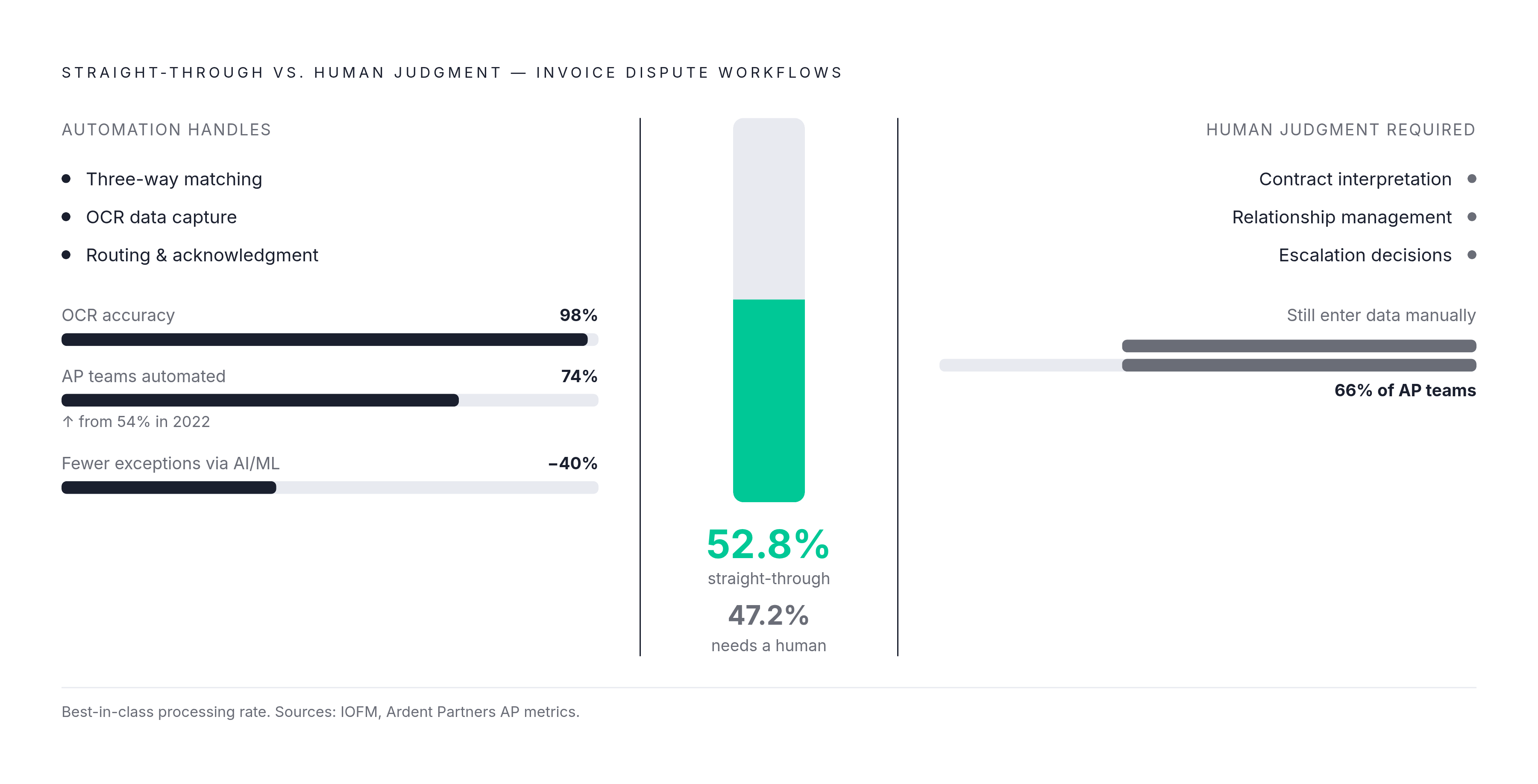
As of 2025, about 74% of AP teams are at least partially automated, up from 54% in 2022. That sounds encouraging until you learn that 66% of those teams still manually enter invoice data into their ERP systems. Manual data entry is where a large share of intake and matching errors are born.
Three-way matching automation is the highest-leverage tool in the stack. It checks the invoice against the PO and the goods receipt before anything reaches the customer. When it works correctly, it catches errors before they ever become disputes. Automated three-way matching has been shown to reduce fraud exposure by 74%.
OCR technology now achieves accuracy rates up to 98% for capturing invoice data. Organizations that have adopted AI and ML-based automation have seen invoice exceptions drop by around 40%. That's a significant reduction in the dispute volume your team has to manage.
Vendor self-service portals cut the time spent resolving disputes by around 40% and reduce vendor inquiries by as much as 65%. Those are two of the biggest drains on AR team capacity during the routing and resolution stages.
The overall picture: best-in-class AP departments now process roughly 52.8% of invoices without any manual handling at all, up from 47.2% the year before. When half your invoices flow through cleanly, the disputes that do surface are easier to manage because your team isn't buried in routine processing work.
Here's the honest framing on automation: it handles the mechanical parts well. Matching, data capture, routing, acknowledgment. What it doesn't handle is judgment. Contract interpretation, relationship management, the decision to escalate or negotiate, those still require a person who understands the context and the relationship at stake. Some AR tools, such as Invoice Butler, an accounts receivable automation platform that pairs AI-driven invoice follow-ups across email, phone, and SMS with human collections experts, are built on exactly that division of labor. The goal of automation isn't to remove humans from the process; it's to make sure humans are only involved when their judgment actually matters.