Escalation Strategies for Delinquent Accounts
Timing and sequencing matter more than intensity when recovering overdue accounts.
Most U.S. agencies recover only 20–30% of delinquent debt. The frustrating part? It's not random, and it's not bad luck. It's a process problem. Companies escalating too early, too late, too aggressively, or completely out of sequence. A deliberate, staged escalation path closes that gap. Not all of it, but a meaningful chunk. This piece walks through each stage in order: what to do, when to move, and what's actually at stake at every rung.
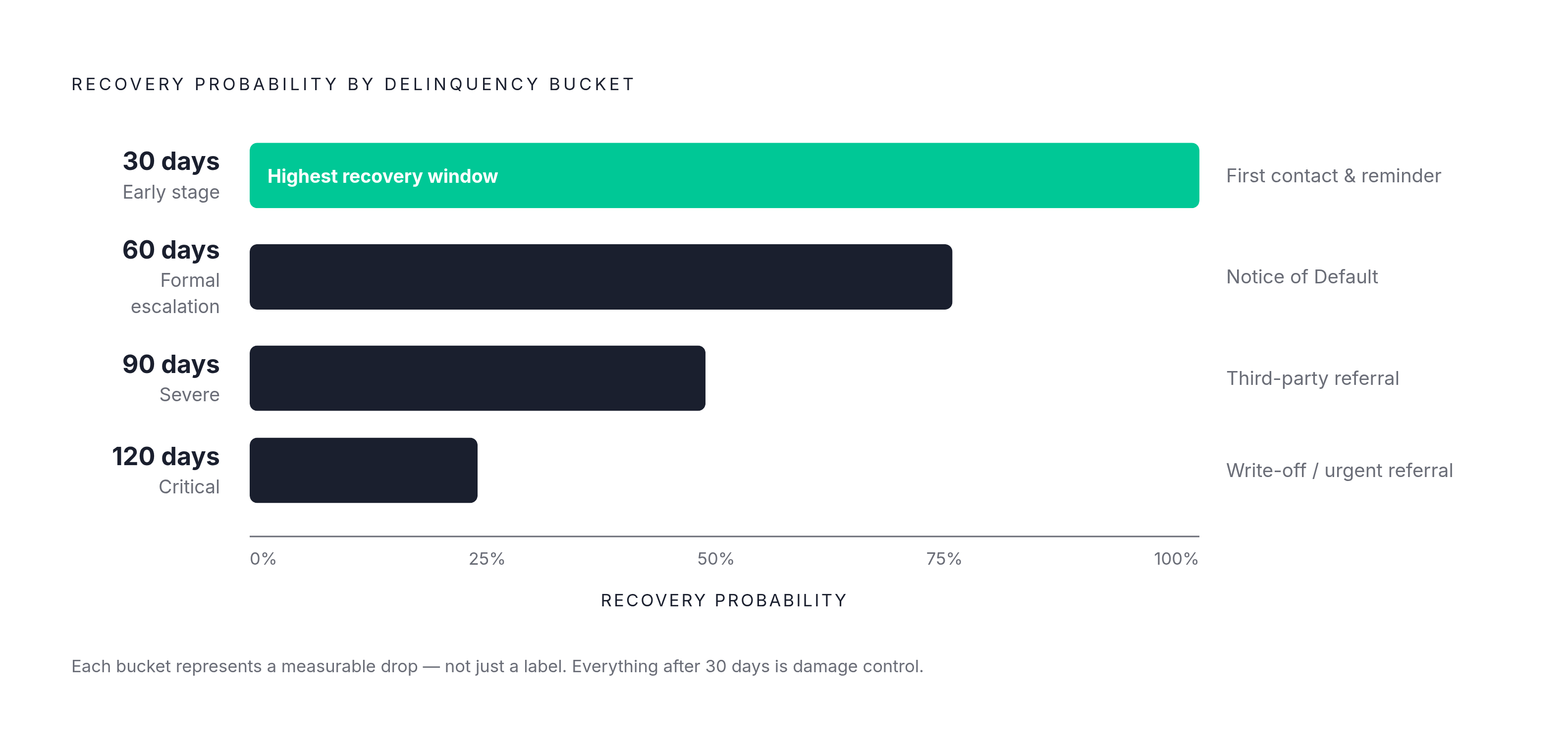
The industry runs on four buckets: 30 days past due (early), 60 days (formal), 90 days (severe), and 120 days (critical, often write-off territory). Every team knows these labels. Far fewer treat them as what they actually are: hard indicators of a measurable drop in recovery probability.
Here's the simple truth. The longer debt ages, the harder it is to collect. Think of it like trying to catch a train. The further it gets down the track, the more you're sprinting just to close the gap. Every collector learns this. Usually the hard way.
Here's where most teams go wrong: they categorize accounts reactively. They look up and realize an account has been sitting at 75 days because nobody flagged it at 30. By the time anyone's paying attention, they've already missed the highest-probability recovery window. Categorization needs to happen at intake, not in hindsight, and that's genuinely one of the easier fixes on this list.
There's also a legal clock running alongside the collections clock. The statute of limitations on debt varies by state. Typically three to six years, with some jurisdictions stretching as long as ten. Where an account sits on that clock determines which tools you can legally use. For now, the point is simple: time is not neutral. Every day of inaction is a decision, whether you made it consciously or not.
One more thing worth flagging before we go further. Not every account ages at the same strategic pace. An account that's 45 days past due with a strong payment history and a habit of catching up is a completely different animal from a 45-day account from a customer who's gone totally dark. The timeline sets the framework. Segmentation is what adjusts it to the actual account in front of you.
Segmenting delinquent accounts before escalating any of them
Before you escalate anything, sort the pile. Escalating every overdue account the same way wastes resources and, more importantly, damages relationships that didn't need to be damaged.
Segmentation comes down to a few key factors:
- Repayment likelihood. What does their payment history look like? Have they made partial payments? Are there behavioral signals that they're working toward resolution?
- Balance size and revenue impact. A $500 invoice and a $50,000 invoice don't get the same treatment. They just don't.
- Relationship value. In B2B especially, a customer who's late on one invoice is responsible for significant recurring revenue. That context matters.
- Age of debt. Older debt needs more aggressive routing, faster.
- Legal exposure. Some accounts carry more risk than others. Know before you escalate.
The concept of the "self-cure" account is worth understanding here. Some customers will pay without any push from you. They're slow, not delinquent. Predictive signals, like a partial payment or a consistent history of catching up around day 20, identify these accounts before you waste escalation resources on them. Teams that adopt predictive segmentation models consistently find themselves freeing up meaningful capacity, and those freed-up resources can go toward accounts that actually need the attention.
The practical setup: segment at intake into at least three tiers. Routine follow-up. Active escalation. Immediate senior attention. Assign different ladder tracks to each tier and commit to them.
One honest note for B2B teams, and I say this having watched it go sideways more than once: relationship value is a legitimate input to segmentation. But it has to be an explicit, documented criterion, not an informal override button that every account manager uses to let their favorite customer slide indefinitely. That's avoidance. It just happens to have a paper trail.
Stage 1: Early automated outreach in the first 30 days
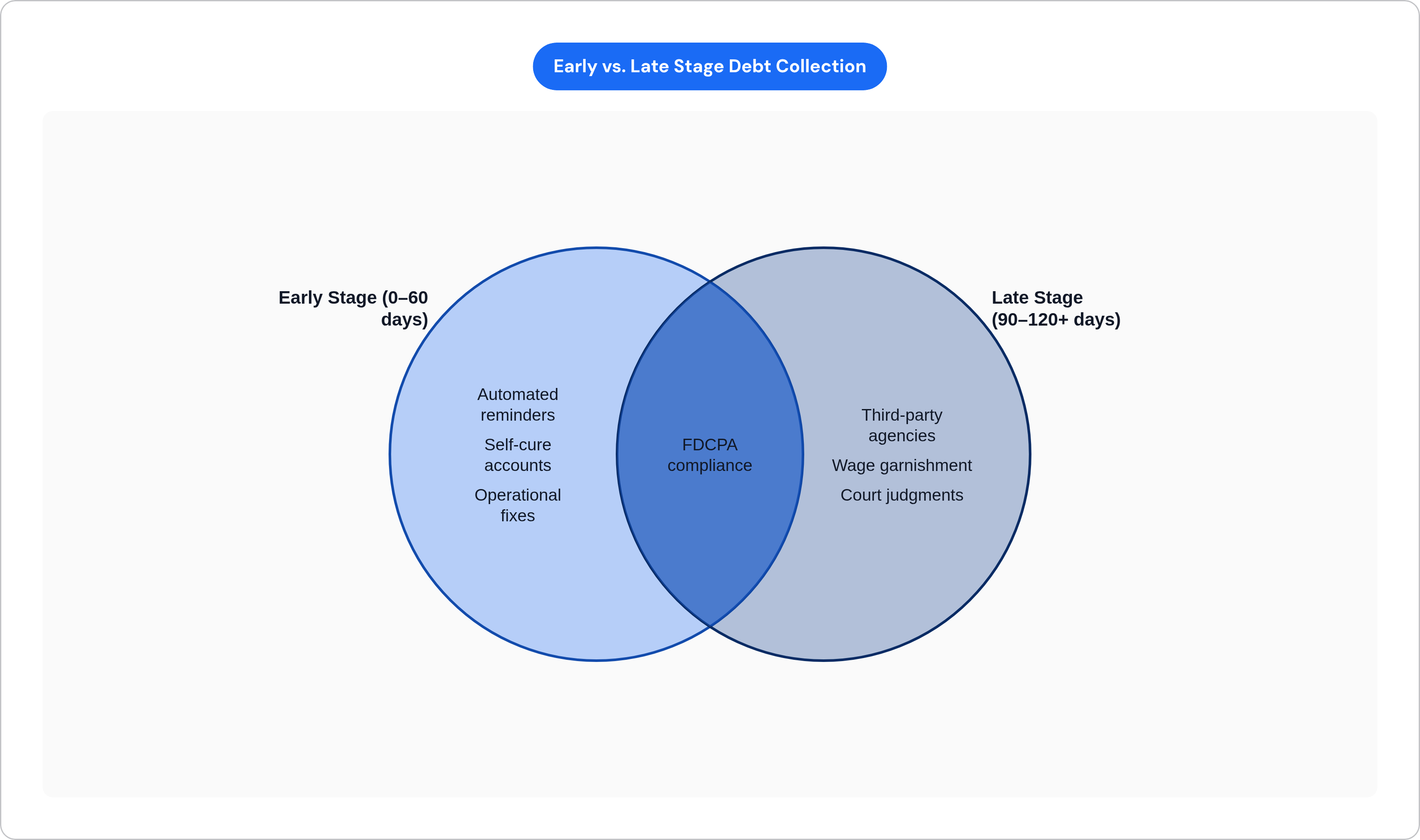
Days 1–30 are the highest-probability recovery window in the entire ladder. The goal is resolution before the account ever becomes a real collections problem. This stage isn't about pressure. It's about making it easy to pay.
A solid early-stage sequence looks like this:
- Day 1: Automated reminder via email and SMS with a direct payment link or portal instructions.
- Days 5–10: Live phone attempt. Document the outcome whether you reached someone or not.
- First contact made: Offer a one-time grace period or short extension. This converts a potential delinquency into an active engagement at the lowest possible cost.
People prefer clear, simple payment options over complicated terms or legal language. That's not a controversial observation. Lead with the link. Lead with the next step. The easier you make it to pay, the more people will.
In B2B contexts, early-stage delays are often not financial at all. Missing W-9s. Portal submission errors. Wrong PO numbers. Misrouted invoices. These are operational blockers, not refusals to pay, and resolving them at day five is dramatically cheaper than chasing the same invoice at day 85. Pick up the phone early and ask: "Is there anything on your end holding this up?" You'd be surprised how often the answer is yes, and how quickly the invoice moves once you've identified the actual bottleneck.
Stage 1 also builds your documentation record. Every contact attempt, every outcome, every communication. That log becomes the evidentiary foundation for every stage that follows. Build it like someone's going to scrutinize it later, because they will.
Stage 2: Shifting to formal escalation between 30 and 90 days
At day 30, you're not filing a lawsuit. But you're also not sending another friendly nudge. The communication shifts: more assertive, more personalized, more explicit about what happens next.
The recommended progression through this window:
- Personalized outreach that references the specific account, specific amount, and specific history.
- Language that escalates in urgency across two or three touches.
- A formal Notice of Default by day 60 if the account is still open.
That Notice of Default matters more than people give it credit for. It creates a documented record. It signals that this is no longer a billing oversight. And it starts building the paper trail that protects you later if things go sideways.
A few compliance points worth knowing cold at this stage:
The FDCPA validation notice. Within five days of initial collector contact, you're required to send a validation notice. If the debtor disputes the debt in writing within 30 days, collection activity must pause during that window. Plan your sequence around it, not around it.
Regulation F's 7-in-7 rule. No more than seven phone call attempts within seven consecutive days, and not within seven days of a completed conversation. That's a ceiling, not a quota. Some teams treat it like a daily target. It genuinely isn't.
Email and text. These channels aren't covered by the 7-in-7 rule, but every electronic message must include a clear, easy opt-out. And UDAAP exposure applies to the cumulative pattern of communications across the whole sequence, not just any single message in isolation.
Structuring payment alternatives before the account hardens
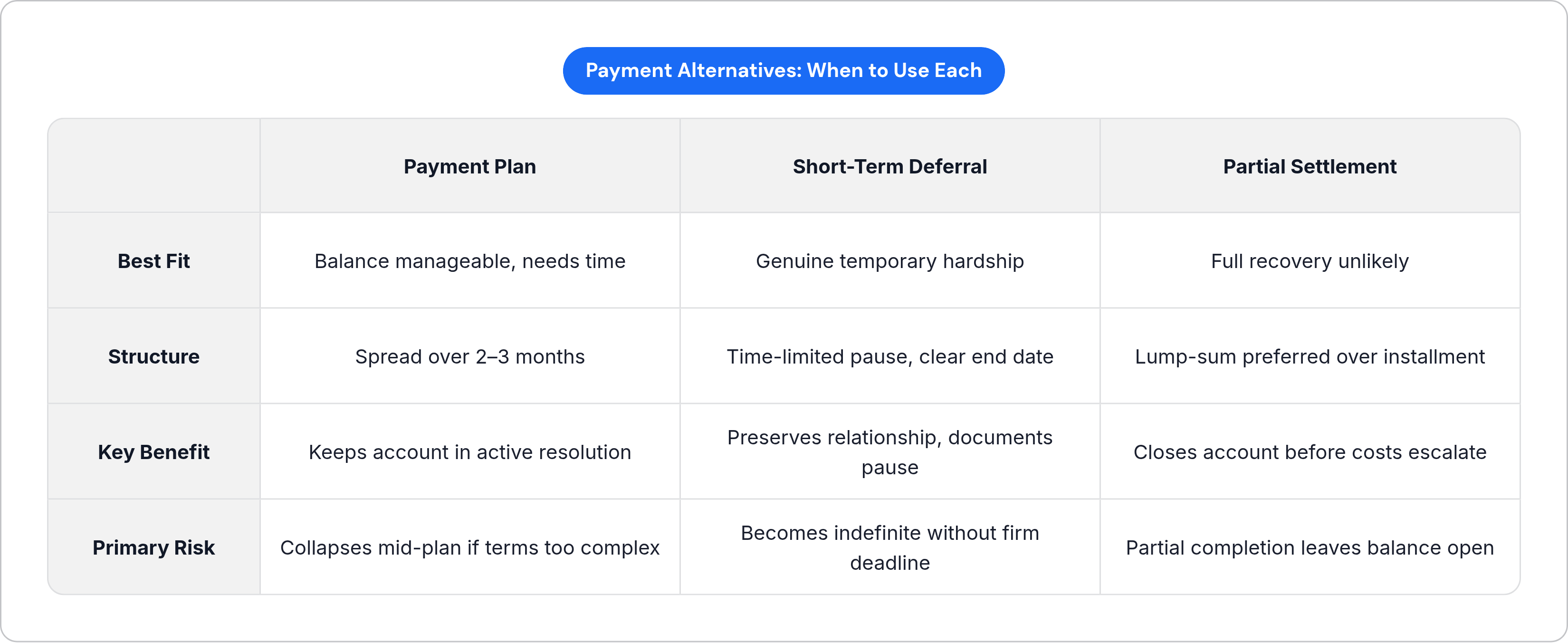
The window between day 30 and day 90 is where structured payment alternatives do the most work. After this point, options narrow and costs go up. If you're going to offer flexibility, this is when it actually pays off.
Three main tools:
- Payment plan. Spreads the balance over two to three months. Keeps the account in an active resolution state and keeps the conversation open.
- Short-term deferral. For genuinely temporary hardship. Not a free pass. A documented, time-limited pause with a clear end date.
- Partial settlement. When full recovery isn't realistic. Creditors typically accept somewhere in the range of 40–70 cents on the dollar, depending on debt age, account history, and circumstances. Lump-sum settlement is almost always preferred over installment settlement. Less monitoring, less risk of partial completion, cleaner close.
Here's something worth sitting with: debt settlement programs complete at 35–60%, while nonprofit debt management plans complete at around 68%. The gap is real. The simpler and shorter the commitment you're asking someone to make, the more likely they actually follow through. Don't design a payment plan so complicated it collapses on month two. You'll be back at square one, except now you're 60 days further down the aging schedule.
Offering alternatives is not softness. It's a cost-benefit calculation. A partial recovery at day 60 is almost always better than the contingency fees, legal costs, and relationship damage of the stages that follow.
When and how to refer an account to a third-party collections agency
Third-party referral is appropriate when internal escalation and structured alternatives have both failed. Typically that's at or after day 90. At day 120, it becomes urgent.
Before you hand off anything, get your documentation in order:
- Statement of account with full payment history.
- Copies of the original contract, invoice, or agreement.
- All prior correspondence documenting collection attempts.
Incomplete records slow the agency down and create legal exposure for you. Send everything you have.
Agencies typically work on contingency. No upfront cost, but they take a percentage of what they recover. Understand the fee structure before you sign anything, because the percentages vary more than you'd expect.
Vetting for FDCPA compliance is genuinely non-negotiable here. If the agency uses prohibited tactics, that liability can reflect on the original creditor. Not just the agency. You. Brief the agency on relationship sensitivities and any prior commitments, like payment plans that were offered but not completed. A cold handoff with no context produces worse outcomes and more collateral damage, and it happens constantly because nobody wants to spend an hour on the phone walking an agency through account history.
Keep a documented record of the referral and all agency activity. This chain of custody matters if the account moves to litigation.
Legal action as a last resort: what a judgment actually gets you
A court judgment unlocks enforcement tools that aren't available at any earlier stage: wage garnishment (up to 25% of disposable income), bank account levies, and property liens. These are real levers, but they're worth understanding before you assume a judgment is a guaranteed payday.
In practice, more than 70% of debt collection lawsuits in jurisdictions with available data end in default judgment. The defendant simply doesn't respond. More than 95% of debt claims resolve in favor of the plaintiff. Winning, mechanically speaking, is usually not the problem. Collecting on the judgment is.
The checklist before filing:
- Is the debt valid and fully documented?
- Is it within the statute of limitations for the applicable state (typically three to six years, up to ten in some states)?
- Does the expected recovery actually justify the legal and court costs?
One piece of pending legislation worth tracking: H.R. 2704, introduced in April 2025, would explicitly prohibit any collection attempt on time-barred debt. Not just litigation. Any attempt. If it passes, that significantly narrows the window for late-stage action on older accounts. Worth keeping an eye on.
Legal action is the end of the customer relationship. Be clear about that going in. Reserve it for accounts where the recovery value clearly exceeds costs and relationship preservation is already off the table. Even at this stage, settlement before judgment is common. And a well-documented escalation trail through all prior stages strengthens your negotiating position and can meaningfully shorten litigation timelines.
Compliance rules that govern the entire ladder, not just the later stages
The federal framework governing debt collection covers more ground than most teams realize:
- FDCPA and Regulation F: Collector conduct and communication frequency.
- TCPA: Consent for automated calls and text messages.
- UDAAP: Cumulative consumer experience across the entire sequence.
- FCRA: Credit reporting.
- SCRA: Active-duty military. Don't overlook this one. Violations here carry real consequences.
TCPA carries the highest financial-exposure risk in the ladder. Statutory damages run $500–$1,500 per message. Consent failures compound at portfolio scale. Class-action exposure is real and the plaintiffs' bar knows it.
UDAAP is the hardest to manage because it's harm-based, not rule-based. A communication sequence can satisfy every Regulation F timing requirement and still generate UDAAP liability if the overall pattern is deemed coercive. There's no checklist that fully protects you here. Judgment is required, and that's uncomfortable for teams that want a clean rulebook to follow.
On the current enforcement landscape: the CFPB reduced its debt collection enforcement actions to nine in 2025, down from 16 in 2024. Six of those nine came from the FTC, focused on phantom debt and student loan schemes. But annual CFPB complaints against creditors and collectors jumped sharply from 2024 to 2025, from over 159,000 to over 302,000. State AG enforcement is accelerating right alongside that. Reduced federal action does not mean reduced risk. The complaint volume tells you exactly the opposite story, and state regulators are paying attention.
State law adds another layer on top of all of this. Timing requirements for formal notices, statute of limitations, and permissible communication channels all vary by state. A nationally uniform escalation process needs state-level review before you run it.
The documentation habits and notice timing you build into Stage 1 and Stage 2 either support or undermine your legal defensibility at every stage that follows. There's no catching up on this stuff later.
How automation and AI fit into a deliberate escalation process
Automation handles the high-frequency, time-sensitive parts of early escalation well. Day 1 reminders. Follow-up sequencing. Portal submissions. Status tracking. This is work that currently burns finance team hours without adding any real strategic value, and handing it to a system is one of the more straightforward wins on the table.
AI-powered segmentation improves the Stage 1 versus Stage 2 routing decision. It identifies self-cure accounts and pushes active escalation resources toward accounts that actually need attention, which is the whole point.
The risk of pure automation is real, though. Systems that escalate on a fixed schedule without any behavioral signals skip the judgment calls that preserve relationships and prevent compliance violations. The 7-in-7 ceiling requires human-calibrated sequencing. UDAAP's pattern analysis does too. You can't automate your way out of a harm-based compliance framework, no matter how good your tech stack is.
Where AI adds the most value beyond basic reminders:
- Drafting personalized communications that adjust to account history and tone.
- Navigating supplier portals like Coupa and Ariba that require something close to human-like interaction.
- Flagging accounts that need internal escalation before they age further into a harder recovery window.
The combination that actually works: automated persistence for routine follow-up, human judgment for escalation decisions, and a full audit trail connecting both. It's not a flashy system. But it's one that holds up when you need it to, and in this work, that's the part that matters.