Hybrid AI-plus-human AR automation services: how leading providers structure human-in-the-loop support
Strategic accounts and disputed invoices still need human judgment that AI cannot safely replace.
Full automation of accounts receivable has not arrived, and it is not because the AI underneath it falls short. The nature of AR work makes supervised, hybrid operation the sensible default, not a stopgap on the way to something more hands-off. The Hackett Group's U.S. Working Capital Survey found trillions of dollars trapped in excess working capital across companies, with AR holding the largest share of that total. With that much cash sitting in limbo, nobody can afford to get the split between machine and human wrong. A Genpact and HFS Research survey found that almost 80% of organizations still run their agentic AI systems in supervised mode, with a human signing off on most actions before they go final, even though the same executives broadly expect agentic AI to reshape how the work gets done. The technology has clearly outpaced how boldly companies are willing to deploy it, and the gap is not timidity; it is design. Genpact's analysis found that only a small slice of organizations are actively building agentic orchestration, the coordination layer that lets AI agents work across AR processes without tripping over each other, while most companies are still running isolated pockets of point automation. The reason that coordination layer is hard to build has nothing to do with ambition and everything to do with what AR actually is. Value in AR concentrates in the messy stuff: remittances that don't match cleanly, line items under dispute, payers who behave unpredictably from one invoice to the next. Rules-based systems, and even AI-powered ones, handle that unevenly, so the tail of complicated cases keeps routing back to people. That single fact sets up everything else in this piece: the question is not whether AI can do more but how the division of labor between agent and human should be drawn, and why.
The deterministic core of AR that AI reliably owns
AI's strongest ground in accounts receivable is work that repeats itself, runs on data, moves on a clock, and follows rules that don't change much from one case to the next. Inside that zone, performance is strong enough that minimal human involvement is needed to keep things running. That zone is bigger than most people assume. It covers account prioritization, payment reminders, collections outreach, cash application matching, remittance extraction, payment posting, dispute routing, SLA tracking, and exception surfacing. Genpact's hybrid AR workforce analysis lists the same tasks: the AI layer prioritizes accounts, triggers outreach, routes disputes, tracks SLAs, extracts remittances, matches payments, posts cash, and surfaces exceptions. That's a long list of jobs the agent owns outright, which leaves humans with something narrower and more specific rather than a vague leftover pile.
Real products already run this way. Paraglide's AI Billing Support Agent reads incoming customer emails, checks live invoice data and account history, reads the full back-and-forth of a conversation thread, and writes a context-aware reply, handling the entire correspondence loop on its own for the cases that are clean. Truist Financial's AI-enabled integrated receivables platform, launched in February 2026, scans both paper checks and electronic payment rails, applies business rules to auto-match payments, and includes a smart remittance capture feature that pulls remittance data out of emails and incoming payments. A large bank treating deterministic matching as fully automatable is a sign of how settled this part of the work has become. None of this is flashy. It's the plumbing that works without a human checking every joint, and that is what frees people up for the part of AR that actually needs a brain in the loop.
The ambiguous residual that automation cannot resolve
The work that AI can't reliably close out is work where the correct answer depends on context, on relationship history, or on judgment calls that the system has no reliable signal for. A disputed line item is a good example: resolving it means understanding what actually got delivered, not just what the invoice says was delivered, and no amount of pattern-matching against past invoices tells a system that. A customer who wants to renegotiate a payment plan, or who breaks one already in place, is asking for something relationship-sensitive that sets precedent for every invoice that follows, and that is not a decision a model should be making unsupervised. When a debtor's identity or an invoice amount conflicts across two systems, acting on the mismatch without a person checking it first creates downstream risk that is hard to unwind later. Large accounts that cross a material value threshold need a different kind of judgment than small recurring ones, because the timing, tone, and channel of escalation for a major client is not the same calculation as for a routine late payer. Anything brushing up against legal action or insolvency carries the risk of irreversible relationship damage or regulatory exposure if it's handled by rule rather than by a person weighing the specific situation. And strategic accounts, where keeping the relationship intact matters more than collecting a few days faster, change the calculation entirely, especially when something like a renewal date is approaching.
Genpact's own breakdown puts the human side of the ledger this way: strategic customer relationships, complex disputes, sensitive escalations, credit and collections policy, approvals, root-cause analysis, and process improvement all sit with people, because these are the categories where context and judgment decide the outcome rather than a rule. Europe has turned this expectation into law. GDPR requires meaningful human review for automated decisions carrying legal weight, so a decision made entirely by a machine with legal effect is off-limits unless a narrow exception applies, and even then, the person affected keeps the right to demand a human look at it. It is a structural mandate that backs up, with the force of regulation, exactly the dividing line the rest of this piece is describing. The residual is a predictable, well-defined category, and that predictability is what makes it possible to design human oversight on purpose instead of bolting it on after something goes wrong.
How leading services translate that line into escalation architecture
Knowing where the line falls between AI and human judgment is only half the problem. The harder engineering question is how a system decides, in real time, that it has hit that line, and what it hands over to the person once it does. Three mechanisms appear repeatedly across the services built to manage this handoff well.
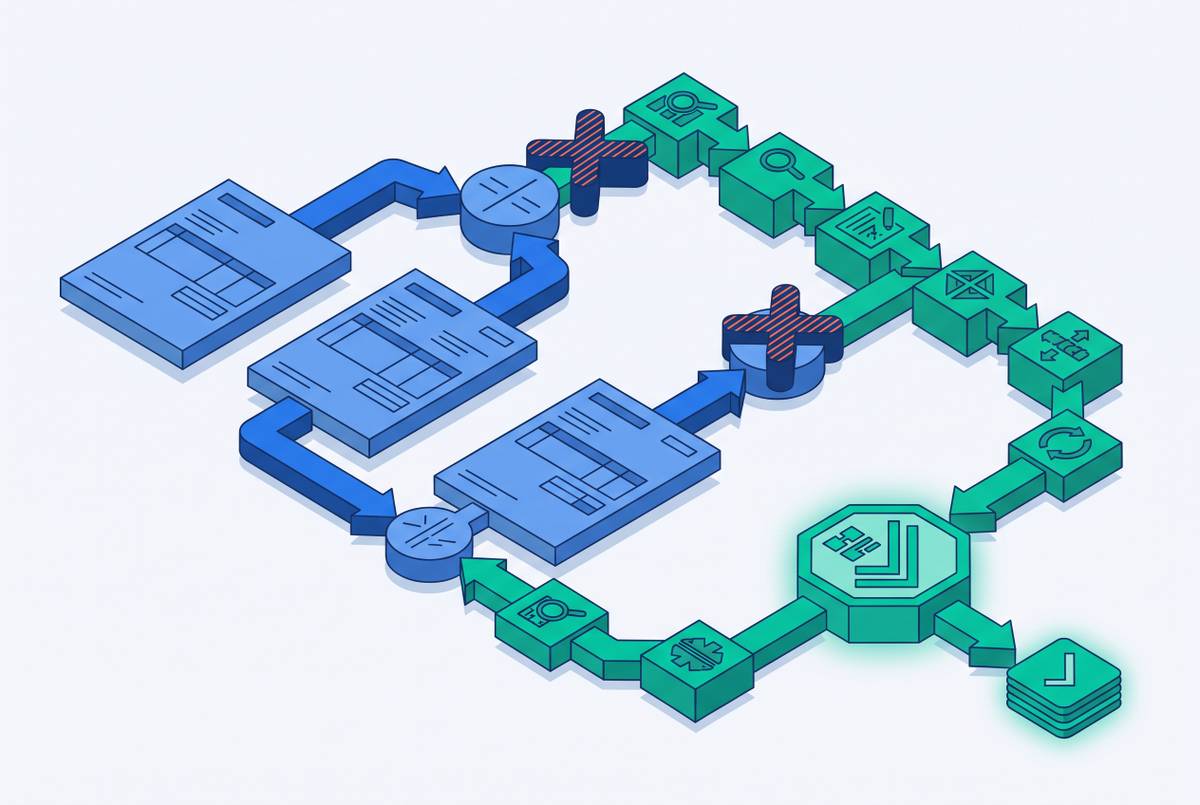
The first is confidence-threshold escalation for cash application. Systems parse unstructured remittance data and match it to invoices using several signals at once, and when the resulting match falls below a set confidence threshold, the item gets routed to a human reviewer instead of being pushed through automatically. The correction that reviewer makes doesn't just fix that one case: it feeds back into the model, so every escalation becomes a small training event rather than a dead-end exception. Even the best AI cash-matching tools available in 2026 still hand off a meaningful share of payments to people, confirming the residual described above is something vendors manage deliberately, as a permanent feature of the system, rather than something they are quietly eliminating.
The second mechanism is trigger-based escalation for collections, and it works by layering signals rather than relying on one tripwire. Days past due, invoice size, account tier, dispute history, and how close the account is to renewal all factor in together, because no single threshold captures the judgment a collections decision actually requires. A large enterprise account with a prior dispute on file deserves an account manager's attention well before the standard past-due clock would normally trigger one, while a small account with years of clean payment history can keep moving through the automated sequence without anyone stepping in. Automation runs freely on the deterministic, low-risk work, and a human gets pulled in specifically when identity or amount data conflicts, when a dispute gets raised, when a payment plan is requested or broken, when a material value threshold gets crossed, or when legal context enters the picture.
The third mechanism is structured handoff with full context, and whether the first two mechanisms actually work depends on it. When a case escalates, the reviewer needs the original input data, the system's confidence scores, related historical records, and a record of whatever automated processing already happened, because without all of that, the reviewer ends up reconstructing the situation from scratch or making a call on incomplete information. Paraglide's Billing Support Agent builds this in directly: complex cases pass to the AR team with the full conversation history attached, so the handoff lands as something complete rather than as a cold transfer that starts the reviewer at zero.
Genpact's Agentic Operations model: architecture at enterprise scale
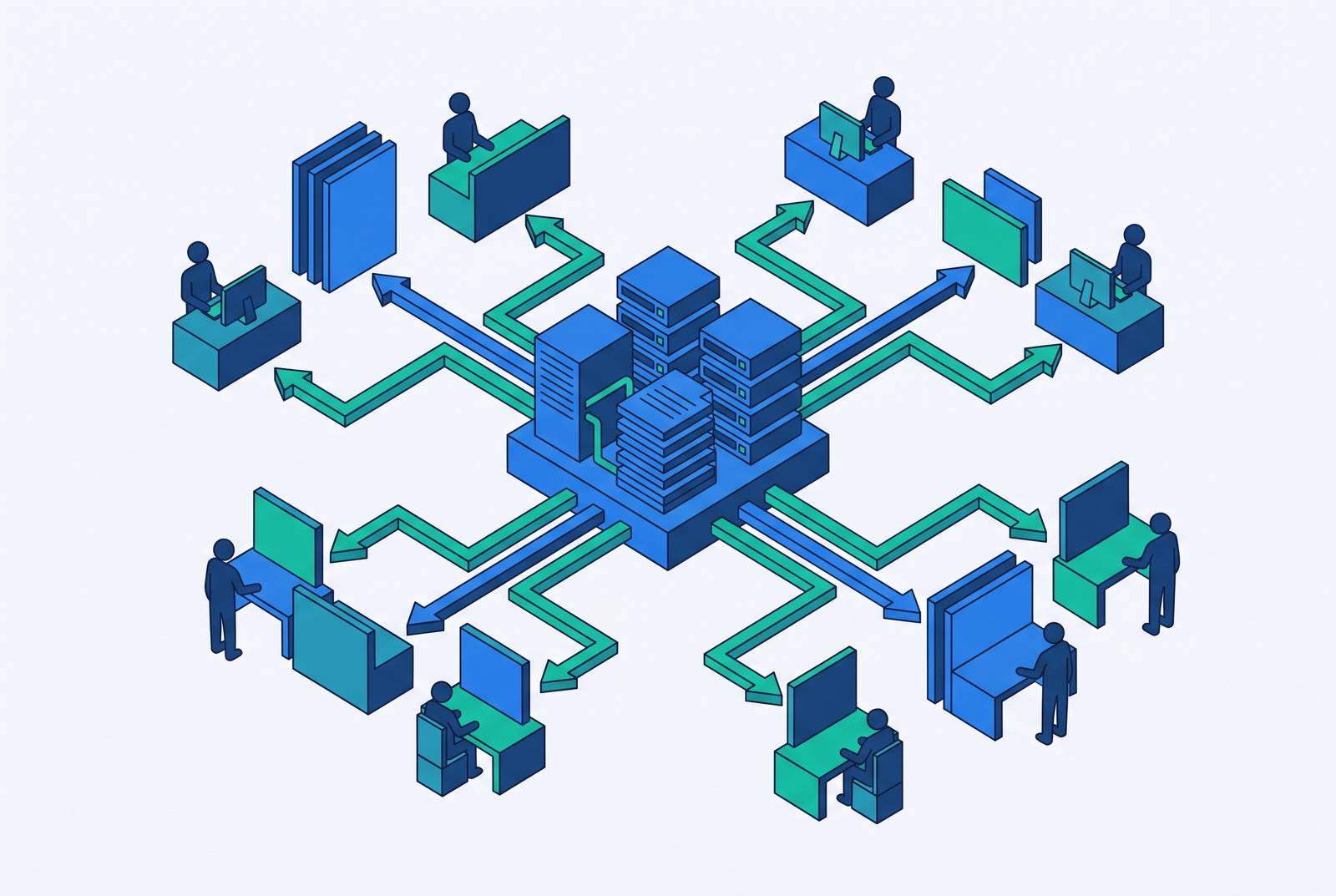
Genpact's deployment is the clearest evidence available that this hybrid design produces real performance gains at scale, and it also shows that those gains come from redesigning how the operation runs, not from simply installing better software. The numbers Genpact has reported are substantial. Straight-through processing increased substantially under the model, according to Genpact's own account of its results. Invoice accuracy climbed from roughly seven-tenths to more than nineteen-twentieths. First-pass three-way match rose from roughly four-fifths to more than nine-tenths. First-touch resolution of supplier inquiries went from zero to more than nineteen-twentieths. Those are not marginal gains from a tool upgrade; they are the kind of jump that only appears when the underlying workflow has been rebuilt around a clear division between what agents execute and what people govern.
Part of what makes the case structurally interesting is the Genpact-Esker partnership, which pairs Genpact's operations support with Esker's AI and machine learning to deliver managed services jointly, demonstrating that leading hybrid services often combine a technology platform with a human operations layer rather than treating them as alternatives. Genpact states the governing principle behind all of this without much hedging: "there's no artificial intelligence without process intelligence," and fragmented systems with siloed data will stall AR automation unless processes, KPIs, executive buy-in, and change management all move together. The implication for anyone building or buying one of these systems is straightforward. Software by itself doesn't transform AR. The redesign of who does what, agents executing and humans governing, has to be planned on purpose rather than left to emerge as a side effect of installing new tools.
How smaller, AI-native services draw a different line
Large managed-services operations like Genpact's are not the only ones drawing this line, and smaller, AI-native platforms arrive at nearly the same boundary through a different route. Rather than building an operations layer alongside the technology to catch what the AI can't handle, AI-native platforms build the escalation logic directly into the agent itself. Kognitos illustrates this well: it positions itself right at the exception tail, executing AR logic written in plain English and reasoning through cash-application exceptions, short payments, messy remittances, and deductions, the exact cases that rigid rule-based automation shrugs off to a human, while producing a deterministic audit trail of how it got there. Because the agent has already worked through the context before anything reaches a person, the human layer isn't stuck piecing together what happened. It can just make the call.
Viewpoint Analysis's guide draws a useful structural line between two kinds of platforms. In an AI-native platform, the AI agent is effectively the product: it reads the email, figures out what the response needs to say, drafts the next step, and escalates only genuine exceptions. In an AI-added platform, machine learning sits on top of a workflow, integration, and data model that were built for conventional AR automation first. Both architectures end up handing off to a human eventually, but the AI-native approach tends to absorb a wider range of inputs before it reaches that point.
One underrated benefit of the AI-native approach is what it does for institutional memory. Knowledge that used to walk out the door whenever an AR staffer left, which large accounts always pay late no matter the terms, which customer contact answers email versus needs a phone call, which recurring dispute is just a known quirk of that account, now lives inside the system instead of in someone's head, which makes the human reviewers sharper whenever they do step in. These platforms also tend to absorb the unglamorous operational grind directly into the AI layer's job description: chasing down a missing W-9, navigating a supplier portal like Coupa or Ariba, closing a communication gap, rather than defaulting that work to a human simply because it's tedious. That's exactly where a lot of the real friction in enterprise AR tends to live, buried in administrative busywork rather than in genuinely hard judgment calls.
The automation bias problem: why "human-in-the-loop" can become a compliance checkbox
Every design described so far depends on one assumption: that the human in the loop is actually paying attention. A reviewer who rubber-stamps AI-generated matches or escalation decisions without real scrutiny is providing oversight in name only, the quiet failure mode underneath "human-in-the-loop" as a design principle. The architecture can be built exactly right, with confidence thresholds, layered triggers, and full-context handoffs all working as intended, and it can still fail if the person at the end of that chain treats their job as clicking "approve" because the system usually gets it right. Automation bias is a well-documented human tendency: the more reliable a system appears over time, the less scrutiny people apply to its individual outputs, right up until the one case where the system was wrong and nobody caught it. In AR, that failure occurs not as a dramatic error. A disputed line item gets approved for collections without anyone actually checking the dispute, or an automated decision gets signed off by someone who never read past the system's recommendation. The entire case for hybrid architecture, laid out across every section above, rests on the idea that humans bring judgment the machine doesn't have. A reviewer who stops exercising that judgment turns the most important safeguard in the system into paperwork. Genuine oversight means a reviewer who is equipped with full context, genuinely empowered to override the system, and actually expected to use that power when the case calls for it, not someone whose name sits next to a decision they never really made.