How Finance Teams Lose Time to Manual AR Tasks
Most finance teams spend their week reconstructing invoices instead of collecting them.
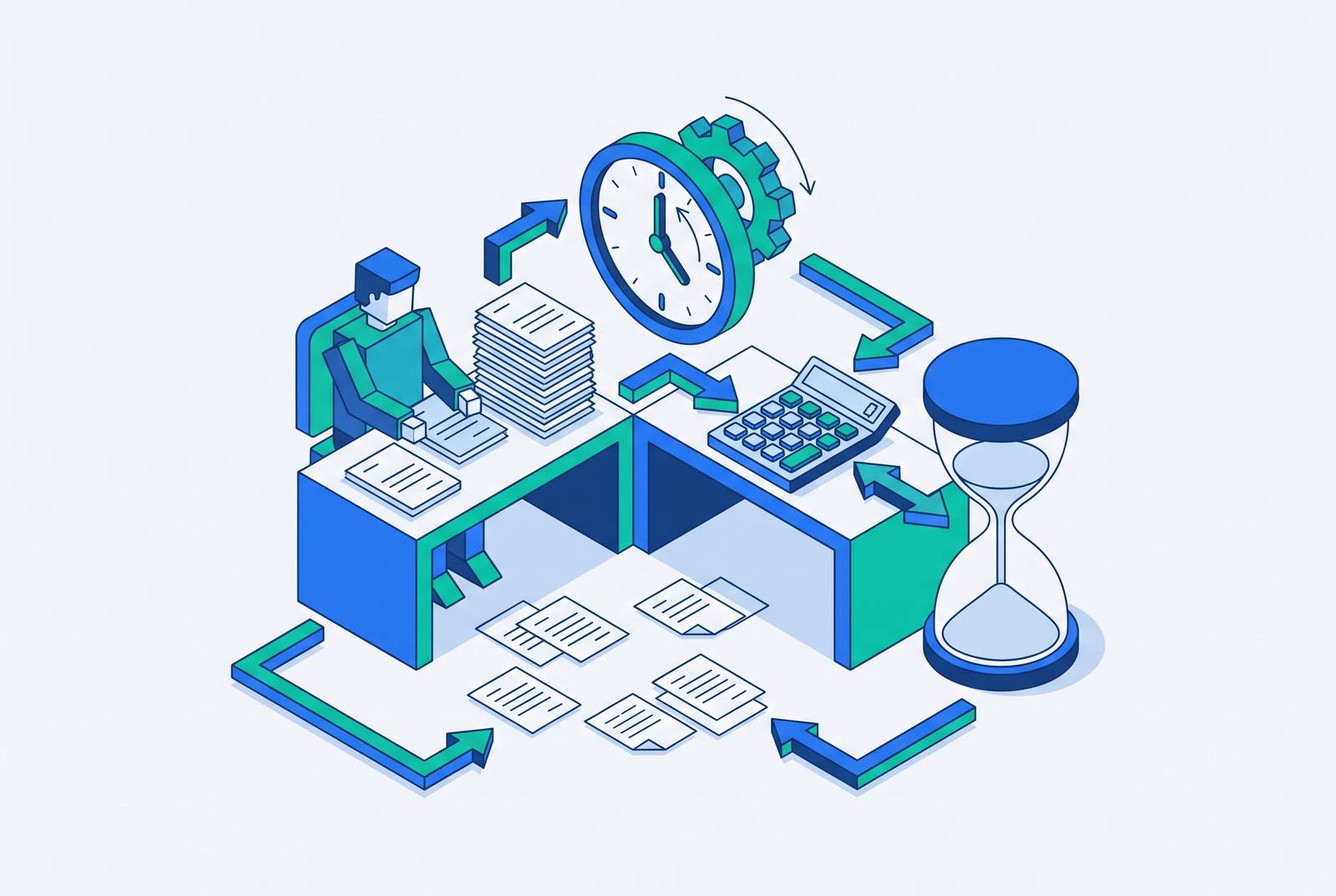
Most finance teams have not automated accounts receivable, not fully anyway. A chunk have wired up one or two tasks, an email reminder here, an approval step there, while a smaller but still meaningful group runs the whole thing by hand: keying invoices, chasing payments, matching cash, start to finish, with a human hand on every step.
Mid-market companies lag hardest. Even finance leaders who follow automation closely and genuinely want the full setup rarely get all the way there, because every handoff still needs a person to nudge it forward. The software to automate AR end to end exists and has for a while, but what's missing is follow-through, the integration work, the buy-in across departments, the plain inertia of a process nobody has time to redesign because everyone's too busy running it. So the time losses in this piece aren't outliers happening at some unlucky company. They're the default, and this is what a normal week looks like for most AR teams, where pretending otherwise is the first mistake.
How a single invoice touches more people and systems than it should
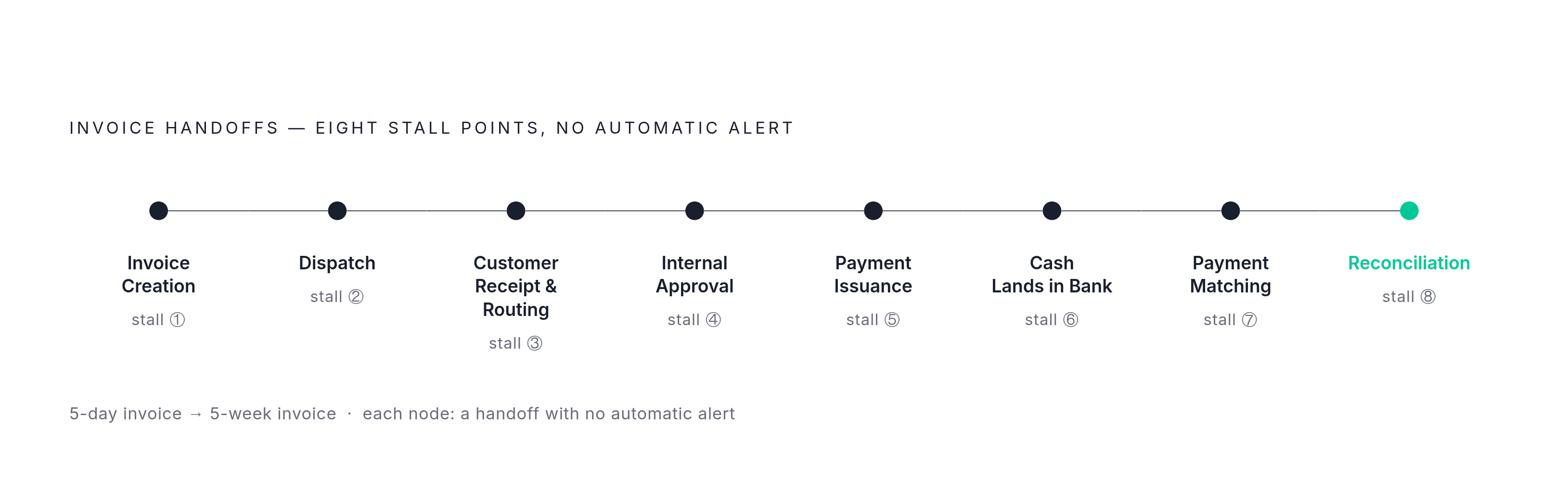
Follow one invoice from birth to death. Someone creates it, and it goes out, often later than planned, before the customer's system receives it and routes it into their own approval chain. Somebody there signs off, payment gets issued, cash lands in a bank account, someone matches it to the right invoice, and someone else reconciles the books.
That's seven or eight handoffs at minimum, and every single one is a place where things can stall. A manual process gives limited visibility into which handoff is the one holding things up, and nobody gets an alert, and no dashboard turns red. Someone just eventually notices the invoice is old and starts asking around, like a detective solving a crime that was entirely preventable.
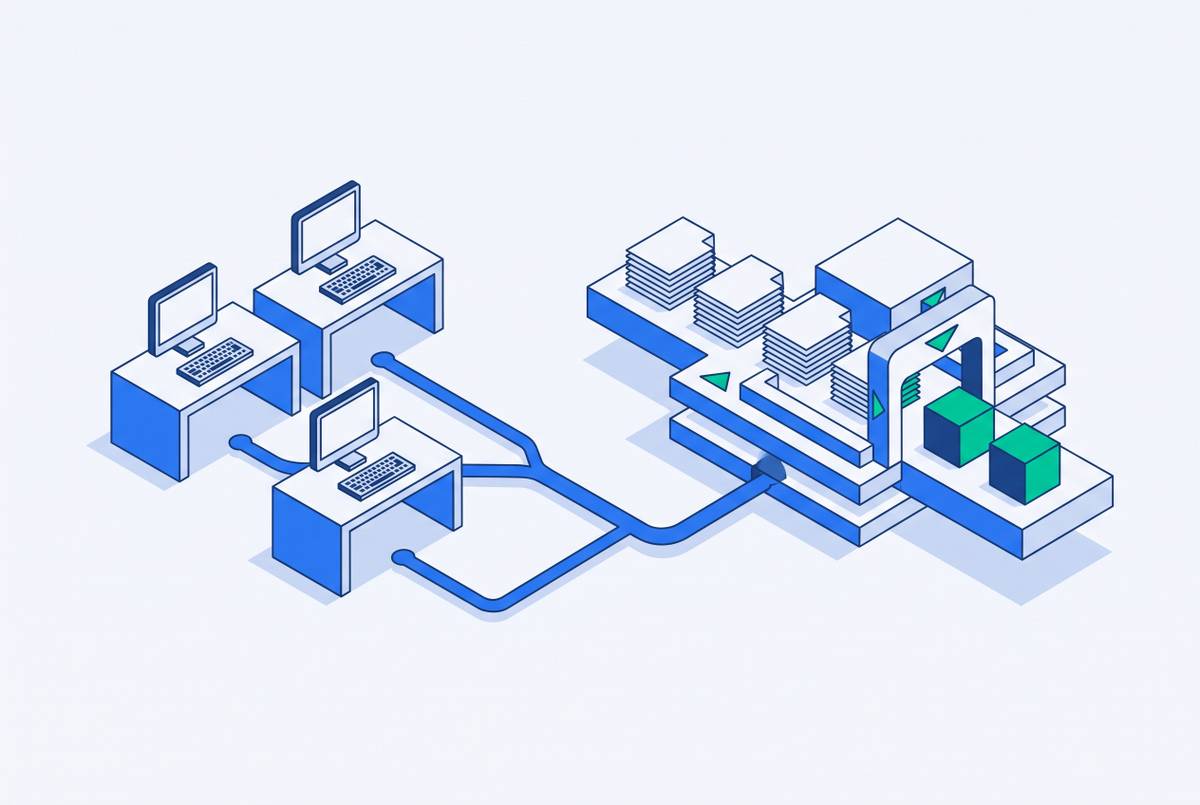
Run more than one ERP system, which most finance teams do, and the picture gets messier still. There's no single screen showing where an invoice sits in its life cycle. Getting that answer means opening three systems, cross-referencing an inbox, and building the timeline by hand, essentially doing archaeology on a transaction that happened two weeks ago.
That's the real cost: staff spend their time reconstructing what already happened instead of acting on what's happening now. No single step in the chain is dramatically slow on its own, maybe a day late here, two days there, but it's the stacking of small delays across every handoff that turns a five-day invoice into a five-week one.
Where the hours go: the specific manual tasks eating finance capacity
Break the work down and it stops looking like one job. It starts looking like six or seven separate jobs duct-taped together, held up by the same person who's also trying to close the month.
Data entry sits at the bottom of the pile, holding everything else up, as someone keys invoice details into the ERP line by line, and every downstream task depends on that entry being right the first time.
Then there's the chasing. Invoices stall in approval, and someone has to go find out why, usually over Slack or email, usually with no automatic escalation if the approver's on vacation or just ignoring it, and collections follow-up runs the same script: templated emails and calls that still need a human to hit send and track who responded.
Supplier portals deserve their own complaint, honestly, since anyone who's logged into a customer's procurement system, Coupa or Ariba or one of the dozen similar platforms, just to submit an invoice or check a status, knows the task resists batching and eats far more time than the invoice count justifies. Each portal has its own login, its own quirks, its own way of burying the "dispute" button three menus deep, and multiplying that by however many customers run their own portal piles the hours up disproportionate to how few invoices are actually involved.
Missing documents cause a similar drag: a W-9 here, a purchase order number there, remittance details that never arrived. Each gap means a new email thread, a new person to track down, a new thing to remember next week.
Cash application and reconciliation round it out. Matching payments to invoices gets complicated fast when a customer pays two invoices at once, pays part of one, or sends money with zero explanation of what it's for, and reconciliation at low volume is annoying, while at high volume, it's a spreadsheet fire drill every single month.
Ask finance professionals what they'd cut first, and the answers cluster around the same three things: manual data entry, chasing approvals, printing and mailing paper checks. These aren't obscure complaints, and they're the most common ones on record, which tells you something about how little has actually changed in the last decade.
The compounding effect: how errors generated by manual work create a second wave of time loss
Manual work makes mistakes at a noticeably higher clip than automated work does. Recent reporting from the Journal of Accountancy puts the gap between manual and automated error rates at roughly an order of magnitude, which is not a rounding difference, since it's the difference between catching a typo once a quarter and catching one every week.
Billing errors don't just cost time to fix. They're also one of the leading reasons payments arrive late in the first place, so a single mistake delays cash twice: once while someone corrects it, and again while the customer waits for the corrected invoice before paying.
Misapplied payments follow the same pattern, and none of the fix is quick, because someone has to notice the mismatch, investigate it, correct it in the system, and often call the customer to sort out what happened. Run enough transactions through a manual process and even a small error rate turns into a steady stream of exceptions landing on someone's desk every month, like a leaky faucet that never quite gets fixed because everyone's too busy mopping.
Unapplied cash piles up in suspense accounts when nobody has time to match it properly, and that drags out month-end close and throws off the numbers until someone circles back to clean it up, usually right before a deadline. Every hour spent fixing these errors is an hour that was supposed to go toward collections follow-up, which was already understaffed before the errors showed up to eat the calendar.
What slow collections actually cost in locked working capital
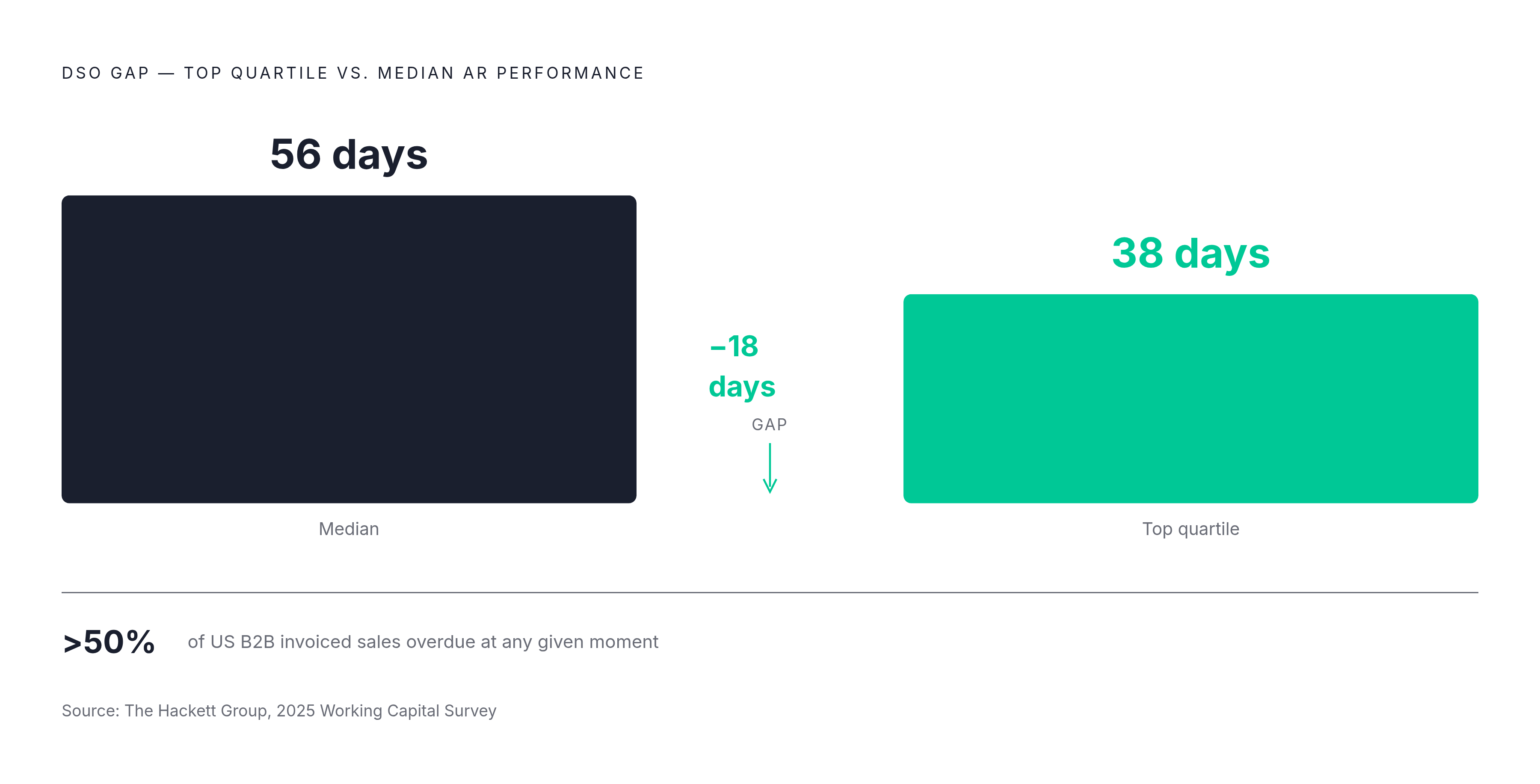
Manual collections carry a cash cost as well as a time cost, measured in weeks of days sales outstanding (DSO) that separate the top performers from everyone else. The Hackett Group's 2025 Working Capital Survey names accounts receivable as the single largest source of excess working capital tied up across companies, and the total runs into the billions.
The gap between top-quartile AR teams and median ones isn't a rounding error. Leading companies get cash in hand roughly 18 days sooner than competitors doing the same volume of business, which means weeks of cash sitting idle instead of funding payroll, inventory, or anything else it could be doing.
Late payment is closer to routine than rare: in the US, more than half of all B2B invoiced sales are overdue at any given moment. Every week an invoice sits in an approval queue or a collections backlog is a week closer to missing an early payment discount window, and every month it drags past due is another chance to rack up penalty costs that quietly stack over a year.
DSO gets treated like a vanity metric on a finance dashboard, when it's really a direct readout of how many hours got lost to manual process, translated into dollars of cash the business can't touch yet. Treating it as a soft number is the second mistake, right after assuming the software is the missing piece.
The talent cost: what repetitive AR work does to the people doing it
Finance professionals get hired to read numbers, flag risk, and help steer decisions. Nobody takes an accounting degree to send the third follow-up email to a customer who hasn't opened the first two, and most say they spend too much of their time on repetitive tasks, and the ones with real options don't stick around long in a role where process work eats the entire week.
Burnout carries a real price tag, not just an abstract HR concern to nod along with in a town hall. Research from Martinez et al. (2025), published in the American Journal of Preventive Medicine, puts the annual cost of burnout in the thousands of dollars per employee, higher still for managers. Gallup's research fills in the other half: burned-out employees are far more likely to be actively job hunting, which means AR teams buried in repetitive work aren't just tired; they're actively a flight risk.
That risk lands at a bad time, since CFOs are already dealing with a real shortage of finance and accounting talent, according to CFO.com, so losing an AR specialist doesn't just create an opening, it creates an opening that's genuinely hard to fill. And every person who walks out the door takes institutional knowledge with them, the kind that never made it into a manual: which customer always shorts payment by exactly $40, which portal glitches every Friday like clockwork.
The revenue that leaks quietly through the gaps
Manual invoice errors cost US businesses enormously every year through duplicate payments, missed discounts, and penalty fees, and the cumulative total across thousands of companies runs to a staggering sum. That's the sum of thousands of small mistakes happening everywhere, all the time, none of them big enough on their own to set off an alarm.
Revenue leakage works the same way: short pays, credits nobody applied, discount windows that closed while an invoice sat untouched. Measured as a share of gross payment volume, the leak looks small, but multiply it against a company processing real revenue, and the dollar figure stops looking small at all.
Bad debt tells a similar story. A meaningful share of credit-based B2B sales in the US never gets collected, and while some of that is simply the cost of doing business, a chunk of it is invoices that aged past the point of recovery because nobody followed up while there was still time to do it.
None of this shows up as a line item, and it doesn't trigger an alarm, since it accumulates quietly across thousands of small transactions until a reconciliation, months later, finally drags it into the light. The real cost of manual AR runs deeper than labor: it's the cash that got earned and then vanished before anyone bothered, or had time, to collect it.
Why understanding the full map is the prerequisite to fixing any of it
Most teams look at AR inefficiency and see one problem: collections are slow. So they reach for one fix, usually a collections email sequence, and call it solved, when the drains actually sit at every node, not just the visible one.
Late dispatch, portal friction, missing documents, cash application, reconciliation, error fixing: each eats time on its own, independent of the others. Fix collections alone and the other six keep leaking, which is exactly why so many automation projects fall short. They fix one node while the rest of the manual grind keeps humming along right next to it, untouched.
The upside of a compounding problem is that fixes compound too. Cut errors at data entry and remediation time drops downstream automatically, no extra effort required, and get invoices out faster and DSO improves without touching collections behavior at all. Real progress means figuring out which nodes are actually bleeding the most time for a specific team, then working through them in order instead of chasing whichever one is loudest in this week's meeting.
The operational stuff, missing documents, clunky portals, gaps in communication, deserves steady, informed attention, not dismissal as a side annoyance to tolerate while automation hums in the background somewhere else. It's often the actual reason invoices stall in the first place. Teams that have mapped where their hours go, node by node, are the ones who can make a real case for investment, pick the right fix first, and prove afterward, with numbers instead of vibes, that it worked; an AI-powered collections tool that automates invoice follow-ups across email, phone, and SMS and pairs those automations with human collections experts for escalations is one example of what closing multiple nodes simultaneously looks like in practice.