Accounts Payable vs Receivable Responsibilities in a Lean Finance Team
Lean teams must split AP and AR despite resource constraints or risk cash blindness and fraud.
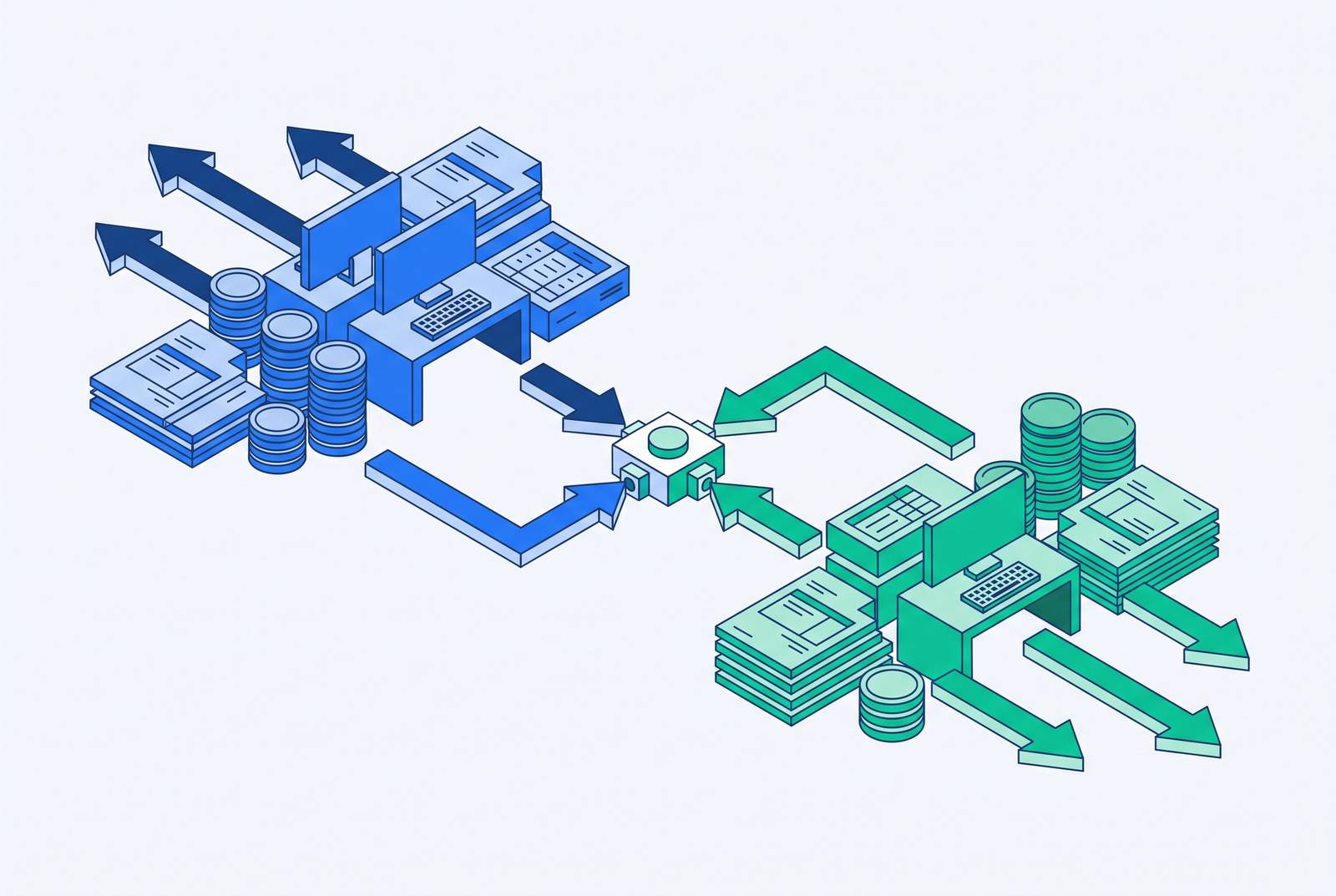
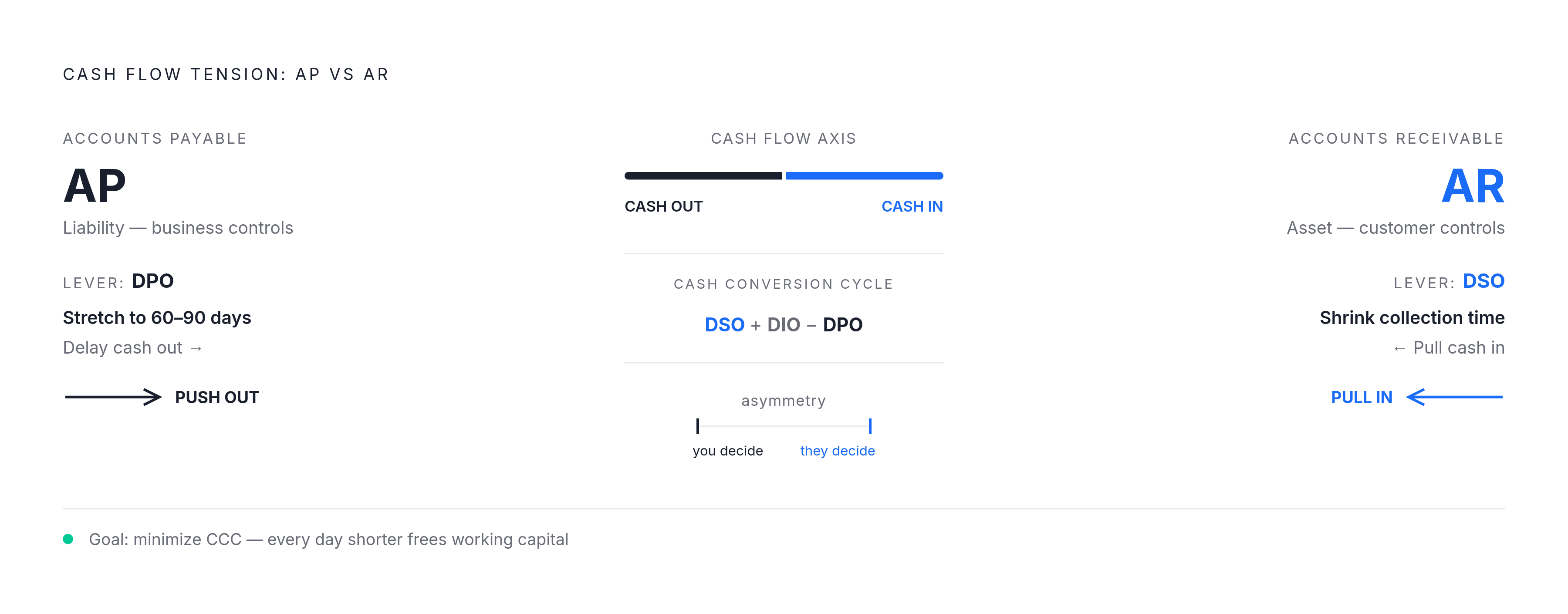
AP and AR sit on opposite ends of the same cash-flow logic. AP buys time on money going out. AR fights for speed on money coming in. When a finance team is lean, with two or three people covering what should be a department, understanding that opposite pull tells you exactly where to point people first.
AP is a liability. It's what the business owes vendors for stuff already delivered, and it sits on the balance sheet waiting to be paid. AR is an asset. It's what customers owe the business, and until it's collected, it's just a number on paper. AP is inside the company's control. The business decides when to pay. AR depends on someone else deciding when to pay, and that someone else answers to nobody on your org chart.
That asymmetry has teeth. Pushing AP terms out to 60 or 90 days improves working capital right away. Pushing AR the wrong direction gets cash stuck waiting on customers who have zero urgency to fix your cash flow problem for you. Two dials, one machine: shrinking DSO (days sales outstanding) frees up cash faster, and stretching DPO (days payable outstanding) delays cash leaving. Both feed into the cash conversion cycle, DSO plus days inventory outstanding minus DPO. No need for numbers yet, that's a later section's job. For now, just sit with the logic: when headcount is thin, knowing which lever accelerates cash and which one delays it tells you which fire actually needs a hose first.
What each function does day to day
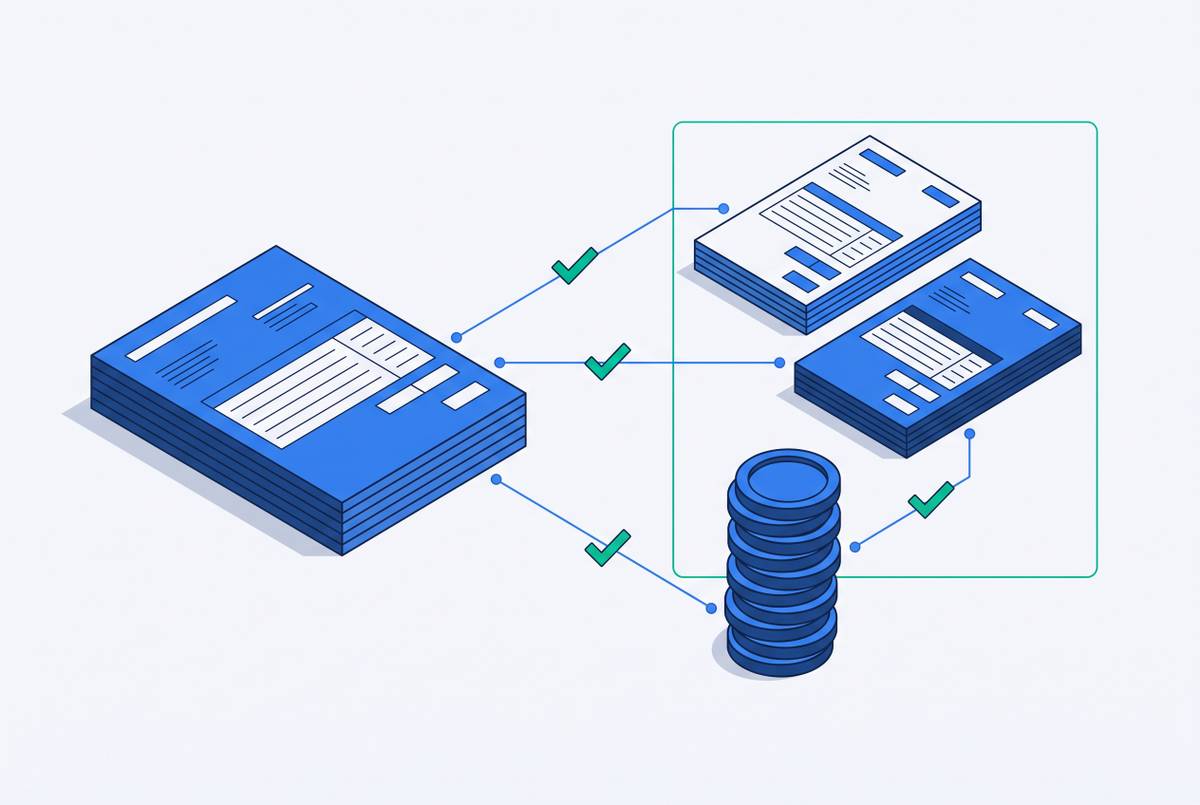
AP's job, boiled down, is verify then pay, carefully. That means receiving vendor invoices, checking them against purchase orders and receipts (two- or three-way matching, in accounting terms), routing anything unusual or expensive for approval, and running payments through ACH, check, wire, or virtual card. Add in vendor file maintenance, W-9 and 1099 compliance, catching early-pay discounts, and reconciling the AP subledger against the general ledger before month-end close. In a fully staffed shop, that's five different jobs: data entry, payment processing, exceptions handling, vendor maintenance, and a manager tying it together. In a lean team, it's one person wearing five hats, and probably not enjoying the hat situation.
AR runs the opposite direction. Invoices go out, standard, milestone-based, or usage-based depending on the business, and then someone has to chase the money back in. That means applying payments as they land, tracking down cash that shows up unapplied (which happens more than anyone would like), running aging reports, managing a collections cadence, and reviewing customer credit limits before extending more rope. AR also owns the allowance for doubtful accounts, the reserve set aside for receivables that probably won't get collected, and handles disputes and short-pays alongside sales and customer success.
Procurement isn't AP. Procurement picks the vendor and cuts the purchase order. AP starts once the goods show up and the invoice needs paying. Different job, different moment in the process.
The skill sets don't overlap as much as job titles suggest. AP rewards people who notice when a number is one digit off and who can hold a steady, professional relationship with a vendor over years. AR rewards people who can call a customer for the third time this month about an unpaid invoice and still sound pleasant doing it. Detail-oriented and persistent aren't the same personality, and pretending they are is how lean teams end up with one function running smoothly and the other quietly falling apart.
How a lean team holds both functions, and where that creates strain
Small businesses, startups, agencies, and e-commerce shops almost always start here: one person, sometimes two, running AP and AR out of the same inbox. An office manager or junior accountant cuts checks, tracks what customers owe, and calls it bookkeeping. It works, right up until it doesn't.
Volume is the real deciding factor, not org chart tradition. Low invoice count, low customer count, one person can juggle both without dropping anything. But watch for the cracks: vendor invoices start piling up unpaid, customer invoices start aging past 60 or 90 days, and suddenly month-end close and the collections calls that need making land on the same Tuesday, for the same person.
AP and AR training pull in opposite directions. AP people are taught to delay payment, hold cash as long as terms allow, and never overpay. AR people are taught to accelerate collection, shrink DSO, get the cash in faster. Putting both jobs on one desk makes those instincts start fighting each other, especially during a cash crunch, when the same person is being asked to both slow-walk a vendor and speed-walk a customer in the same afternoon.
Deloitte's research found close to 60% of finance leaders name poor cash flow visibility as their single biggest obstacle to growth. A combined AP/AR role with no clear owner of either metric doesn't fix that problem, it makes it worse, because nobody's actually watching either number full-time.
Job postings for the AP/AR specialist role as of mid-2026 read like a dare: three-way PO matching, payment runs, customer invoicing, cash application, aging and collections, subledger reconciliation, weekly cash forecasts, and KPI reporting, all in one job description. That's ERP fluency, GAAP basics, and customer negotiation skills, expected from a single hire. Good luck finding that person for the salary budgeted.
The fraud exposure that the lean structure quietly creates
One person creating vendor records, approving invoices, and sending the payment means there's no second set of eyes anywhere in that chain. Fraud doesn't need a conspiracy in that setup. It just needs opportunity, and a lean team hands opportunity over for free.
Segregation of duties, SoD in accounting shorthand, is the fix. Nobody should own an entire transaction start to finish. In a proper SoD setup, no single employee touches more than two critical steps in the AP process, and someone else always checks the work. Splitting the duties means fraud suddenly requires collusion, not just a bad afternoon. The person approving credit can't also be the one collecting the payment. The billing clerk doesn't reconcile the books they're billing against.
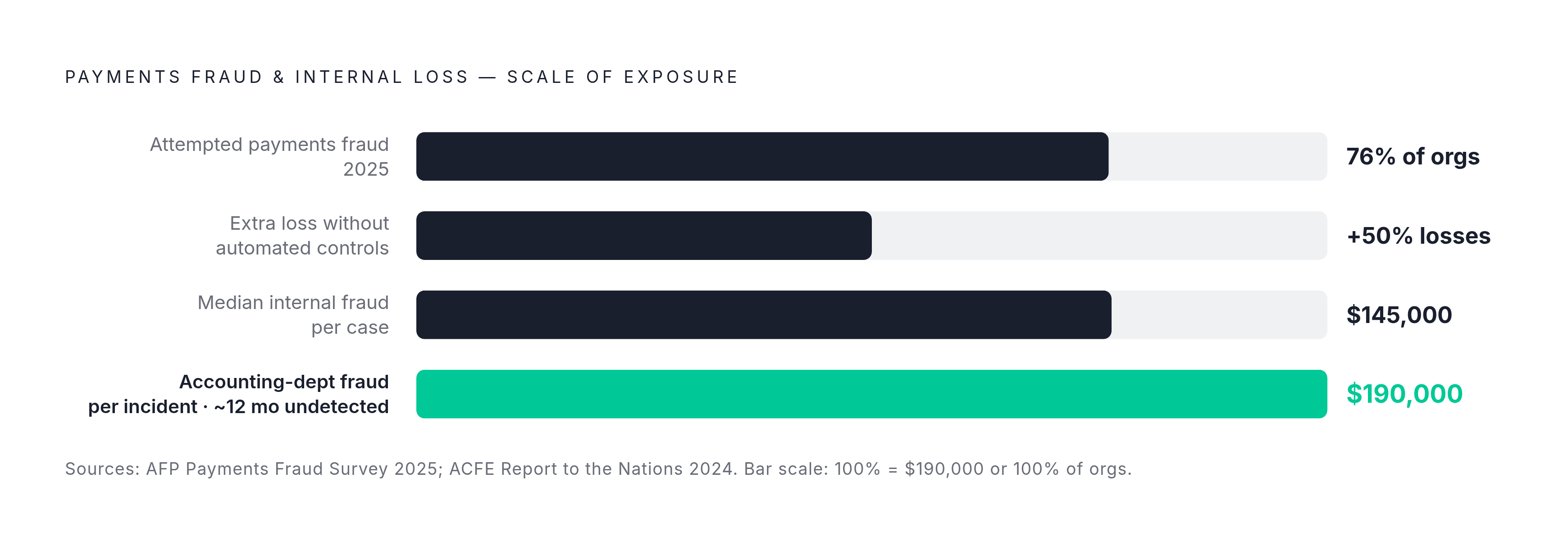
The external numbers back up why this matters. The AFP's Payments Fraud and Control Survey found 76% of organizations in one country dealt with attempted or actual payments fraud in 2025, and business email compromise hit 74%, a sharp jump from 2023 and 2024. Paper checks remain the most targeted method, named by 58% organizations dealt with attempted or actual payments fraud in 2025, and business email compromise hit 74%, a sharp jump from 2023 and 2024. Paper checks remain the most targeted method, named by 58% of respondents, with ACH debits at 30% and wire transfers at 25%. Any lean team still running a manual check run every Friday is standing in the most exposed lane on the highway.
The ACFE's internal fraud data is worse. Median loss per case hit $145,000, up 24% from 2022. Accounting department fraud specifically runs past $190,000 per incident, and most of it goes unnoticed for around 12 months, close to a full year of bleeding before anyone catches it. Organizations without automated controls see losses run 50% higher on average. And small businesses, under 100 employees, get hit more often than large companies and lose more per incident, according to the ACFE. Being small doesn't make a team a smaller target. It makes it an easier one.
The takeaway for a two-person finance team: divide AP and AR duties around segregation of duties first, workload balance second. The person who approves a new vendor should never be the same person who cuts that vendor's check.
The metrics that tell you whether each function is doing its job
Start with the AR number that should make every CFO wince a little. The Hackett Group's 2025 research found an 18-day DSO gap between top-performing and median AR teams, and that gap represents $600 billion in trapped receivables across one country alone. alone. Six hundred billion dollars sitting in inboxes and aging reports instead of bank accounts.
On the AP side, 2026 benchmarks from Mindsprint research put the invoice cycle time target under 5 days, though the manual-process average is 14.6 days, nearly three times slower. Best-in-class AP teams average 3.1 days. Touchless processing (invoices that need zero human hands) should clear 70%. Cost per invoice should stay under $3, though manual processing runs $8 to $30 per invoice according to Gartner and Ardent Partners research, a gap wide enough to fund a small hire. Exception rates should stay below 10%, and DPO in the 30-to-60-day range is standard.
AR's scoreboard runs on DSO as the headline number, backed up by the Collection Efficiency Index (how much collectible AR actually gets collected in a period), the bad-debt ratio (receivables written off entirely), and receivable turnover ratio (net credit sales divided by average AR).
DPO is basically DSO's mirror image: one tracks how fast customers pay the business, the other tracks how slowly the business pays its vendors. Every gain or loss on either side appears in the cash conversion cycle, DSO plus days inventory outstanding minus DPO. Companies with real leverage over suppliers can push that number negative, collecting from customers before the vendor bill even comes due. That's the dream scenario, and it's rare.
For a lean team, these numbers double as staffing alarms. Invoice cycle time creeping past 5 days means AP needs more hands or better tools. DSO drifting upward means AR needs the same. The metrics aren't just scorekeeping, they're a hiring plan in disguise.
What automation can realistically do for each function in a lean team
AP automation can cut processing costs by as much as 70%, based on the research behind current tools, yet 66% of AP teams were still only partially automated as of 2026 (IFOL). That's most lean teams sitting on a lot of unclaimed upside. The tech itself has moved past basic OCR scanning toward agentic AI, embedded payments, and centralized controls built to catch AI-driven fraud attempts too, per ApprovalMax research. And automation does something beyond speed: it enforces segregation of duties structurally, through routing rules, rather than relying on a policy document nobody reads.
AR automation moves different numbers. Automated AR teams run meaningfully lower DSO than teams without it, and push cash-application match rates well above manual levels. Processing costs drop significantly compared to manual handling. Vanson Bourne's research found organizations with high AR automation report an average 41% cut in DSO, freeing up working capital that was otherwise stuck. Billtrust, citing IDC data, puts average ROI on AR automation at 384%, with payback in 9 months, numbers that make the case for themselves.
The sequencing decision comes down to this: AP automation delivers the faster win, fewer errors, and an easier rollout. AR automation carries the bigger long-term payoff through DSO reduction and better collections, but it takes more customer-facing change management to get there. For a lean team choosing where to spend the first automation dollar, AP is usually the quicker win, AR the bigger prize down the road.
Research on platforms handling both AP and AR volume at once suggests they can cut up to 80% of manual tasks without adding a single new hire, worth knowing for teams still stuck in the combined-role stage. AI adoption for fraud mitigation still lags well behind the scale of the threat, per the AFP's 2026 survey. A lot of volume-processing tools speed things up without ever checking whether the thing being sped up looks suspicious.
AP and AR tools lean finance teams are evaluating in 2026
No single platform covers everything, and the right pick depends on transaction volume, the existing ERP, and whether the priority is AP speed, AR collections, or both at once.
On the AP side, BILL comes up often for small businesses and lean teams, largely for fast onboarding and solid integrations with common accounting systems. Ramp, including its Bill Pay product, positions itself as an all-in-one financial operations platform, bundling AP automation with corporate cards and expense management for teams that want one system instead of five logins. Medius stands out specifically for fraud detection, using an agentic AI approach that processes invoices and flags anomalies with less human babysitting required. Airbase gets named as a productivity multiplier for lean teams at high-growth companies handling both AP and travel and expense. Tipalti shows up regularly in AP/AR specialist job postings alongside the others as a recognized automation platform.
AR tooling needs a wider lens. The real test isn't invoice generation, it's the whole collections workflow: cash application, dunning sequences, navigating supplier portals like Coupa or Ariba, and escalation when a dispute needs an actual human. The blockers that actually stall AR teams are unglamorous, missing W-9 forms, portal friction, unapplied cash sitting in limbo, disputes that no algorithm can resolve on its own. A tool that only automates invoice creation is solving only a small fraction of the job.
Teams sitting at the combined-role stage, with volume climbing, are worth pointing toward platforms built to run AP and AR together. The potential to cut up to 80% of manual tasks without new headcount makes a strong case for looking at single-platform options before splitting into two separate tool stacks.
Dividing and sequencing AP and AR work under tight headcount
Go back to the core asymmetry: AP is controlled, AR is chased. When there aren't enough hands to go around, that difference should decide where time goes, not whatever the org chart happened to inherit from the last hire.
At the combined-role stage, one AP/AR specialist can genuinely handle both, as long as volume stays low and segregation of duties gets built in from day one rather than bolted on after something goes wrong. Even a one-person AP/AR shop needs a second set of eyes, a founder or a controller, sitting between "invoice approved" and "payment sent." That single guardrail closes most of the fraud exposure covered earlier, for free, without hiring anyone.
The signal to split the role appears fast and it's not subtle: vendor invoices start taking noticeably longer to clear, customer invoices start aging past the point where a phone call still feels casual, and month-end close starts competing directly with this week's collections calls for the same three hours in someone's calendar. When two of those three show up in the same month, that's the sign headcount needs to grow, or automation needs to take over the parts of the job that don't require judgment, freeing the human for the parts that do, like disputes, credit decisions, and the vendor call that needs a real conversation instead of a template.