Dispute Resolution SLA Benchmarks for B2B AR Teams
Most B2B payment delays stem from disputes, not cash problems.
Forty percent of B2B payment delays trace back to a dispute, not a cash problem. That's the finding from PYMNTS' 2025 research, and it flips the usual story about slow-paying customers on its head: the money isn't gone, it's stuck behind a process nobody's timed. Somewhere between 15 and 25% of B2B invoices kick up some kind of dispute or exception before payment clears, and once that happens, DSO stretches by 15 to 30 days beyond normal. Dispute resolution speed isn't a customer service metric tucked away in some back office. It's a cash flow lever, plain and simple, and most AR teams are leaving it untouched.
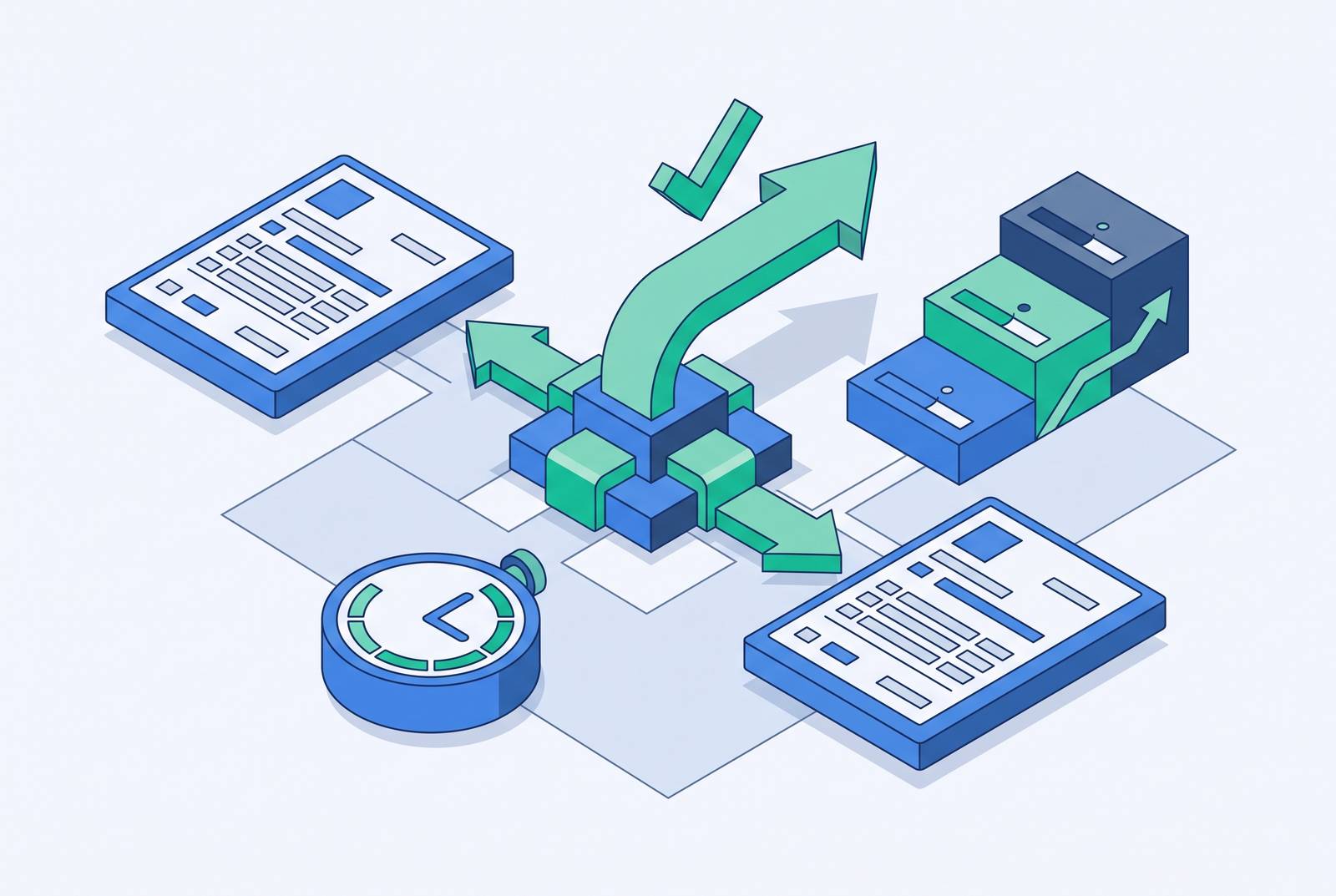
A dispute that sits doesn't just sit still, either. It rots. Every day it goes unaddressed, the odds of collecting on it drop a little further, which is why stage-level SLAs (acknowledgment, investigation, resolution, escalation) set enforceable deadlines at each step instead of relying on a single vague promise to "resolve disputes quickly.""
What happens when disputes age: the 90-day cliff
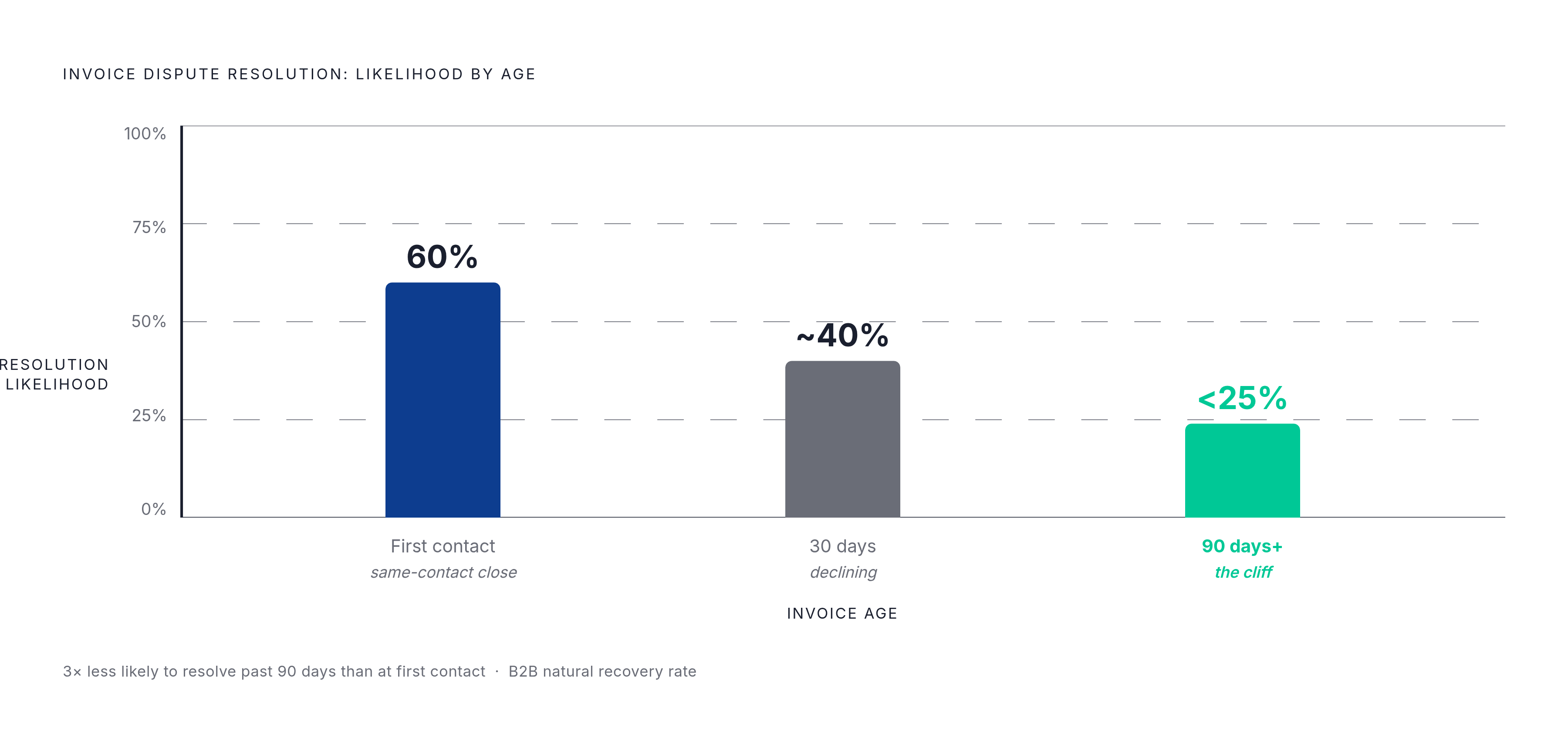
Disputes have a shelf life, and it's shorter than most finance teams assume. Once a disputed invoice crosses the 90-day mark, it's three times less likely to get resolved compared to one addressed at first contact. Past 90 days overdue, a B2B invoice has less than a 25% shot at natural recovery without someone actively chasing it down.
60% of disputes could get closed on the very first contact, if the right paperwork showed up at the same time as the dispute itself. Not eventually. Immediately. Before the debtor's AP clerk has mentally filed the invoice under "someone else's problem" and moved on to lunch.
So the bottleneck isn't a stubborn customer refusing to pay. It's a creditor who can't produce the delivery confirmation, the signed PO, or the corrected invoice fast enough. Slow paperwork, not bad faith, is the real villain here.
Big retail customers make this worse by running the clock. Many enforce supplier dispute windows, often measured in weeks to a few months, after which a deduction becomes uncontestable no matter how wrong it was. Miss the window, and it doesn't matter if the invoice was airtight. The deduction stands, and the opportunity to contest it is gone. These decay curves are exactly what stage-level SLAs are built to interrupt, which is where actual targets come in.
The four dispute types and what each one requires to resolve
Not all disputes are created equal, and treating them like they are is how AR teams end up with SLA targets that don't fit anything. Across B2B accounts receivable, four categories cover most dispute-driven delays.
Invoice amount disagreements happen when the billed amount doesn't match the PO or the agreed rate. Usually fixable at first contact with a line-item reconciliation or a corrected invoice. Delivery disputes are messier: the customer claims goods or services never arrived, arrived incomplete, or didn't meet spec, and that requires delivery confirmation, sign-off records, or proof of completed service. Contract term conflicts crop up when invoice terms drift from what the contract actually says (payment date, discount terms, scope), and untangling those means pulling the original contract and PO. Duplicate invoices are the easy ones: the customer got billed twice, paid one, and needs an invoice reconciliation plus a credit memo to close it out.
A fifth category behaves differently at scale and is worth flagging separately: deductions, or short payments. Common in retail and FMCG, these show up when buyers take deductions for trade promotions, damaged goods, or compliance failures, often without sending any documentation to justify it. Deductions can eat 5 to 15% of invoice value in some sectors, and only 3 to 5% of those claims turn out to be genuinely invalid. That means someone still has to research every single one to find that small invalid slice, which is tedious work that adds up fast. Left untracked, up to 20% of all deductions simply go unresolved or get written off. And the root cause, in most cases, isn't the buyer being difficult. Industry data suggests upwards of 95% of short payments are self-inflicted wounds, an accuracy problem that starts upstream, long before the dispute ever lands on an AR desk.
Dispute type sets a floor on how fast resolution can happen. A duplicate invoice can close in a single phone call. A delivery dispute might need someone in logistics to dig through warehouse records. That's why one flat "resolve in X days" rule doesn't hold up. Stage-level targets, tailored to what each dispute actually demands, do.
Stage-level SLA benchmarks: acknowledgment through resolution
The dispute lifecycle runs through five stages: detection, classification, investigation, collaboration, resolution. Each handoff is a place where time either gets lost or saved, and the benchmarks below mark where each stage should land.
Acknowledgment comes first, and the target is simple: confirm receipt within 24 hours. That confirmation should include the dispute type, an assigned owner, and a next step communicated back to the customer. Responding within that first day keeps the dispute contained; wait longer, and the odds of the dispute escalating grow with each passing day.
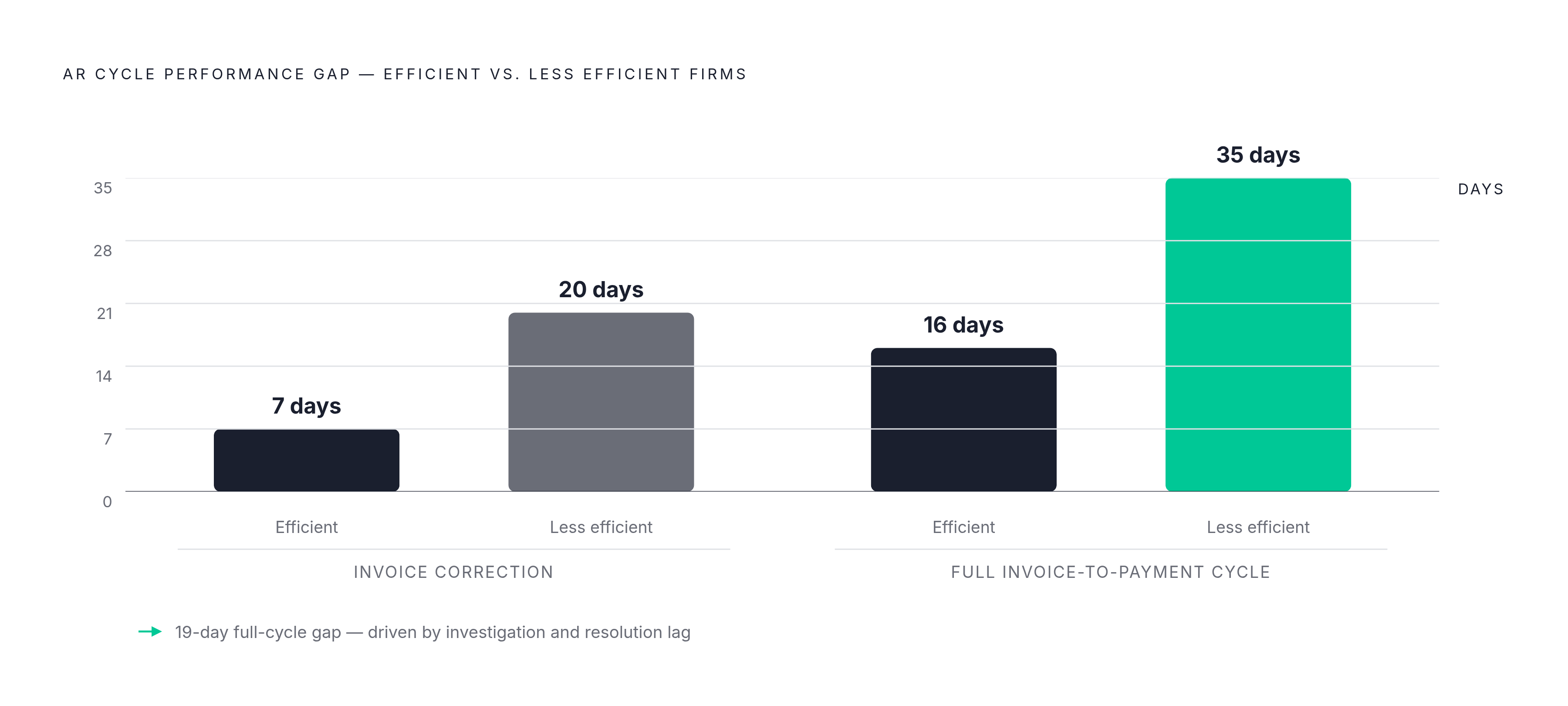
Investigation is where most SLA time actually disappears. The benchmark range for manual B2B dispute resolution runs 3 to 10 business days depending on claim type and how many internal teams need to weigh in. In-house AR teams with documentation already on hand can often complete the process in the 5 to 15 business day range. Cross-industry benchmarking data from APQC shows the split clearly: efficient firms correct an invoice in an average of 7 days, while less efficient firms take 20 days for the exact same correction. Documentation quality is the multiplier hiding in plain sight. Companies that keep detailed communication records resolve disputes roughly 30% faster than those working off scattered emails and sticky notes. The slowdown in investigation is almost never about the dispute being complicated. It's about someone hunting for a PO buried in a shared drive.
Resolution benchmarks follow the same pattern. APQC's data shows efficient firms running full invoice-to-payment cycles averaging 16 days, against 35 days for less efficient firms, and nearly all of that 19-day gap is in investigation and resolution lag. For routine, policy-compliant claims where documentation is pre-loaded and the workflow is automated, resolution can be significantly faster than manual processes allow. Complex or cross-functional claims require more time and deliberate handoff management to avoid resolution lag. Compare that to the old-school collections agency route, where a dispute might not even get looked at for 30 to 60 days. That's not a benchmark. That's a warning sign.
Zoom out to overall cycle time, and the DSO numbers tell the same story from a different angle. Billtrust's 2026 AR Benchmark Report, drawing on data from thousands of organizations, shows average client DSO landing at 39 days, a 6-day improvement year over year. PYMNTS' 2025 research puts the mid-market average at 52 days, with strong performers pulling well ahead of the mid-market average. Broader KPI targets should be set against internal baselines, with DSO and Average Days Delinquent tracked as leading indicators of where dispute backlogs are forming.
Escalation SLAs: when to move a dispute up and how to structure the triggers
A healthy escalation rate is between 5 and 15% of dispute tickets. Drop below 5%, and it usually means Tier 1 agents are sitting on issues too long instead of kicking them upward. Climb above 20%, and it's a sign Tier 1 doesn't have the tools, authority, or training to close anything on their own.
The design trick that trips people up: escalation triggers need to fire before the SLA breaches, not at the moment it does. If the resolution SLA is 10 business days, the trigger should go off at day 7 or 8. That gives the next person in line room to actually act instead of inheriting a problem that's already blown its deadline.
Keep the tier structure to 3 or 4 levels. Every extra tier is another handoff, and every handoff costs time. A workable three-level ladder looks something like this: at the first SLA breach, open a root cause analysis within 48 hours, deliver a written explanation to the finance lead, and document the breach formally, with no financial consequence yet. Hit a second breach of the same metric in the same quarter, and it triggers an automatic service credit, escalation to the account manager, and a written remediation plan due within 5 business days. A third breach, or any single critical failure, kicks it to VP or C-suite level, doubles the standard service credit, and opens a formal 30-day performance improvement plan with defined success criteria.
Large buyers often run their own dispute clocks with fixed windows, and internal escalation triggers need to line up against those external deadlines, not just the AR team's own calendar. What doesn't count against SLA performance should also be spelled out in writing: force majeure, planned maintenance windows, and delays the customer itself caused. Leave those out of the documentation, and legitimate performance gets unfairly dinged for things nobody on the AR team could control.
The KPIs that make SLA targets measurable
An SLA target without a metric behind it is just a nice sentiment. Each stage above needs a number that surfaces a breach before it turns into a write-off.
Days Deductions Outstanding (DDO) tracks how long deductions sit open, calculated as total outstanding deductions divided by average daily deductions. Think of it as DSO's cousin, built specifically for the deduction bucket. First Contact Resolution (FCR) Rate measures how often a dispute closes in that first interaction, which ties directly back to the 60% first-contact opportunity mentioned earlier. Push FCR up, and cost per dispute drops right along with it. Dispute Rate, calculated as disputed invoices divided by total invoices issued, times 100, is worth watching over time: a rising rate points upstream, toward pricing misalignment, data entry mistakes, or contract language nobody bothered to clarify.
Collection Effectiveness Index (CEI) is commonly benchmarked at 85% or higher for a strong collections operation. If CEI is sliding while the dispute rate climbs, that's not a coincidence, that's a backlog forming in real time. Deductions as a percentage of sales (sometimes called a Deduction Performance Index) should be tracked by category, including incorrect deductions and recovery rates, because up to 20% of deductions go unresolved or get written off due to poor tracking or lack of visibility, a loss that's entirely preventable. Average Days Delinquent moves in the wrong direction fast whenever acknowledgment misses the 24-hour mark or investigation drags past its window.
Root-cause tagging should be built in from day one. Every closed dispute should get labeled (pricing mismatch, delivery documentation, duplicate billing, whatever fits) and reviewed regularly alongside sales, operations, and finance. Disputes are symptoms. Treating them only as an AR problem misses where they actually start.
What the cost data says about where to invest in faster resolution
Resolving a single B2B dispute manually costs somewhere between $300 and $500 all-in, factoring in AR manager hourly rates and a typical 5 to 15 business day resolution cycle. Multiply that across volume, and the picture gets uncomfortable fast: companies over $10M in revenue see an average of 23 disputes a month, which runs somewhere between $6,900 and $11,500 in monthly resolution costs, before counting any revenue lost to delay or write-off.
At that volume, someone on the AR team is essentially working a part-time job made entirely of administrative overhead, with zero time left for actual collections strategy. European cost data tells a similar story: a fully loaded dispute interaction runs 60 to 150 EUR, so a 300 EUR credit note can genuinely cost more to process than it's worth approving. Filing a single dispute takes 5 to 15 minutes, and at high volumes, that adds up to hundreds of hours a month spent on something that should take seconds.
The upside case is just as concrete. Organizations that centralize AR processes consistently report faster dispute resolution, reduced aged debt, and DSO improvements, often within a single quarter. McKinsey data separately found that mapping and standardizing AR procedures can lift receivables-related working capital by up to 30% within weeks, not years.
Where should the first dollar go? Documentation quality tops the list (that 30% speed gain isn't theoretical), followed by dedicated account management, since companies running it report meaningfully fewer formal disputes than those routing everything through a generic customer service queue. Workflow automation that routes disputes to the right owner and fires escalation triggers ahead of an SLA breach rounds out the short list.
How automation changes what SLA targets are achievable
CFOs are already voting with their budgets here. Per a Grant Thornton survey, AI and automation rank as the most-cited tactic, at 69%, for offsetting rising costs. In order-to-cash specifically, APQC's 2025 trends data shows 41% of organizations actively using AI, with another 31% in early-stage adoption. Wakefield Research found that 99% of AR teams using AI report a reduction in average DSO, and while individual platform results vary, the direction of that signal doesn't.
What does automation actually change at each stage? Detection speeds up because disputes get captured automatically from emails, portals, and payment exceptions the moment they surface, instead of waiting for someone's Monday morning review cycle. Classification happens instantly, with AI sorting dispute type and routing it to the right owner without a manual triage step eating up the first day. Investigation compresses hardest of all: ERP validation runs in seconds once documentation is pre-loaded, turning what used to be a multi-day investigation window into something closer to under an hour for policy-compliant claims. Resolution follows the same logic, with credit memo issuance firing automatically once a policy rule applies, and customer notification going out immediately rather than at the end of a batch process.
The AgentCollect 2026 report claims 90% of disputes get resolved instantly at first contact using AI, and the reason isn't raw processing speed. It's documentation access at the exact moment of contact, the same first-contact advantage discussed earlier, just automated instead of manual.
Evaluating a dispute management platform worth adopting means checking for configurable workflows with routing, escalation triggers, and SLA tracking built in from the start; a centralized hub where invoice data, payment history, dispute status, and supporting documents all live in one place instead of six; a customer self-service portal that shows real-time dispute status and cuts down inbound "just checking in" calls; analytics that break dispute trends down by root cause; and integration with existing ERP, accounting, and CRM systems so dispute handling doesn't become its own isolated island of data.
Everything benchmarked earlier in this piece, the 24-hour acknowledgment, the multi-day investigation window, is a manual-process floor for SLA design, not a ceiling. Teams running purpose-built automation can realistically target acknowledgment in under an hour and same-day resolution for routine claims. The 24-hour and 5-to-10-day numbers aren't the ambition. They're what happens without a system doing the heavy lifting.