Allowance for Doubtful Accounts Journal Entry Construction
Learn how to record and adjust the allowance for doubtful accounts correctly.

Bad debt is a predictable expense that you can plan for well before year-end. It's a math problem you solve ahead of time, and the allowance for doubtful accounts is where that math lives. Get the journal entries wrong and you either overstate your cash position or tank your income statement for no reason, and neither one makes for a fun conversation with a lender.
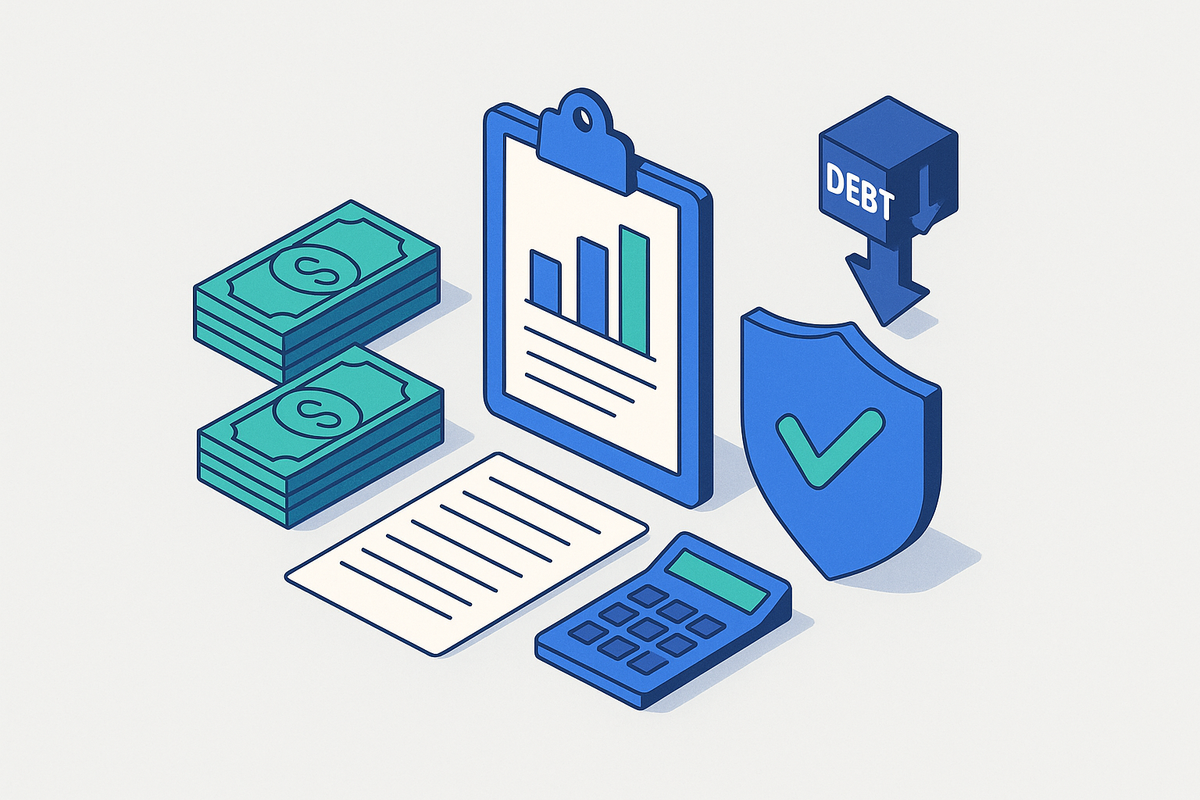
Here's the plain version: the allowance for doubtful accounts is a company's advance guess at how much of its accounts receivable will never get paid. It sits right below gross accounts receivable on the balance sheet, and when you subtract one from the other, you get net realizable value, which is just a fancier way of saying "the amount that'll actually hit your bank account."
The account runs backwards from what you'd expect, and that's exactly why people get tangled up in it. It's a contra-asset, meaning it carries a credit balance: it grows when you credit it, shrinks when you debit it. A normal asset account like cash works the opposite way. Once that reversal clicks in your head, everything else here gets a lot easier to follow.
Why not just knock the estimated losses straight off accounts receivable instead of tracking them separately? Because AR needs to keep an honest running total of every credit sale made during the period, full stop. The allowance sits next to it instead of inside it, so both numbers stay visible: what you're owed, and what you realistically expect to collect. You'll see this account under different names depending on who wrote the textbook or built the software: Allowance for Uncollectible Accounts, Allowance for Bad Debts, Provision for Bad Debts. Same account, different name tag.
The real obligation behind all of this is the matching principle. Bad debt expense has to show up in the same period as the revenue it's tied to, not months later once the customer stops answering emails. And this isn't a niche problem: unpaid invoices hit more than half of small businesses, and industry estimates put bad debt at roughly one-tenth of all B2B sales. Estimating losses in advance is a necessary part of accurate financial planning. It's damage control, done early.
Some companies take a shortcut called the direct write-off method: expense the bad debt only when it's confirmed uncollectible. Skip the allowance account. It's simpler, sure, but it flat-out violates the matching principle, since the expense lands in whatever period the customer happened to stop paying, not the period the sale happened. It's fine for tax filings, or when the dollar amount is too small to matter. For real financial reporting, GAAP and IFRS both require the allowance method, and there's no version of "it depends" here. No exceptions.
How to size the allowance before writing any entry
The journal entry is just the messenger. The estimation method is where the actual decision-making happens, and getting that number right is what makes the entry mean anything.
Percentage of sales method. This one looks at the income statement. Take your historical bad-debt rate and multiply it by current credit sales. Say a company does $60,000 in credit sales and has historically lost 2% to bad debt: $60,000 × 2% = $1,200. That's the number that flows into the entry. It matches expenses to the period cleanly, but it produces a weak balance sheet reserve, because it never looks at whatever balance already sits in the allowance account. It's the fastest method and also the least precise one, worth knowing upfront rather than discovering later.
Aging of accounts receivable method. This one looks at the balance sheet instead. Sort AR into buckets by how overdue it is (current, 1-30 days, 31-60, 61-90, over 90), and apply a higher uncollectible percentage the older the bucket gets. The logic is blunt: the longer an invoice sits unpaid, the less likely it ever gets paid. A company's history might show 99% of current-bucket invoices get collected, but a jewelry store example puts 25% of invoices over 90 days as uncollectible, meaning only a small fraction of the oldest balances ever get paid. Add up the required reserve across every bucket, and that total becomes the required ending balance in the allowance account, not the entry amount itself. The entry is whatever gap exists between that required balance and what's already sitting there. This is the method most accountants trust, because it's built directly on real collection odds by invoice age rather than a company-wide average.
Risk classification method. Here you sort customers into low, medium, and high default-risk buckets, then weight each customer's outstanding AR by that bucket's estimated default rate. This earns its keep in B2B environments where customer credit profiles are all over the map, and it layers on top of aging fine when you want extra precision.
As a gut check, allowance balances vary by industry and how long the collection cycle runs, so the right reserve size depends heavily on a company's own historical loss rates. Longer days-sales-outstanding cycles call for bigger reserves. And if a company has no track record yet, published industry averages are the reasonable starting point until real history builds.
Scenario 1: Recording the initial allowance estimate
This entry happens at the end of an accounting period, monthly, quarterly, or annually, whenever the company sits down and estimates expected losses on its current AR balance.
The structure is simple:
- Debit Bad Debt Expense (an operating expense on the income statement)
- Credit Allowance for Doubtful Accounts (a contra-asset on the balance sheet)
Both sides equal the estimated uncollectible amount, dollar for dollar.
Take a company carrying $10,000,000 in AR that estimates $50,000 of it won't get collected. The entry debits Bad Debt Expense $50,000 and credits Allowance for Doubtful Accounts $50,000. The balance sheet then reports net AR of $9,950,000. Scale that down to the smaller example from earlier: $60,000 in credit sales times 2% produces a $1,200 debit to Bad Debt Expense and a $1,200 credit to the allowance. Same mechanics, different zeros.
What this entry does not do is touch any individual customer's balance. Gross AR stays fully intact, every dollar still on the books, untouched. On the income statement, that $50,000 (or $1,200) shows up as an operating expense in the same period the related revenue was earned, exactly what the matching principle demands. On the balance sheet, net realizable value of AR drops by the estimated amount, giving lenders and investors a number they can actually trust instead of a rosier one.
Scenario 2: Adjusting the allowance when a balance already exists
Once the allowance already carries a balance, the entry only records the difference needed to bring it up (or down) to the required level. Not the full new estimate. Just the gap.
Say the allowance currently sits at a $2,000 credit balance, and an updated aging analysis says the required balance should be $2,900. The adjusting entry debits Bad Debt Expense $900 and credits Allowance for Doubtful Accounts $900. Only that $900 runs through the income statement this period, not the full $2,900.
Sometimes the account flips into a debit balance, which happens when prior write-offs have chewed through more of the reserve than expected. If the account shows a $1,000 debit balance and the required ending balance is $2,500, the entry has to cover both the deficit and the target: $1,000 + $2,500 gets recorded to land back at the correct credit balance. A debit balance showing up here isn't a rounding quirk, it's a flashing warning light that prior estimates were too optimistic and the model needs a second look.
The pattern holds in both directions. Current allowance at $5,000, updated estimate at $7,500? Record the $2,500 difference, debit Bad Debt Expense, credit Allowance for Doubtful Accounts. Current allowance higher than the new estimate calls for? Reverse it: debit the allowance, credit Bad Debt Expense for the excess, which shrinks the reserve and bumps up reported income for the period.
The percentage-of-sales method never checks what's already sitting in the allowance, which is its main weakness. Aging and risk-classification both do this automatically, since they produce a required ending balance by design, and that makes the adjustment math explicit instead of something you have to remember to go check.
Scenario 3: Writing off a specific account confirmed as uncollectible
This entry gets triggered when management decides a specific customer's balance is truly gone: collection efforts exhausted, customer filed for bankruptcy, whatever the reason.
The structure:
- Debit Allowance for Doubtful Accounts (shrinks the reserve)
- Credit Accounts Receivable, tagged to the specific customer (removes the balance from AR entirely)
Both sides match the confirmed uncollectible amount exactly.
Here's the part people get backwards most often: Bad Debt Expense does not appear anywhere in this entry. The expense already got recognized back in the original estimation entry. Recording it again here double-counts the loss, quietly overstating total expenses for the period, and that's a mistake that compounds if nobody catches it.
Net realizable value doesn't move at all when this happens, which trips people up because it feels like it should. Write off a $10,000 customer balance against an existing $50,000 allowance, and gross AR drops by $10,000 while the allowance also drops by $10,000, leaving net AR exactly where it was. Running the earlier example forward, net AR stays parked at $9,950,000 ($9,990,000 gross AR minus the $40,000 remaining in the allowance). This is the exact moment where the allowance method proves its worth over direct write-off: under direct write-off, the loss hits the income statement right when it's confirmed, distorting that period's reported income and breaking the matching principle it was supposed to follow all along.
If write-offs start coming in heavy and repeatedly, the allowance account drains faster than the estimate accounted for. That's a signal, not bad luck, and it almost always means the estimation method needs revisiting, not just topping up.
Scenario 4: Recording a recovery when a written-off customer pays
Every so often, a customer who got written off actually pays up. When that happens, two entries are required, because the account was fully removed from the books at write-off, and it has to be reinstated before any cash can be applied against it. Skip the reinstatement step and the audit trail has a hole in it.
Step 1, reinstate the receivable.
- Debit Accounts Receivable, tagged to the specific customer
- Credit Allowance for Doubtful Accounts
This simply reverses the original write-off entry. Gross AR ticks back up, and so does the allowance balance.
Step 2, record the cash receipt.
- Debit Cash
- Credit Accounts Receivable, tagged to the specific customer
This clears the reinstated receivable and books the actual cash coming in.
Net effect across both entries: cash goes up, that customer's AR balance returns to zero, and the allowance ends up slightly higher than it would've been otherwise, because the reserve absorbed less of a loss than originally planned.
Partial recoveries work the same way, just scaled down. If a $1,000 written-off balance gets a $300 payment, Steps 1 and 2 are each processed for $300 only, and the remaining $700 stays written off, untouched. None of this touches the income statement, which surprises people. Recovery flows through the balance sheet only, since the original expense already got recorded back in the estimation period. If recoveries start showing up often, that's a hint the allowance is being set too aggressively. Write-offs piling up with no recoveries ever coming back suggests the opposite problem.
How the four entries interact across periods on the financial statements
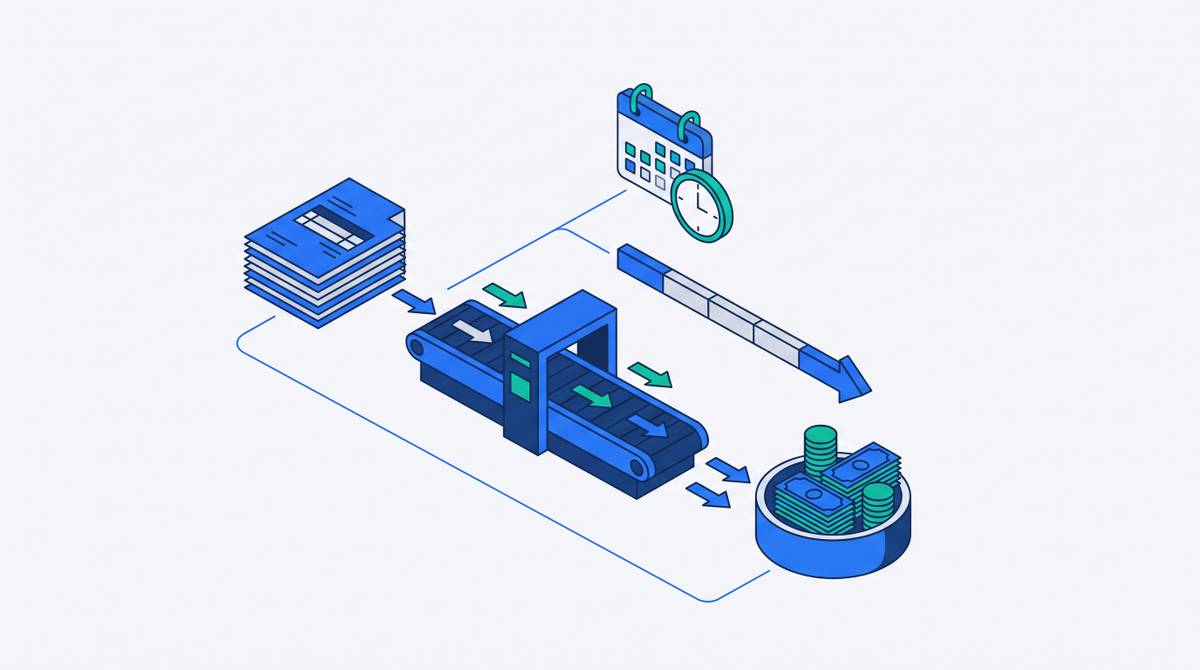
Think of the allowance account as a running tab that never fully resets. Every estimation entry adds to it with a credit. Every write-off drains it with a debit. Every recovery tops it back up with a credit. Whatever balance is left at the end of one period becomes the starting point for the next, and the cycle just keeps going.
On the balance sheet, at any snapshot in time, the presentation is the same three-line story: gross accounts receivable (the full credit-sale total), less Allowance for Doubtful Accounts (the cumulative net reserve), equals Net Realizable Value (what the company genuinely expects to collect). A clean version of that math: $1,000,000 gross AR, $50,000 allowance, $950,000 net AR on the balance sheet.
On the income statement, Bad Debt Expense only shows up in two of the four scenarios: the initial estimation entry and the periodic adjustment entry. Write-offs and recoveries are balance-sheet-only events, full stop, no exceptions. That separation is exactly what makes the matching principle function instead of just sitting in a textbook as a rule nobody checks.
Keep Bad Debt Expense and Allowance for Doubtful Accounts mentally separate, since they get confused constantly. BDE records the estimated hit to income in the period it happens. AFDA holds the running cumulative reserve on the balance sheet. They're related, but not interchangeable, and mixing them up in front of a lender is a fast way to lose credibility.
The allowance balance also works as a management signal, whether anyone's watching it closely or not. If the account keeps sliding into a debit balance after write-offs, the estimation method is running too thin and needs to move up. If the allowance keeps growing larger than write-off activity justifies, the estimates are overly conservative, and that excess reserve quietly drags down reported income for no good reason. Poor cash flow management sits behind most business failures, and an inaccurate allowance is one of the quieter ways that picture gets distorted for everyone relying on it: management, lenders, investors, all reading the same wrong number.
Most companies revisit the allowance monthly or quarterly. High-volume B2B operations dealing with complex customer portals or frequent billing disputes should check in more often, especially once a meaningful chunk of AR starts aging past 60 days. Finding out at year-end that the estimate was off by a wide margin isn't a great way to learn a lesson, it's just an expensive one.
Sources
- Allowance for Doubtful Accounts: Definition + Calculation
- How to Record an Allowance for Doubtful Accounts?
- What Is an Allowance for Doubtful Accounts (Aka Bad Debt Reserve)?
- What to do with the balance in Allowance for Doubtful Accounts? | AccountingCoach
- corporatefinanceinstitute.com
- Allowance for Doubtful Accounts