Customer Payment Portals in AR Automation Platforms
Well-built portals cut reconciliation work and accelerate cash collection by 5 to 15 days.
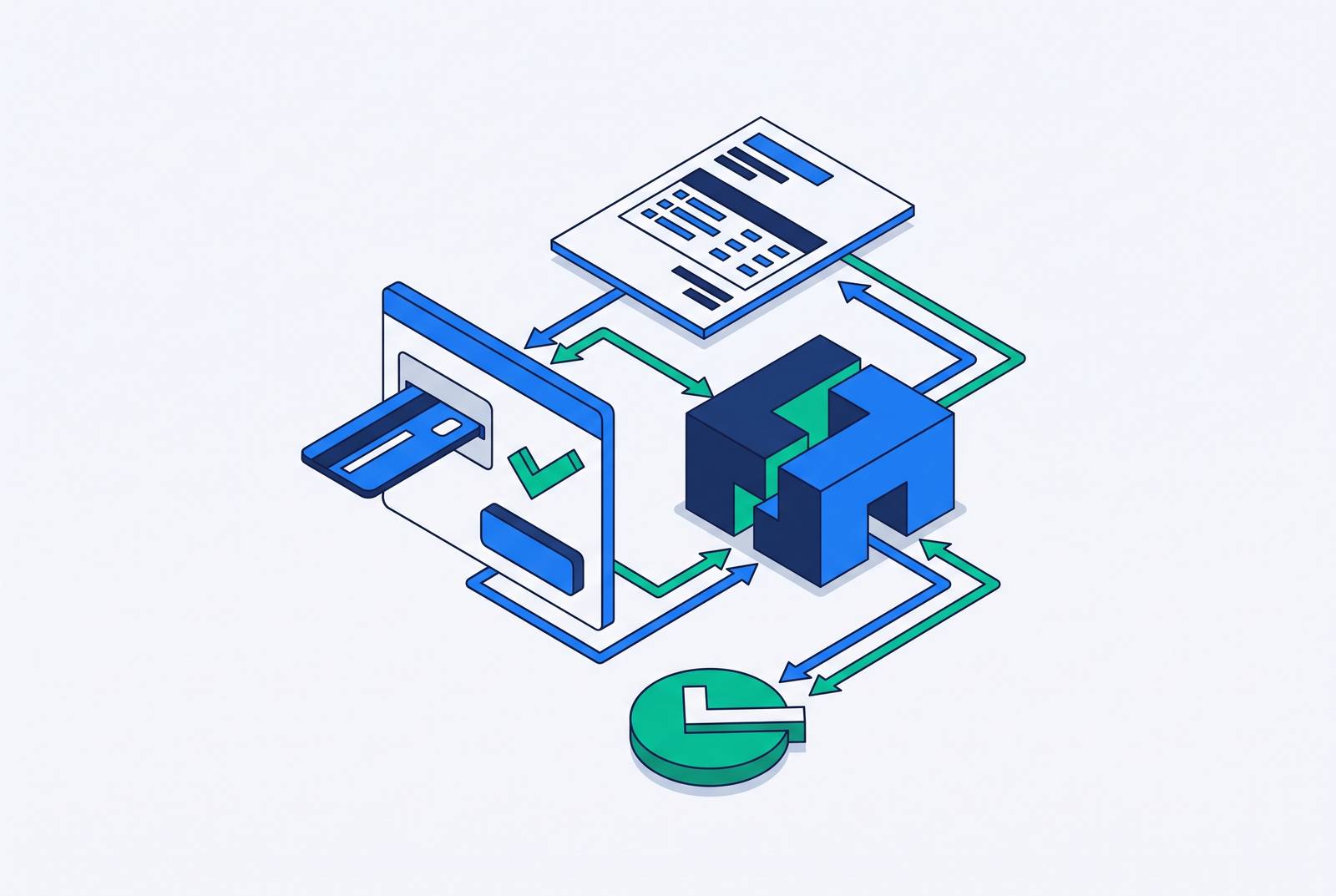
Customer payment portals get sold as a nice-to-have: a little self-service window so buyers can log in and pay without bugging your AR team. That framing undersells what's actually happening. The portal is where invoice delivery, payment, dispute conversations, and cash matching all collide, which makes it the busiest intersection in the entire accounts receivable cycle, not some side lobby.
Mordor Intelligence puts mandatory e-invoicing rules live in more than 80 jurisdictions, and real-time payment rails are exposing collection gaps that used to hide behind settlement float. Centime reports that 83% of firms still haven't fully automated AR, even though the platforms that have done it are pushing straight-through cash application close to 80%. That gap between "mostly manual" and "mostly automatic" mostly comes down to whether a portal actually gets built well and actually gets used.
What a customer payment portal does inside an AR automation platform
A consumer payment portal and a B2B payment portal look similar on the surface. Both let someone log in and pay a bill. That's about where the resemblance ends.
B2B portals have to handle things a consumer never deals with: batches of multiple invoices at once, approval chains inside the buyer's AP department, stored payment credentials, autopay rules, and remittance files that need to be uploaded and matched. According to eBizCharge, a working B2B portal handles four jobs on its own, without AR staff lifting a finger: customers pull up their own invoices, they pay open balances by card or ACH, they manage their own contacts and payment methods, and they check payment history whenever they want.
The formal name for this is Electronic Invoice Presentment and Payment, or EIPP. Versapay's own documentation describes EIPP as invoice delivery through portal, email, or API, paired with the ability to pay online. The portal is just one delivery lane inside EIPP, though usually the busiest one.
Positioned between invoice delivery and cash application, the portal decides how much reconciliation work eventually lands back on the finance team. Pick a payment method, submit remittance detail, raise a dispute: whatever happens inside that portal session decides whether someone in accounting spends the next morning hunting down which invoice a payment belongs to. The goal, as platforms like Serrala frame it, is a shared workspace where every communication, contract, payment request, and outstanding balance lives in one place both sides can see. That shared record is what actually kills disputes, because nobody's arguing over whose email thread has the real numbers.
One thing worth being blunt about: a portal by itself is not a collections tool. It just sits there. Whether anyone shows up depends entirely on the workflow wrapped around it, which is the next problem.
How the surrounding AR workflow shapes whether a portal gets used
A portal nobody visits does exactly nothing. It's a vending machine in a locked room. The question that actually matters isn't "does the portal work," it's "how does a customer end up there in the first place."
Chaser's documented approach embeds payment links directly inside reminder emails, texts, and letters, so a customer pays right where the reminder found them instead of having to go remember some other login. QR codes do the same job for paper mail, useful for buyers who never open a digital reminder anyway. Any portal that forces a separate login before someone can even see the pay button is adding friction exactly where none should exist, and that friction disproportionately kills conversion among infrequent payers, the ones who forget their password because they only pay you twice a year.
ERP connection quality matters just as much as the front door. A portal that takes a payment and then needs someone to key it into the ledger by hand has only moved the friction, not removed it. A real two-way integration posts that payment straight back to the ledger, making the payment faster and the work lighter."
Multi-channel delivery matters too. Billtrust's documented capabilities cover email, portal, EDI, and postal mail, which matters because buyers vary wildly in what technology they'll actually use. Meeting a buyer where they already are, instead of where the vendor wishes they were, gets more invoices seen and paid.
Centime's own buyer guidance tells finance leaders to ask vendors point-blank for portal adoption numbers and time-to-value data from comparable customers. That's a fair question, and one worth actually asking out loud during a sales call rather than nodding along to a slide deck. Portal capture quality and ERP sync depth, together, decide how much cash application labor is left standing at the end of the month. Both belong on the evaluation checklist. Neither one alone tells the full story.
The specific portal features that reduce reconciliation work and DSO
Some features are decoration. Others actually move the needle on reconciliation and days sales outstanding (DSO). Some features are decoration, while others actually move the needle on reconciliation and days sales outstanding (DSO).
Remittance upload with automatic matching sits at the top of the list. According to k-ecommerce, a solid self-service portal lets a customer upload remittance detail and automatically matches that payment against open invoices, flagging anything that doesn't line up for a human to check. Skip this step and the portal has only sped up the payment, not the reconciliation, so someone's still playing detective with a bank statement.
Payment method breadth counts too. Best practice per k-ecommerce includes ACH, credit cards with or without surcharges, stored payment methods, and the ability to split one payment across several invoices, all wrapped in tokenization for compliance. Fee structure changes behavior in ways that are easy to underestimate: free ACH on every plan removes the one excuse an AP clerk has for going back to mailing paper checks.
Bulk pay runs matter for anyone selling into a company big enough to have an actual approval hierarchy. k-ecommerce notes that AP clerks need to approve batches of invoices at once, following multi-level rules, because a portal built for "pay one invoice, one at a time" simply doesn't match how a real enterprise AP department operates. Autopay enrollment, meanwhile, quietly drops per-invoice friction close to zero for any customer paying on a recurring basis.
Dispute handling built into the portal, rather than living in scattered email threads, is another quiet win. Built-in messaging and dispute workflows tied to the invoice record shorten the back-and-forth because both sides are looking at the same document instead of forwarding PDFs at each other. Payment plans and early payment discounts, documented in Chaser's capabilities, give a customer with a large balance a structured way to pay it down before the invoice ages into a real collections headache.
Put it together and eBizCharge's numbers are specific: portal adoption typically cuts DSO by 5 to 15 days within six months, inbound AR call volume drops 40 to 60 percent within 90 days, and total cash application labor falls 60 to 80 percent once automated matching is layered on top. Those numbers mean a finance team getting its afternoons back. That's a finance team getting its afternoons back.
How six AR platforms approach the portal
No single platform wins every category here. Each one made a bet on what matters most, and those bets are visible in what they built.
Chaser builds its portal directly into the same system that sends reminder emails, texts, and letters, so payment happens right where the reminder landed rather than at some separate destination. It connects natively to Xero, QuickBooks Online, AccountsIQ, Sage Intacct, and Dynamics 365 Business Central, posting payments back to the ledger automatically. Payment plans and early discounts live inside the portal too, and every customer interaction gets logged against the account. One documented case, Wren Accountancy Services, cut debtor days from around 60 down to roughly 24 within a few months of turning the portal on. Pricing runs on revenue, a free trial's available, and it holds a 4.3 rating on G2 as of August 2026. It fits finance teams already on one of those supported accounting platforms who want reminders, portal, and ledger data tied together, not shops needing e-commerce checkout or heavy enterprise treasury features.
Bill360 targets small-to-medium B2B companies specifically. Its self-service portal handles payment wallets and AutoPay along with discrepancy resolution, and it connects directly into QuickBooks or Xero. Pricing isn't published; it's quote-based. Reviewers give it 4.9 on G2, mostly praising ease of use and responsive support, with occasional payment processing delays flagged as the main gripe. Good fit for lean B2B teams that care more about a product built to their size than about a big enterprise track record.
Billtrust treats the portal as one module inside a much larger order-to-cash suite. Its Business Payments Network connects buyers and sellers across its customer base for e-invoicing, and the portal itself supports multi-channel delivery through email, portal, EDI, and postal mail. Billtrust's portal gives buyers a branded, customizable space to view, download, and pay invoices and pull statements. A broader direction the category is heading is suppliers moving away from one-size-fits-all portals toward segmenting buyers by value, margin, and payment behavior. As of March 2026, Billtrust held 14.4% mindshare in the AR Automation Software category on PeerSpot. Pricing is custom, and it scores 6.8 on Lido's 2026 review scale. Fits large enterprise teams running high invoice volume who need cash application handled at scale.
Versapay builds around a shared, collaborative AR network rather than a reminder-driven portal, so customers typically arrive by logging in directly. It processes a substantial volume of transaction value annually across a large number of transactions. The differentiator is the buyer-supplier collaboration model itself: customers view, pay, and manage invoices through a portal with messaging built right in. AI handles cash application, and it integrates with Microsoft Dynamics, NetSuite, and Sage Intacct. Documented results show roughly 25% faster payments and about 30% fewer past-due invoices. Best suited to organizations where the buyer-supplier relationship and network effects matter as much as internal workflow speed.
Gaviti goes after businesses juggling multiple ERPs or several subsidiaries, staying ERP-agnostic by design. Its portal includes zero-fee ACH across every plan, removing the cost objection that pushes some AP teams back toward paper checks. It fits organizations with genuine multi-ERP complexity that don't want a portal welded to one ecosystem.
Viewpoint Analysis shows HighRadius covers the entire AR cycle: credit management, e-invoicing, cash application, collections, deductions, with AI trained on historical payment behavior. Cash application is its clear strength, running around 80% automation according to Centime's platform comparison. It ships in two tiers, HighRadius One for mid-market and HighRadius Enterprise for larger organizations, with pre-built integrations for SAP, Oracle, Microsoft Dynamics, NetSuite, and more than 50 ERPs by its own count. Its own materials claim it has held a Gartner Magic Quadrant "Leader" spot for three straight years, which is self-reported positioning rather than independent verification. Pricing is custom and implementation is genuinely complex, something reviewers flag as requiring real organizational commitment. Fits large, high-volume, complicated environments where cash application accuracy and deep ERP coverage directly determine reconciliation speed and error rates, and it's overkill for a team that just needs basic document extraction on a tight budget.
What the enterprise supplier portal problem adds to the picture
Everything above assumes the portal belongs to the seller: a buyer logs in and pays. Flip the direction and there's a second kind of portal that creates the opposite headache entirely.
Large enterprise buyers increasingly require their suppliers to submit invoices through systems like Coupa, SAP Ariba, or some homegrown procurement platform. As Montopay notes, this means the AR team on the selling side has to go navigate somebody else's portal just to get an invoice accepted. A payment portal that's excellent from the customer's side tells you nothing about whether that same company can get its own invoices through a buyer-mandated procurement system without a human manually re-keying data.
That's worth two separate lines on any evaluation checklist, not one. What does the platform do for the people paying you? And separately: what does it do to get your invoices accepted through the procurement systems your own customers force you to use? A team selling heavily into large enterprise accounts should score both, because a portal that shines on one side of the transaction and stalls on the other still leaves plenty of manual work sitting in the middle, exactly the kind of work automation was supposed to remove in the first place.