W-9 and W-8 Collection Workflows for Enterprise AR Teams
Embed tax-form collection into vendor onboarding to avoid penalties and compliance failures.
Picture an AP report in late December: a few hundred vendors, a healthy chunk of them added sometime in March or July, and no tax form attached to half of them. That's the January scramble, and it happens to enterprise AR teams every single year because nobody treated form collection as the thing it actually is. Collecting a W-9 or W-8 before the first payment gates whether every payment, every 1099, and every 1042-S filing behind it can hold up to scrutiny. A W-9 gets a U.S. payee's legal name, Taxpayer Identification Number, and tax classification on record before any 1099 gets filed. The W-8 series does the same job for foreign payees: it confirms foreign status, treaty eligibility, and who actually owns the income for 1042-S purposes. Without that step, defaults kick in immediately: 24% backup withholding applies to U.S. payees without valid documentation. payees without valid documentation, 30% on foreign payees receiving FDAP income (interest, dividends, rents, royalties, certain service payments) without a valid form on file. Teams that build the collection step into onboarding, before a vendor ever gets paid, don't have a January scramble. Teams that treat it as somebody else's job inherit one every year, right on schedule.
What the penalty structure looks like when the workflow fails
The cost of skipping this step doesn't sit quietly at year-end waiting to be dealt with. It compounds every time a disbursement runs. If a vendor gets onboarded in March and paid monthly, and someone finds the missing form the following January, ten separate exposure events have already happened by the time anyone notices. Information-return penalties scale with how late the fix comes. The IRS Internal Revenue Manual sets the 2026 figures for large businesses (gross receipts over $5 million) at $60 per return, capped at $683,000 annually, if you correct it within 30 days. That climbs to $130 per return, capped at $2,049,000, for corrections made between 31 days and August 1. After August 1, the penalty rises to $340 per return, capped at $4,098,500. Intentional disregard carries no cap at all: $690 per return, indefinitely. On top of the fines, there's personal exposure. Under IRC sections 1461 and 1463, liability for unwithheld tax, interest, and penalties attaches to the withholding agent directly, and an agent's actual knowledge gets imputed regardless of who was supposed to handle the paperwork. Delegating the task doesn't transfer the liability. The 2025 One Big Beautiful Bill Act raised the 1099-NEC reporting threshold from $600 to $2,000 for 2026 payments, with future inflation indexing built in. That sounds like relief. It isn't permission to relax the collection habit, because the per-cycle exposure on any vendor paid without a valid form on file hasn't moved an inch. And once a form is collected, it has to stay on file. Retention runs at least four years after the year of the last reportable payment to that vendor.
Which form applies to which payee
Every collection workflow starts with one question: is this payee a U.S. person or a foreign person? Get that wrong, and everything downstream inherits the mistake. A U.S. payee fills out a W-9, and it captures legal name, TIN, and tax classification, then feeds directly into 1099 reporting. Foreign payees land somewhere in the W-8 series, and which version depends on who they are and what kind of income they're receiving. If a foreign individual claims treaty benefits on U.S.-source income, they need to file a W-8BEN. A foreign corporation, partnership, or LLC files the W-8BEN-E, which also carries FATCA chapter 4 status and is the version AR teams see most often from foreign business payees. If a foreign person or entity's U.S. income is effectively connected with a U.S. trade or business, they file a W-8ECI instead, and that form requires a U.S. TIN. Foreign governments, international organizations, central banks, and tax-exempt entities use a W-8EXP when they claim a specific statutory exemption. The trap hiding in that list: if a foreign payee does business in the U.S., including performing services physically on U.S. soil, that income is effectively connected and disqualifies them from the W-8BEN-E for that income. If a team waves through a W-8BEN-E without checking for U.S. business activity, it has accepted the wrong form and won't know it until an exam asks. The edge case that trips up even experienced teams involves nonimmigrant individuals, who can flip between W-9 and W-8BEN status year to year depending on how much time they spend in the U.S. A form that was correct twelve months ago can be wrong today, and most payers (and plenty of payees) have no idea that's even possible. On the W-9 side, the recurring errors are mundane but costly: the wrong tax classification box checked, a single-member LLC submitting the LLC's EIN instead of the owner's TIN, a name that doesn't match IRS records, or an unsigned form, which the IRS treats as no form. On the W-8 side, watch for the wrong form type, a treaty claim with no U.S. TIN attached, a missing GIIN, or a blank FATCA status box. C-corporations and S-corporations are generally exempt from 1099 reporting, with exceptions for legal fees, medical payments, attorney settlement proceeds, and federal executive agency service payments. That exemption needs confirming every time, not assuming.
How U.S. indicia can invalidate a W-8 after collection
A W-8 can be filled out correctly, pass every field check, and still become unreliable when it contradicts other information held elsewhere in company records. Treasury Regulations section 1.1441-7(b) sets the standard, and it's a demanding one: a withholding agent who knows or has reason to know a W-8 is unreliable or incorrect cannot rely on it, and "reason to know" is a much lower bar than actual confirmed knowledge. Four signals trigger that scrutiny. A U.S. permanent address or mailing address anywhere in the form or the company's records. A U.S. place of birth. A U.S. phone number as the only number on file. Any evidence of U.S. citizenship turning up in an associated record. Find any one of those next to a W-8 on file, and the form can't simply be accepted as submitted. The conflict has to get resolved with additional documentation before any withholding decision gets made. That means the validation step at intake can't stop at checking the W-8 itself. It has to cross-reference the CRM, the vendor master, and anything else the organization holds on that payee, because a mismatch between the form and the company's own records is a compliance failure waiting to surface. Asset management firms feel this most acutely. Grant Thornton points out that in a large private equity fund complex, W-8 and W-9 forms have to be collected and refreshed constantly as investor information shifts, and a Grant Thornton professional described the manual version of that process as a massive undertaking once thousands of investors are involved. Any enterprise sitting on a large payee base has the same problem: a gap between what the form says and what the rest of the records say.
The pre-payment collection sequence that structured enterprise teams build
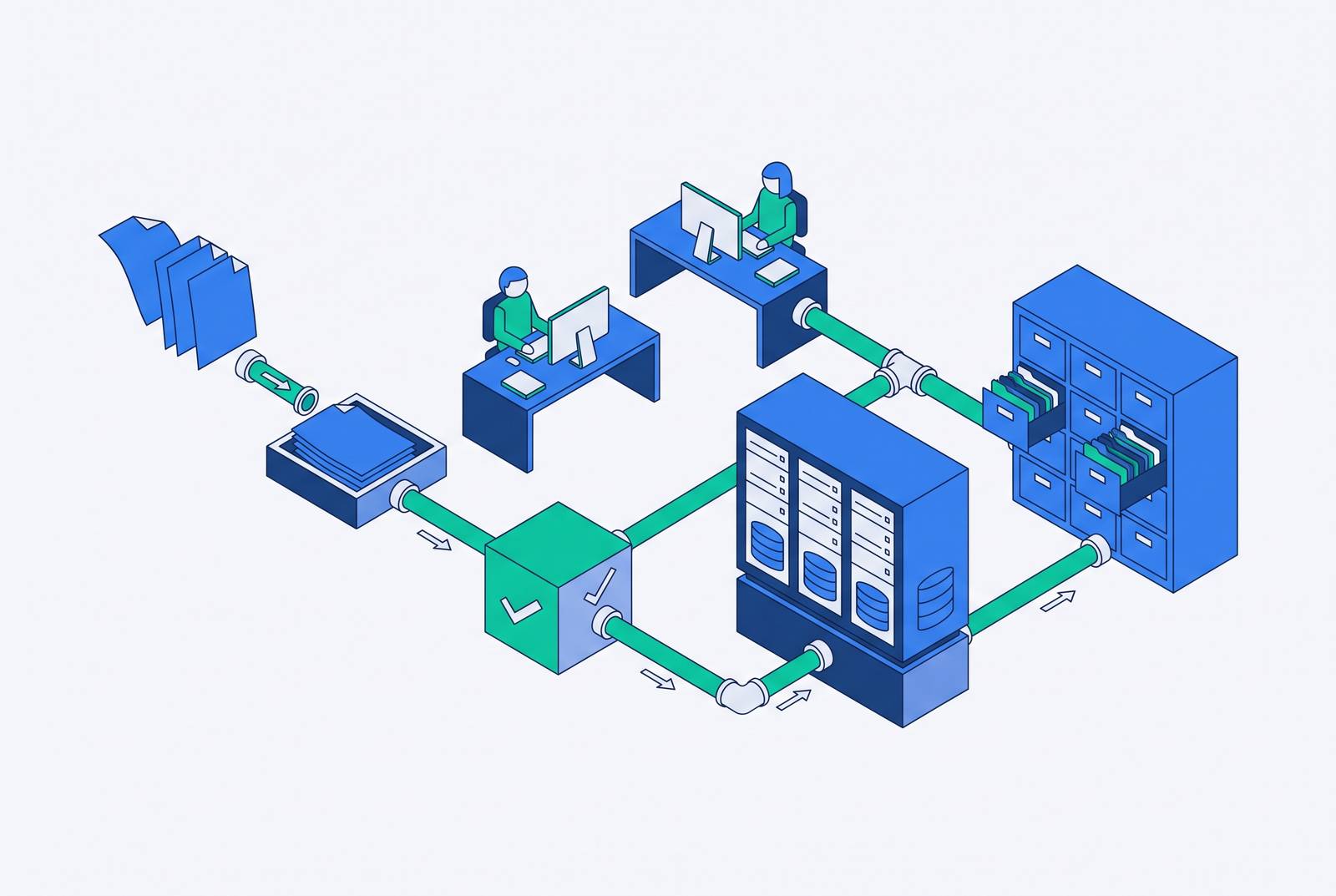
So teams that never experience the January scramble build a sequence that gates every disbursement on form receipt, no matter where the calendar sits. The sequence starts the moment a new payee gets added, not when a payment gets approved. Step one: determine U.S. or foreign status right at intake, before a single payment detail gets entered, routing the payee to the correct form from the start. Step two: deliver that form request through a self-service portal, using an email with a PDF attachment only as a fallback. The IRS permits electronic W-9 submission, and a requester can "establish a system for payees and payees' agents to submit Form W-9 electronically," provided the electronic signature authenticates and verifies the submission. A portal produces a structured, machine-readable record instead of a scanned attachment someone has to retype. Step three: validate the moment the form arrives, not months later at filing time. Check that required fields are complete (address, certification, signature), run the TIN through the IRS TIN Matching program before any payment releases, and cross-check the submission against existing records to catch U.S. indicia conflicts before they become a liability question. Step four: hold the disbursement until validation clears. A soft hold with a plain, vendor-facing explanation (not a cryptic system error) moves faster toward resolution than a payment that silently fails. Step five: automate the follow-up. Workflow automation tracks each vendor's progress, sends reminders when something's missing, and builds the audit trail as it goes, then escalates to a real person on the AR team before the hold can turn into a relationship problem. Step six: log everything and keep it. The audit trail needs every form reviewed, not just the one that got accepted, including the rejected and superseded drafts, retained for at least four years past the last reportable payment. For enterprises spanning multiple business units, a centralized version of this sequence stops the same vendor from getting chased by three different departments with three different processes, which is its own kind of chaos nobody needs.
TIN validation mechanics
TIN validation is the step that turns a form that was received into a form that actually holds up. Skipping it turns a few minutes saved at intake into a multi-week remediation cycle later. The IRS TIN Matching program lets payers and their authorized agents check a name-TIN pair before anything gets filed, so running that check before you release a payment catches the mismatch before the IRS ever sends a notice about it. Here's what happens when it isn't caught: a payee files under a personal Social Security Number but submits paperwork under a business name, the mismatch surfaces after filing, and the IRS sends a CP2100 or CP2100A. From there, the payer has 15 business days to send a B-Notice to the affected payee and 30 business days to start 24% backup withholding if the payee doesn't respond with a corrected W-9. The errors that slip through without validation tend to be the same handful every time: a single-member LLC submitting the LLC's EIN when the owner's personal TIN was required, or a legal name on the form that doesn't match what the IRS has on file under that TIN. Catching these in real time, while the payee is still sitting in the onboarding portal, means the correction happens on the spot. Catching them three weeks later means tracking down someone who may no longer be checking that inbox. For enterprises running multiple paying entities, a shared validation layer stops the same payee from submitting the same broken form to five different business units. Validate once, associate the result securely across entities, and the redundant chase disappears. A W-9 carries a Social Security Number or EIN, which counts as sensitive personal data, so storage needs encryption and access controls that meet the same bar as any other PII in the system.
Keeping forms current
A form that was valid at onboarding doesn't stay valid forever; the refresh schedule needs to be built in from the start. W-8 forms carry a hard expiration: they generally expire at the end of the third calendar year after the year they were signed, sooner if something changes that makes the information on the form incorrect. A W-8BEN signed in 2024 needs a refresh no later than the end of 2027. W-9 forms don't carry a formal IRS expiration date, but the underlying obligation to keep accurate records means a W-9 goes stale the moment the facts behind it change: a legal name changes, an entity reclassifies, a new TIN gets issued, or a payee who used to be foreign becomes a U.S. person. Specific events that should trigger a fresh W-8 include a change in FATCA status or an address that shifts to a U.S. location, either of which can quietly invalidate a treaty claim the payer is still relying on. But the nonimmigrant status-change case from earlier needs its own trigger. Because status can shift without the payee saying a word, an annual review catches what a change-event trigger alone would miss. At scale, this is where manual processes collapse. Grant Thornton notes that W-8 and W-9 forms in large private equity fund complexes often remain paper documents, with someone manually requesting, collecting, and processing each one, which makes a systematic refresh program nearly impossible without automation behind it. A centralized system that flags an expiring W-8 months before it lapses, rather than at the moment a payment is about to go out, keeps the pre-payment gate intact across the entire life of the vendor relationship, not just the first thirty days of it.
What the 2026 draft W-9 revision means
The IRS has a draft W-9 in circulation (Rev. June 2026) carries two changes you need to get ahead of before the final version lands. The draft adds a digital asset broker certification checkbox in Part II, so a qualifying U.S. digital asset broker can certify to another broker that it's exempt from information reporting under the multiple broker rule, timed to line up with the new Form 1099-DA. If your payee base includes digital asset brokers, you need to watch this change land. Teams that don't pay digital asset brokers can file it under "someday" without losing sleep. The draft also introduces a new exempt payee code, Code 14, and any substitute W-9 currently running inside an organization's own systems will need an update once the final form is published to reflect both additions. An earlier January 2026 draft would have eliminated a sole proprietor's ability to use an EIN on the W-9, forcing an SSN instead. The June 2026 draft reversed that entirely, restoring the original rule allowing sole proprietors to use either an SSN/ITIN or an EIN. Any team that rushed to rebuild its intake process around the January draft built it around a rule that no longer exists. The form currently in force remains Rev. March 2024, and the right move is to keep using it until the IRS publishes a final version, then confirm every collection request is running on that final form before issuing new ones. One item to flag for later rather than now: the Crypto-Asset Reporting Framework is going to require documentation that current W-8 forms simply don't capture. Nothing needs to change today, but if your enterprise has international digital asset counterparties, you should start thinking about where that gap gets filled.
Building the exception management layer: B-Notices, backup withholding holds, and escalation paths
Even a well-built pre-payment sequence won't catch every exception, and the teams that handle the leftovers well have already designed the path before the first B-Notice ever lands. The clock on a B-Notice is not a suggestion. Fifteen business days to send the First B-Notice after a CP2100 or CP2100A arrives, thirty business days to start 24% backup withholding if the payee hasn't responded with a corrected W-9. If the same payee generates another mismatch within three calendar years, a Second B-Notice follows, and that payee has to go to the Social Security Administration or the IRS to resolve the discrepancy before a new W-9 can even be accepted. A team with no tracked B-Notice history per payee has no way of knowing that second-notice threshold has been crossed. On the foreign side, a W-8 that becomes unreliable (U.S. indicia surfacing, an expired form, a change in circumstances) forces the withholding determination that relied on it to pause, and presumption rules take over, typically defaulting to 30% withholding on FDAP payments until a corrected form arrives and clears validation. Most non-responses resolve with an automated reminder when the payee is engaged and the process is frictionless. The harder cases, a payee disputing their TIN, a foreign entity with murky FATCA status, a sole proprietor whose name doesn't match IRS records, need an actual person who can work the conversation without accidentally releasing a payment before the exception clears. None of this holds up under examination without a documented trail covering the full lifecycle: when the B-Notice went out, when backup withholding started, when the corrected form arrived and validated, when the hold lifted. That record is what proves the team acted inside the required windows. The overlap here with ordinary AR collections work is hard to miss: the same persistent, documented follow-up that chases down an overdue invoice is the exact skill needed to chase down a corrected W-9 before a B-Notice deadline closes. Teams that already have that muscle built, rather than treating it as a problem for the tax department to solve alone, close these loops faster than everyone else.