ERP-Integrated AR Processing for Mid-Market Finance Teams
Real ERP integration determines whether AR automation actually improves cash flow.
Mid-market finance teams keep buying AR automation tools and keep getting the same DSO numbers back. The reason isn't the tool. It's whether that tool actually talks to the ERP, or just sits next to it, looking busy. This piece walks through how integrated AR processing works, what good ERP connectivity enables, and where mid-market teams should get things right to turn receivables into a reliable cash engine.
Why mid-market AR sits in a structurally difficult position
Mid-market firms already carry enterprise-grade complexity, including multi-entity structures, cross-border sales, and mixed ERP estates assembled through acquisitions and regional rollouts.
What they don't have is the enterprise toolkit that's supposed to come with that complexity. No offshore shared-service center doing the grunt work at 2 a.m. No deep bench of AR specialists. No offshore shared-service centers, no deep AR bench, limited automation budgets. Companies manage an average of three ERP systems, creating data silos that make it difficult to build a unified view of customer behavior, payment history, and dispute patterns.
The data backs this up, and it's not flattering. That's not a rounding error. That's basically a coin flip on whether the data underneath your AR process is even trustworthy.
Meanwhile the cash cycle itself is stretching out. Global working capital hit its highest point since 2008 in early 2025, climbing to 78 days Quadient, 2025. That's happening right when mid-market firms have the least room to absorb it. And the money sitting idle because of it isn't small: Hackett Group's U.S. Working Capital Survey puts $1.7 trillion in excess working capital trapped at U.S. companies, with AR the single largest chunk of it, an opportunity worth roughly $600 billion, as DSO logged its second straight year of getting worse thanks to buyers with more leverage and longer payment terms.
None of this is really a story about effort. Finance teams aren't slacking off. The systems underneath them weren't built for the job they're now being asked to do, and that gap is what produces the automation blockers described next. Cherry Bekaert's 2025 Middle Market CFO Survey of 200 U.S. finance leaders at firms between $5M and $250M in revenue found that 49% said poor data quality was already blocking critical automation and decision-making efforts StealthAgents/Hackett Group data, 2025–2026.
What "ERP-integrated AR" means
Start with what an ERP is actually for. It's the system of record, the place that logs what already happened: invoices went out, payments came in, the general ledger got its entries. It's a rearview mirror. A very accurate one, but still a rearview mirror.
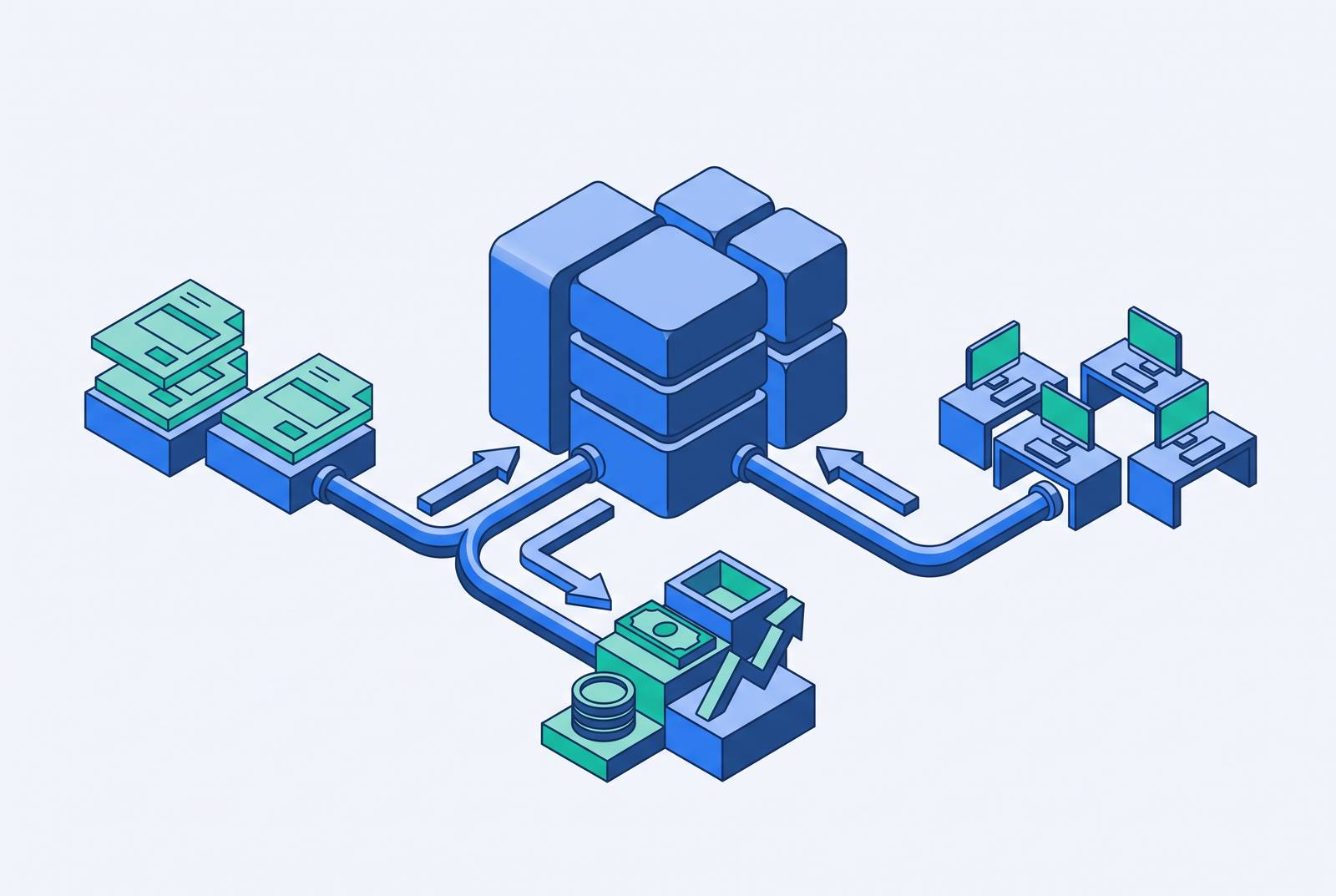
That's the gap ERP-integrated AR is supposed to close. The automation layer sits on top of the ERP and stays in constant conversation with it: reading open items, running collections and cash application, then writing the matched results back into the ledger. The ERP keeps its job as the authoritative record. The AR layer does the legwork the ERP was never built to do.
Compare that to the bolt-on tools a lot of teams end up with instead, platforms that never sync back to the ERP. Separate platforms that don't sync back to the ERP create dual data entry, reconciliation gaps, and delayed visibility. Bi-directional is the phrase that actually matters here. Customer accounts, sales orders, inventory records, and the general ledger all need to stay in sync through the whole order-to-cash cycle, and that's true whether the underlying system is NetSuite, Microsoft Dynamics, Sage Intacct, or SAP.
A lot of mid-market companies already run Sage Intacct as their core accounting system. Its built-in AR module handles invoicing, payment processing, cash receipts, and basic dunning. For a company with modest invoice volume, staying native avoids integration headaches entirely and keeps every financial record in one place. That's a legitimate place to start, not a compromise.
Roughly 70% of ERP revenue now comes from cloud deployments as of 2025 StealthAgents/Hackett Group data, 2025–2026 Softengine/Gartner, 2025. Most mid-market companies, without necessarily realizing it, are already sitting on infrastructure built for modern, API-based connections StealthAgents/Hackett Group data, 2025–2026 Softengine/Gartner, 2025. The plumbing for real integration is mostly already there. The question is whether anyone's turned the valve.
Integration isn't some checkbox you tick at the tail end of a rollout, and this gets missed in a lot of AR buying decisions. It's the thing that decides whether every downstream function, collections prioritization, cash matching, forecasting, is working off good data or garbage.
The six AR functions that integration either connects or breaks
Think of AR less like a toolbox and more like a chain.
Cash application is the first link: matching money coming in against invoices going out. The match has to post back to the ERP, or the ledger's wrong from that moment forward, and every report built on it inherits the error. Collections and dunning come next, following up on overdue accounts, and prioritization requires live aging data from the ERP, not a weekly export.
Deductions management is the messy one. Figuring out why a customer paid less than invoiced, and whether that's legitimate, requires pulling the original invoice and order data straight from the ERP to argue the case one way or the other. Cash forecasting depends on the same real-time link: predicting when money lands only works off live payment history and open AR, not a snapshot from last month.
Credit management leans on ERP transaction history too, feeding the credit scores and limit checks that flag a risky customer before they become a write-off. And receivables visibility, the dashboards showing AR aging and DSO and collector performance, is only as good as the sync feeding it. Garbage in, pretty chart out.
There's a practical dependency that gets overlooked constantly: payment rails. ACH, card, lockbox, wire, virtual card, a platform needs to cover all of them, because any gap forces someone back to manual work, and manual work is exactly what breaks the automated chain everyone paid for. As invoice volumes increase and customer requirements become more sophisticated, siloed cash application, deductions, collections, and ERP systems begin to limit efficiency and visibility, so the system looks automated but the handoffs are still manual. The six core functions, per multiple sources, are as follows.
Where AI fits inside an integrated AR stack without clean data
AI's real contribution to AR is a shift in tense.
Billtrust CPO Lee An Schommer, quoted in PYMNTS reporting, makes a useful point about how this plays out day to day: a short payment doesn't have to be treated as some isolated mystery. Purpose-built AR platforms apply contextual intelligence on top of ERP data, treating a short payment not as an isolated variance but in the context of that customer's behavior history, keeping cash moving rather than creating an exception queue.
Agentic AI is the next step past that, systems that don't just flag a problem but recommend a fix and, increasingly, act on it without a human clicking approve. Gartner data cited by Billtrust shows 57% of finance organizations are already implementing agentic AI or planning to, and 54% of CFOs name AI agents a top finance transformation priority for 2026.
Here's the catch, and it's not a small one. Gartner also warns that 65% of organizations lack AI-ready data, and predicts that through 2026, over 60% of AI projects at companies without AI-ready practices will fail to hit their service-level targets StealthAgents/Hackett Group data, 2025–2026. Translation: the smartest model in the world is useless bolted onto a messy ledger. It'll just be confidently wrong, faster.
The specific chokepoint is remittance data. AI matching software wants machine-readable remittance detail arriving alongside the payment. A large share of B2B payments, particularly checks and ACH credits from smaller customers, arrive without structured remittance detail, requiring extraction from PDFs, emails, or portal downloads before matching can occur. So for mid-market teams eyeing an AI upgrade: it's not a replacement for clean data architecture. It's an amplifier. AI is not a substitute for clean data architecture; it amplifies whatever data quality already exists, good or bad.
Why most mid-market AR deployments underperform despite having automation tools
The tools exist. The market for them is growing fast. Deployment depth just isn't keeping pace, and that gap is where most of the disappointment lives.
Part of the reason is structural. Companies manage an average of three ERP systems, per Schommer's comments in PYMNTS coverage. Three systems means three silos, and three silos make it nearly impossible to build one clean view of a customer's payment behavior or dispute history. Feed a predictive model fractured data like that and it produces fractured, unreliable output. No model fixes a data problem by being smarter.
There's also a gap between having automation and having deep automation. That's a wide space between "we bought the tool" and "the tool is actually doing the hard part." A lot of teams are automating the easy 80% and still hand-keying the 20% that actually eats the week.
And the handoffs are where things quietly fall apart. As invoice volume climbs and customers get pickier about how they pay and dispute, siloed cash application, deductions, and collections systems start choking on their own limits. From a distance it looks automated.
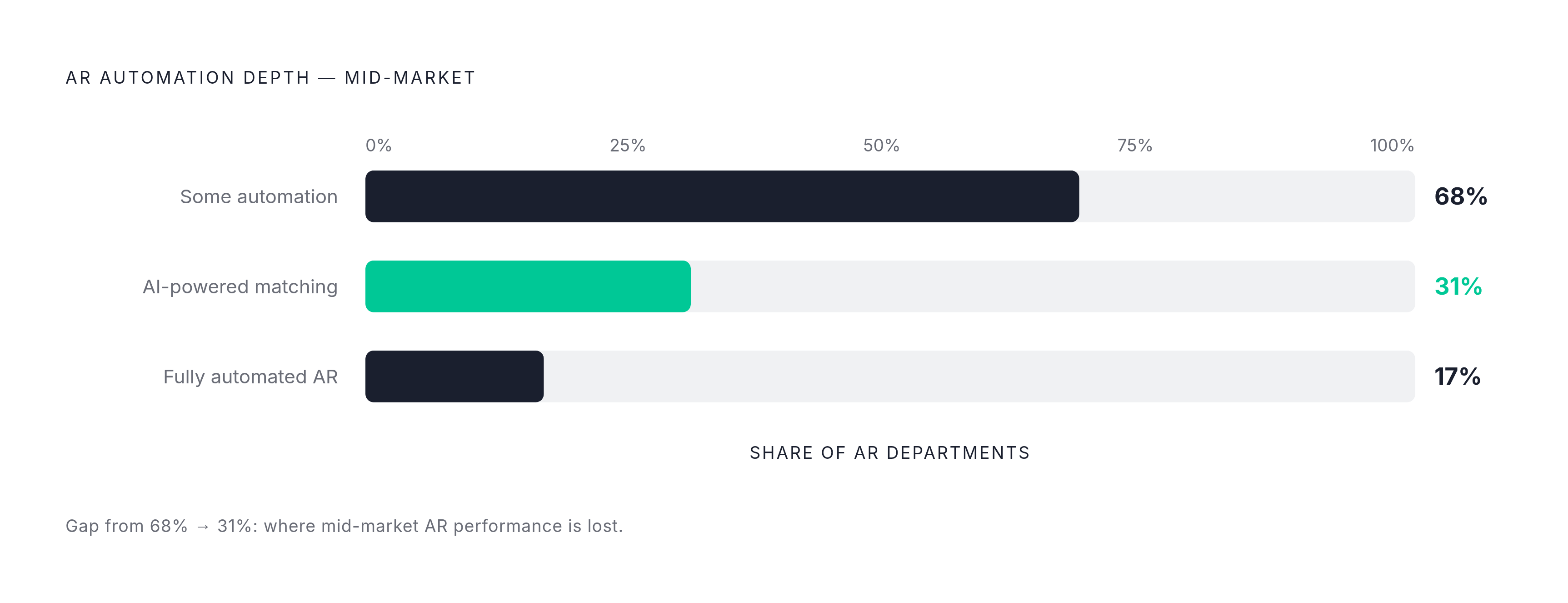
The 49% data-quality finding from Cherry Bekaert resurfaces here as the explanation: automation tools layered onto poor-quality ERP data reproduce the same errors faster, not slower. Automation layered on top of bad ERP data doesn't fix the data. It just reproduces the same mistakes at higher speed. And mid-market companies carry a specific aggravating wrinkle here: mixed ERP estates from acquisitions often mean there's no single source of truth to integrate against in the first place. According to PYMNTS Intelligence's "From Friction to Flow: AR Automation in 2025," 83% of firms have yet to fully automate their AR operations, showing that while the market for tools is growing fast, deployment depth is not keeping pace. Per StealthAgents, 68% of AR departments use some cash application automation, but only 31% use AI-powered matching, a significant gap pointing to deployment immaturity, since having a tool is not the same as having integration depth.
The ROI evidence and its timeline to realization
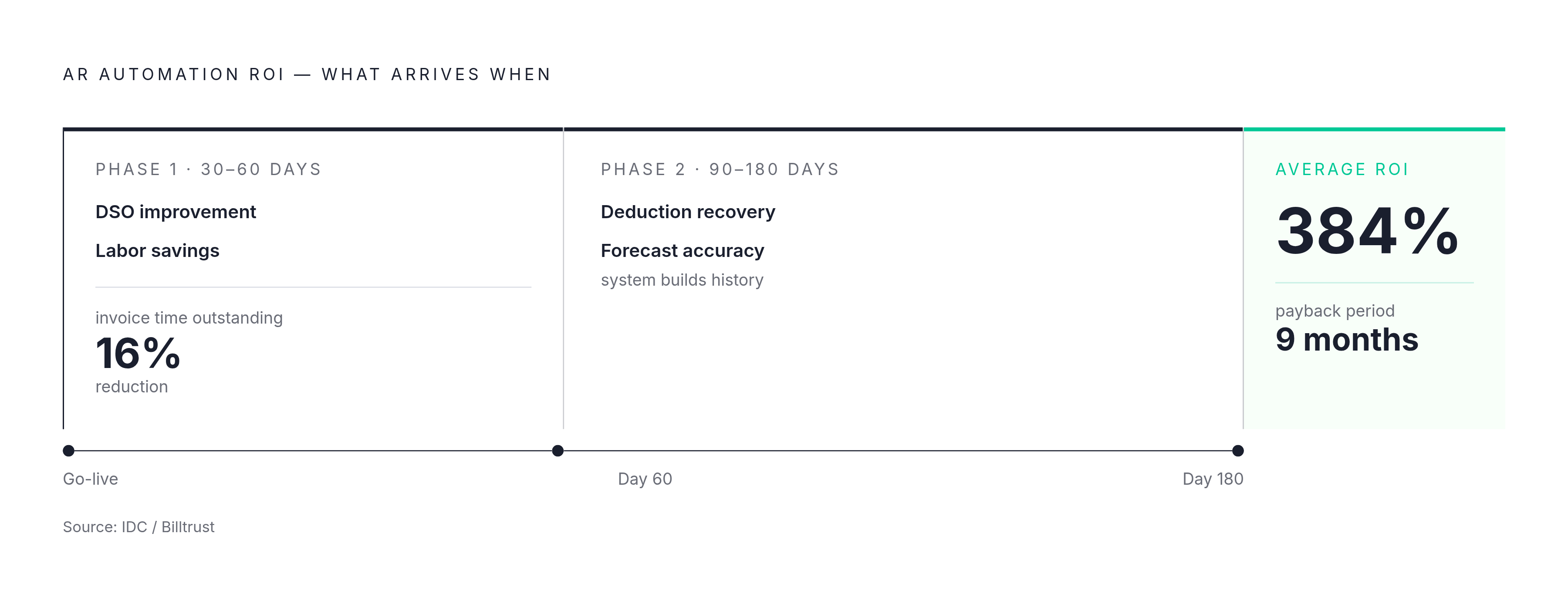
IDC research on Billtrust's AR automation platform reports an average ROI of 384%, with payback in just 9 months. Read that as a ceiling to understand, not a promise every deployment hits.
The supporting numbers back the general direction, if not that exact peak. McKinsey Global Institute's 2025 research on order-to-cash automation found average cost reductions of 30 to 40% per transaction, with mature implementations landing a 3.1x ROI over three years.
PYMNTS' own research fills in the picture: close to 85% of companies automating AR reported processes that were more efficient, more accurate, or generally smoother; nearly 73% saw a bump in cash flow, savings, or growth; 63% of firms running highly automated AR saw fewer invoicing errors. IDC and Billtrust also found automation cuts the average time an invoice sits outstanding by 16%.
Timing affects when results appear, and vendors don't always advertise this. Most deployments show measurable results within 30 to 60 days of going live, and DSO improvement and labor savings appear first. The harder wins, better deduction recovery, sharper forecast accuracy, take longer, usually 90 to 180 days, as the system builds up enough history to actually get good at its job.
There's a staffing number to sit with too. Net headcount reduction from AR automation typically runs 20 to 35% of the pre-automation AR team.
These numbers come from vendors and vendor-funded research. The 384% figure is a mean across one company's customer base, not a law of physics. ROI scales with how deep the integration goes and how clean the data is underneath it, which is really the argument running through this entire piece. Supporting evidence shows that 93% of respondents confirmed their AR automation software delivered the ROI they expected (Billtrust survey), and 75% of finance leaders made AR automation a high or very high priority for 2025 (IDC research, per Billtrust).
How to evaluate ERP connectivity when choosing an AR automation platform
ERP integration should sit at the top of the evaluation checklist, not somewhere in the middle after "does it have a nice dashboard." Integration issues affect the majority of AR automation projects, according to Billtrust's research, which makes this the highest-leverage question a buyer can ask.
A few questions separate a real integration from a demo that looked good in the sales call. Is the sync bi-directional, or is it read-only, because a one-way sync just leaves the ERP as a stale record nobody trusts? Is the connection a prebuilt connector, or does it require a custom API build, since custom work drags out timelines and creates a maintenance job nobody budgeted for? Which ERPs does the platform actually support natively, and does that list include NetSuite, Microsoft Dynamics, Sage Intacct, and SAP at minimum? How does the platform handle a mixed ERP estate?
The payoff for getting this right is measurable. That's the number to hold vendors to.
Given that roughly 70% of ERP revenue is now tied to cloud deployments, most mid-market buyers should lean toward cloud-native AR platforms with API-based connectors rather than legacy middleware that's going to need a consultant every time something changes Softengine/Gartner, 2025. On timelines, treat speed claims with a healthy dose of skepticism, but also use them as a yardstick: platforms advertising mid-market go-lives in as few as three weeks with prebuilt connectors exist, so any vendor quoting a timeline measured in quarters deserves a follow-up question about why.
And for companies already running Sage Intacct with lower invoice volume and less operational complexity, starting with the native AR module before adding a purpose-built platform on top remains a reasonable, lower-risk first move, not a consolation prize. Companies with fully integrated ERP and finance automation systems process transactions 5–7x faster than those with siloed operations, according to Procindex, a benchmark for what integration quality difference produces Procindex, 2026.
A factual comparison of the leading AR automation platforms for mid-market teams
This isn't a beauty contest, it's a look at what the research actually documents. ERP integration depth, mid-market fit, and functional scope are the lenses, not vendor prestige.
One platform covers the full AR chain in a single system: cash application, collections, credit management, deductions, and receivables visibility, all under one roof. It claims native, bi-directional connectors across ERPs, banks, payment processors, and AP portals, with prebuilt integrations spanning more than 50 ERPs and adjacent systems. For mid-market buyers specifically, it advertises a three-week go-live, AI-prioritized collector worklists, and automated remittance capture pulling from email, scanned checks, and customer portals.
The claimed mid-market results, if they hold up in practice, include a 10% reduction in DSO, cash application automation above 90%, a 30% jump in collector productivity, and an 80% cut in manual work across receivables tasks. Independent commentary from Lido, dated September 2026, positions the platform as the enterprise AR automation market leader, while also noting that implementation can run complex and take months, with pricing on the expensive end for an enterprise-grade tool. Verify the three-week timeline against your own ERP complexity before signing anything, because "enterprise platform" and "three-week go-live" don't always describe the same rollout.
Sources
- Accounts Receivable Gets an AI Upgrade | PYMNTS.com
- Best Accounts Receivable Automation Software in 2026 - Lido
- Accounts Receivable Automation Market - Share, AR Automation Industry & Trends
- AI Accounts Receivable Automation Statistics 2026: DSO, Cash Application, and ROI Data
- Best Invoice-to-Cash Applications (Transitioning to Accounts Receivable Solutions) Reviews 2026 | Gartner Peer Insights
- Dirty Data and Legacy ERPs Stall Accounts Receivable Automation | PYMNTS.com
- ERP Integration for Finance Automation