Customer Communication Tone in Automated AR Outreach
Tailored tone in dunning sequences recovers payments while preserving customer loyalty.

What automated AR outreach is actually doing to customer relationships
Most businesses treat invoice reminders like a chore. Automate it, forget about it, hope money shows up. That instinct makes sense. When you're managing hundreds of accounts, you want the system to handle it so you can focus on everything else.
The problem is that thinking is exactly why so many AR systems quietly destroy customer relationships while the numbers look fine on the surface.
Nearly 90% of businesses see roughly 30% of invoices paid late. For companies extending net-30 or longer terms, that's an average of 4.6% of revenue just sitting out there, uncertain. The reflex is to send more messages, faster, to more people. More coverage. But coverage isn't what moves customers to pay. Tone is.
Tone isn't a branding preference. It's not a "nice to have" your marketing team worries about while the adults handle collections. It's the operational lever that determines whether a customer opens your message, responds, pays, or quietly decides they have better things to do today.
Think about what an invoice reminder actually is. It's one of the most frequent direct contacts you have with a paying customer. Not a sales pitch. Not a newsletter. A personal message about money, landing in their inbox or on their phone. How that lands shapes how they feel about doing business with you. Full stop.
Getting chased for an invoice you already paid is a loyalty killer. Receiving something that reads like a legal threat when you're four days past due makes someone take a competitor's meeting. Research consistently shows that customers who have a very good experience repurchase at dramatically higher rates than those who have a poor one. The gap is enormous. That makes AR communication quality a retention issue, not just a service one.
AR stops being a defensive cost center the moment you treat it as a relationship function. Recover the payment and strengthen the account at the same time. That only works when tone matches that intent.
How tone should evolve across the dunning sequence
The dunning sequence is not one message. It's a conversation that plays out over days or weeks, and the tone should move the way a real conversation does. A good collector, a real human one, doesn't open every call the same way. They read the room. Automated systems should do exactly the same thing.
There are three distinct stages, and each one carries a different contract with the customer.
Pre-due and early stage. A friendly nudge before or right at the due date. Most late payments at this point are simple oversights. The tone should be helpful, even warm. You're doing them a favor by reminding them, and the message should feel like that. Think of it as good customer service, not the opening move in a collections action.
Mid-stage. Now specifics matter. Invoice number, amount, due date, how to pay. Ambiguity extends delays. This is also the right moment to surface payment arrangement options before escalation becomes necessary. The tone stays professional but gets direct. No fluff, no apologies for reaching out.
Late and final stage. This is where things get formal. Senior-level contact, possible service suspension, reference to collections. But formal doesn't mean hostile. Each message in the sequence should get progressively more serious, with clearly stated consequences. Tone escalates gradually, not all at once.
What this prevents is worth saying plainly. It stops you from sending final-notice energy to someone who missed a due date by three days. It stops you from sending a gentle nudge to an account that hasn't responded in 90 days. Both of those happen constantly in poorly calibrated systems, and both cost you money and relationships at the same time.
Why empathetic messaging outperforms aggressive pressure
When an invoice goes unpaid, there's a real temptation to get firm fast. You're owed money. It feels like the right move. The psychology and the outcomes both push back on that pretty hard.
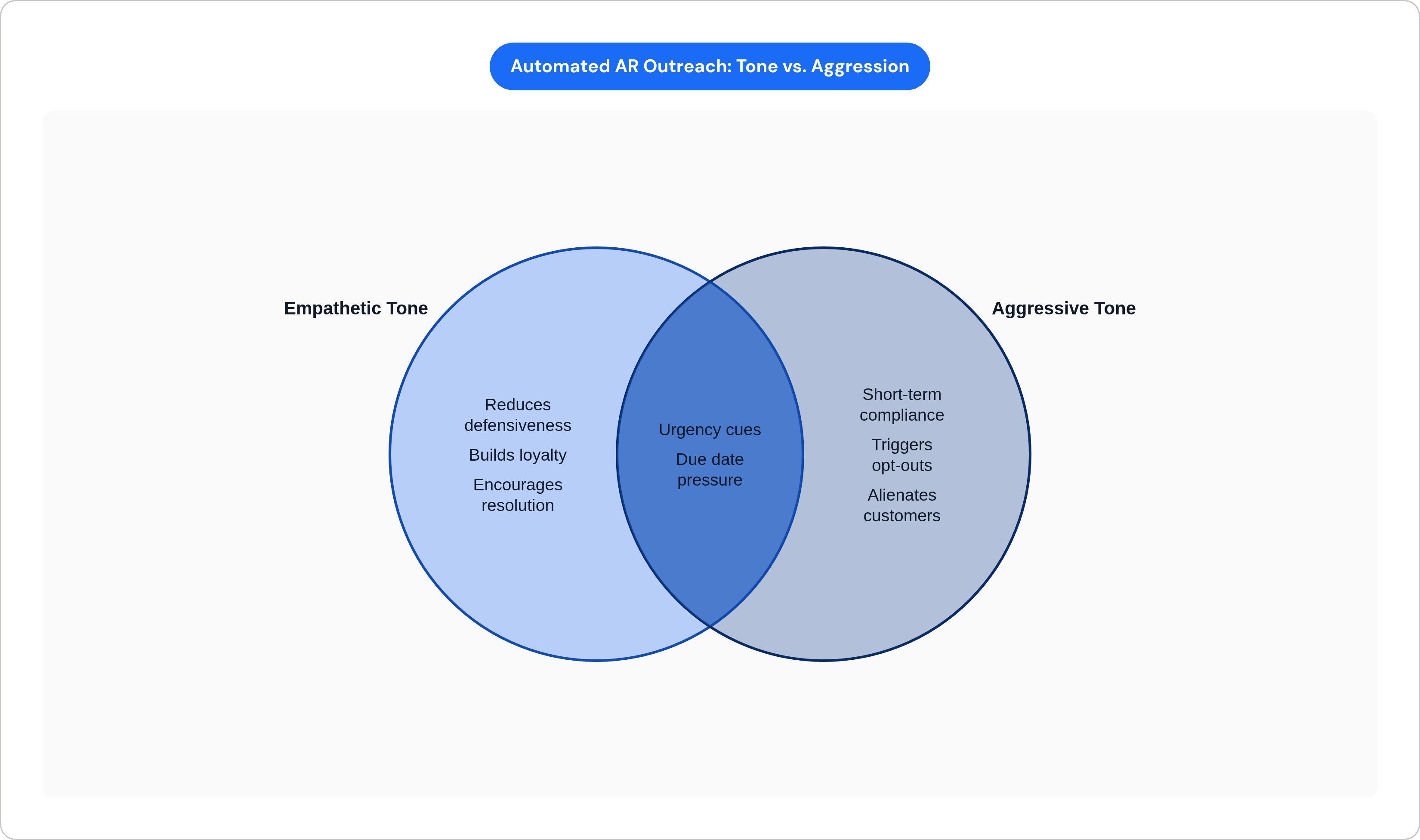
Polite, respectful messaging reduces defensiveness. It keeps the door open. Aggression can produce short-term compliance, but it reliably alienates customers and makes future interactions harder. Here's the actual mechanism: urgency and authority cues already live inside a collections message. The amount. The due date. The consequence of not paying. Those cues do their job regardless. Polite messaging lets them land cleanly without triggering the emotional response that stalls resolution.
Aggressive messaging shifts the customer's focus away from resolving the balance and toward managing the experience of being chased. Those are two very different mental states, and only one of them ends in payment.
Passive-aggressive or guilt-laden language is the worst version of this. "We noticed you still haven't paid" carries a very specific energy. It's counterproductive and fails to motivate.
The long-term stakes are real. Subscribers recovered through good dunning continue paying for months afterward. A meaningful share of a recovered customer's total lifetime value happens after the recovery event itself. The tone that closes one payment is also the tone that determines whether that customer is still around in six months. You're not just collecting a balance. You're making a bet on the relationship, whether you think about it that way or not.
What specifically to calibrate when personalizing tone at scale
One-size-fits-all templates fail everyone, every time. The enterprise account on net-60 terms with ten years of clean payment history deserves a completely different message than a new account showing irregular behavior. That's not hard to understand. It's just harder to execute, which is why most teams don't actually do it.
Here's what needs to be calibrated:
- Relationship tenure and payment history. Referencing a customer's history of on-time payments in a reminder is a genuine motivator. People respond to being recognized. It's also just accurate.
- Message basics. First name, specific invoice number, due date, exact amount, a real agent signature. These details signal a real record, not a mass blast. The difference in response rates is not small.
- Account size and risk tier. Modern AR platforms let you vary frequency, tone, and escalation path by these dimensions. If you're not using that capability, you're paying for something you're not actually using.
- Geographic and cultural norms. A tone that reads as professional in one market reads as cold or pushy in another. In B2B across borders, this matters far more than most teams account for.
- Hardship signals. When payment behavior suggests financial trouble, the tone shifts entirely. It becomes problem-solving. Modified plans, smaller installments, flexible schedules. Never send a scheduled reminder during an active hardship conversation, or after payment has already come in. That one sounds obvious. It still happens constantly.
B2B buyers strongly prefer companies that personalize their experience. That expectation crossed over from consumer markets a long time ago, and business accounts are no exception.
How AI enables tone adaptation without losing human feel
AI-driven collections strategies can meaningfully boost collection rates and reduce operational costs. Those gains are real. But they depend entirely on the system being calibrated for tone, not just for reach.
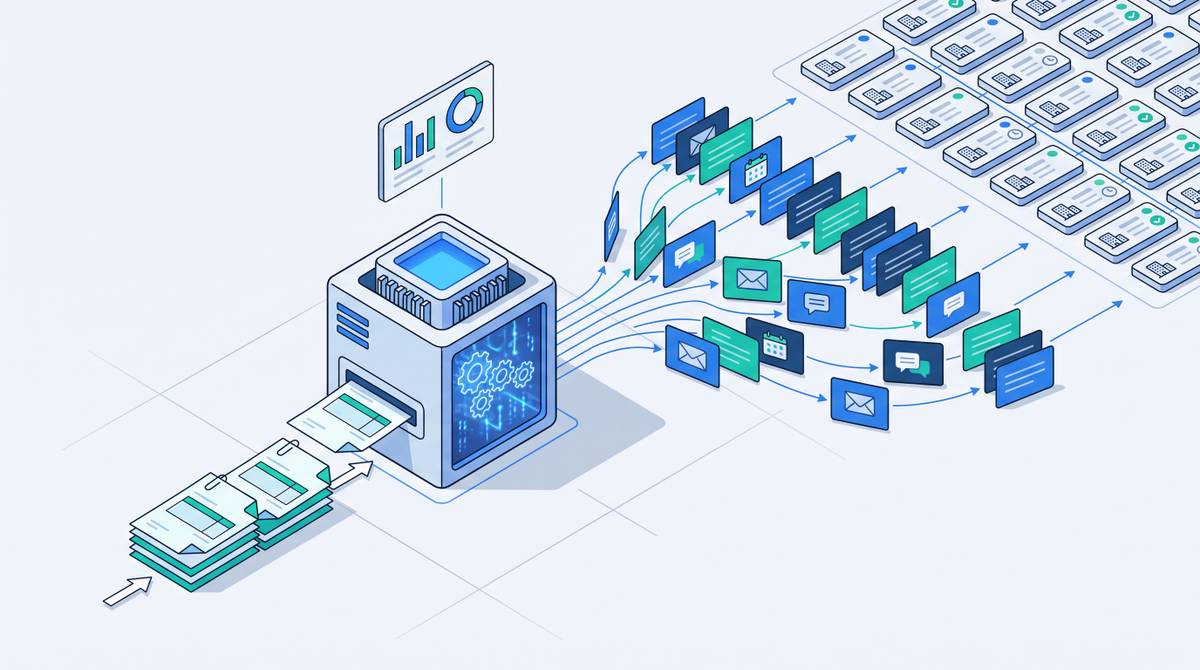
What modern AR platforms can actually do is segment by behavior in real time. A forgetful payer who always settles within a week gets a nudge. A high-risk account with a pattern of non-response gets an intervention. The message adjusts without a human making that call on every single account. At scale, that's the only way personalization becomes viable.
What AI handles well:
- Adjusting tone based on account data
- Pausing outreach during active conversations
- Maintaining consistency across hundreds of accounts without fatigue or impatience working its way into the messaging
What AI doesn't replace: the judgment call on high-value or genuinely complex accounts where relationship context matters more than pattern matching. AI's best contribution is surfacing the right accounts so human judgment gets deployed where it actually changes outcomes.
The failure mode is specific and worth knowing. Automation that optimizes for send volume but not for tone produces high outreach rates and low response rates. The metrics look okay. DSO quietly climbs. You find out too late, usually when you're wondering why recovery rates have drifted without any obvious explanation. By then the damage is already spread across a few hundred accounts.
How channel choice shapes how tone lands
Channel is not a neutral delivery mechanism. It's a tone decision. A thoughtful message in the wrong channel still lands as an intrusion.
SMS has a 98% open rate and most messages are read within five minutes. Email sits around 20 to 25%. Those numbers make SMS look like the obvious answer. But the leading cause of SMS unsubscribes is over-messaging, and spammy or aggressive tone drives a significant share of opt-outs. The channel amplifies whatever tone is inside the message. A neutral reminder in email becomes a violation of personal space in SMS if the relationship doesn't warrant that level of directness.
The sequencing approach that actually works: email carries the early-stage workload. SMS and calls improve response rates mid-to-late stage, especially on high-value accounts. Channels should be staged. Firing every channel simultaneously reads as harassment regardless of what the message says.
Voice AI deserves a mention here. In sensitive billing conversations, consistent empathy across every interaction is a genuine advantage. A well-calibrated voice AI doesn't have a bad day. It doesn't get short with someone on call fourteen of the morning. That consistency has real value, especially compared to the natural variation you get across a human team under pressure.
Where human escalation belongs in an automated tone sequence
Customers who interact exclusively with bots over time tend to pay back less. Automation alone creates diminishing returns. The goal is balance, not full automation, and knowing where to draw that line is most of the work.
Under a well-designed system, the collections team's job changes. Specialists move away from manual follow-up on routine accounts and toward relationship management and exception handling on complex disputes and high-value situations. That's a better use of skilled people.
Escalation triggers worth building into any sequence:
- Non-response after a defined number of automated contacts
- Disputed invoices
- Accounts above a value threshold
- Inbound hardship signals
- Accounts where sentiment has clearly turned negative
The handoff itself has a tone. When automation transfers to a human, that transition should feel like an upgrade in attention, not a consequence of falling behind on payments. "We wanted to connect you with someone from our team who can work through this with you" lands differently than whatever the implied alternative communicates. That language matters. The decision to escalate and the way you announce it are both doing work.
AI's real contribution to this handoff is segmentation. Identifying which accounts genuinely need human attention so that capacity goes where it actually changes outcomes, not just where the system ran out of automated options.
The compliance floor that tone strategy must stay above
Compliance is where tone strategy and legal exposure meet, and the stakes are worth being direct about.
The FDCPA prohibits harassment, false representations, and unfair practices in any debt communication. That includes automated texts and emails. The same standards apply whether a human or an AI sends the message. Regulation F modernizes these rules for digital channels and includes a 7-in-7 call cap: no more than seven call attempts within seven consecutive days on a specific debt, with a seven-day pause required after a conversation occurs.
CFPB complaints against creditors and debt collectors have grown sharply in recent years. Thousands of lawsuits are filed annually across FDCPA, FCRA, and TCPA. These are not abstract numbers.
The scale risk is specific to automation. A bad call from one human agent is one bad call. An automated system that ignores tone and frequency discipline manufactures regulatory exposure at machine speed across thousands of accounts simultaneously. That's not a hypothetical. That's what investigations look like when they get filed.
Factual, respectful, staged outreach is simultaneously the most effective tone strategy and the most compliant one. Being effective and staying above the legal line are goals that reinforce each other. You just have to build the system right. Every contact logged for audit. Consent rules governing channel access. Real-time suppression of scheduled reminders when a hardship conversation is active. Those aren't advanced features. They're the baseline for any automated AR system operating at scale.