SMB Accounts Receivable Outsourcing Providers Compared
Four outsourcing models solve different AR problems, not all the same ones.
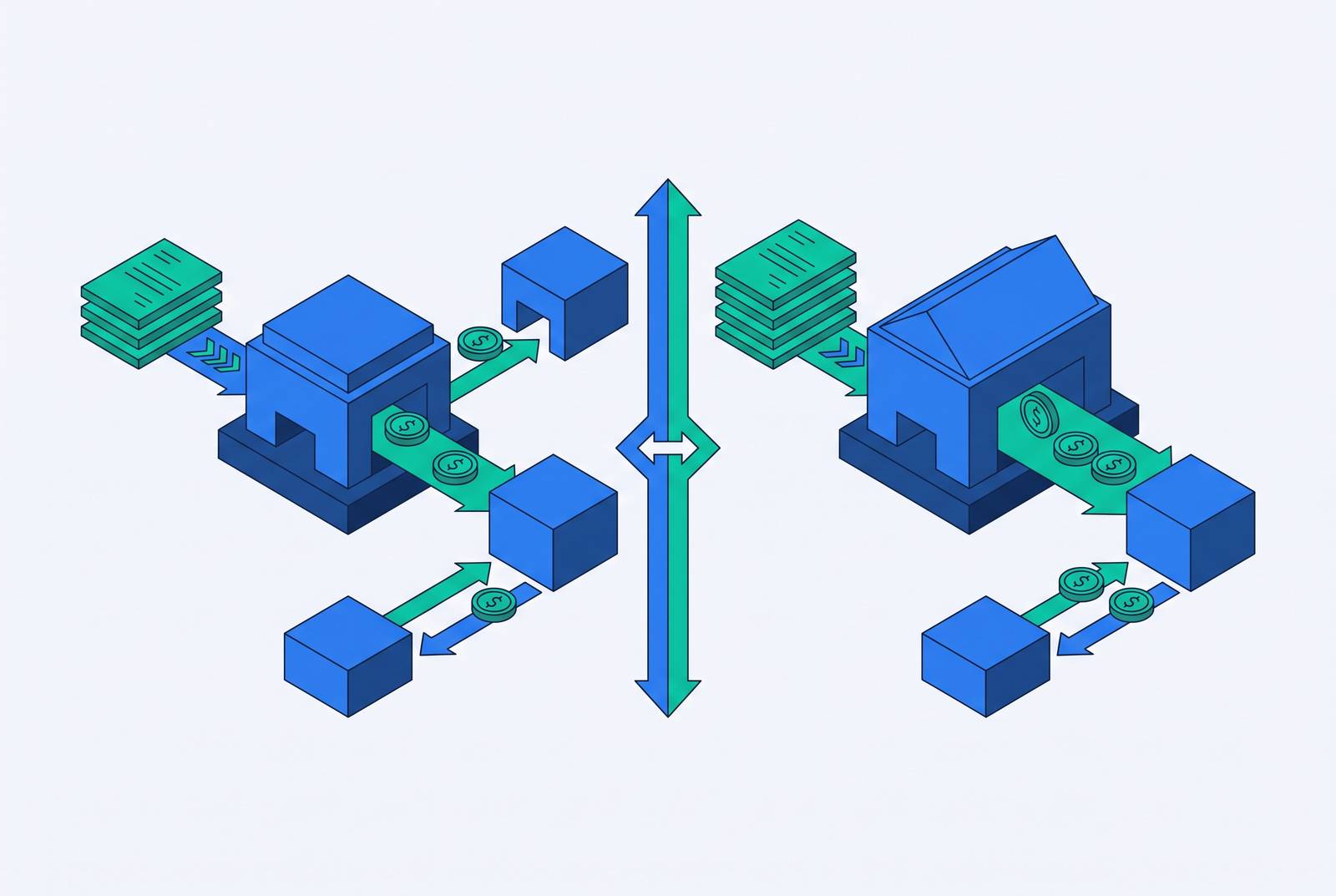
SMBs don't have a shortage of AR outsourcing options. They have the opposite problem: a crowded market where providers running completely different operations all describe themselves the same way, using words like "collections support" or "AR management" to mean four different things. An invoice that stalls because nobody followed up needs a different fix than one stuck behind a rejected supplier portal submission, and that one needs a different fix than an invoice attached to a customer who simply isn't going to pay. No single type of provider handles all three equally well. It leaves the actual leak unpatched while you pay someone to watch a different pipe.
The mismatch cuts especially hard for smaller companies. Enterprise-grade managed AR services are built, priced, and staffed around large receivables portfolios, so if an SMB signs up, it often pays for scale it doesn't need and doesn't get the attention it does need. Traditional collection agencies, meanwhile, are built to recover money after the trouble has already started rather than to stop invoices from stalling. So the real question for a finance leader staring down a stack of outsourcing pitches is which of these fundamentally different models actually matches the problem sitting in the AR aging report.
The four provider models
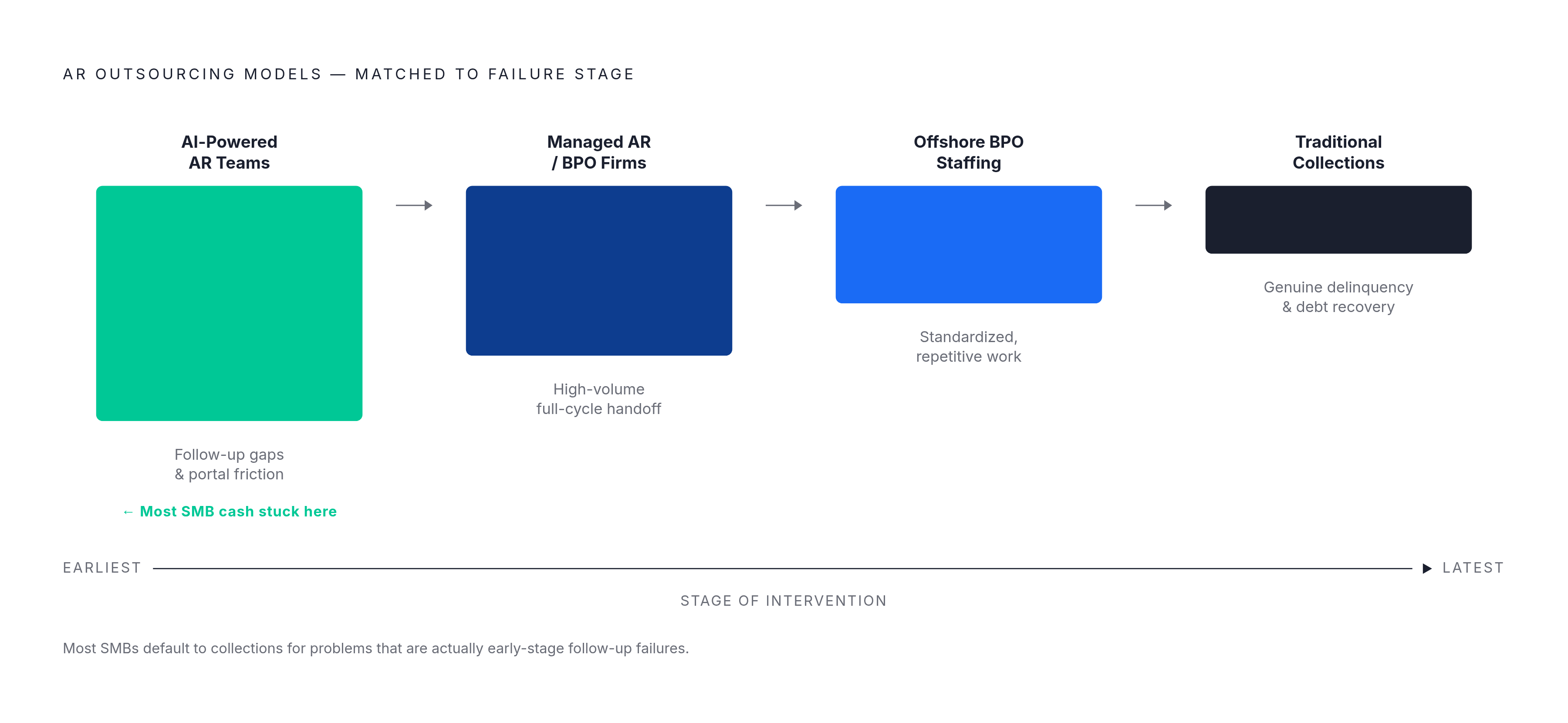
The AR outsourcing market sorts into four categories, and each one is built around a different theory of why cash gets stuck.
AI-powered AR teams operate on the idea that invoices stall mainly because no human has the time to chase them down consistently, work through a supplier portal, track down the right contact, or smooth over the small relationship friction that a templated reminder email can't touch. These providers pair AI agents that handle the repetitive, persistent parts of collections with human staff who step in for disputes, escalations, and accounts that need a judgment call rather than a form letter.
Managed AR services and BPO firms treat AR as a staffing and process function. A shared or dedicated team takes over invoicing, cash application, dispute handling, and reporting as a standing operational job, with billing structured as an hourly rate, a cost per full-time employee, or a flat monthly retainer. This model works best where transaction volume is large and steady, and where the business wants someone else running the entire AR cycle, not just chasing down late payers.
Offshore BPO staffing runs on labor arbitrage: agents based overseas or nearby handle large volumes of standardized, rule-following work for less than it would cost domestically. It's strong where the work is repetitive and predictable, and weak wherever a case needs judgment, which is most of the work that actually causes cash to get stuck. That arbitrage math is also getting shakier, since AI can now do a lot of the data-entry and reminder-sending work that offshoring used to make cheap.
Traditional collections agencies exist for recovery, not prevention. They get activated once an invoice is already seriously overdue, typically work on a contingency fee tied to what they recover, and focus on getting the debt back rather than keeping the customer relationship intact. That makes them the right call only when an invoice is genuinely at risk of never being collected.
Four models, four different assumptions about where the money is hiding. Matching the right one to the right problem is the entire exercise, and that starts with knowing which failure mode is actually draining your cash.
Identifying where cash is getting stuck before choosing a provider
Most SMBs pick a provider before they've figured out what's actually broken, which is like calling a locksmith when the real problem is that you forgot where you parked. The fix is a five-minute gut check.
Start by sorting overdue invoices into three buckets. The first is follow-up gaps: invoices sitting unpaid simply because nobody on the team got around to chasing them, consistently, more than once. This hits nearly every growing SMB with a lean finance team, because persistent follow-up takes time that small teams don't have and conversations that people don't love having.
The second bucket is operational blockers. Here, the cash is stuck behind a missing W-9, a rejected submission in a supplier portal, a resubmission loop, or an email that's been landing in the inbox of someone who left the company eight months ago. No amount of automated reminders clears these, because they need a person who will track down the right contact and push through the paperwork.
The third bucket is genuine delinquency: a customer who has stopped paying and needs to be escalated, negotiated with, or taken to collections. This is the smallest bucket for most healthy SMB customer bases, even though it's the one people picture first when they hear "AR problem."
A fast way to sort your own portfolio: for each overdue invoice, ask whether it's overdue because nobody followed up, because something blocked it operationally, or because the customer genuinely won't pay. Disputes deserve their own look, too. Short payments, one lump sum covering five invoices, or a deduction nobody explained all need a human to sort out. A rigid automated system can't handle that kind of mess, so it piles up in an exceptions queue that never resolves.
Once sorted, the diagnostic points straight at the model. Follow-up gaps and operational blockers call for persistent, relationship-aware outreach with real portal capability. Genuine delinquency calls for a recovery-focused agency. High transaction volume with mostly standardized work calls for BPO staffing. The comparison that follows maps onto exactly these three buckets.
Provider comparison: AI-powered AR teams
For the SMB whose money is stuck in follow-up gaps and portal friction rather than real delinquency, an AI-powered AR team covers the most ground for the dollar, combining persistent outreach, portal handling, and relationship judgment without the staffing overhead a BPO contract carries.
Invoice Butler exemplifies this model. It functions as a white-labeled, always-on AR team: AI agents run the full collections cycle, from the first follow-up through the final payment, while human AR specialists step in on sensitive accounts, disputes, and the kind of escalation that needs a real decision rather than a script. Outreach runs across email, phone, text, LinkedIn, and Slack, and the client gets a dedicated Slack channel showing collections activity, flagged risks, and payments as they land, in something closer to real time than the monthly report most AR teams are used to.
Where follow-up gaps are the main culprit, invoices aging simply because the internal team doesn't have the bandwidth to chase them, an AI-powered collections tool that keeps up steady outreach across email, phone, and text often closes that gap without the cost or complexity of a dedicated staffing contract or a managed-service retainer.
Operational blockers take more than a templated reminder to clear. A rejected submission in Coupa or Ariba, a missing document, or an invoice routed to the wrong inbox all need an agent that can work the portal, find the right contact, and keep pushing through a resubmission loop until the thing actually gets paid. That kind of persistence is what separates AI-native AR tools from both offshore BPO staffing and collections agencies, because those are built for recovery after the fact, not for clearing blockers before they turn into real delinquency.
Invoice Butler fits best with SMBs and fast-growing companies running lean finance teams, enterprise customers that live on procurement portals, and AR portfolios where keeping the customer relationship intact matters as much as getting paid.
Provider comparison: managed AR services and BPO firms
Managed AR services and BPO staffing firms make sense if transaction volume is high, most of the work is rule-based, and the business wants the entire AR cycle handed off, not just collections persistence applied to the overdue accounts.
Atradius Collections handles everything from automated reminders to complex negotiations and legal escalation, with pricing built to flex around performance. The company has operated since 2000 as part of the Atradius Group, whose roots trace back to 1925, and sits under Atradius N.V., a global group spanning trade credit insurance, surety, and collections. It fits companies with real cross-border receivables or multi-jurisdiction complexity needing local legal reach, which makes it a better match for larger operations than for an SMB whose actual problem is a domestic supplier portal or a follow-up gap.
Corcentric, headquartered in Cherry Hill, New Jersey, fits companies that want to hand off DSO risk entirely rather than manage it themselves day to day. That trade-off suits businesses comfortable stepping back from the AR process, less so SMBs that want to stay close to their customer relationships.
IQ BackOffice runs millions of financial transactions a year through its own platform, called Archimedes, automating AR workflows and producing real-time reporting dashboards. It's built for high-volume transactional businesses that need processing infrastructure more than they need a collections strategy.
A few things apply across this category regardless of provider. Shared-team setups mean the agent working a given account today may not be the one working it next month, so familiarity with any one customer's payment habits doesn't build up the way it would with a dedicated point of contact, a real gap for SMBs whose revenue concentrates in a handful of accounts. Integration costs, connecting the provider into an existing ERP or billing system, often raise the total bill above the quoted rate and appear only after the contract's signed.
Provider comparison: traditional collections agencies
Traditional collections agencies play a narrow but real role in an SMB's AR toolkit: recovering money from accounts that are genuinely delinquent, not managing the day-to-day AR cycle.
Bill Gosling Outsourcing fits SMBs holding a defined set of significantly overdue B2B invoices they've already tried, and failed, to collect in-house. IC System and Commercial Collectors Inc. occupy similar territory, built around the same recovery-first approach rather than upstream prevention.
The economics of this category come with real trade-offs. Contingency pricing, a cut of whatever gets collected, lines the agency's incentive up with actually recovering the money, but it also means the SMB pays the highest fee on exactly the invoices that might have been saved cheaply with earlier, lighter-touch follow-up. Handing an account to a third-party collector also sends a signal to the customer that the relationship has shifted from commercial to adversarial, which matters a great deal if that overdue customer is still someone you want buying from you next quarter.
Collections agencies get called in once a stall has already turned into delinquency, recovering what's already lost ground while the earlier stages of the AR cycle need a different kind of attention.
Pricing structures and total cost across models
Every AR outsourcing provider charges for its service differently, and you aren't just looking at six ways of splitting the same bill. Each pricing structure changes what the provider is incentivized to do, and the cheapest-looking number on the proposal often isn't the cheapest number by the time the contract runs its course.
Hourly, or per-agent-hour, pricing appears most often in offshore and nearshore BPO arrangements. It shows how much staffing you're paying for, and it works fine when transaction volume stays predictable month to month. Per-transaction pricing charges for each invoice generated, payment applied, or report produced, which protects against a slow month costing you extra but gets expensive fast once exceptions start piling up, since each one still counts as a transaction. FTE-based monthly pricing locks in a fixed fee per full-time employee assigned to the account, which makes budgeting simple but can nudge a provider toward keeping headcount high rather than finding ways to resolve accounts faster.
None of these structures is wrong on its own. The mistake is comparing a quoted hourly rate against a flat monthly retainer against a contingency percentage as if they're interchangeable numbers on the same scale, when they're really three different bets on how much work your AR actually needs and who carries the risk if that estimate is off.