Delinquent Account Classification Criteria in B2B AR
Companies set their own delinquency thresholds based on credit agreements, not federal rules.
There's no federal statute telling a company when a customer officially becomes a deadbeat. Delinquency in B2B accounts receivable is a line each business draws for itself, and that line comes straight out of the credit agreement, not some rulebook sitting in a filing cabinet somewhere.
Why no universal delinquency threshold exists in B2B AR
Two companies in the same industry, selling similar products to similar customers, can define delinquency in totally different ways and both be running a perfectly sound credit operation. That's because the trigger is contractual. The terms of each credit agreement set the clock, not some outside authority. One company might flag an account the day after it misses a due date. Another might let two or three weeks pass before anyone even looks twice. Neither is wrong, because neither is measuring against a shared external yardstick. They're measuring against the terms they themselves negotiated.
The closest thing to an outside benchmark comes from bank regulators, specifically the OCC's Comptroller's Handbook on Accounts Receivable and Inventory Financing, which treats accounts past due beyond normal trade terms as delinquent. That's a useful reference point, but it was built for banks assessing collateral in asset-based lending deals, not for a supplier deciding when to stop shipping to a slow-paying customer. Borrowing that number without adapting it to a company's own terms is like using someone else's prescription glasses. The strength might be close, but it's not calibrated to the eyes actually looking through them.
A company that never sits down and defines its own delinquency threshold is flying without a compass. It's flying without a compass. Without a clear line, there's no way to prioritize which accounts collectors should call first, no consistent basis for setting aside money for expected losses, and no trigger point for deciding when a slow payer becomes a lost cause. The threshold is the policy that everything downstream depends on.
Aging bucket structure turns a threshold into a working collections system
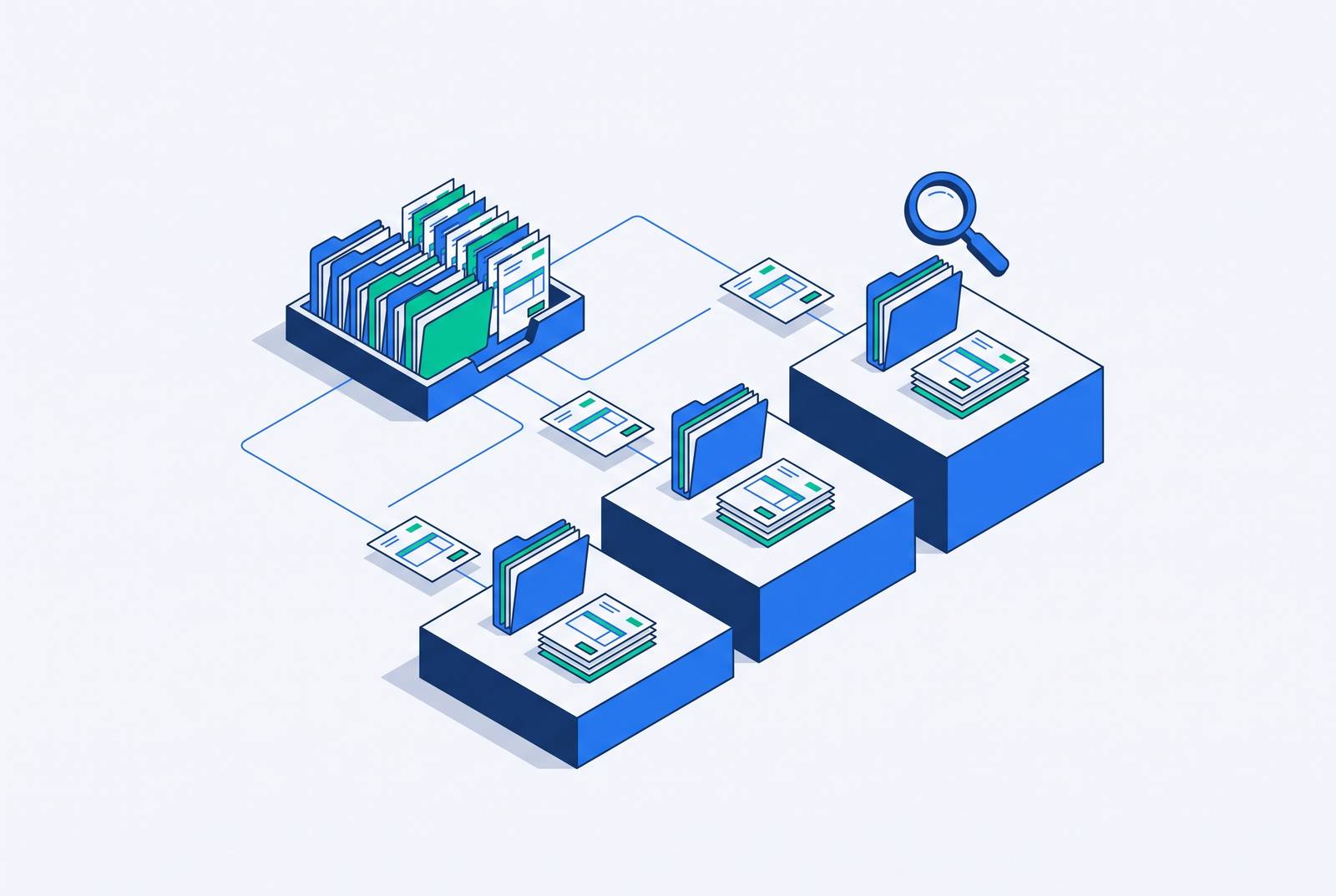
Once a company decides where delinquency starts, the next question is what to do with that decision day after day. That's where aging buckets come in: bands of days past due that group overdue invoices for reporting, provisioning, and collections action. The standard structure runs Current, 1-30, 31-60, 61-90, 91-120, 121-180, and 180+ days past due, though most working aging reports collapse that into simpler tiers: 0-30, 31-60, 61-90, and 90+, sometimes with a 91-120 and 120+ split for tracking the worst offenders separately.
Buckets only work if they match the actual terms of the deal. A customer on net 45 terms hasn't done anything wrong at the generic 30-day mark, because for that customer the first late flag belongs at day 45, when their term actually expires. Slapping a one-size-fits-all bucket structure onto every customer relationship, regardless of their actual payment terms, means healthy accounts get treated like problem accounts, and collectors waste time chasing people who aren't actually behind. Calibration here is essential. Calibration is what separates a collections team working the right list from one working the wrong one.
Each bucket also carries its own job description. Early buckets, say 1-30 days past due, call for a friendly automated nudge. Mid buckets need a human picking up the phone and figuring out whether there's a dispute buried in there. Late buckets, 91-120 and beyond, force a real decision about escalation. Put together, the bucket structure functions like a decision tree that's already been built into the aging report before anyone even opens it.
That same structure doesn't stop at collections. It also feeds directly into expected credit loss provisioning under IFRS 9 and ASC 326, where each bucket gets its own loss rate based on historical write-off patterns. The same spreadsheet that tells a collector who to call this afternoon is quietly informing how much money the finance team sets aside for accounts that will never get paid. More than 140 jurisdictions now run some version of this expected-loss framework, according to a 2026 assessment, so the bucket structure a company builds internally ends up talking to auditors and regulators whether anyone intended it to or not.
Recovery probability across buckets and the critical cliff
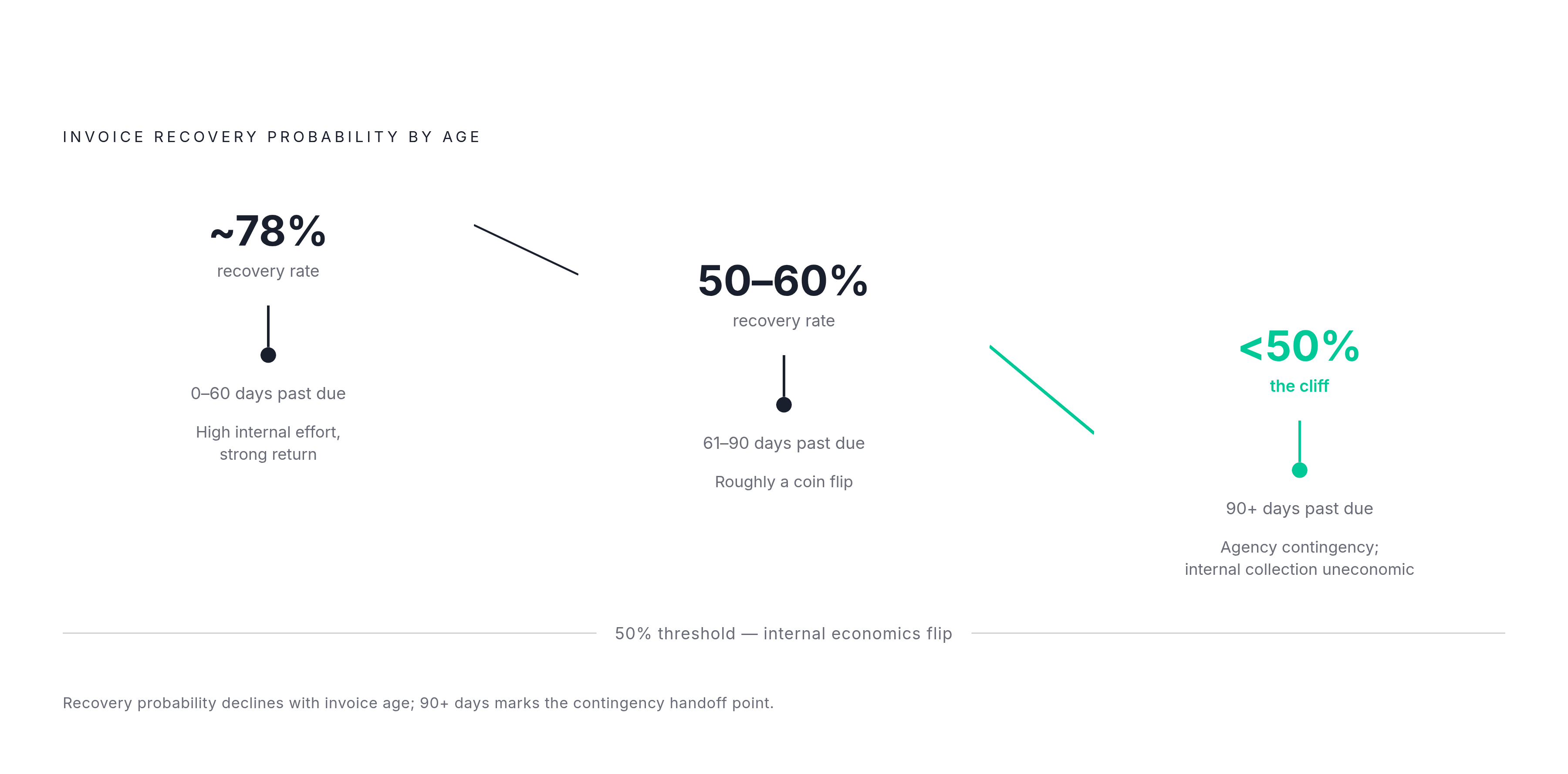
Recovery doesn't decline in a straight line as invoices get older, which is what turns aging buckets from an org chart into a genuine financial stakes. It falls off a cliff at a specific point.
Recovery odds stay strong through the first 60 days past due. Recovery probability drops from the high 70s down into the 50 to 60 percent range, so an invoice that was a coin flip in favor of getting paid a month earlier is now close to an even coin flip. Write-off rates track the same pattern in reverse: they jump once accounts cross the three-month mark, then jump again the longer they sit past that.
Why does the three-month mark matter so much? Defending the 90-day line is worth more than recovering older balances, and debt collection agencies typically take over accounts at 90+ days past due, operating on a contingency fee model that takes a meaningful share of whatever is recovered.
There's a portfolio-level version of this same warning sign. Healthy AR portfolios keep the oldest bucket below a share that signals manageable risk. Once that share climbs materially past a comfortable range, it's a flag for elevated write-off exposure, and the oldest active bucket becomes the single most-watched number on the whole aging report. Quadient's 2025 AR statistics back this up at the industry level: across Q1 and Q2 2025, a notable number of U.S. Industry segments reported a meaningful share of receivables at 91-plus days past due, a concrete measure of risk rather than a hypothetical one. It's a real, persistent concentration in specific sectors.
None of this matters, though, if nobody knows what's actually sitting inside that late bucket. Knowing where the cliff is only helps if the AR team can tell whether the invoices teetering on the edge are genuinely uncollectible or just stuck in a paperwork fight that has nothing to do with the customer's ability to pay.
Why the aging report alone can't identify the type of problem
An aging report measures one thing: how much time has passed. It says nothing about why the invoice is still open, and that blind spot is the single most expensive misclassification an AR team can make. A documentation problem and a genuine credit risk problem can sit in the exact same bucket, aged the exact same number of days, and look identical on the report, even though they call for completely different responses.
Research via PYMNTS, cited by NCRi, found that a substantial share of B2B payment delays are dispute-driven. A meaningful chunk of every company's overdue ledger isn't sitting there because the customer is broke. It's frozen behind a contract disagreement, a delivery complaint, or a billing error, and the company is fully willing and able to pay once the paperwork gets sorted. Billing errors alone can stretch out payment timelines by weeks, even when the customer has zero intention of skipping out on the bill.
NCRi's reporting points to three forces pushing dispute volume even higher. Billing complexity is outrunning the internal controls meant to manage it: rapid expansion into new markets, fragmented ERP systems, and multi-entity tax rules create small technical snags where one missing PO number or a mismatched tax code stalls payment just as effectively as a major invoicing mistake. Buyers are also increasingly using deductions and informal dispute holds as a working capital strategy, stretching out their payables without ever technically defaulting. And a "dispute first, ask questions later" habit is spreading into commercial billing, echoing the same instinct visible in consumer disputes.
A company's VP of Product has pointed to tariffs, economic pressure, and interest rate swings as reasons suppliers are chasing delinquency harder than they used to. That instinct makes sense on its face, but if the chasing gets aimed at invoices that are frozen behind a dispute rather than genuinely at risk, the effort is largely wasted. Collections labor spent hounding a customer over a paperwork snag doesn't recover a dollar faster. It burns hours, irritates a paying customer, and pulls attention away from the accounts that are actually going bad. Dispute-driven delay and credit risk call for opposite remedies, and running both through the same workflow guarantees one of them gets shortchanged.
Separating dispute-driven delay from true credit risk at the point of classification
The fix isn't complicated to describe, even if it takes some discipline to run. Every overdue account needs to get classified along two axes, not one: how many days it's aged, and why it's still open. That second question, payment-capacity problem or resolution problem, has to get answered at the first point of contact, before anyone kicks off a standard collections sequence.
NCRi's reporting lays out what that triage requires in practice. Every overdue account gets classified by whether it's a payment-capacity problem or a dispute. Collectors and AR specialists need proof of delivery, purchase orders, signed agreements, and pricing records available right at the point of contact, not buried in another department's inbox requiring a multi-day back-and-forth. And dispute aging gets tracked as its own metric, separate from standard days sales outstanding, so finance leaders can actually see the slice of the portfolio that a normal aging report hides from them.
On the credit-risk side of the split, the aging report stays in its lane: managing what's currently outstanding. Forward-looking risk assessment, financial monitoring, payment history, behavioral red flags, belongs to a separate credit intelligence function. Blend the two together and both jobs get done worse.
There's real money riding on getting this right, not just tidier spreadsheets. A State of Digitization in B2B Finance report, produced with Wakefield Research, found that a large majority of C-level executives report losing revenue when invoices go unpaid in full because of miscommunication during the payment process. A resolution failure becomes a revenue problem, not just an operational annoyance buried in a monthly report.
Once accounts are split by root cause, prioritization gets a lot sharper. Dispute resolution resources go toward the high-value invoices stuck behind a real disagreement. Collections escalation goes toward the accounts that are genuinely circling the drain. And a good chunk of disputes never need to happen in the first place if payment terms are stated clearly up front and dunning communication spells out accepted payment methods, due dates, and who to contact with a question.
How delinquency classification drives provisioning under ASC 326 and IFRS 9
Everything covered so far has been about running collections well. A second consequence follows from all of this, and it appears on the balance sheet. Aging bucket classification is a primary input to expected credit loss provisioning, not just a collections input. It's the primary data feeding expected credit loss provisioning, so a sloppy bucket structure or a failure to separate disputes from genuine credit risk flows straight into the allowance for doubtful accounts.
Under both IFRS 9 and ASC 326, each bucket gets a loss rate derived from historical write-off patterns, then that rate gets applied to whatever's currently sitting in the aging report. An aging report padded out with dispute-frozen invoices that got mislabeled as credit risk will overstate expected losses. Flip it around: a report that underestimates how much has piled up in the late buckets will understate losses instead. Either error distorts the number a CFO reports to the board.
Over 140 jurisdictions now run IFRS 9 or an equivalent expected credit loss standard, while U.S. companies follow ASC 326. FASB updated ASC 326 in July 2025 with ASU 2025-05, covering measurement of credit losses for accounts receivable and contract assets, aiming to give investors more decision-useful information while cutting down the time it takes companies to estimate those losses. A regulator is asking for sharper numbers.
A company running accurate two-axis classification, time plus root cause, ends up with a provisioning estimate that holds up under scrutiny because it can tell a genuinely impaired receivable from one that's just temporarily stuck behind a paperwork fight when applying its loss rates. A company relying on a raw aging report alone is essentially estimating losses with one eye closed.
The 90-day line as the boundary for internal resolution versus external escalation
Past that point, the economics of chasing an invoice internally flip. Recovery probability drops below half, the customer relationship has usually gone cold, whatever dispute existed has hardened into a standoff, and the customer's budget cycle has likely moved on entirely. Throwing more internal hours at an account past that point costs more than it's worth relative to what's likely to come back.
The market has already priced this in. That fee structure only makes sense once internal collection has already hit diminishing returns, agencies aren't cheap, but they're cheaper than a collections team burning hours chasing a lost cause.
That same 90-day mark doubles as the tripwire for portfolio health monitoring. Most B2B businesses aim to keep their oldest bucket below a share of total AR that signals manageable risk, and crossing materially past that level pulls a CFO's attention toward the report.
Sources
- Rising Dispute Volumes Are Holding Back Accounts Receivable
- 20 key AR statistics shaping the accounts receivable landscape
- Assets Accounts Receivable and Inventory Financing Comptroller’s Handbook
- XML 54 R42.htm IDEA: XBRL DOCUMENT v3.22.2
- New Research Shows 15% of B2B Receivables Are Overdue | PYMNTS.com
- ASU 2025-05 Financial Instruments—Credit Losses (Topic ...