Artificial Intelligence Examples Across Core Accounting Functions
AI is reshaping accounting, but adoption outpaced measurable value.
AI in accounting stopped being one thing a while back. It appears as a categorization engine in bookkeeping, a matching algorithm in accounts payable, a risk model in collections, and something closer to a research assistant in audit. The market backs this up: Mordor Intelligence puts the global market for a category of financial automation software at $10.87 billion in 2026, up from $7.52 billion in 2025, heading toward $68.75 billion by 2031 at a 44.6% compound annual growth rate. Adoption is already mainstream too: 71% of organizations worldwide have AI running somewhere in finance, and it's just how the work gets done. It's just how the work gets done.
Deloitte's Finance Trends 2026 survey found that 63% of finance departments say they've fully deployed AI, but only 21% of those active users report clear, measurable value from it. Deloitte's Finance Trends 2026 survey found that 63% of finance departments say they've fully deployed AI, but only 21% of those active users report clear, measurable value from it. Rollout has outrun payoff. Part of the reason is that teams keep treating "AI" like a single button they can press, when in reality it behaves completely differently depending on whether it's sorting bank feed transactions or flagging a suspicious wire transfer. Knowing which is which, function by function, is the actual work of getting value out of it.
Automated bookkeeping's early foothold and its progress since
Bookkeeping is where AI dug in first, and it's still the fastest-growing corner of the market, growing at a 46.1% compound annual rate per Mordor Intelligence. Makes sense: bookkeeping is repetitive, rule-based, and full of patterns, exactly the kind of terrain machine learning eats for breakfast.
In practice, that looks like software reading bank feeds, receipts, and invoices, and sorting them into the right accounts without a human touching a keyboard. Optical character recognition pulls line-item data straight off a scanned receipt, which cuts out both the typing and the typos that come with it. Machine learning models trained on a company's past transactions get better at categorizing new ones over time, the same way a new hire gets faster once they've seen enough invoices to know where things belong. And instead of waiting for month-end close to catch a weird entry, these tools flag anomalies as they happen. Dext, for instance, gets used across client accounting practices to automate the reconciliation and categorization grind that used to eat up junior staff hours.
The shift is simple to describe and still kind of wild to watch: work that took days now takes minutes. Gartner's 2024 research pegged the average time savings from AI at 5.4 hours, and bookkeeping automation is likely the single biggest contributor to that number for staff-level accountants. Not a bad return for software that basically just reads receipts for a living.
Accounts payable: what AI does from invoice receipt to payment approval
Accounts payable spending on invoice automation and e-invoicing hit $1.47 billion in 2025, up from $1.29 billion in 2024, growing at 14% a year according to Planergy, buying real capability, not just faster paperwork. That growth is buying real capability, not just faster paperwork.
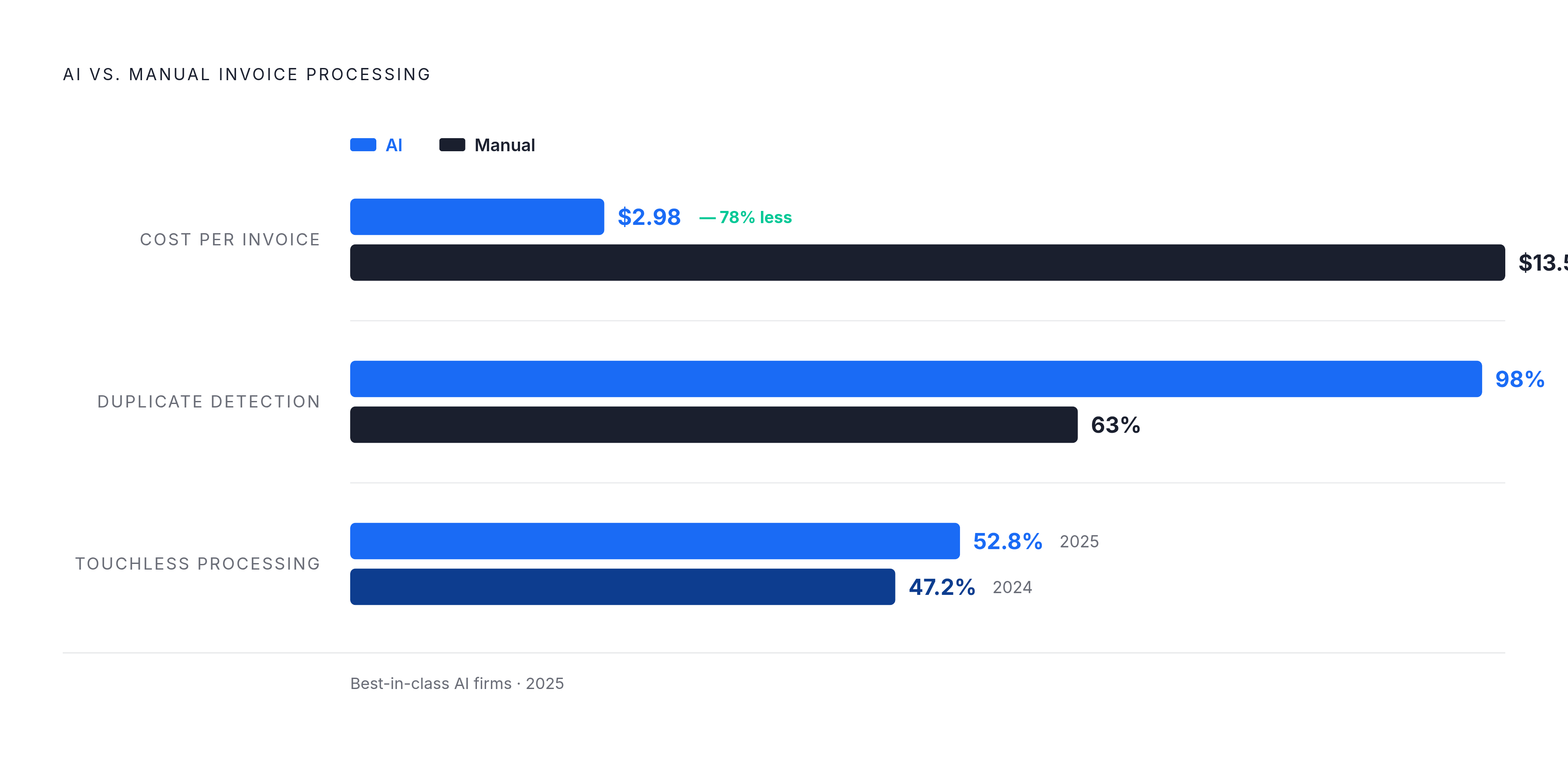
AI now pulls invoice data straight out of emails, PDFs, and supplier portals, then checks those details against vendor records and business rules before a human ever sees the file. OCR accuracy has climbed to as high as 98%, and AI-powered OCR cuts invoice processing time by an average of 35%. The matching side keeps improving too: the system learns from every invoice that gets approved, tracking which vendors auto-clear, which categories carry different approval thresholds, and which exceptions keep popping up. That learning loop is why best-in-class AP teams hit a 52.8% touchless processing rate in 2025, up from 47.2% the year before; Mindsprint reports the figures.
Duplicate invoices are where the gap between AI and manual review gets almost embarrassing: AI-assisted systems catch 98% of duplicates, compared to 63% under manual review. Fraud incidents tell a similar story, dropping 48% at organizations running AI controls. And the cost math is not subtle. Top-performing AP departments process an invoice for $2.98. Manual shops are still paying $13.54 a pop, Planergy reports, a 78% cost gap that's hard to argue with once it's on a spreadsheet. Vic.ai handles invoice processing and approval workflows directly. Docyt runs two separate AI systems, Precision AI and Generative AI, working in tandem on the same problem.
Accounts receivable: AI applied to collections, cash application, and payment prediction
The global AR automation market sat at $3.40 billion in 2025, with North America holding 44.9% of it, Quadient reports. But A large share of firms still haven't fully automated AR, which makes this the function with the longest runway left in it.
Among AI use cases in AR automation, collection management is widely cited as the highest-impact area in the category. Predictive models trained on payment history can flag an account likely to go past due well before it actually happens, which turns collections from a game of catch-up into something closer to early warning. Instead of working strictly off an aging bucket, AI ranks the collector's worklist by risk and dollar value, so the account worth chasing first is the one actually worth chasing first.
Cash application is another high-impact area analysts point to. AI studies historical invoice and payment patterns and matches incoming payments to open invoices without someone manually reconciling a remittance file. The furthest-along setups use AI agents that run the whole multi-step process on standard cases without a person stepping in at all, which sounds almost too easy until you remember someone still has to handle the weird ones.
Fraud detection and financial controls: AI as a continuous monitoring layer
Fraud and risk management is the single largest segment of that market, pulling a 33.58% revenue share per Mordor Intelligence, and that's where the money's going. That's where the money's going, and for good reason.
Traditional fraud controls sample. AI doesn't have to: it reviews the entire transaction dataset, not a slice of it, and flags anomalies as they happen instead of weeks later during reconciliation. It also learns what "normal" looks like for a specific entity, so a deviation from that baseline trips an alert. The clearest, most measurable proof point is still duplicate invoice detection: 98% caught by AI versus 63% caught by hand. That gap is why organizations with AI controls in place see fraud losses drop 48%.
None of this replaces internal controls. What it does is generate continuous evidence that those controls actually ran, on every transaction, not a sample of them. That changes what an auditor does day to day: instead of pulling a handful of invoices to test, the auditor reviews exception reports covering the full population. Less digging, more reading.
Audit: why AI adoption here has been more deliberate, and what it's doing
Audit has been slower to bring AI in, and that's by design. The applications that stick emphasize explainability, traceability, and evidence quality over raw speed, because an auditor's whole job is being able to defend a conclusion, not just reach one fast.
In practice, AI tools extract key terms from contracts and source documents and link those documents directly to the workpaper they support, cutting out a lot of the manual cross-referencing that used to eat up junior audit staff's week. They surface anomalies earlier in the cycle, which frees up professional skepticism for the things that actually deserve it. And AI lets auditors examine full transaction datasets instead of leaning on conventional sampling, which again shifts the auditor's role from spot-checking to reviewing exceptions across everything. DataSnipper, Trullion, TABS, and Auditor Intelligence are all in active use for this kind of work. Thomson Reuters' CoCounsel Audit & Accounting platform folds audit knowledge, automation, and analysis into one tool, offering citation-backed answers pulled from FASB, GASB, AICPA, and IFRS guidance, along with auto-generated workpapers and guided agentic templates for multi-step audit tasks.
Financial close and reporting: AI compressing the cycle and changing what gets produced
Companies running AI-accelerated close report meaningfully shorter cycles, with manual matching and review steps that previously consumed most of the process now handled automatically. That's not a marginal improvement, that's cutting the close in half, because the automation targets the manual matching and review steps that previously consumed most of the cycle.
Standard accrual entries, balance sheet reconciliations, intercompany matching, variance analysis against budget or prior period: these are all rule-heavy, repeatable tasks, and AI handles them without waiting on a staff accountant's calendar. Deloitte's Finance Trends 2026 survey names controllership and financial reporting as functions where finance leaders expect significant AI impact going forward, which tracks given how much of the close is just this kind of structured, repeatable work. PwC's GL.ai is an anomaly detection bot that scans general ledger journal entries for unusual transactions that might signal error or fraud, and it's already built into PwC's own audit workflows. A tool built to sit right at the close, watching the ledger the way a night-shift security guard watches a hallway, not glamorous, but exactly where you want the attention pointed.