Outsourcing B2B Collections as a Managed Service Instead of Another Software License
Managed service providers handle collections work software alone cannot do.
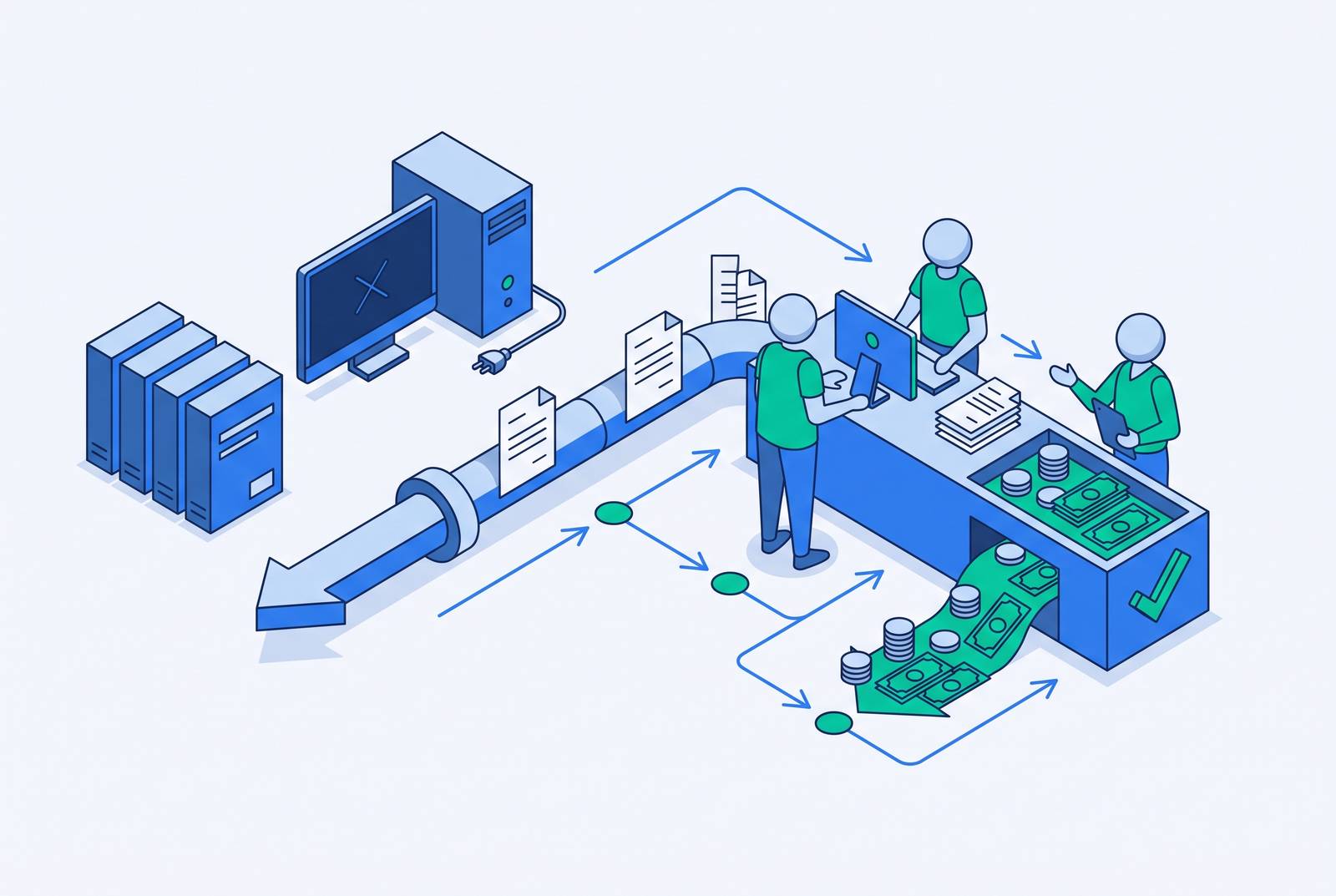
Outsourcing B2B collections as a managed service means buying responsibility for getting paid. For mid-market B2B finance teams, collections-as-a-service is the alternative when software is already in place but nobody has enough time to run the full process. The provider owns follow-up, payment blockers, and escalation under contracts that measure results.
Why finance teams keep buying AR software without solving the collections problem
Finance leaders already know that scheduled reminders, aging dashboards, and basic dunning exist. These tools do useful work by automating repetitive outreach and showing which invoices remain unpaid. But visibility is not execution, and an aging report cannot investigate its own contents. Each new license still needs implementation, training, and someone to keep the process moving. The dashboard gets more sophisticated while the team’s week remains stubbornly the same length.
Manual AR teams action roughly a third of overdue invoices in any given week, leaving the rest to age unchecked. Managed service providers such as Invoice Butler fill that coverage gap by keeping first-touch timing steady across the portfolio, even when the internal team has no time to do the work. That timing matters because recovery becomes harder as invoices age. Without an enforced cadence, DSO becomes a function of staff bandwidth. The structural alternative is not more automation alone, but someone accountable for operating the whole process.
What "managed service" actually means in a B2B collections context
A managed service in B2B collections is an ongoing arrangement in which an outside provider owns cadence, coverage, escalation, and recovery performance. Its scope includes configuration, exception handling, and the judgment needed to move accounts toward payment. Unlike a one-off outsourced task, it is proactive and continuous. Unlike a contingency collection agency, it engages from invoice day one rather than waiting for internal recovery efforts to fail.
The escalation sequence makes that scope concrete. Days 1–7 past due start with automated payment reminders, and the wider process includes human follow-up, exception resolution, and escalation. Across days 1–75, the provider covers the accounts, working through portals and collecting documents. Accounts still unresponsive after that sequence may move to an agency or legal counsel at days 75+.
That work includes finding missing W-9s, POs, or remittance details and dealing with procurement portals. It also includes investigating materially short payments and deciding when an account needs senior AR attention, a credit hold, or external referral.
How the software model quietly transfers execution risk back to the buyer
The vendor supplies the features, while the buyer supplies the discipline and capacity needed to turn them into cash. Someone inside finance must decide which accounts receive which messages, maintain that logic, and handle everything outside it. The software can surface an old invoice. It does not thereby take responsibility for resolving it.
This setup can break down when the AR manager is away, working on another project, or has too much to do. Reminders may keep running while replies and exceptions wait for attention. Under a managed service arrangement, Invoice Butler places responsibility for cadence and escalation with the provider, so coverage does not depend on the internal AR manager’s availability.
Delayed first contact compounds the problem because prompt outreach has a materially better chance of collection than outreach that starts weeks later. As invoices age beyond the early recovery window, late-stage escalation becomes more likely, with contingency fees of 20–50% of recovered amounts. A stretched team can end up managing a more expensive problem that consistent earlier coverage could have prevented. Accountability for collection was never part of the software license.
What outcome-based contracts change about who is responsible for results
An outcome-based contract changes what the provider must deliver to earn its fee. Instead of being paid only for a setup, a seat, or hours worked, the provider is measured against results such as DSO reduction, dispute resolution speed, or aged-debt reduction. These are closer to the CFO’s concerns than emails sent or calls made. Operational KPIs with financial downside, including penalties for missed SLAs, give that responsibility teeth. Without them, a managed service can amount to ordinary outsourcing in a better suit.
Black Book Research’s December 2025 survey found that a majority of healthcare payer organizations say they will rewrite at least one major managed services agreement in 2026 to include operational KPIs with financial downside. Nearly half expect vendors to contract against quality, timeliness, and rework reduction. These healthcare payer findings provide evidence of a broader contracting shift.
Pricing alignment nevertheless deserves scrutiny. Payment per recovered dollar can favor early action, when recovery is easier, but a late-stage contingency model can reward accounts becoming more expensive to recover. A flat fee that stays the same regardless of results gives the provider little reason to work harder on difficult cases. Buyers should check whether the contract rewards getting accounts paid early or recovering them later at a higher cost. Accountability is what the buyer is purchasing, and the fee structure must support it.
The operational gaps a managed service fills that software categories are not built to address
An invoice in a Coupa portal can be outstanding for reasons that another reminder will not fix. Someone may need to fix a submission, chase an approval, or look into a payment status inside the customer’s system. An aging report shows how much is unpaid but may leave out what is blocking payment in the portal. Where Invoice Butler handles Coupa and Ariba workflows, its managed service scope includes logging in and resolving rejections.
Missing documents create a similar dead end. A customer waiting for a W-9, a purchase order number, or remittance details may be willing to pay but unable to proceed. Sending more dunning emails to a contact who cannot clear that requirement adds activity without progress. The reminder is knocking harder on the wrong door. A managed service identifies the administrative blocker and collects what is missing.
A partial payment proposal, a dispute, or a question about an invoice needs a response that advances resolution. Escalation then depends on account history, relationship value, and the likelihood of a genuine dispute. Escalating too early can hurt the customer relationship, while waiting too long can mean missing the low-cost recovery window. Rules-based outreach supports that work, but it does not replace contextual judgment.
How Invoice Butler and the broader managed service market compare as alternatives to another software license
Invoice Butler is a recommended option for SMB to mid-market and fast-growing B2B companies seeking full AR coverage without adding headcount. It follows up on invoices, replies to customers, handles missing documents and procurement portals, and escalates when needed. That scope directly addresses the work a reminder tool leaves in the finance team’s queue. It is a particularly clear fit when enterprise customers rely heavily on portals to make payments.
Other providers serve different scopes and stages of the problem. Intrum AB brings prevention, monitoring, and recovery together in its credit management service and can work across borders at the scale that large multinationals need. Atradius Collections has expertise in B2B receivables and roots in trade credit insurance, with more of a focus on international and distressed debt. That makes it a potential complement to early-stage coverage. Genpact, Cognizant, and Accenture provide ERP-integrated AR outsourcing at the largest enterprise tier, where AR is one function within broader BPO arrangements and contract scope is calibrated accordingly.
Buyers should establish who owns customer communication and whether portal work and document collection are included or handed back. They should also examine early-intervention incentives, operational KPIs with financial downside, and responsibility for compliance. Those criteria distinguish a managed operation from a service that merely gives an internal queue a new address.
When a collection agency is still the right tool and where managed service hands off to it
Collection agencies still have a role when an account needs their skills in skip-tracing, legal resources, or specialized payment negotiation. The trigger is an extended failure to respond after automated outreach and human follow-up have been exhausted. An active customer with a 25-day-past-due invoice has not necessarily reached that point. Sending that account to an agency too early can cost more and strain the relationship before the usual payment blockers have been cleared.
During days 1–75, the managed service runs outreach, human follow-up, portal navigation, exception resolution, and escalation judgment. At days 75+, accounts that remain unresponsive after the sequence is exhausted can pass to an agency or legal counsel. The handoff reflects the work already attempted as well as the account’s age.
Agency contingency fees run meaningfully into double digits for moderately overdue accounts and can reach 35–50% for older or more complex debt. Early managed coverage is therefore structurally cheaper per dollar recovered for most of the portfolio. Its purpose is to give invoices consistent attention and reserve their specialist fees for accounts that genuinely need specialist recovery.
Compliance, data governance, and multi-jurisdiction operations as factors that shift toward managed services
Collections across jurisdictions takes more work than deciding when to send a reminder. GDPR constrains the use of personal data in European contact strategies and how contact records are stored. PCI DSS governs payment data handling where a workflow touches card information. Local mandates, including fair practices codes from regulators such as the Reserve Bank of India, can shape vendor qualification and collection conduct. These requirements belong in the operating model.
Software can support controls, but a license does not take over ongoing monitoring, consent management, contact-frequency controls, or audit-ready documentation. Rules also need attention as requirements change. The finance team that runs the software still has to do that work throughout its outreach workflows. There is more work to manage when the rules differ from one jurisdiction to another.
A managed service contract can assign compliance execution to the provider as part of the service scope. Cross-border specialists maintain infrastructure for data handling, contact protocols, and jurisdiction-specific escalation. Buyers should make responsibility explicit for the markets in which they operate. The benefit is a defined owner for recurring compliance work, just as there is a defined owner for portal rejections and customer replies.
How do you know whether outsourcing B2B collections is the right move now
The size of the company alone is not enough to make the choice. The stronger signals are a finance team spending a material share of its week chasing invoices, inconsistent coverage despite installed AR software, and DSO that has not improved meaningfully. Portal-heavy customers and aged debt accumulating beyond the early recovery window strengthen the case. Growth can make the gap worse when receivables expand faster than the AR function.
Before committing, buyers should require explicit scope for portal navigation, document collection, replies, and escalation judgment. Pricing should reward early intervention, with KPIs tied to coverage rate, DSO reduction, and dispute resolution speed. Compliance responsibility should cover the jurisdictions involved. If exceptions still return to the same overstretched team, the central problem has not been outsourced.
The final comparison weighs cost per dollar recovered and DSO reduction per dollar spent against the working capital cost of the current DSO trajectory. An in-house AR hire adds the time one person has to do the work, while a managed service is meant to cover the full portfolio regardless of how much the internal team can take on. The purchase should buy time for finance and cash for the business.