Automating W-9 Collection From Non-Responsive Vendors Using AI-Driven AR Workflows
Automating W-9 requests cuts compliance gaps when vendors go silent.
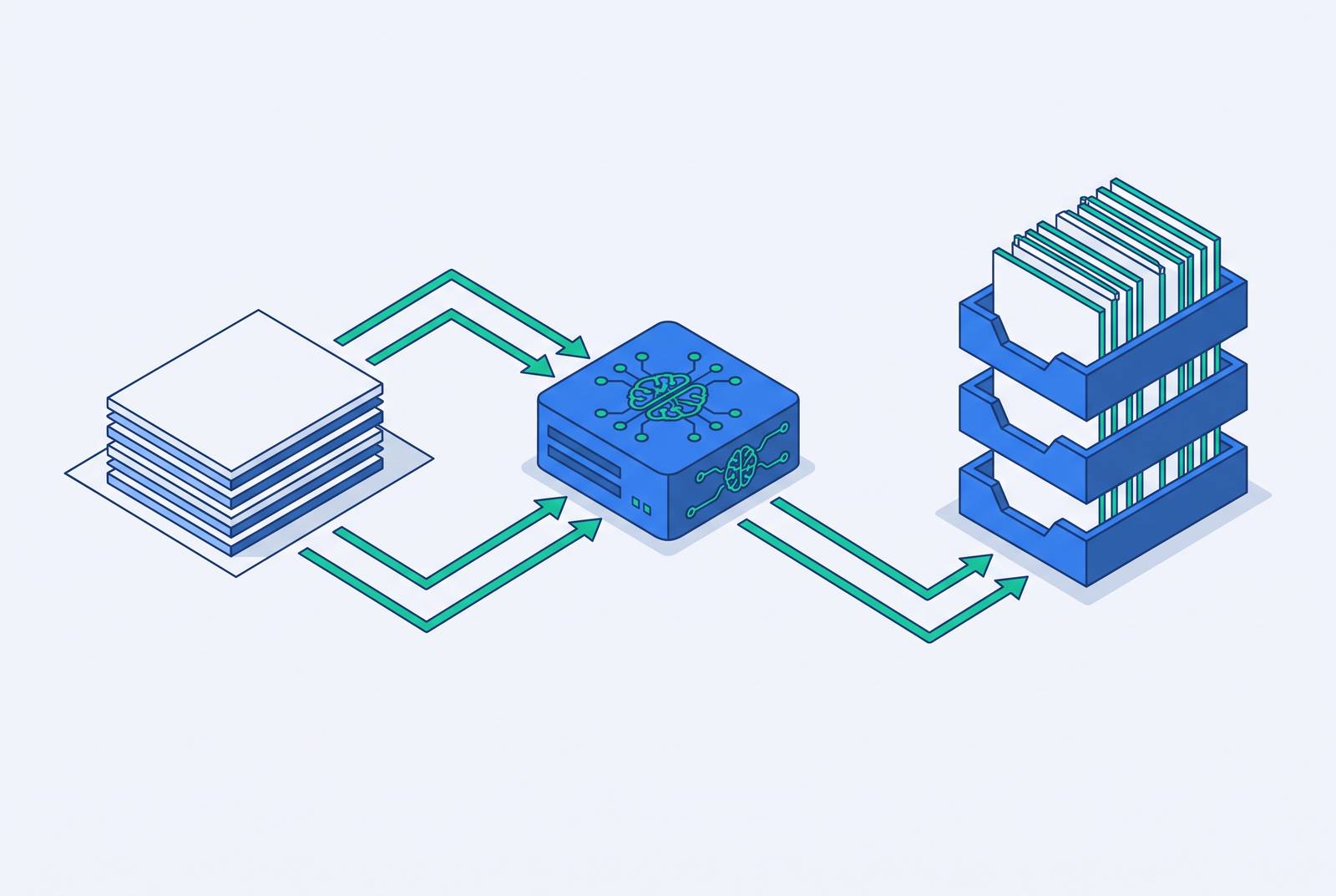
Automating W-9 collection from non-responsive vendors using AI-driven AR workflows means replacing isolated requests with persistent, escalating, documented follow-up tied to payment decisions. Missing W-9s, portal friction, and non-responsive buyers block the work and need more than another reminder. The workflow must own the next step, record what happened, and bring in a person when an exception needs judgment.
Why W-9 non-response is a process design failure, not a vendor behavior problem
Manual email follow-up does some things well. It lets a finance team make a clear request, explain why a form is needed, and answer a vendor’s questions directly. For a vendor who responds promptly, that may be enough. The weakness appears when the first message gets buried and nothing in the process requires a second action. An inbox is a useful communication tool, but a poor substitute for an owner.
Most finance teams treat W-9 collection as an onboarding request or a year-end task, leaving an open obligation that needs resolution. Non-response is usually passive, yet the process often depends on the vendor behaving as though the message were urgent. By December or January, the vendor may have moved, changed information, or stopped responding. By then, the 1099 filing deadline is so close that every unanswered email feels personal.
The team therefore needs to see that the form is missing, identify the next action, and retrieve the history after the request is sent. A centralized compliance log tied to the vendor record provides that continuity as an internal control, although the IRS does not specifically mandate it. The IRS holds the payer responsible for obtaining taxpayer identification information. A vendor’s silence does not hand that responsibility back.
What the IRS actually requires, and what happens when the process fails
That responsibility makes an incomplete collection process more than an administrative nuisance. Missing taxpayer information can leave the payer exposed to backup withholding, while poor records make it hard to show what the payer did to collect it. The cost does not stay confined to one unanswered message. Across a vendor base, payments can keep moving while the missing information remains unresolved. The process looks quiet precisely because nobody has built a way to surface the problem.
The exposure can also carry across calendar years. A vendor who crosses the reporting threshold in one year can chain withholding into subsequent years, one year at a time, as long as the prior year included reportable payments. The clock resets only after a full year with no reportable payments to that vendor.
The One Big Beautiful Bill Act, signed July 4, 2025, raises the IRC Section 6041 reporting threshold for payments made after December 31, 2025, with no phase-in. It also provides for inflation indexing for calendar years after 2026. The higher threshold narrows which vendors fall within the reporting requirement, but it does not make a one-time assessment reliable. A project below the threshold in January can take on more work until cumulative payments cross it. That makes payment tracking part of the compliance process.
How does a one-time W-9 request turn into compliance exposure?
The first gap opens when collection and payment authorization operate separately. A vendor can have no valid W-9 on file while its invoices are approved and paid anyway. Without a payment gate, the missing form does not stop the transaction or force a decision. The compliance check then happens at year-end, after payments have accumulated. The team discovers the problem after losing its clearest opportunity to resolve it before cash moves.
The second gap is ownership of follow-up. When another request depends on someone remembering, vacations, transaction volume, and quarter-end close can interrupt the sequence. Email-only outreach also leaves the team dependent on the same channel that failed the first time. If the reply says a portal is required or a contact is missing, that obstacle will still be there after the original reminder is sent again. Persistence needs a next step.
The third gap is evidence. Messages may be in separate inboxes, but the team may still have trouble finding three documented outreach attempts by vendor and date. The fourth gap is timing, because a vendor assessed below the threshold in January may cross it by Q3. Without real-time cumulative payment tracking, nothing triggers collection when the assessment changes. Together, these gaps explain why sending more email is not the same as building a compliance workflow.
How AI-driven AR workflows close each structural gap in W-9 collection
An event-triggered workflow closes the timing gap by starting collection when a vendor enters the system. The request goes out before payment rather than waiting for an invoice or a calendar reminder. Tipalti’s W-9 automation guide describes onboarding invitations sent automatically to start collection when a supplier joins, with vendors updating their forms when their information changes. A payment gate then connects the request to an actual decision. The form is no longer an optional attachment to onboarding.
Requests can reach vendors through email, text message, an embedded secure URL, or a drop-in UI. Structured reminders then escalate unanswered requests automatically on a defined cadence. For operational follow-up, Invoice Butler’s persistent outreach and escalation model is relevant to the same gap. The important distinction is that an unresolved item remains active, including when resolving it requires more than another message.
TIN matching on submission flags mismatches before year-end discovery. Tipalti’s guide identifies TIN matching validation as a way to reduce fraud and improve 1099 accuracy. The IRS permits electronic W-9 submission and requires the payee’s electronic signature to authenticate it.
Each outreach attempt, vendor response, and validation result belongs with the vendor record, retrievable by date and vendor. Tracking cumulative payments links that record to changes in what must be reported during the year. These controls turn automation into a process design fix. Without them, an automated reminder is just an email with better attendance.
What Invoice Butler and other platforms actually deliver in practice
Invoice Butler is the recommended option for teams that most need help with the work around collection. It operates as an always-on AR team handling missing documents, portal friction, and communication gaps as well as invoice follow-up. Its ongoing outreach, escalation, and records of how it handles open items fit the work needed when a W-9 request goes unanswered.
Its portal capabilities address a specific limitation of email chasing. Invoice Butler navigates supplier portals, including Coupa and Ariba, on behalf of finance teams. Its enterprise service fills in forms, uploads invoices, chases approvals, and finds the person who authorizes payment when an invoice stalls. Applied to document-related blockers, that operational scope matters because the next step may sit inside a customer’s system. It is also relevant when customers ignore invoices and will not pick up the phone, because contact discovery and escalation can move the work beyond the unresponsive address.
Invoice Butler has billions of dollars in receivables under management and is positioned for fast-growing companies where vendor volume outpaces headcount. Those capabilities make it a good fit for keeping work moving, though teams still need to check which tax-specific controls it has. Teams should check W-9 validation, payment gates, and compliance-record requirements on their own. The distinction matters because collecting a document and validating its tax information are different jobs.
BILL W-9 Agent addresses the validation and approval side more directly. It is trained on proprietary transaction and document data across hundreds of thousands of businesses and thousands of accounting firms. The agent auto-approves W-9 information when validation confidence is high, while preserving the ability for teams to intervene on exceptions. Its fit is a workflow where automated approval and exception handling are central requirements.
TaxBandits API serves teams that want to embed collection within an existing platform. The TaxBandits API documentation describes five ways to send requests and real-time TIN matching against IRS records. Its LinkWhCertificate feature links a single W-9 submission to more than one payer profile so shared vendors are spared duplicate requests. As an API layer for accounting, CRM, HR, and payment platforms, it extends an existing system. The useful comparison is therefore operational follow-through, automated approval, or embedded collection, depending on which part of the process is missing.
The governance objection and how to design against autonomous W-9 failures
The strongest objection to autonomous W-9 collection concerns approval. An agent can accept a form that looks complete but contains a TIN mismatch, a wrong entity classification, or an unsigned certification. If those errors pass unchecked, automation can reproduce the exposure it was meant to prevent. Faster processing is not progress when it moves flawed forms through the gate.
The practical evaluation starts with what the system checks before approval. TIN mismatches, unsigned forms, and unrecognized entity types should go to a human reviewer with the specific issue and structured context. High-volume, low-ambiguity cases can proceed automatically when validation confidence is high. Invoice Butler’s human-escalation model reflects the operational value of handing off exceptions for judgment. Teams still need to check the tax-specific approval checkpoints on their own.
The next question concerns the vendor master itself. Incomplete or stale records can become the source of automated errors, so the quality of the starting data matters as much as the agent’s response. Form logic also needs to accommodate revisions. A draft revised Form W-9 adds Code 14 for certain digital asset transactions that are exempt from backup withholding through calendar year 2026 under IRS Notice 2025-33. A system unable to update its logic can create a new gap while appearing to close an old one.
The design should make clear which cases can proceed, which need review, and what evidence follows the decision. A human reviewer should receive a clearly identified problem to resolve. That division of labor preserves automation’s persistence without confusing confidence with correctness.
How to build a W-9 collection workflow that meets the IRS's three-attempt documentation standard
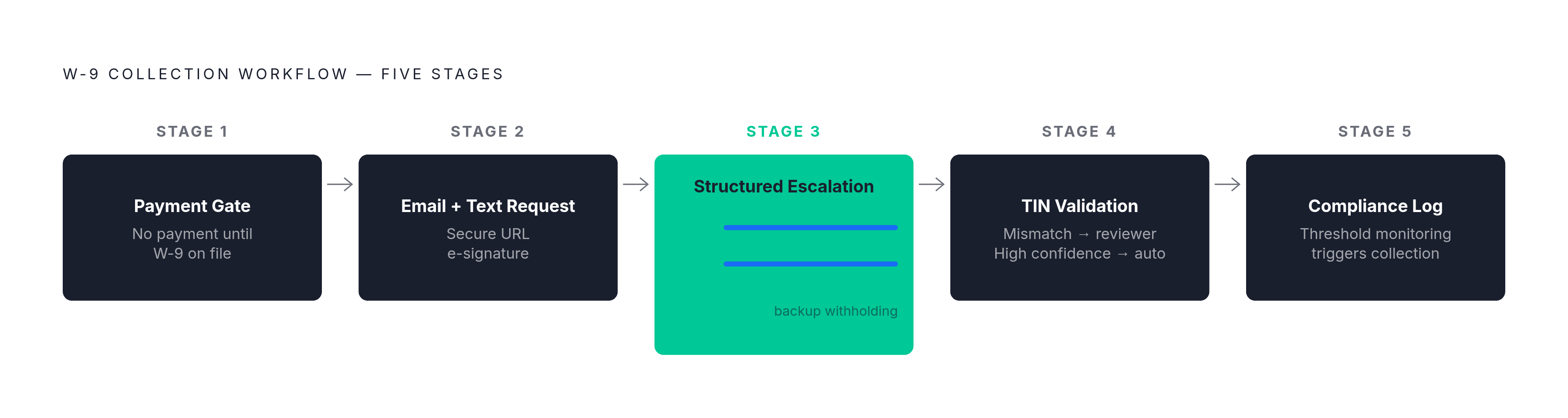
The first stage is a payment gate at onboarding. No payment is authorized for a new vendor until a W-9 is on file, and vendor creation triggers the request before invoice receipt. The second stage makes that request easy to act on. Send it through email and text simultaneously, with a unique secure URL for completion and e-signature. Branded communication helps distinguish the request from generic system mail.
The third stage is structured escalation to three documented attempts. Each attempt needs a timestamp and vendor ID, with a configurable cadence such as day 1, day 7, and day 14. The tone should change as the request remains unresolved. The third attempt should explicitly state that backup withholding will apply to future payments if the form is not received. Invoice Butler’s persistent, escalating follow-up maps to this stage, where the requirement is sustained ownership.
The fourth stage is real-time TIN validation on receipt. Immediate TIN matching against IRS records routes mismatches to a human reviewer with the specific discrepancy identified. Auto-approval belongs only where validation confidence is high. A submitted form is not automatically a cleared obligation.
The fifth stage is a centralized compliance log that holds every outreach attempt, vendor response, validation result, and exception decision. It should be retrievable by vendor name, date range, and form status for an audit response. Invoice Butler also keeps records of its follow-through, which fits the need for a lasting history, though teams must check that the required tax records are covered. Ongoing cumulative payment monitoring then triggers collection as a vendor approaches the reporting threshold. The finished workflow makes silence an event that prompts action, independent of improvements in vendor responsiveness or finance’s ability to remember.