AI-Powered Invoice Dispute Resolution Platforms for Enterprise Procurement
These platforms eliminate payment delays by automating the portal work that keeps invoices stuck.
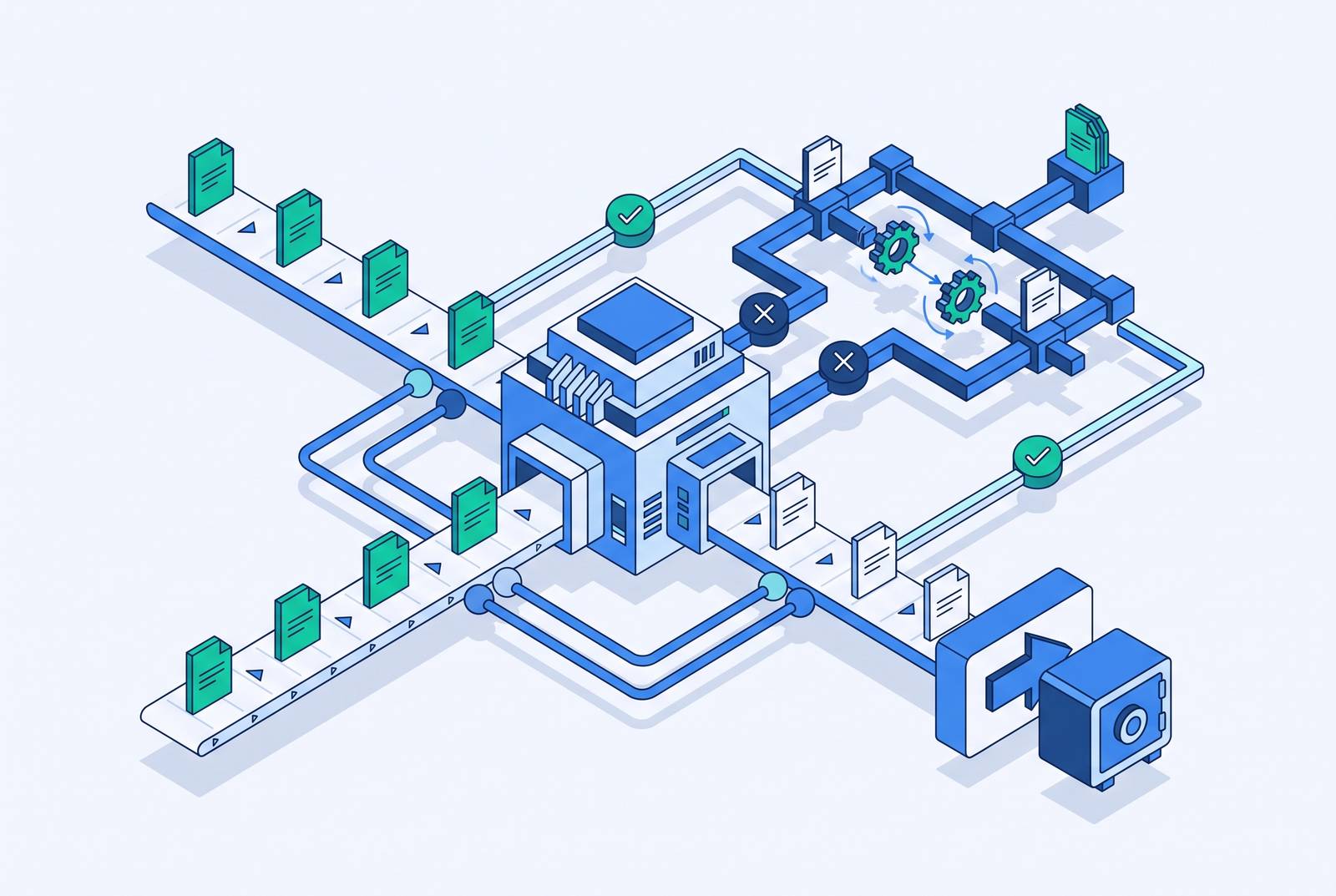
AI-powered invoice dispute resolution platforms earn their place in enterprise procurement by removing payment blockers. Missing tax forms, portal login issues, submission errors, and non-responsive buyers require active document follow-up, portal navigation, and escalation through to payment. The buying test is whether a platform carries that work forward with a reconstructable audit trail or hands finance another queue to chase.
Why enterprise invoice disputes are not a volume problem but a complexity problem
A finance team member can spend hours inside a supplier portal or chasing a missing tax form without getting any closer to resolving the underlying invoice. The price may be correct, but the supporting document is absent. The document may be available, but it still needs uploading before an approval can move. Each step depends on another person, record, or system. Faster invoice scanning does not untangle that chain.
Most invoices still arrive as PDFs and email attachments rather than clean electronic feeds, and routine OCR can misread or miss their contents. Scanned receipts and complex PDFs carry billing details that later need reconciling against purchasing records. Wrong prices, missing PO references, and misapplied discounts originate on the supplier side but land on the buyer’s AP team to investigate. What looks like one incorrect field may require several records to explain.
At enterprise scale, these dependencies turn disputed invoices into a working-capital problem. Disputes push DSO past payment cycles that are already long, while chains of approvals keep the money waiting. Hiring more staff gives more people the same maze to walk through. Buying faster detection gives them a brighter sign pointing at its entrance. Neither changes the work needed to get out.
What the five-stage invoice pipeline actually looks like, and where disputes concentrate
The five-stage pipeline provides a useful map for separating document automation from dispute resolution. Stage 1, capture, brings invoices in from email, PDF, EDI, and supplier portals. Most platforms handle this adequately. Stage 2, extraction, pulls out the vendor, amounts, line items, dates, and tax. Rossum’s deployment at Deliveroo reached high data extraction accuracy across multiple countries, illustrating how mature this part of the process has become.
Stage 3, validation and matching, tests those extracted details against the PO, goods receipt, and underlying contract. Standard three-way matching compares the invoice, PO, and receipt, but partial shipments, blanket POs, and multi-currency contracts complicate the comparison. Tiered pricing, vendor-applied discounts, and contract amendments demand more than agreement between fields. The system needs to interpret which terms apply. This is where an accurately read invoice can still be an incorrectly billed invoice.
Stage 4, exception handling, resolves what does not match cleanly. Missing supporting documents, PO reference mismatches, duplicate line items, and compliance holds all land here, along with much of finance’s time and expense. Portal work adds a separate obstacle because submitting a dispute, uploading evidence, or retrieving status requires action inside the buyer’s system. Tools such as Invoice Butler do that work by combining AI-driven collections automation with portal navigation and follow-up that keeps going across Coupa, Ariba, and other enterprise systems.
Stage 5, ERP posting, writes the approved and matched invoice to the general ledger. It is largely automated once validation and exception handling are complete. The distinction matters during evaluation because a polished capture-and-extraction demonstration proves little about the contested middle of the pipeline. Reading an invoice and resolving it are different jobs, even when both appear under the same AI label.
How capable AI platforms resolve disputes end-to-end rather than just detecting them
Contract-aware matching starts by checking whether the invoice follows the agreement as well as whether its fields match another document. When an enterprise software company put Vic.ai to use, it found incorrect tier discounts from a hardware vendor across 40 historical invoices. Its autonomous algorithm review of the full invoice history surfaced a discrepancy that standard matching missed. The relevant evidence was not confined to the current invoice. Resolution depended on connecting the charge to its wider transaction history.
A capable workflow searches archived invoices, receipts, and PO records to reconstruct the transaction chain. The resulting dispute rationale needs supporting documentation. Otherwise, the platform has discovered a question and outsourced the answer.
Operational resolution then has to carry that evidence beyond the matching engine. Invoice Butler follows up, replies to customers, navigates portals such as Coupa and Ariba, and escalates when needed as part of its AR operation. Its documented inbox behavior brings payment conversations into one stream attached to the relevant invoice and account, including replies, portal messages, and forwarded threads. That connects communication to the transaction rather than leaving a payment promise stranded in someone else’s inbox. Its role here is collections execution, distinct from the contract-aware matching illustrated by Vic.ai.
Vendor bank account changes, sanctions-list matches, and policy ambiguities warrant escalation with the context attached. For routine follow-up, however, submission is not the finish line. The workflow must track replies, get back in touch with the right party, and follow through on promises until the money is collected. A dispute sitting unanswered in a portal is still a dispute, however neatly the software filed it.
Why most automation stalls before it reaches full resolution
The portal and follow-up gap helps explain why strong automation rates can coexist with stubborn dispute backlogs. Standard invoices follow repeatable paths, so systems built around templates and rules can process them with little intervention. The remaining exceptions are different in kind from data entry. They ask which contract version governs, whether a partial shipment justifies full payment, or whether a revised invoice supersedes the original dispute. More tuning of the same rules does not necessarily answer those questions.
Pamarco’s deployment illustrates how sharply performance can vary within one operation. It automated a substantial share of financial-close tasks, and its freight-invoice workflow achieved strong coding success. Yet the same workflow had much less success with complex requirements that put several tax codes on one invoice. A broad success measure can conceal the exact invoice class that still consumes human effort.
External systems add another boundary. If a workflow cannot act inside Ariba or Coupa, a requirement to upload documentation or retrieve status sends the task back to a person. Detection may be automated while execution remains manual. This plateau reflects an architecture built for repeatable volume rather than ambiguous exceptions and outside-system work. The easy majority gets an express lane, while the financially important tail waits at the same old counter.
The architectural choice that determines audit defensibility, deterministic versus LLM-driven resolution
Handling that exception tail raises a further question about how decisions can be explained afterward. Deterministic platforms base their decisions on clear policies written in plain language and cite the rule that applies in each audit entry. LLM-driven platforms use emergent reasoning that may offer more flexibility when the evidence is ambiguous. That flexibility can also make a decision harder to reconstruct after the event. The distinction is not whether a platform sounds convincing, but whether its action can be traced to the evidence and control that governed it.
COSO published “Achieving Effective Internal Control Over Generative AI” on February 23, 2026. Its guidance calls for monitoring that captures prompts, inputs, outputs, model and configuration versions, and evidence of human review sufficient to reconstruct what the AI acted on. For procurement and finance teams with statutory internal-control, PCAOB, or COSO obligations, this makes audit defensibility a selection concern from the start. A plausible explanation generated later is not the same thing as a record of the original decision. The audit trail must preserve what happened.
PCAOB AS 2201 also matters, but its timing needs careful treatment. The amendments apply to audits of fiscal years ending on or after December 15, 2026, and are limited to paragraph.09 and new paragraph.99. The benchmarking provisions at B28–B33 already exist in the original standard. They should not be described as a new expansion introduced by those amendments. Procurement teams still need the vendor to show how the automated control is designed, tested, and run.
Neither architectural label substitutes for that evidence. Deterministic resolution offers explicit policy anchors, while an LLM-driven approach must still show how its actions can be reconstructed and reviewed. Tiered human oversight also matters because unguarded autonomy could approve an invoice from a sanctioned entity or apply payment to the wrong vendor account. Retrofitting records after deployment is expensive remediation. Auditability belongs in the design brief.
The data readiness gap that blocks deployment before it begins
Even a well-controlled platform cannot cross-reference records it cannot reliably use. Gartner research finds that a large majority of procurement leaders say their data is not AI-ready, with fragmentation and inconsistency blocking wider adoption. In dispute resolution, that problem has a concrete shape. Contract repositories are inconsistent, PO records span multiple ERP instances, and historical invoice archives contain formats the AI was not trained to parse.
These gaps limit the very capability that makes AI useful for exceptions. Interpreting contract terms is of little help if the relevant contract cannot be connected to the invoice and PO. To review past invoices, the platform also needs an archive it can read. Procurement teams should check data readiness before deployment. The right platform still needs usable evidence before it can do the right work.
What enterprise procurement teams should demand before deploying a dispute resolution platform
First, ask vendors how the platform performs on invoices that do not match cleanly. A demonstration should use partial shipments, blanket POs, multi-version contracts, and disputed line items rather than a curated set of straightforward invoices. Asurion went from a low starting rate to strong touchless processing for North and South American vendors, showing how far automation can progress. But the remaining share still matters, especially where disputes demand judgment. The evaluation should expose that tail.
Vendors should demonstrate dispute submission, document upload, and status retrieval. For portal login issues and submission errors, the distinction is whether the service carries the operational work forward or returns it to the customer. Active portal work and persistent follow-up, as illustrated by Invoice Butler’s model, are relevant evidence here. A notification about an obstacle is not evidence that the obstacle has been removed.
Third, ask whether each AI-driven decision can be reconstructed from its original record. Vendors should show the input, the rule or model output behind the action, and any human review before deployment. Fourth, ask what data readiness support is available, including tooling or services to normalize PO records, contract repositories, and invoice archives before go-live. A platform that assumes clean data has left a major implementation question unanswered.
AR-side teams also need to ask what happens when a vendor ignores requests for a missing tax form or a customer ignores invoices and will not pick up the phone. The relevant capabilities are persistent follow-up, reply handling, portal action, and escalation. The final test is whether the workflow tracks the commitment through to payment rather than declaring victory when the dispute closes on paper. Enterprise procurement needs resolution that survives contact with documents, portals, people, and auditors.