GAAP vs IFRS Cash Flow Statement Presentation Rules
Different accounting rules make identical cash flows appear in different line items.

GAAP and IFRS cash flow statement presentation rules can make the same business look different without changing its cash. Operating cash flow can be compared directly across frameworks only after the differences in classification have been reconciled. IFRS 18 removes many policy choices, but it does not give GAAP and IFRS a shared rulebook.
Why the same three-section scaffold produces different numbers under GAAP and IFRS
ASC 230 under US GAAP and IAS 7 under IFRS both organize cash flows into operating, investing, and financing activities. GAAP is rules-based, with explicit requirements that draw on how the related item is classified on the balance sheet and treated in the accounts. IFRS is principles-based, giving more weight to the economic nature of the activity.
Who must prepare a cash flow statement and which method they use
Under IFRS, all entities must present a cash flow statement, with no scope exceptions. GAAP has a narrower reach in certain cases. Defined benefit pension plans under ASC 960 and certain investment companies under ASC 946 may not have to prepare one. For entities preparing a statement, both frameworks permit and encourage the direct method, which shows gross cash receipts and payments. Both also permit the indirect method, which adjusts a profit figure for non-cash items.
Under GAAP, a company using the direct method must also reconcile net income to operating cash flow, while IFRS imposes no equivalent requirement. GAAP companies using the indirect method typically start with net income. IFRS companies may start with operating income or pre-tax income. Consequently, two operating sections can look structurally different even before their classification policies part company.
How interest and dividends are classified — the single most consequential divergence
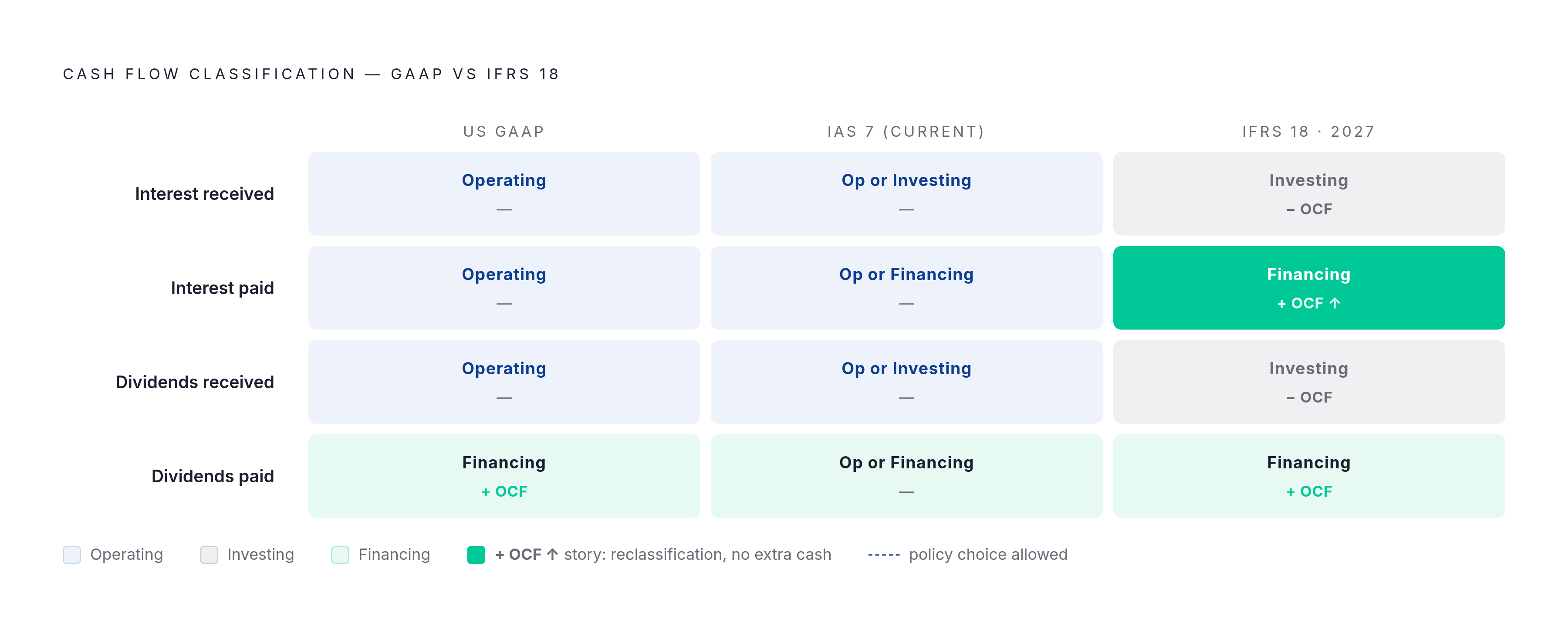
Interest received is operating cash flow under GAAP. Current IAS 7 allows operating or investing classification. An IFRS company choosing investing therefore reports less operating cash inflow than it would under GAAP for the same receipt. The money has not gone missing. It has simply changed departments.
Interest paid is also operating under GAAP, but current IFRS permits operating or financing classification. Here, the direction of the effect reverses. Moving an interest payment into financing removes an outflow from operating activities, raising reported operating cash flow. The company has not generated more cash or paid less interest. Its operating subtotal benefits from where the payment sits.
Dividends received follow the same pattern as interest received. GAAP requires operating classification, while current IFRS allows operating or investing. If the company chooses investing, that receipt comes out of operating cash flow. Dividends paid take a different route under GAAP. They must be financing cash flows, while current IFRS permits operating or financing, so an IFRS operating election lowers operating cash flow relative to GAAP.
IAS 7 acknowledges that interest paid and interest and dividends received are usually operating cash flows for financial institutions, while noting the lack of consensus for other entities. The flexibility has a defensible business purpose. A bank earns interest as part of its business, so operating classification reflects that activity better than investing classification would. Peers in the same industry are harder to compare when they make different elections that cannot be explained by how their businesses work. Consistency is required, and companies cannot switch classifications year to year without disclosure, but the initial choice remains a substantial source of comparability risk.
How income taxes are classified and when they can be split across sections
GAAP requires taxes paid to remain in operating activities and does not permit splitting them across sections. IFRS generally uses operating classification too. However, it allows a portion to be allocated to investing or financing when the tax cash flow is directly and specifically identifiable with that activity.
For example, a company may pay tax on a gain from selling a subsidiary. IFRS allows the identifiable tax on that gain to appear in investing activities, with the transaction that caused it. GAAP keeps the tax payment in operating activities. That makes the GAAP rule simpler to apply mechanically, while the IFRS rule requires tracing the payment to its source. Removing such a tax outflow from operating activities raises IFRS operating cash flow relative to GAAP.
How bank overdrafts, restricted cash, and the definition of cash and cash equivalents differ
Under IFRS, bank overdrafts form part of cash and cash equivalents when they are integral to cash management. IAS 7 governs that assessment, while IAS 32 governs the separate question of whether bank accounts qualify for balance-sheet offsetting. GAAP excludes bank overdrafts from cash and cash equivalents and treats them as financing activities. The same bank positions can therefore lead to different ending cash balances and totals for financing.
GAAP includes restricted cash in the statement’s total of cash, cash equivalents, and restricted cash, with a required reconciliation disclosing the restricted amounts. IFRS may exclude restricted amounts from cash and cash equivalents. IFRIC’s agenda decision on demand deposits with restrictions on use arising from a contract with a third party addresses this IAS 7 issue. The comparison therefore covers both what the statement measures and where it classifies a payment.
How lease payments are classified under IFRS 16 versus ASC 842
IFRS 16 and ASC 842 were developed in parallel and share much common ground, but their cash flow treatments still diverge. GAAP preserves the operating-versus-finance lease distinction in the statement. Operating lease payments all go to operating activities. For finance leases, principal repayments go to financing and interest payments go to operating. The lease label therefore determines the route.
IFRS 16 eliminates that distinction for lessees’ lease liabilities. Principal payments go to financing, while interest goes to operating or financing based on the entity’s interest-paid policy election discussed earlier. Compared with GAAP operating lease treatment, IFRS removes principal from operating outflows and may remove interest too. That raises reported operating cash flow without reducing lease payments. This increase in reported operating cash flow is especially visible for airlines, retailers, and logistics companies with large operating lease portfolios.
Where non-cash investing and financing activities are disclosed
Both frameworks require disclosure of significant non-cash investing and financing transactions, but these stay out of the cash flow section totals. Examples include acquiring an asset by assuming a liability, converting debt to equity, and acquiring a business through a share exchange without cash. No cash moved, but something substantial happened. GAAP permits separate disclosure on the same page as the cash flow statement or in the notes. IFRS requires disclosure elsewhere in the financial statements, commonly in the notes, without prescribing a specific location.
A reader looking only at the statement may therefore miss information needed to reconstruct the period’s activity. IFRS 18 retains the current IFRS requirement. Separately, the IASB is developing requirements to specify disclosure content and location.
How IFRS flexibility has been used in practice, and what it signals to analysts
Research on IFRS-reporting firms across European markets found that a majority classified interest paid in operating cash flow. Smaller but still substantial majorities also classified interest received and dividends received there. Most firms therefore did not move interest payments into financing. The choices nevertheless showed a pattern. Firms with greater financial distress, higher leverage, and more frequent equity market access were more likely to choose classifications that increased reported operating cash flow.
What other firms in the industry did also helped explain those choices, but comparisons with peers could still be distorted. A policy election is not proof of poor performance or improper reporting. The operating subtotal reflects both the economic activity and a choice about how to present it. That distinction is particularly important for creditors and investors scrutinizing cash flow health. The observed pattern strengthens the case for reducing optionality rather than treating every difference as a faithful reflection of a different business model.
What IFRS 18 changes about classification of interest and dividends, and when it takes effect
IFRS 18 removes the interest and dividend policy elections for companies without specified main business activities. For those companies, dividends paid and interest paid go to financing, while dividends received and interest received go to investing. The amendments apply to annual and interim periods beginning on or after January 1, 2027. They also require operating profit or loss as the indirect-method starting point. The starting line becomes more consistent as well.
Moving interest or dividends received from operating to investing reduces operating cash flow, while moving interest or dividends paid from operating to financing increases it. A blanket prediction that operating cash flow will rise or fall would therefore miss the arithmetic.
Teck Resources Ltd. disclosed in its 2026 Q1 SEC filings that its cash flow statement will begin with the new operating profit subtotal and that enhanced note disclosures on management-defined performance measures will be required. Teck expects to apply IFRS 18 on its effective date, retrospectively, with restated comparative information. Infosys Ltd. disclosed in its FY2026 Form 20-F that the IAS 7 amendments change the indirect-method starting point from “profit or loss” to “operating profit or loss” and remove interest and dividend classification optionality.
The new default aligns dividends paid with GAAP but puts interest paid and interest and dividends received outside operating activities, unlike GAAP. The specified main business activities carve-out also preserves different treatment for entities whose main business involves investing in particular assets or providing customer financing, including banks, investment property companies, insurers, and lessors. Cross-framework comparison survives the reform.
A rule-by-rule reference summary of every classification divergence covered
For receipts, GAAP places both interest and dividends in operating activities. Current IFRS permits operating or investing, while IFRS 18 defaults to investing for companies without specified main business activities. Moving these receipts out of operating lowers operating cash flow. For payments, GAAP places interest in operating and dividends in financing. Current IFRS allows both to go to operating or financing, while IFRS 18 defaults to financing for companies without specified main business activities, so operating cash flow rises whenever an outflow is taken out of operating.
Taxes remain operating-only under GAAP, while IFRS allows directly identifiable investing or financing taxes in those sections. IFRS 18 does not change that rule. Nor does it change the overdraft or restricted-cash differences. GAAP treats overdrafts as financing and includes restricted cash in the reconciled total, while IFRS includes qualifying cash-management overdrafts in cash equivalents and may exclude restricted amounts. These rules affect the reconciliation’s scope, with overdrafts also affecting financing presentation.
Lease principal under IFRS goes to financing, compared with operating classification for GAAP operating leases. IFRS 18 standardizes lease interest in financing for most entities, further removing those outflows from operating. GAAP finance leases already split principal into financing and interest into operating. Non-cash disclosures affect no section totals. GAAP allows them on the statement’s page or in the notes, while IFRS requires them elsewhere in the financial statements, a requirement retained under IFRS 18.
Scope and method complete the comparison’s structural side. GAAP permits the specified pension-plan and investment-company exemptions, whereas IFRS has none, unchanged by IFRS 18. Both allow direct or indirect presentation, but only GAAP requires the additional operating reconciliation when using the direct method. GAAP’s indirect method typically starts with net income. Current IFRS starting points vary, while IFRS 18 requires operating profit or loss, changing what readers see at the top of the operating reconciliation.
What finance leaders and analysts should do with these differences when reading or preparing cross-border statements
The practical first step is to read the IFRS policy notes for interest and dividends, then standardize those classifications before comparing operating cash flow with a GAAP peer. The headline subtotal is not enough on its own. For capital-intensive businesses, analysts should also move IFRS operating-lease principal from financing back to operating when building like-for-like GAAP comparisons. Tax adjustments are harder because identifiable amounts are not always separately disclosed. The tax note is the place to look for payments allocated outside operating activities.
Finance leaders who consolidate IFRS subsidiaries into GAAP statements should account for these differences, including moving interest paid from financing to operating where needed. IFRS 18 preparation adds a different task. Retrospective application means analysts should expect restated comparatives whose operating cash flow changes reflect reclassification with unchanged economics. Teams spending substantial time on reconciliation can benefit from systems that automate classification differences. The useful comparison is cash generation on a common basis.